100 marka 1919
Market Prices
About This Note
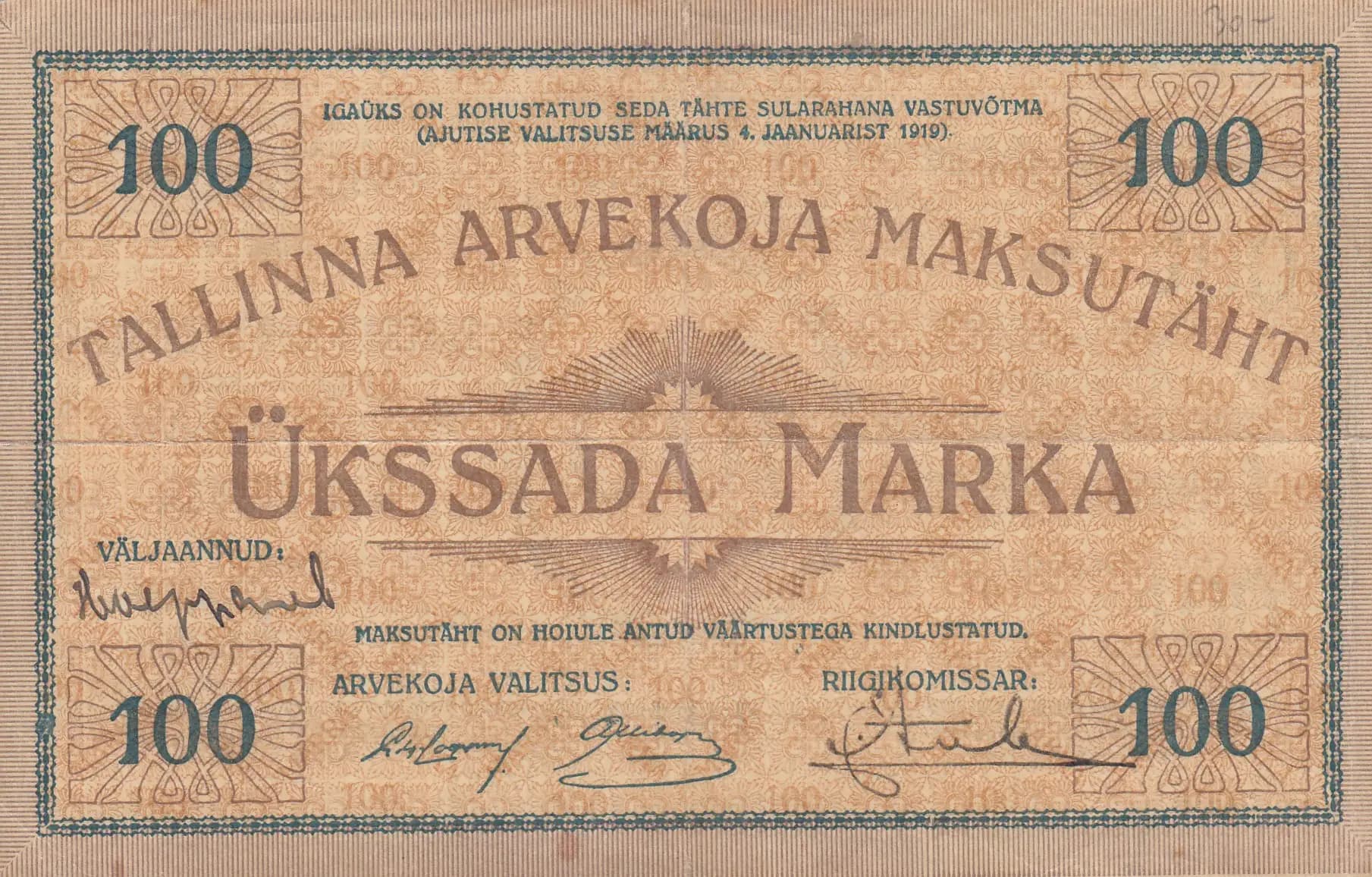
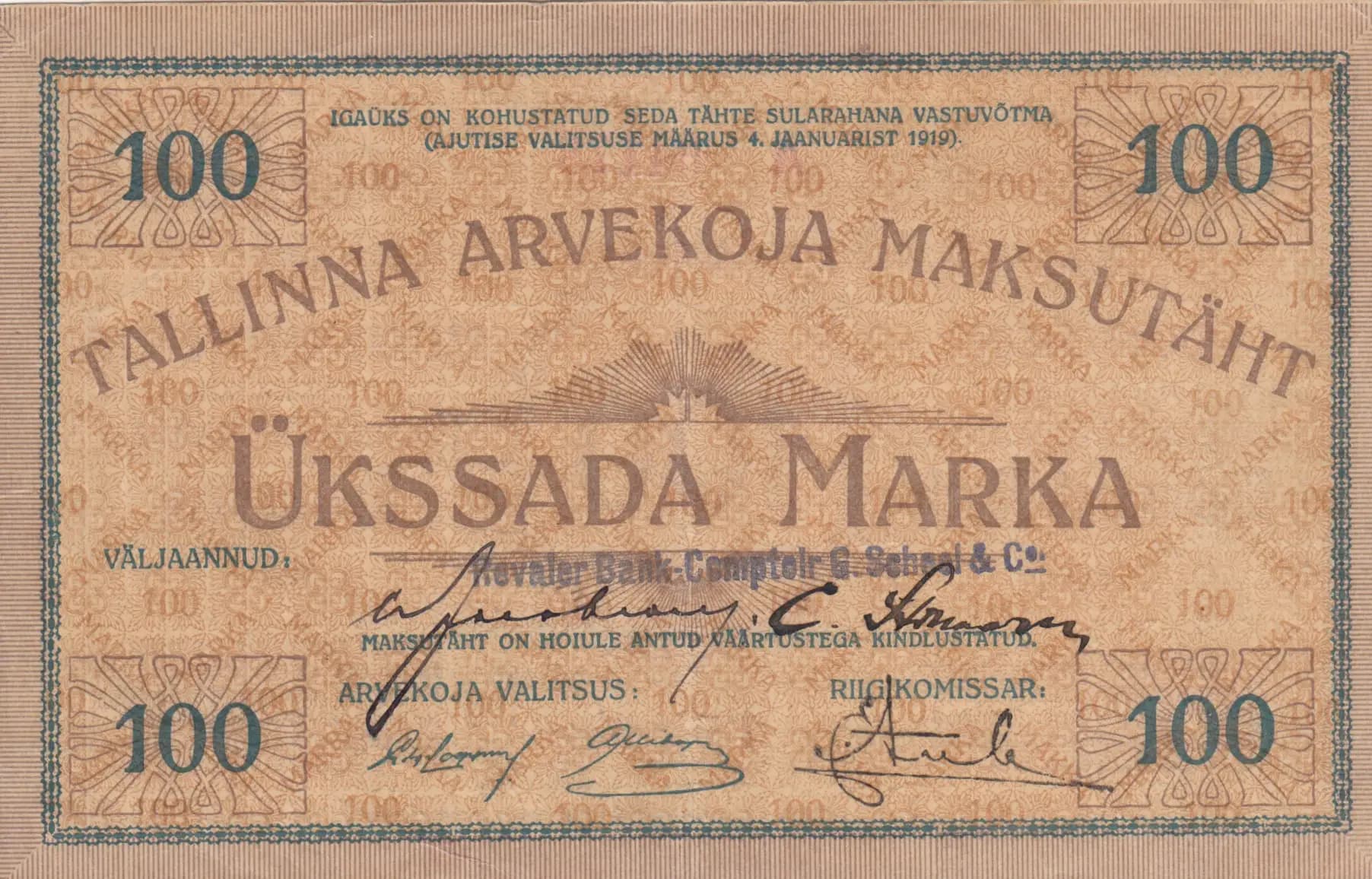
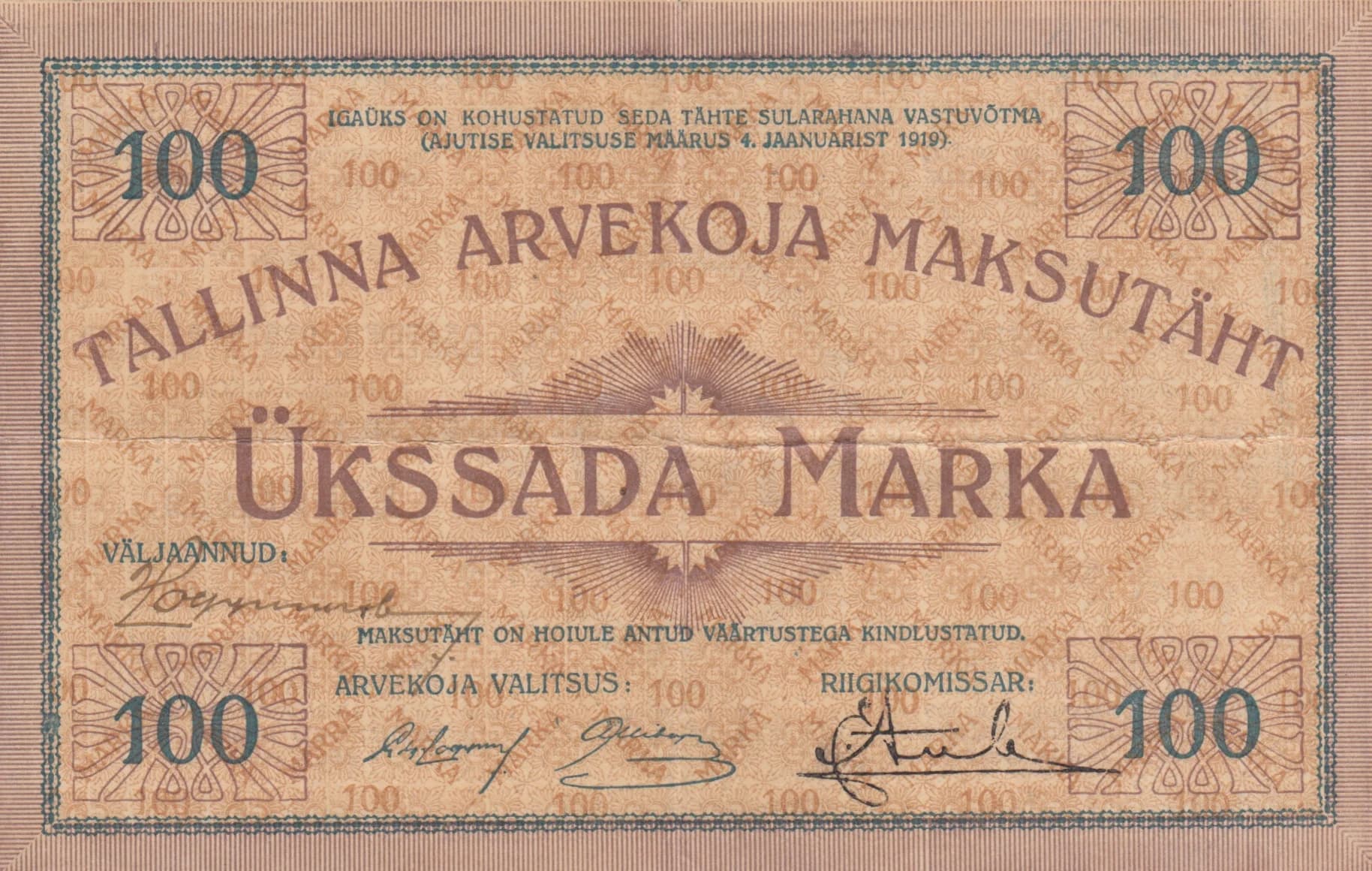
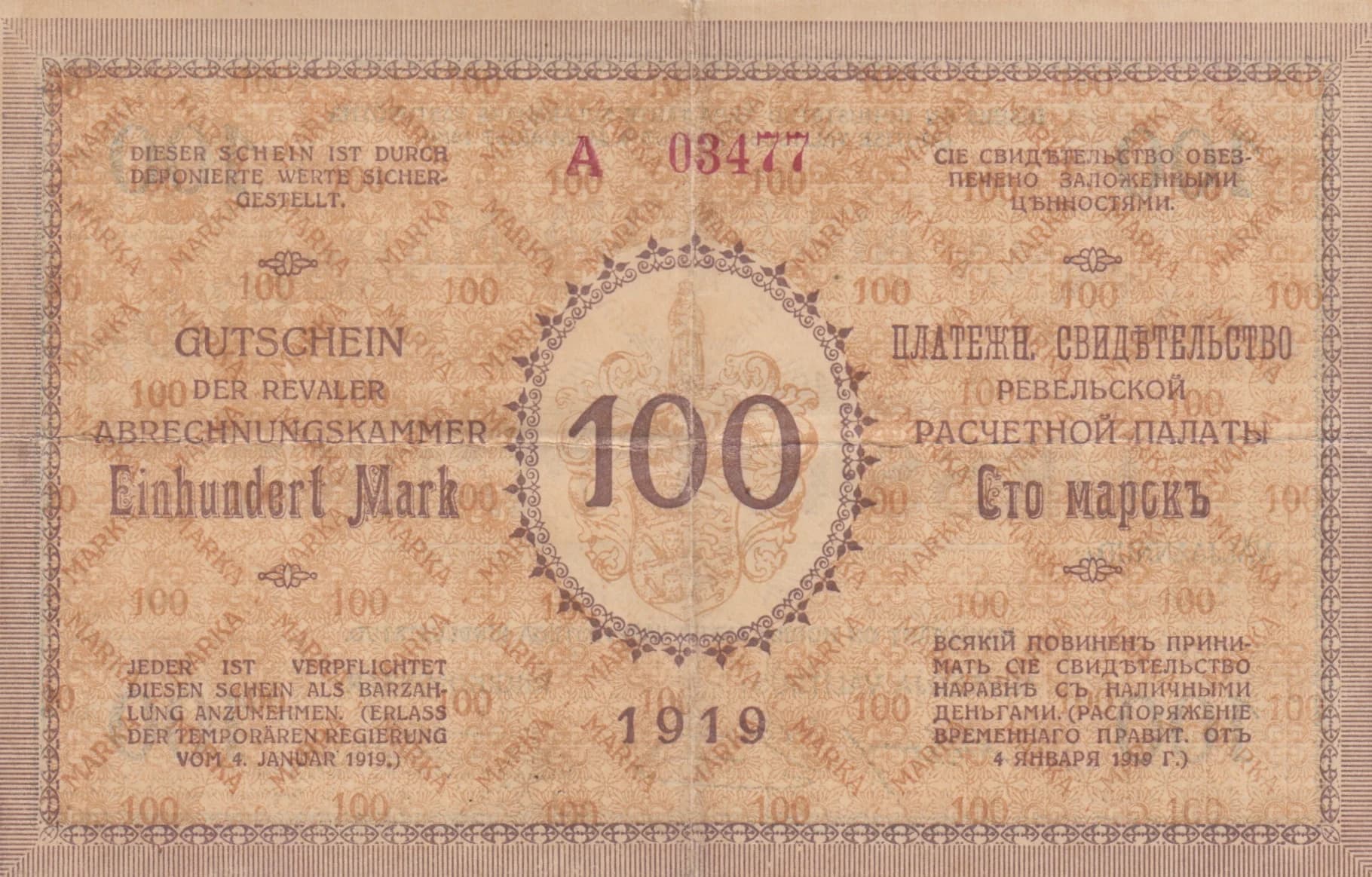
This 1919 Estonian 100 marka emergency note issued by the Tallinna Arvekoja (Tallinn Accounting Chamber) exemplifies the transitional currency period following Estonian independence. The note displays the characteristic tan/beige aged patina consistent with early 20th-century paper stock, with visible creasing and foxing throughout, grading VF. The trilingual design (Estonian, German, Russian) with centered sunburst motif and ornamental corner denominations reflects Reval's multinational heritage during the provisional government period.
Common. The eBay market data shows multiple listings in the $45-$275 range, with numerous examples available at modest prices ($48-$120 for unknowns, $54.90-$245 for graded specimens). Catalogue values (2016) of $350-$1350 reflect rarity in higher grades (G-EF), but VF specimens regularly trade for under $300 on secondary markets. The Tallinna Arvekoja issued substantial quantities of these emergency notes in early 1919, and survival rates appear reasonable for the denomination. This is a typical survivor of Estonian emergency currency, valuable primarily for historical significance rather than scarcity.
Issued January 4, 1919, this note represents Estonia's first independent currency emergency, predating the official kroon. The Tallinna Arvekoja functioned as a municipal accounting chamber issuing temporary payment certificates secured by deposited valuables, as explicitly stated in the multilingual text. The trilingual inscriptions in Estonian, German, and Russian document the linguistic complexity of post-independence Estonia, where Estonian had recently become the official language while German and Russian retained administrative presence from the imperial period.
The 100 marka features a symmetrical design emphasizing denomination and security through ornamental complexity rather than portraiture. The front displays a prominent sunburst medallion in the center, flanked by large numerals '100' in all four corners within decorative frames—a security technique of the period. The design employs fine-line border patterns and ornamental corner elements typical of Central European emergency currency. The back features a large decorative oval frame enclosing the denomination, maintaining the tan/beige color scheme with teal/blue-green border accents. Serial number A 03560 appears prominently. No portraits or specific landmarks are depicted; instead, the design relies on geometric and floral ornamental motifs characteristic of early Estonian official documents.
FRONT SIDE: 'IGAÜKS ON KOHUSTATUD SEDA TÄHTE SULARAHANA VASTUVÕTMA (AJUTISE VALITSUSE MÄÄRUS 4. JANUARIST 1919)' translates to 'Everyone is obliged to accept this note as cash (Decree of the Provisional Government from January 4, 1919)'. 'TALLINNA ARVEKOJA MAKSUTÄHT' = 'Tallinn Accounting Chamber Payment Certificate'. 'ÜKSSADA MARKA' = 'One Hundred Marks'. 'MAKSUTÄHT ON HOIULE ANTUD VÄÄRTUSTEGIA KINDLUSTATUD' = 'Payment certificate is secured by valuables deposited'. Signature lines read 'VÄLJAANNUD:' (Issued), 'ARVEKOJA VALITSUS:' (Board of Accounting Chamber), and 'RIIGIKOMISAR:' (State Commissioner). BACK SIDE: German text includes 'GUTSCHEIN DER REVALER ABRECHNUNGSKAMMER' (Certificate of the Reval Accounting Chamber), 'Einhundert Mark' (One Hundred Marks), 'DIESER SCHEIN IST DURCH DEPONIERTE WERTE SICHER-GESTELLT' (This note is secured by deposited valuables), and 'JEDER IST VERPFLICHTET DIESEN SCHEIN ALS BARZAHLUNG ANZUNEHMEN. (ERLASS DER TEMPORÄREN REGIERUNG VOM 4. JANUAR 1919.)' (Everyone is obliged to accept this note as payment in cash. Decree of the Temporary Government from January 4, 1919). Russian text includes 'ПЛАТЕЖН. СВИДЕТЕЛЬСТВО РЕБЕЛЬСКОЙ РАСЧЕТНОЙ ПАЛАТЫ' (Payment Certificate of the Reval Accounting Chamber), 'Сто марок' (One Hundred Marks), 'ЦИЕ СВИДЕТЕЛЬСТВО ОБЕЗ-ПЕЧЕНО ЗАЛОЖЕННЫМИ ЦЕННОСТЯМИ' (This certificate is secured by pledged valuables), and 'ВСЯКИЙ ПОВИНЕН ПРИНИМАТЬ СИЕ СВИДЕТЕЛЬСТВО НАРАВНЕ С НАЛИЧНЫМИ ДЕНЬГАМИ. (РАСПОРЯЖЕНИЕ ВРЕМЕННАГО ПРАВИТ. ОТ 4 ЯНВАРЯ 1919 Г.)' (Everyone is obliged to accept this certificate as equivalent to cash. Order of the Temporary Government from January 4, 1919).
Letterpress (relief) printing on laid paper stock, evidenced by the crisp fine-line ornamental borders, sharp corner decorative frames, and uniform text impression visible in the images. The multilingual text layout and ornamental complexity suggest professional security printing from an established printer serving the Austro-Hungarian successor states, likely using traditional engraved plates. The aged appearance and foxing patterns are consistent with early 20th-century chemical wood pulp paper without modern anti-counterfeiting treatments.
This specimen is variety P-A3a with serial number A 03560. The 'A' prefix series is standard for this issue. Varieties are typically distinguished by signature combinations on the issuing authority lines and by serial number series/prefixes. No overprints or secondary markings are visible in this example. The note represents the standard first printing from January 1919, prior to any modifications or reissues of the Tallinna Arvekoja series.