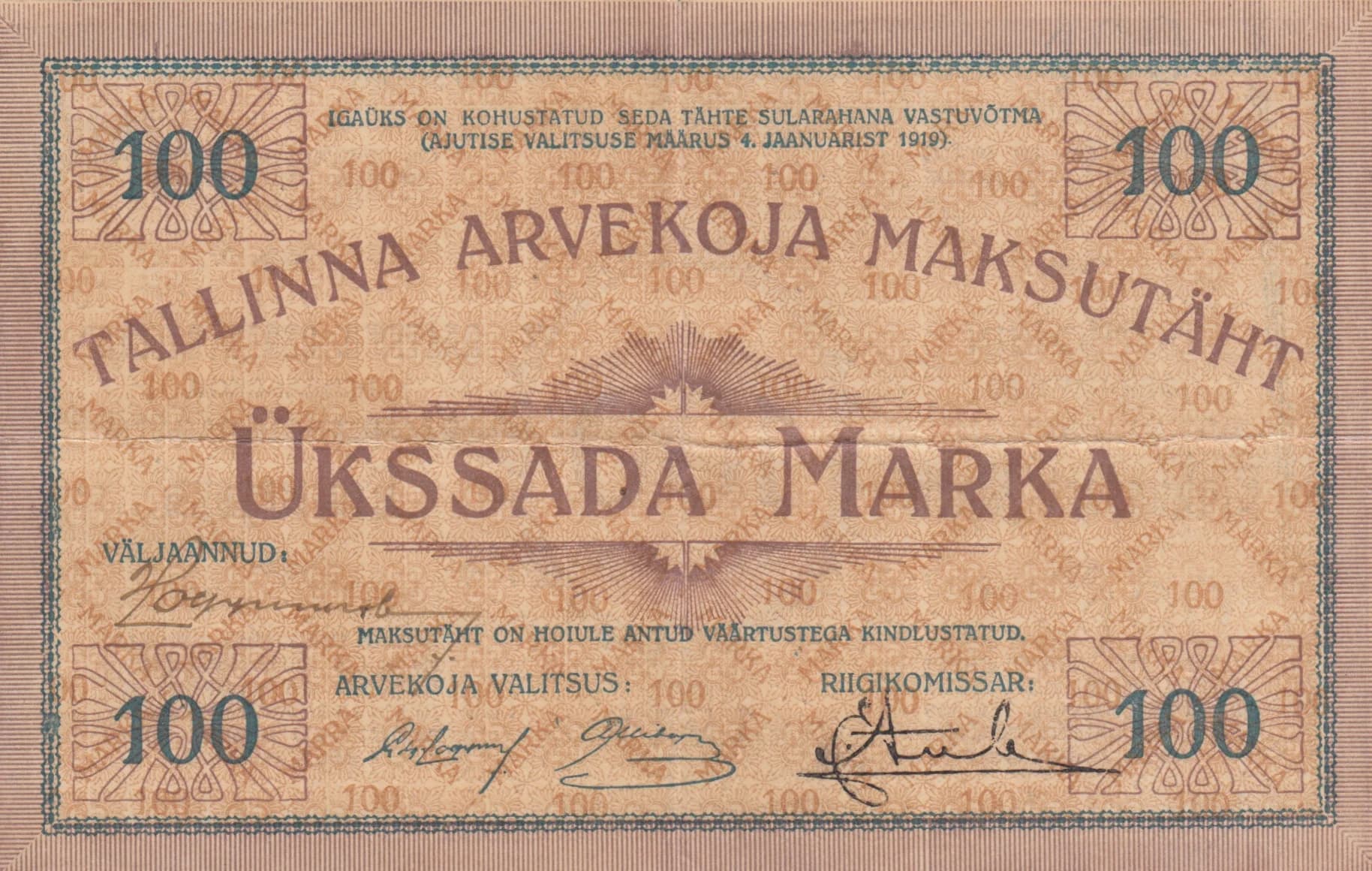
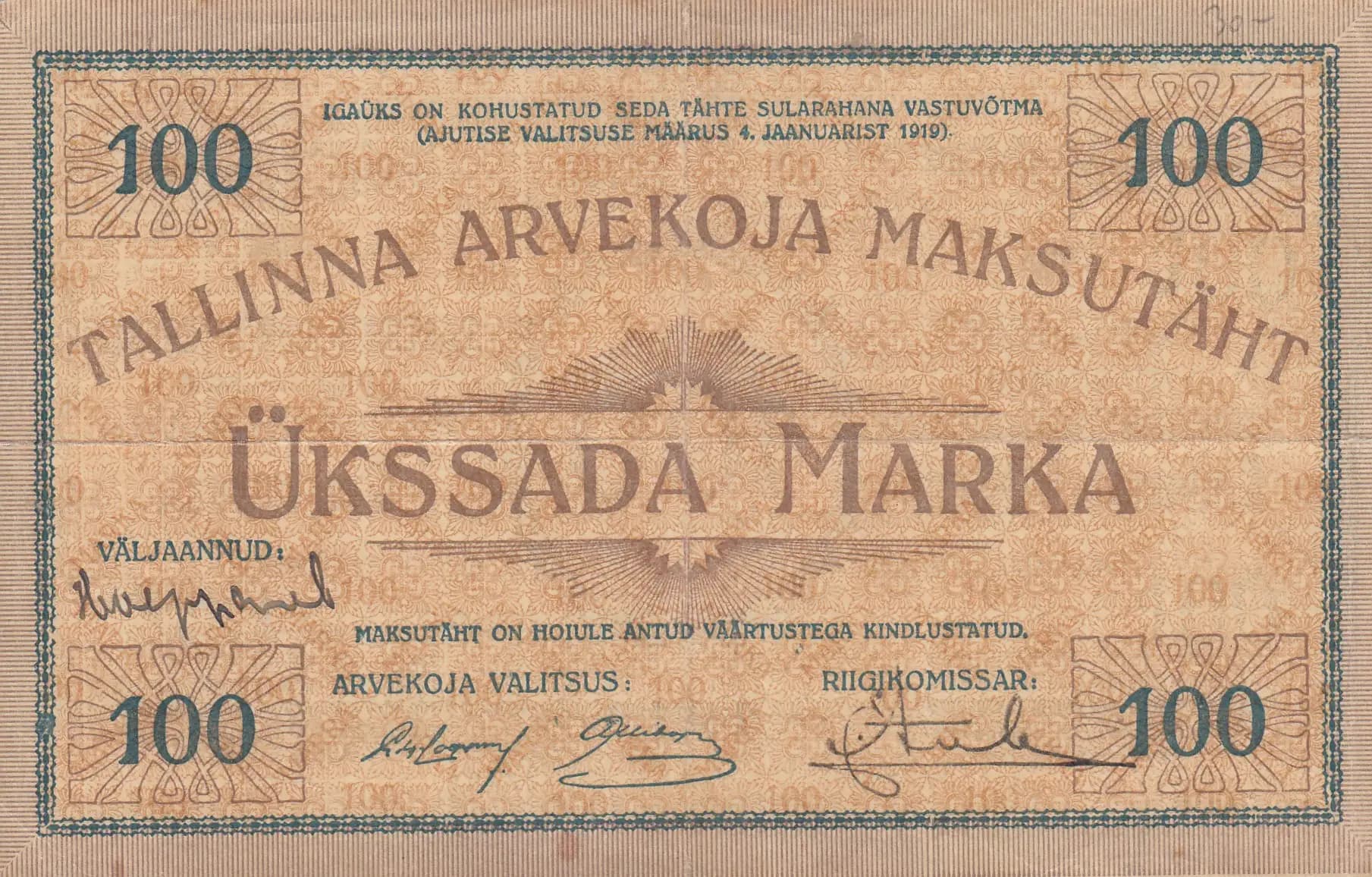
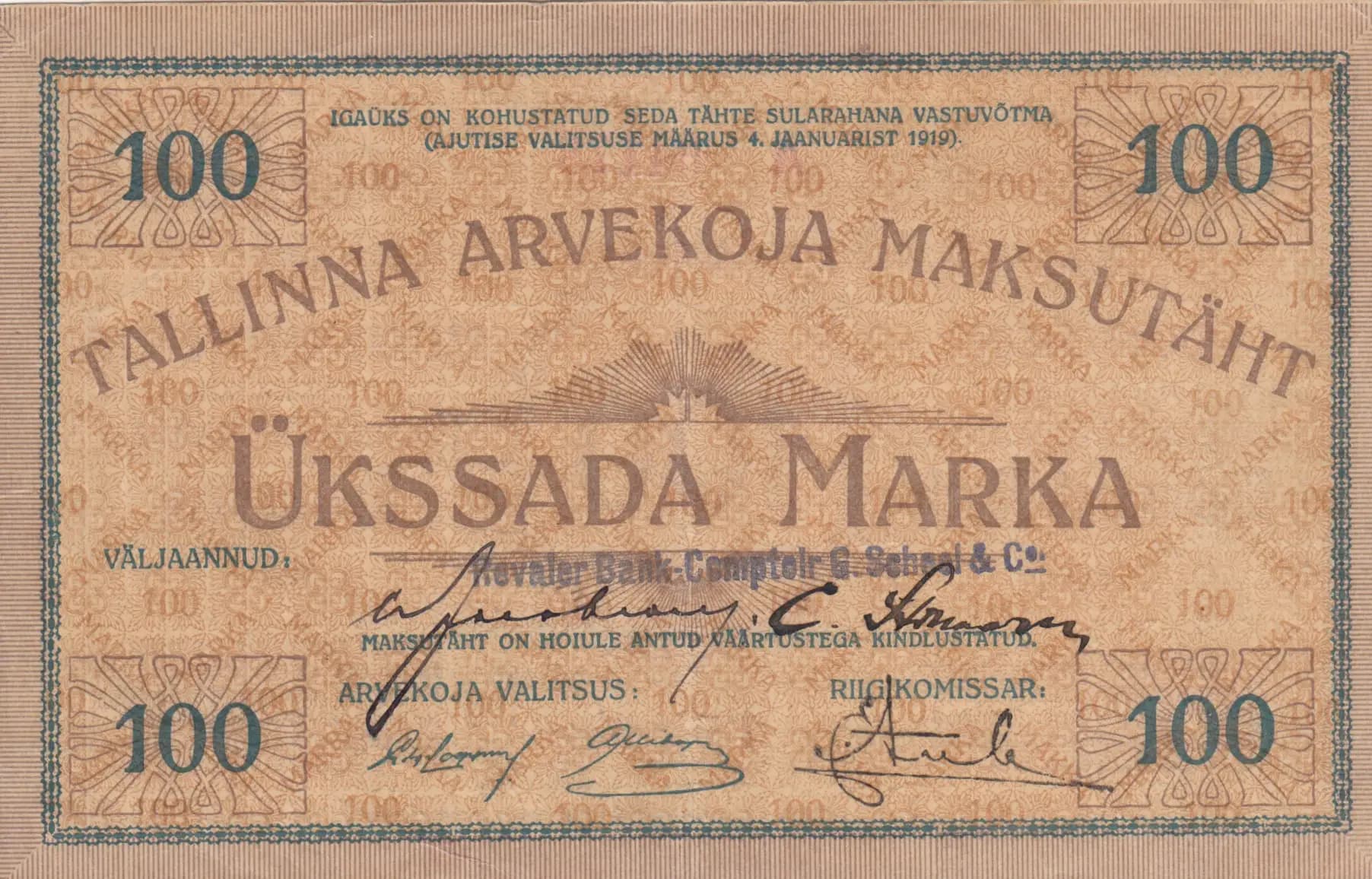
100 marka 1919
“serie B”
Market Prices
About This Note
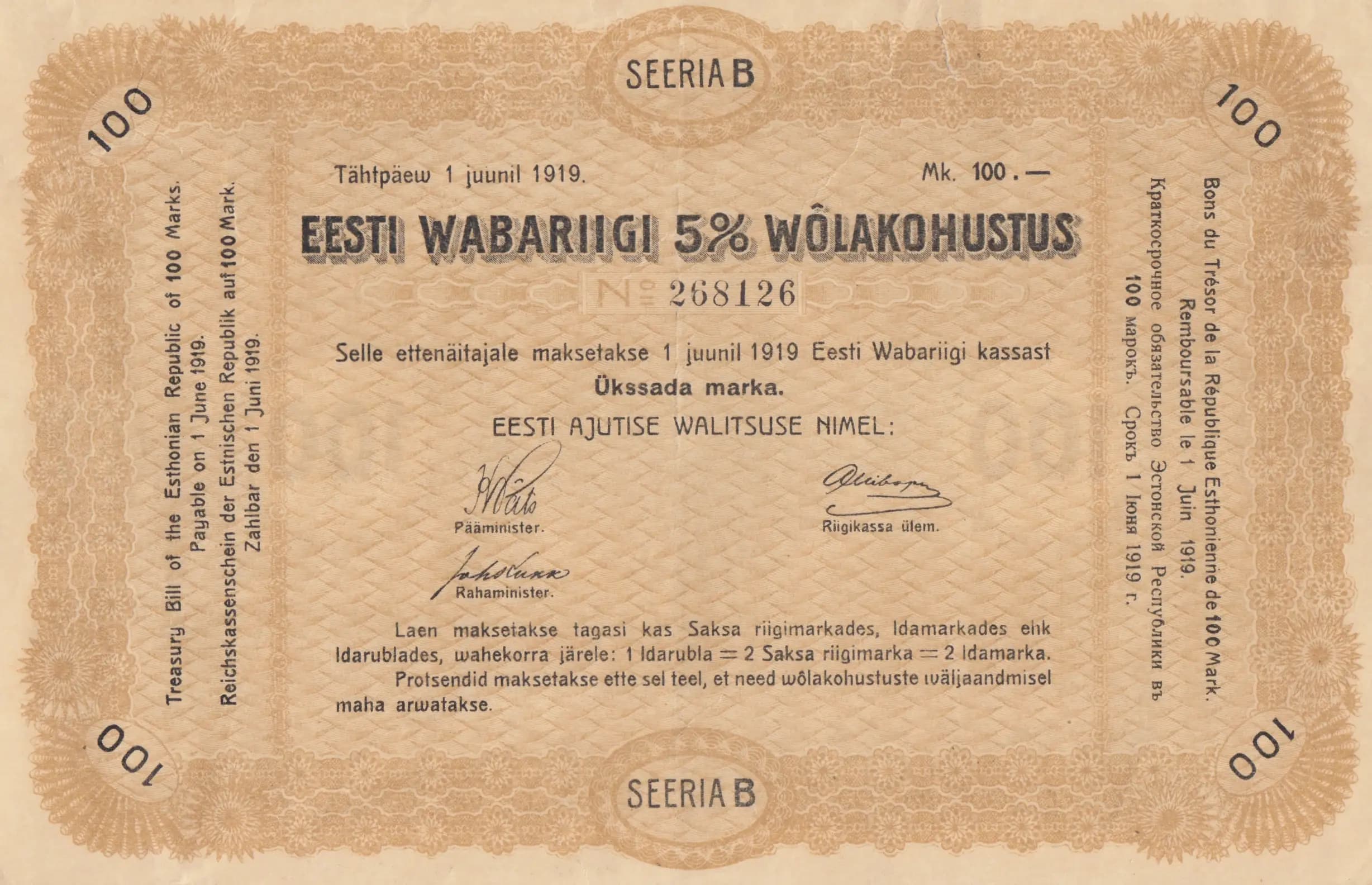
This is a Series B example of Estonia's 100 Marka treasury bill issued on 1 June 1919 by the Estonian Republic's Provisional Government. The note is printed in tan and brown on both sides with intricate ornamental borders and radiating sunburst patterns, showing excellent preservation consistent with EF grade—no major creases, tears, or stains are evident, with only normal aging patina appropriate to its 105-year age. As an early independence-era fiscal document from the newly sovereign Estonia, this note represents a significant piece of Estonian numismatic history during the turbulent post-WWI transition period.
Common. While this is an early Estonian independence-era note from a short-lived treasury bill system, the eBay market data shows consistent pricing in the $45–$100 range for similar grades (XF condition listed at $45–$99.50), indicating reasonable availability in the collector market. The 2016 catalogue value of $200 for F grade appears to be an outlier compared to actual realized market prices. The note was issued in series, with serial number 268126 observed on this specimen suggesting a significant print run. Series B examples are regularly encountered in collections, and the denomination and issuer do not indicate scarcity factors such as short print runs, recall status, or extreme rarity.
This treasury bill was issued during Estonia's critical transition to independence following World War I and the Russian Revolution, printed by the Estonian Provisional Government before the establishment of a permanent banking system. The multilingual inscriptions in Estonian, German, and French reflect Estonia's complex geopolitical position—bordered by German and Russian spheres of influence—while the repayment clause specifying German Reich marks, Eastern marks, and Eastern rubles demonstrates the monetary chaos of the period. The 5% loan bond structure was typical of post-war governments attempting to stabilize their economies through treasury instruments rather than traditional currency.
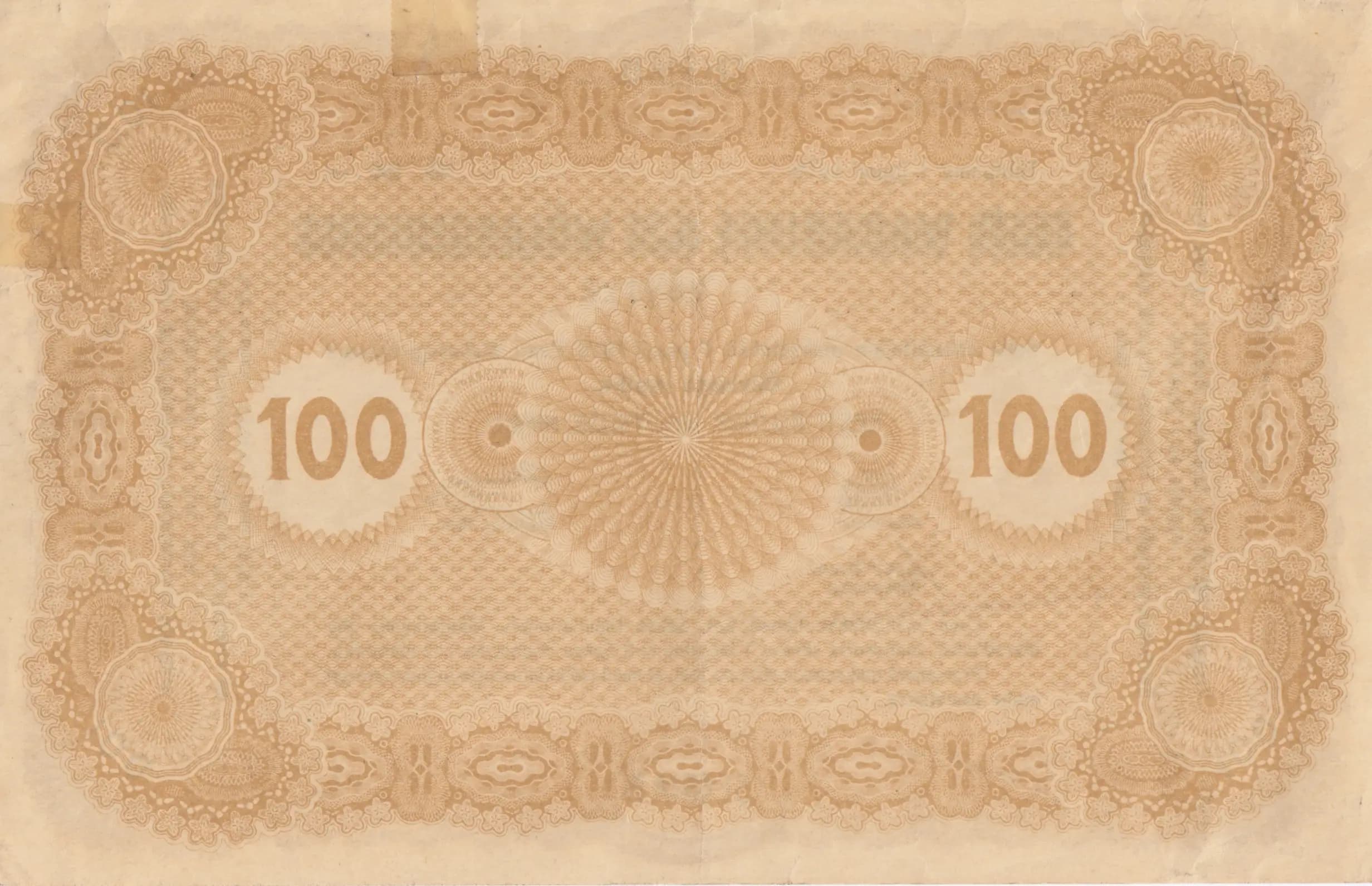
This is a non-denominational portrait treasury bill featuring purely ornamental security design rather than historical figures or landmarks. The front displays centered text with official government declarations and signature lines for three authorities (Prime Minister, Finance Minister, and State Treasury Head), surrounded by an ornate decorative border composed of radiating fan or sunburst motifs and geometric lace-like patterns in the corners featuring circular rosette designs. The reverse side is dominated by a large central radiating sunburst or fan pattern flanked by circular medallions in ornate frames, with large denomination numerals '100' positioned symmetrically on the left and right sides. The entire design employs intricate geometric and floral patterns throughout the border to create security against counterfeiting, with no portraits or specific landmarks depicted—instead relying on artistic complexity and the multilingual text to establish authenticity and governmental authority.
FRONT SIDE: 'SEERIA B' (Series B) | '100' (denomination) | 'Tähtsaev 1 juuni 1919' (Dated 1 June 1919) | 'Mk. 100.—' (100 Marka) | 'EESTI WABARIIGI 5% WÕLAKOHUSTUS' (Estonian Republic 5% Loan Bond) | 'No 268126' (Serial number) | 'Selle ettenäitajale maksetakse 1 juunil 1919 Eesti Wabariigi kassast Ükssada marka' (The bearer will be paid 100 marka from the Estonian Republic treasury on 1 June 1919) | 'EESTI AJUTISE WALITSUSE NIMEL' (On behalf of the Estonian Provisional Government) | 'Pääminister' (Prime Minister) | 'Rahaminister' (Finance Minister) | 'Riigikassa üllem' (Head of State Treasury) | 'Laen maksetakse tagasi kas Saksa riigimärkades, Idamärkades eik Idarublades, vahekorra järele: 1 idarubla = 2 Saksa riigimarka = 2 Idamarka' (The loan will be repaid in German Reich marks, Eastern marks or Eastern rubles, according to the following rate: 1 Eastern ruble = 2 German Reich marks = 2 Eastern marks) | 'Treasury Bill of the Estonian Republic of 1 June 1919' (English translation) | 'Recksbesetzasch der Estnischen Paralale on 1 Juni 1919' (German version—Reich Treasury Bill of Estonia on 1 June 1919) | 'Bon du Trésor de la République Esthonienne de 1 Juin 1919' (French version—Treasury Bond of the Estonian Republic of 1 June 1919) | 'Protsendid maksetakse ette sel teel, et need wõlakohustuste üalijaandmisel maha arwaiakse' (Interest will be paid in advance by deducting it when these bonds are surrendered) | BACK SIDE: '100' (denomination appearing on both left and right sides) | 'SEERIA B' (Series B appearing twice)
This note was produced using intaglio engraving (steel plate printing), evidenced by the crisp, deeply detailed ornamental borders, fine geometric line work, and the sharp impression quality visible in both the decorative patterns and text. The consistency of ink application, the precision of the radiating sunburst patterns, and the fine detail in the corner rosettes are characteristic of high-quality intaglio work typical of early 20th-century security printing. The printer for Estonian treasury bills of this period is not definitively identified in the visible inscriptions, though the technical quality suggests work by an established European security printer, possibly German given Estonia's proximity and the German language text present.
This specimen is identified as Series B, which is the standard circulating variety for this Pick number (P-9A). The visual analysis confirms 'SEERIA B' markings on both obverse and reverse. Pick 9A notation indicates this is the two-sided printing variety (distinguishing it from a uniface variant). Serial number 268126 places this within the regular issue range. No overprints, color variations, or other anomalies are noted that would distinguish this as a rare printing variety—it represents the typical Series B circulation issue from the 1 June 1919 emission.