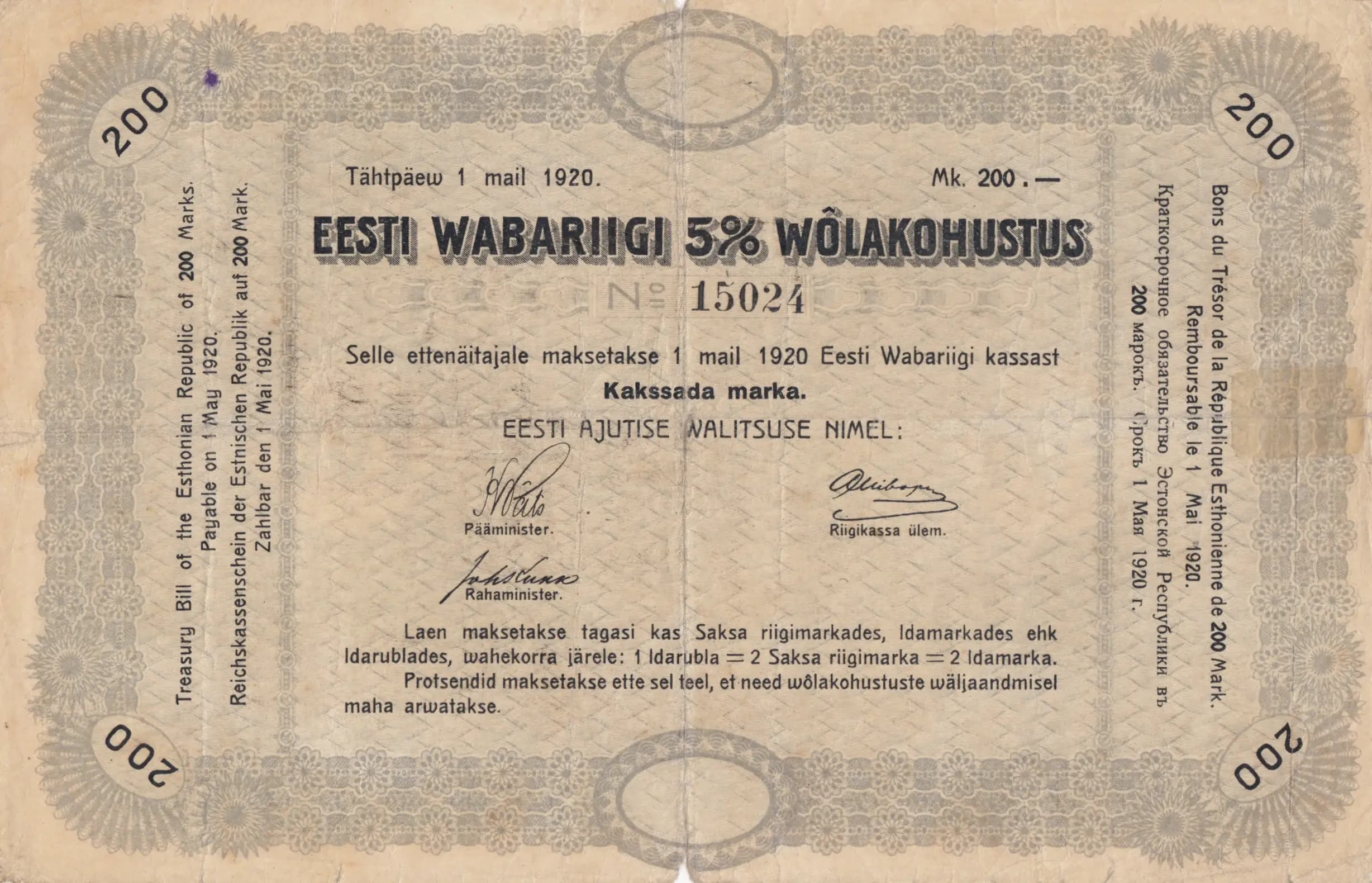
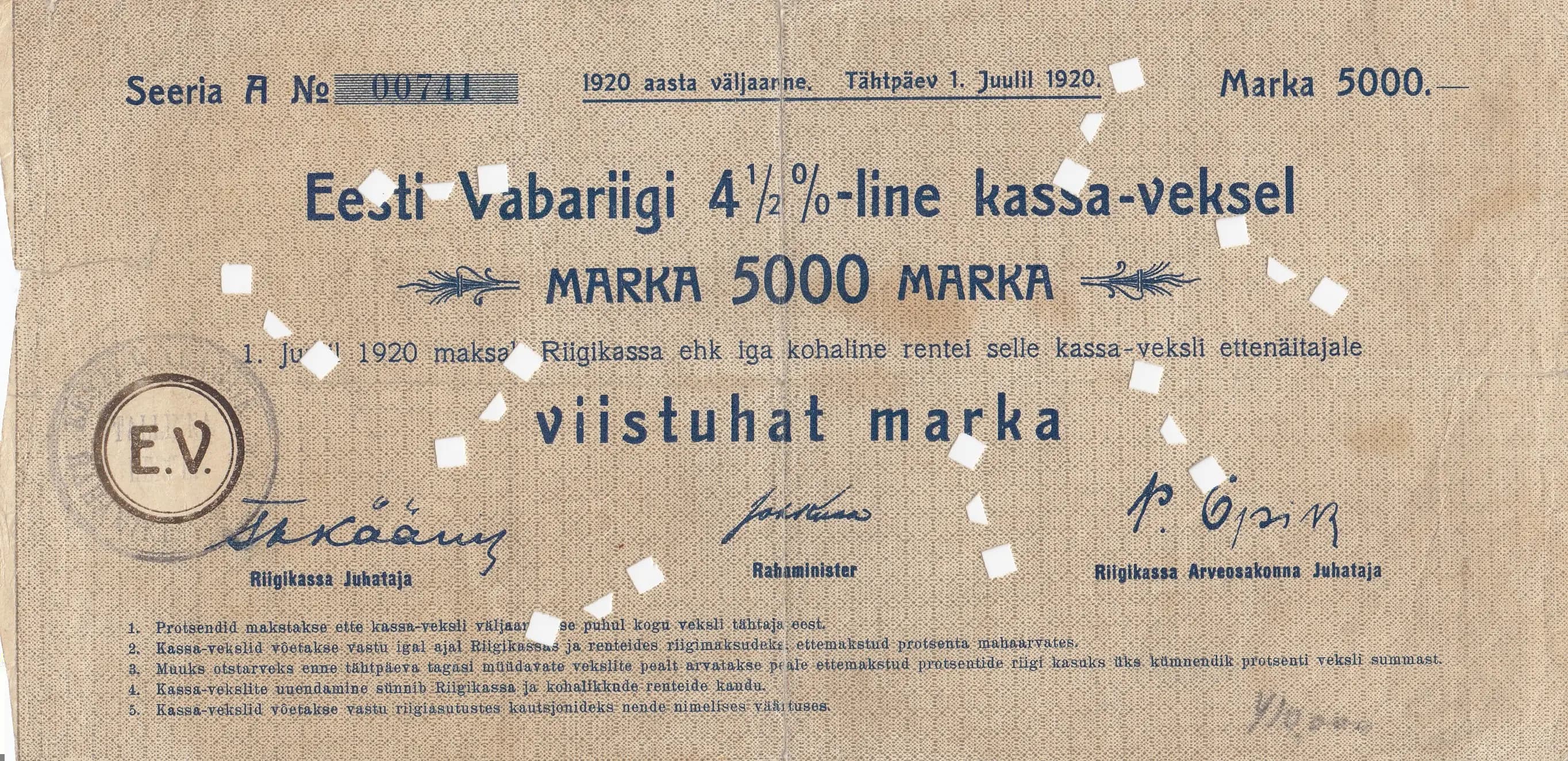
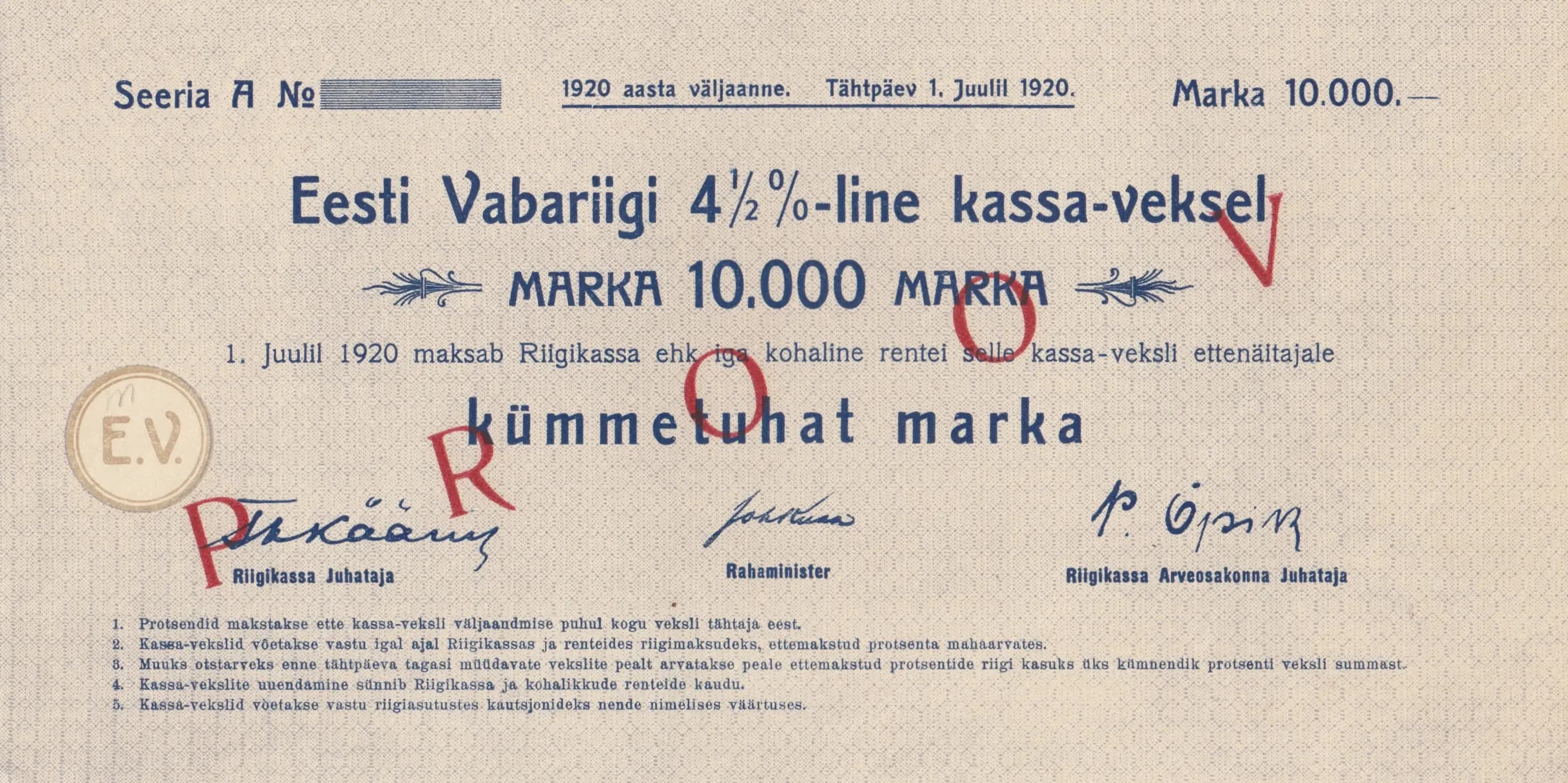
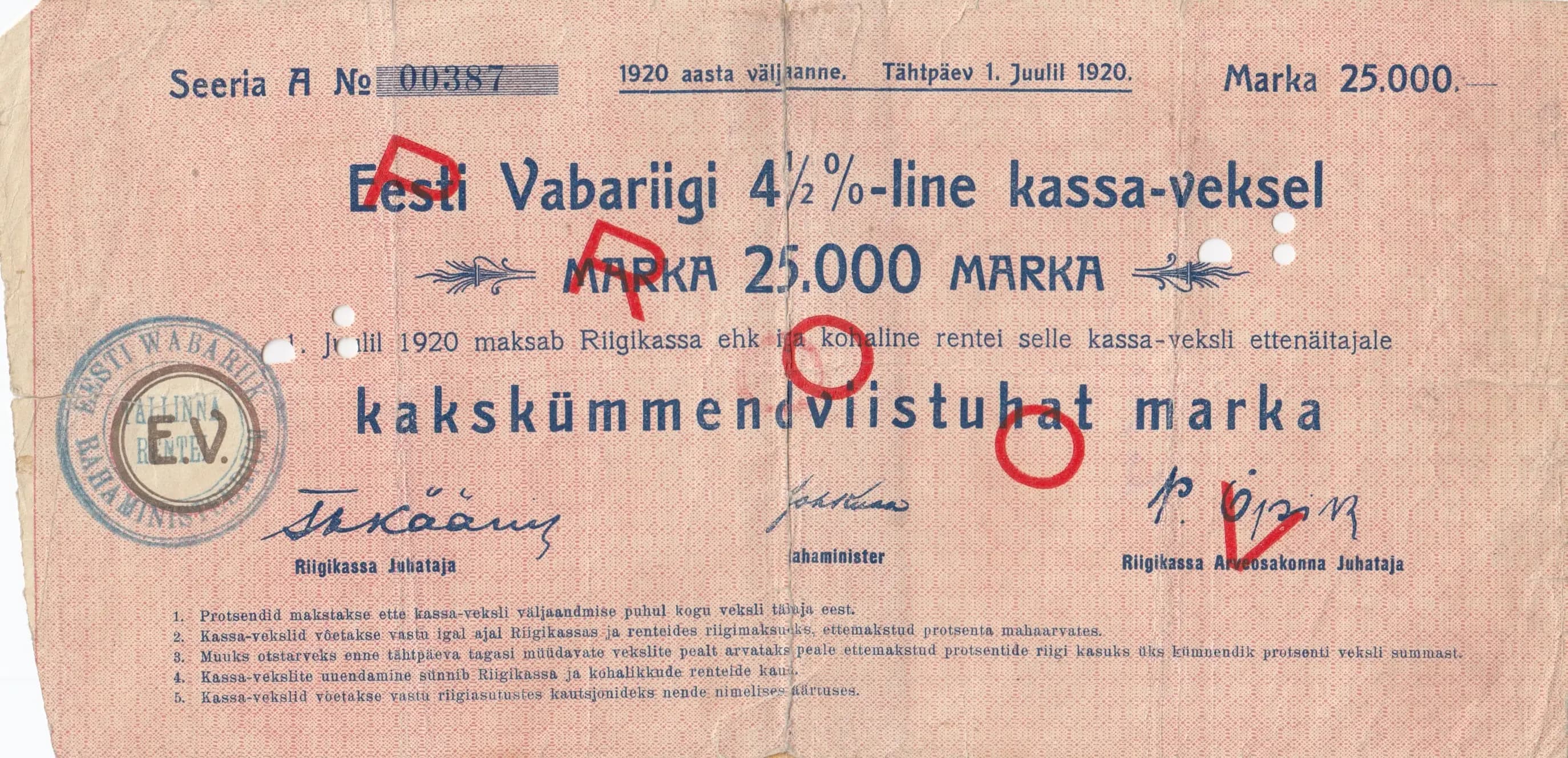
100 000 marka 1920
“serie D”
Market Prices
About This Note
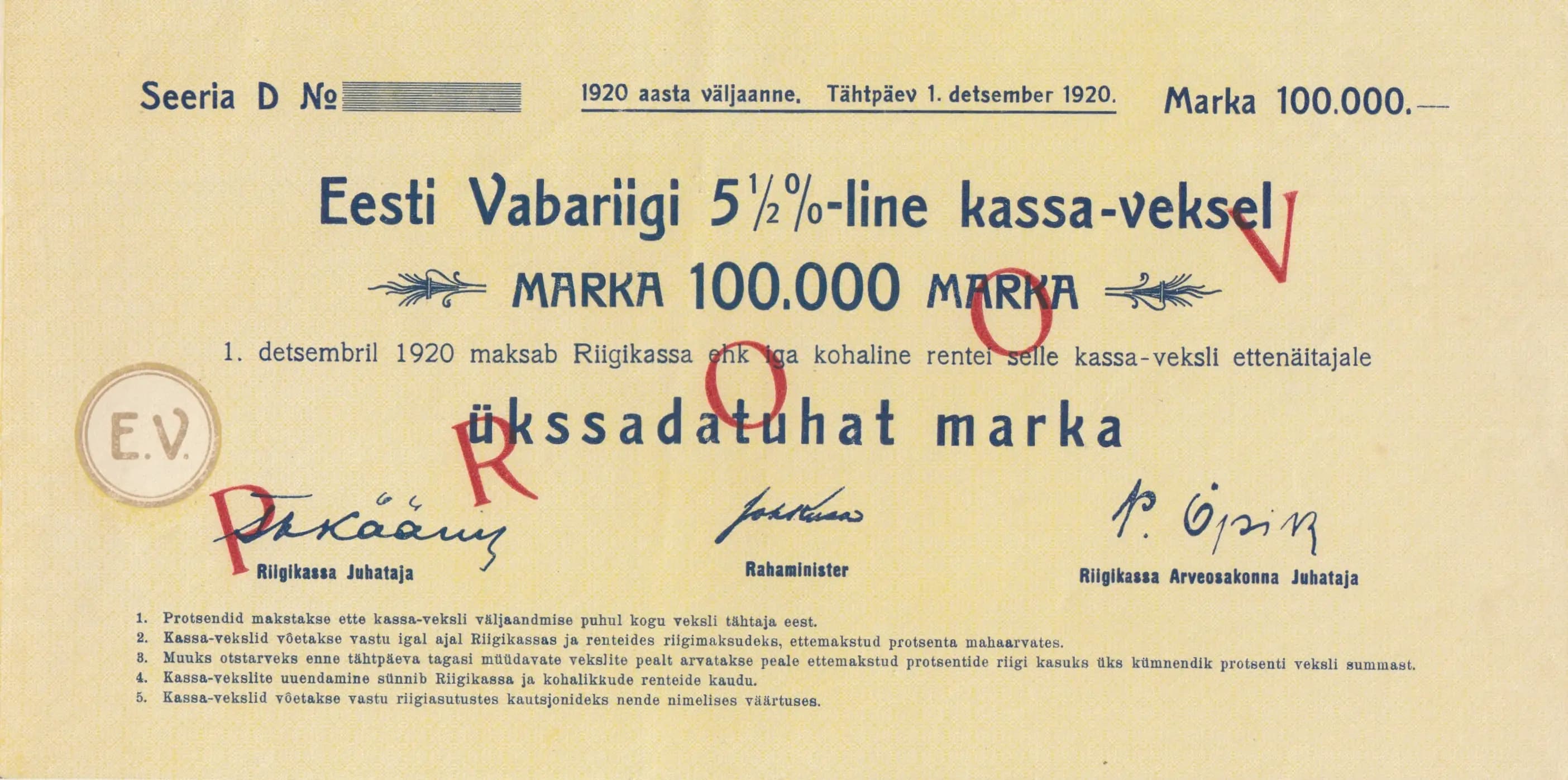
This is a scarce Estonian Republic 100,000 Marka treasury note (kassa-veksel) from 1920, graded EF, representing one of the higher denomination issues during Estonia's early independence period. The note is a Series D specimen featuring official government stamps and signatures, with visible red cancellation marks indicating its historical use and subsequent invalidation. The cream-colored paper with blue and black printing shows age-appropriate foxing and discoloration consistent with a document over 100 years old, making it an important artifact of Estonia's monetary history.
Uncommon. While the eBay price tracking shows considerable variation ($2.95 to $669.00 USD), the median prices for graded examples (VF at $54.90-$82.00, XF at $45.00, AU at $269.99) suggest these notes trade regularly but are not abundant in the collector market. The specimen status, Series D designation, and the specific 100,000 Marka denomination from 1920 indicate a limited original print run. The visible cancellation marks indicate many examples were destroyed upon maturity, further reducing availability today.
This treasury note was issued by the newly independent Estonian Republic in 1920, just two years after Estonia declared independence from the Russian Empire in 1918. The 5½% interest-bearing nature of this kassa-veksel reflects the young nation's efforts to finance itself through treasury instruments during a period of economic stabilization. The December 1, 1920 maturity date and official signatures from the State Treasury Director, Finance Minister, and Accounting Department Director demonstrate the formal governmental structures Estonia had established to manage its finances independently.
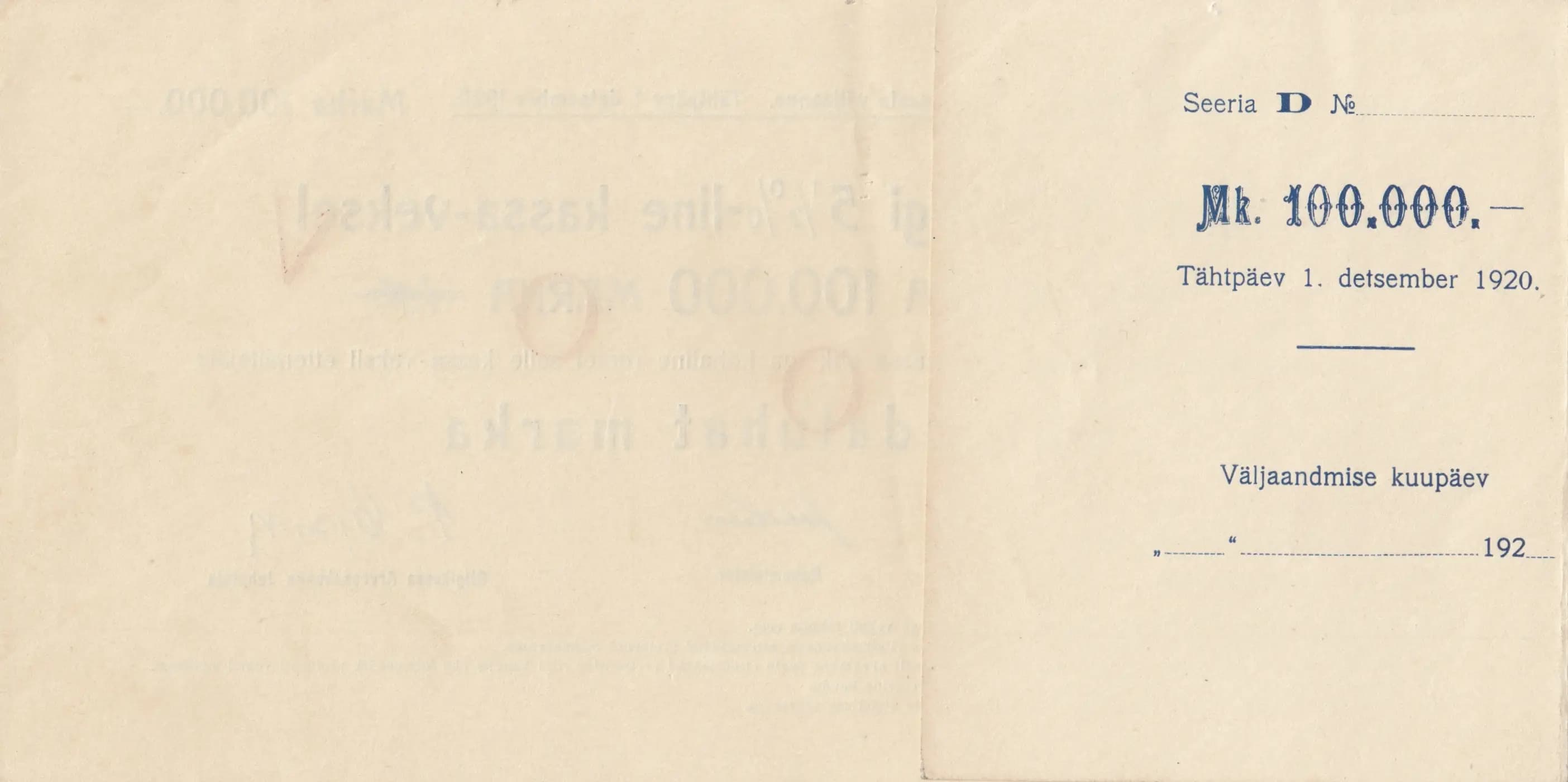
This treasury note is a formal governmental bond certificate rather than a circulating banknote, printed on cream/beige paper with blue and black typography. The front features the denomination prominently displayed ('MARKA 100.000') with decorative blue flourishes flanking the main text elements, creating a professional governmental appearance. An oval seal bearing 'E.V.' (Eesti Vabariik - Estonian Republic) is prominently displayed on the left side. The document includes three signature lines for authorized officials (State Treasury Director, Finance Minister, and Accounting Department Director), reflecting the multi-level authorization required for such high-value instruments. The reverse side is largely blank with minimal administrative information. The note bears multiple red stamp marks and annotations indicating official cancellation or invalidation, a common practice for historical treasury instruments that had reached maturity or been retired from circulation.
FRONT SIDE: 'Seeria D №' (Series D №) | 'Eesti Vabariiqi 5½%-line kassa-veksel' (Estonian Republic 5½% treasury note) | 'MARKA 100.000 MARKA' (100,000 Mark) | 'Marka 100.000.—' (100,000 Mark) | '1920 aasta väljaanne. Tähtpäev 1. detsember 1920.' (1920 year issue. Due date December 1, 1920.) | '1. detsembril 1920 maksab Riigikassa ohk'ga kohaline rententel selle kassa-veksli ettenäitajale ükssadatühat marka' (On December 1, 1920, the State Treasury will pay to the bearer of this treasury note one hundred thousand mark) | 'Rikkasadatühat marka' (cancelled/invalidated mark) | 'Riigikassa Juhataja' (State Treasury Director) | 'Rahaminister' (Finance Minister) | 'Riigikassa Arveosakeonna Juhataja' (State Treasury Accounting Department Director) | Terms of use regarding interest payment, acceptance as taxes, renewal procedures, and collateral value. BACK SIDE: 'Seeria D №' (Series D №) | 'Mk. 100.000.—' (100,000 Mark) | 'Tähtpäev 1. detsember 1920.' (Due date December 1, 1920.) | 'Väljaandmise kuupäev' (Date of issue) | '192' (192[0])
Letterpress printing on bond paper, utilizing blue and black inks with hand-applied red stamp marks for cancellation and administrative markings. The clean typography and formal layout suggest printing by an official state printer, consistent with early 20th-century Estonian government document production standards.
This is Pick catalog P-38Ps, identified as a Specimen Note (indicated by 'Ps' suffix). The Series D designation and the gray color mentioned in external references suggest this may be P-38A (orange) or another color variant. The PMG population report indicates only 1 variant has been catalogued for the base P-38 pick number, suggesting the market's limited familiarity with these specific treasury instruments. The red cancellation marks and dated maturity of December 1, 1920 indicate this is a post-maturity example that was officially invalidated rather than redeemed.