100 000 marka 1920
“serie B”
Market Prices
About This Note
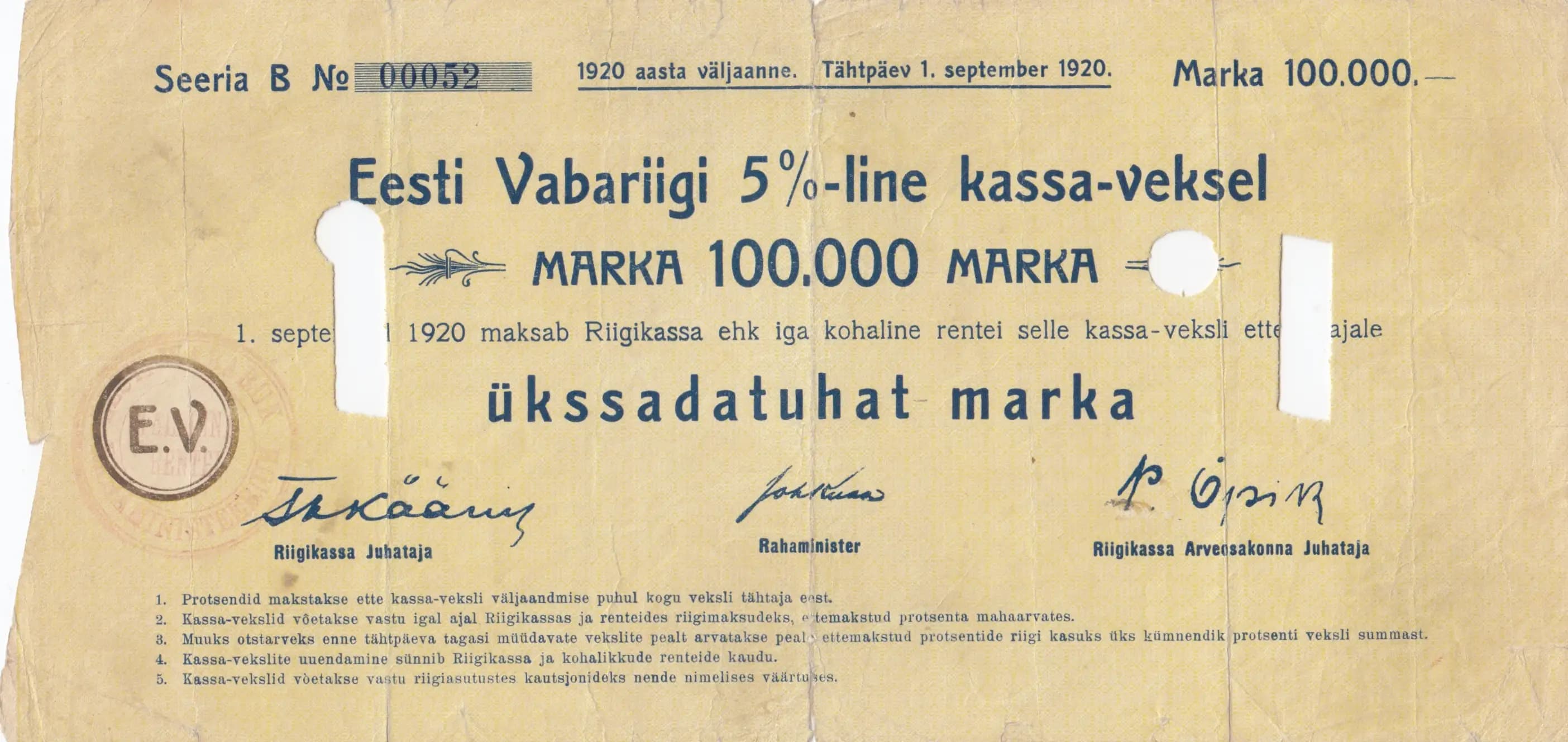
This is an Estonian 100,000 Marka treasury note from 1920, Series B, in Fair (F) condition. The note features a formal cream-colored design with dark blue text and multiple official signatures representing the State Treasury, Finance Minister, and Treasury Accounts Department. The specimen exhibits extensive age-related wear including fold lines in a grid pattern, significant foxing and brown discoloration throughout, and archival cutouts on both sides—characteristics typical of this high-denomination hyperinflation-era note that saw limited circulation before Estonia's monetary reform.
Common. The eBay market pricing data provided shows consistent sales ranging from $9-$185 USD depending on condition, with Fair condition examples trading in the $300 catalogue value range according to the 2016 Realbanknotes catalog. Multiple examples appear in the market at various price points, and PMG population reports show this as a known issue type without rarity designations. The relatively high denomination (100,000 Marka) and the hyperinflationary context suggest moderate original circulation despite the large face value, but this note type does not appear to be scarce in the current collector market.
Issued on September 1, 1920, during Estonia's early independence period following World War I, this 5% treasury note reflects the newly established Estonian Republic's attempt to stabilize its economy through interest-bearing instruments. The note was issued during a period of significant inflation in the Baltic region, as the newly independent Estonia sought to establish financial stability and creditworthiness. The formal layout with multiple official signatures and the explicit redemption guarantee demonstrates the young republic's effort to establish confidence in its financial instruments during a turbulent economic transition.
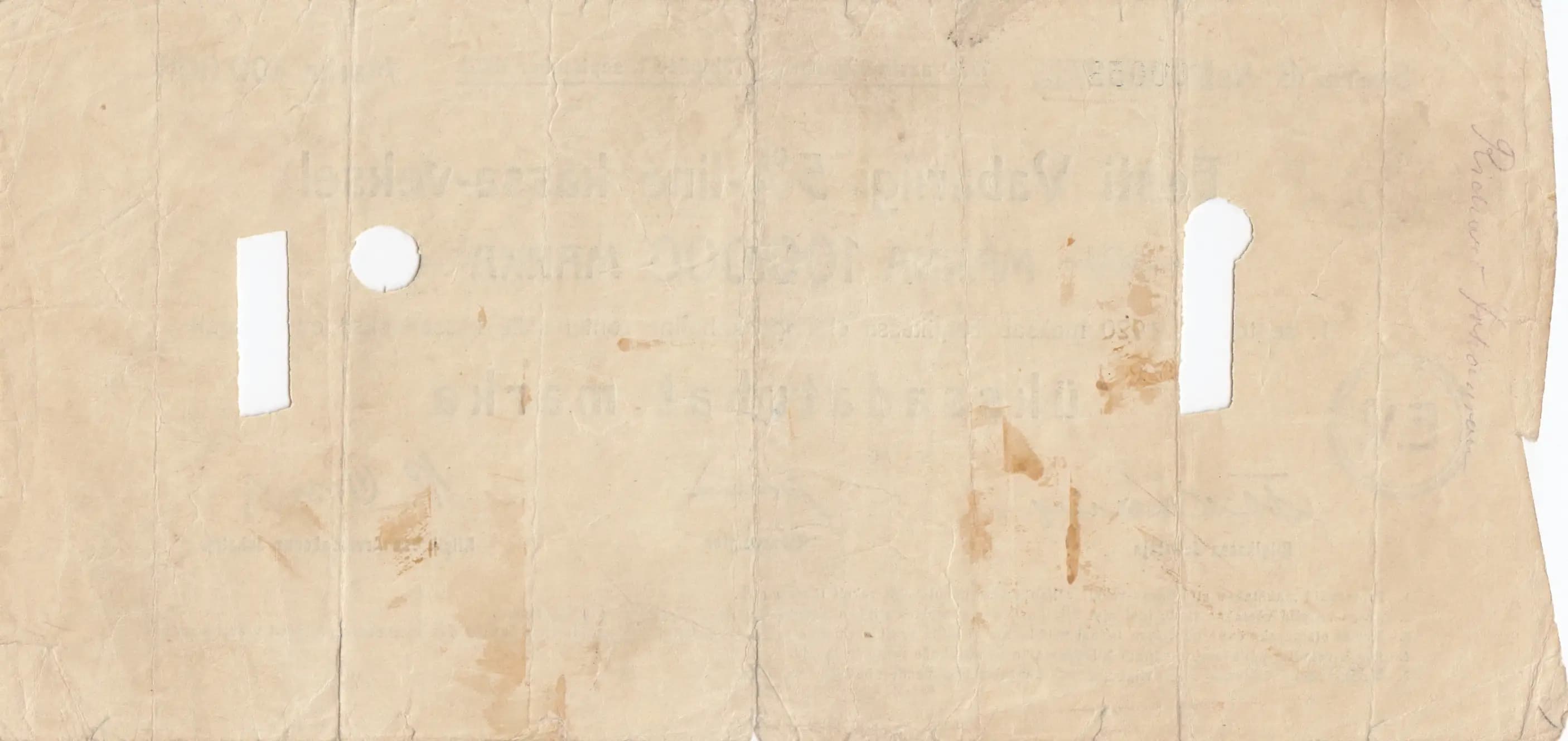
This treasury note features a utilitarian, formal design typical of 1920s Eastern European financial instruments rather than traditional banknote imagery. The front displays a centered layout with no portraits or landmarks, instead emphasizing the legal and financial terms of the instrument. A circular seal marked 'E.V.' (Eesti Vabarigi—Estonian Republic) appears on the left side as the primary security device and authenticity marker. The note is printed predominantly in blue/dark blue ink on cream/beige paper. Three signature lines appear at the bottom, with spaces for the Head of State Treasury, Finance Minister, and Head of the Treasury Accounts Department. A decorative flourish or ornamental design appears above the denomination. The back is blank, which was standard for treasury notes of this period. The archival cutouts (two rectangular and one circular) visible on both sides are consistent with binding and storage methods used by institutional collectors and archives rather than manufacturing features.
FRONT SIDE: Series B No. 00052 | '1920 edition. Date September 1, 1920.' | 'Marka 100,000' | 'Estonian Republic 5% Treasury Note' | 'MARK 100,000 MARK' | 'On September 1, 1920, the State Treasury or any local revenue office will pay one hundred thousand marks for this treasury note on demand' | Official titles: 'Head of State Treasury' | 'Finance Minister' | 'Head of State Treasury Accounts Department' | Terms and conditions: '1. Interest is paid in advance when the treasury note is issued for the entire duration of the note.' | '2. Treasury notes are accepted at any time from the State Treasury and revenue offices as payment for state taxes, with accrued interest deducted.' | '3. In other respects regarding returned notes: unpaid interest shall be protested by one-tenth percent of the note's amount.' | '4. Treasury notes may be renewed through the State Treasury and local revenue offices.' | '5. Treasury notes are accepted in state institutions as securities at their nominal value.' | BACK SIDE: Blank with no inscriptions.
Based on the visual characteristics—sharp blue text, formal typography, and the regular grid pattern visible in the note's aging—this note was produced using letterpress or typographic printing, the standard method for official documents and treasury notes of the 1920s. The uniform color application and clean edges of text suggest professional state printing facilities. The Estonian state printer (Riigi Trükikoda) would have been the likely producer for official treasury instruments of the newly independent republic, though specific attribution to a named security printer is not documented for this series.
This note is specifically Series B, number 00052, representing a variant within P-38. The external catalog reference mentions that P-38K (the code provided in the catalog data) represents a gray-colored variety, with P-38A noted as having an orange color variant. The visual analysis confirms this as the gray variety based on the cream/beige and blue color scheme. This is distinct from the 200 Marka denomination mentioned in some reference catalogs, confirming this is the higher-denomination 100,000 Marka version. The series designation and specific numbering (Series B) suggests this note is from a particular printing run distinct from other series variants.