100 000 marka 1920
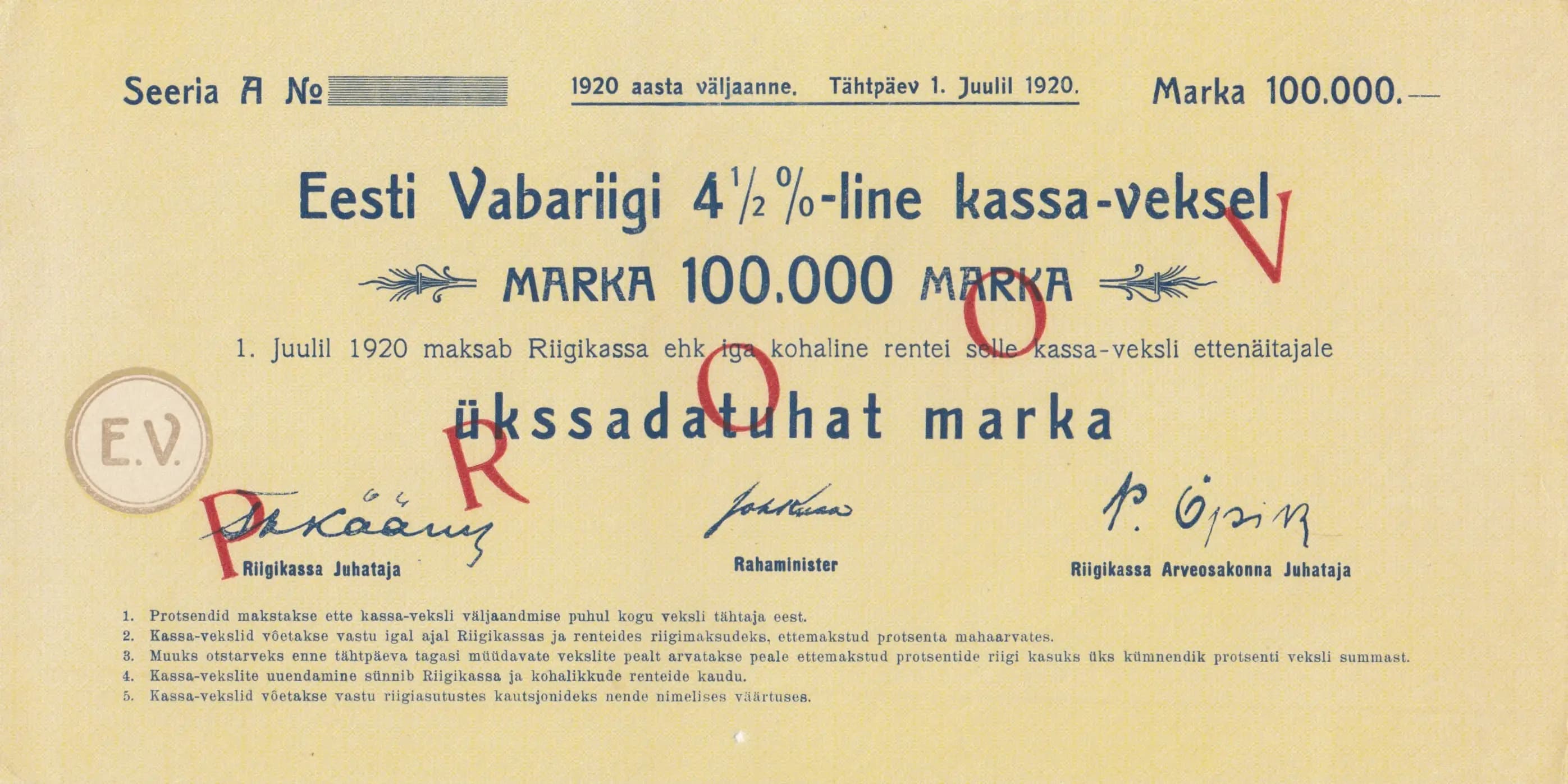
“serie A”
Market Prices
About This Note
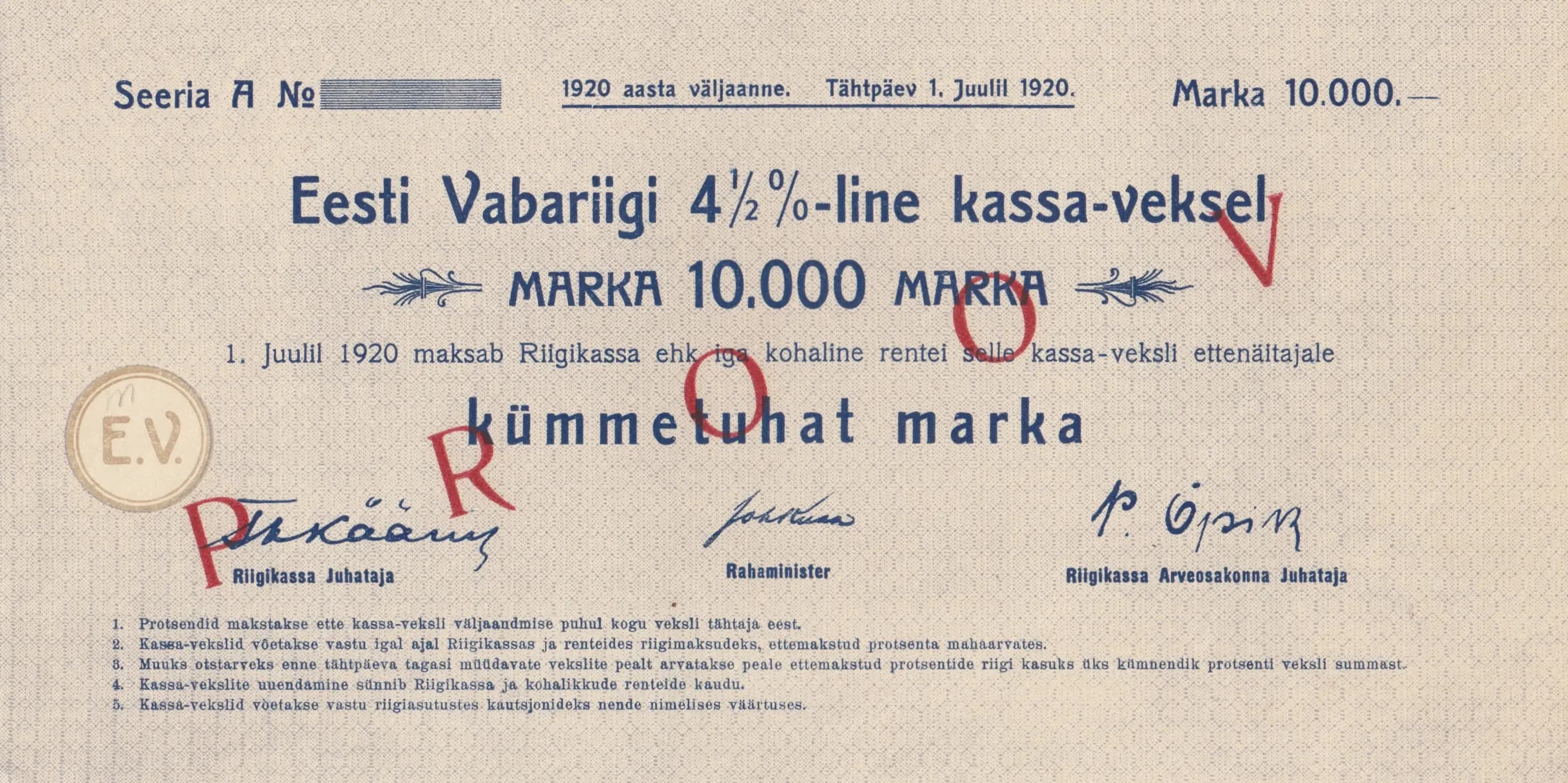
This is an Estonian Republic 100,000 marka treasury note from 1920, graded EF, representing a significant inflationary currency issued during the early period of Estonian independence. The note features a cream/pale yellow background with blue and red printing, including prominent red 'Riks' (State) stamps across the document and an E.V. circular seal, indicating official government authorization. Series A designation and the note's mature appearance with age-appropriate patina make this an important example of post-WWI Baltic monetary history.
common
This 4½% treasury note was issued by the newly independent Estonian Republic on May 1, 1920, just months after Estonia declared independence from Russia in 1918. The note's designation as a 'kassa-veksel' (treasury note or cash voucher) with a maturity date of July 1, 1920, reflects Estonia's immediate financial needs during the consolidation of statehood. The E.V. seal and multiple signature lines for State Treasury Director, Finance Minister, and Accounting Director underscore the official nature of this instrument during a period of economic stabilization in the new nation.
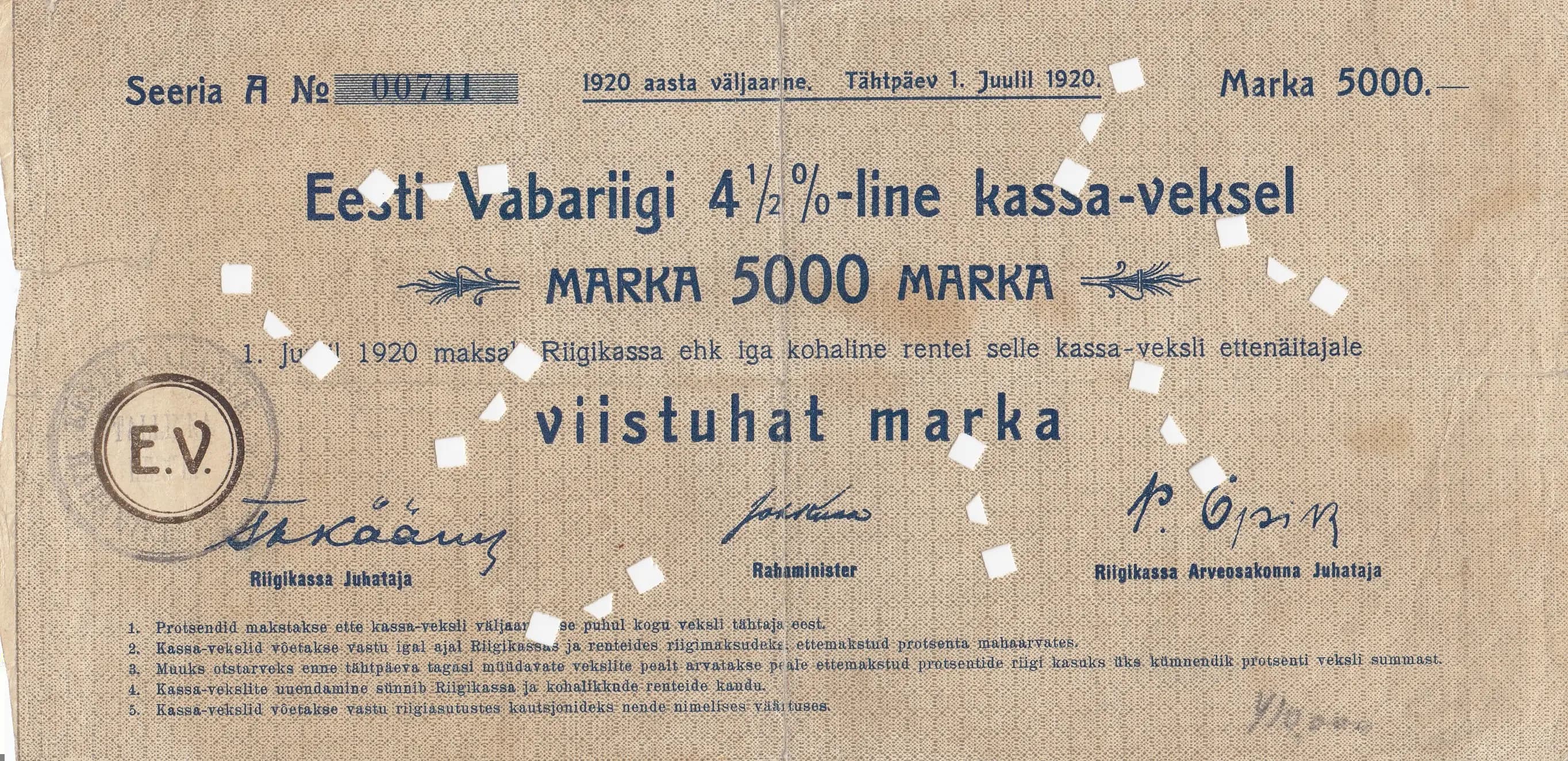
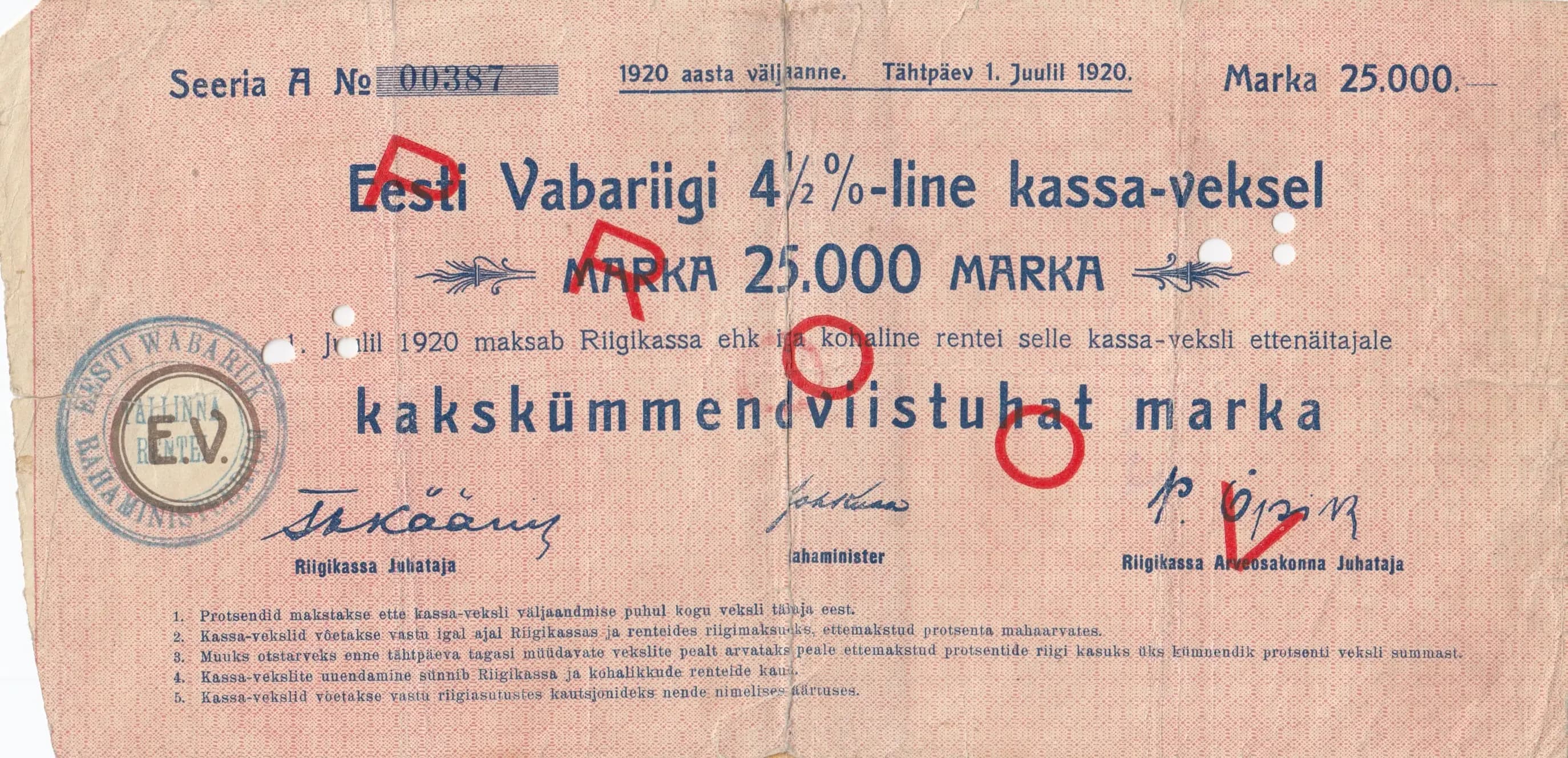
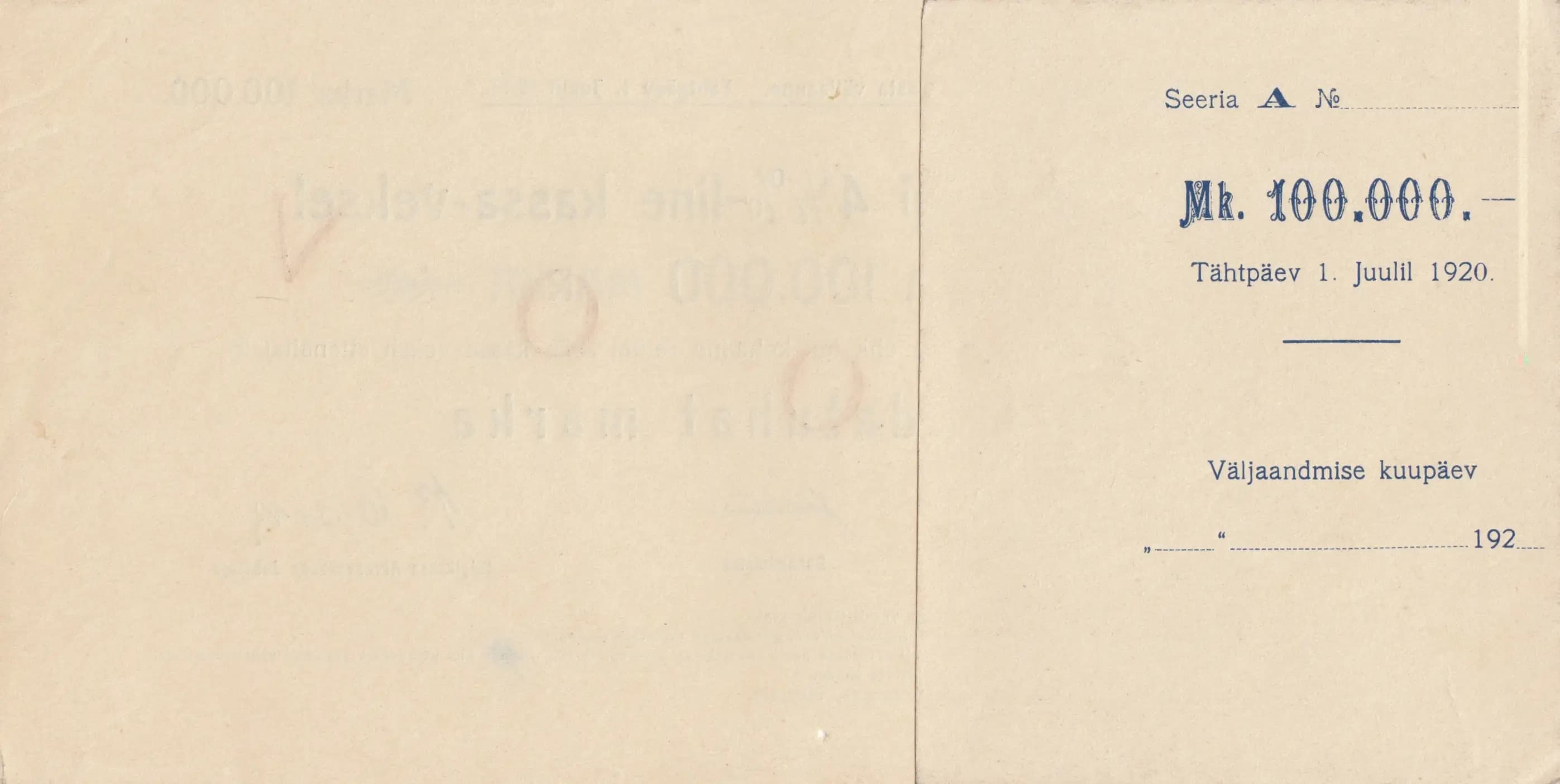
This treasury note employs a minimalist design typical of early 20th-century government financial instruments rather than decorative currency. The front features centered typography with the large denomination 'MARKA 100.000 MARKA' as the dominant element, flanked by decorative floral ornaments. The note includes no portraits, consistent with its function as a treasury note rather than circulating currency. The E.V. (Eesti Vabariik/Estonian Republic) circular seal appears in the bottom left corner as the primary heraldic element. The back is largely blank except for minimal administrative information. The color scheme of cream/pale yellow paper with dark blue and red printing provides clear visual hierarchy, with red 'Riks' stamps applied across the document as security and authorization marks. The extensive text block containing five numbered conditions of use occupies the lower half of the front, reflecting the legal and financial nature of the instrument.
FRONT SIDE: Series A No. / Marka 100,000.— / 1920 edition. Date 1 July 1920. / Eesti Vabariigi 4½%-line kassa-veksel (Estonian Republic 4½% Treasury Note) / MARKA 100.000 MARKA / On 1 July 1920 the State Treasury or any local treasury will pay the bearer of this treasury note one hundred thousand marks / Riks (State) / Petsaary (Treasury) / Riigikaasa Juhataja (State Treasury Director) / Rahaminister (Minister of Finance) / Riigikaasa Arveosaconna Juhataja (State Treasury Accounting Director) / Terms and Conditions: 1. Interest is paid in full at the maturity date of the treasury note upon issue. 2. Treasury notes are accepted at any time at the State Treasury and revenue offices with accrued interest deducted. 3. On treasury notes sold back before maturity, in addition to accrued interest paid by the state, one tenth of one percent of the note's value is deducted. 4. Treasury notes must be renewed at the State Treasury and local revenue offices. 5. Treasury notes are accepted at state institutions as deposits at their nominal value. BACK SIDE: Series A No. / Mk. 100.000.— / Date 1 July 1920. / Issue date / 192 (incomplete year notation)
The note exhibits characteristics of letterpress printing combined with applied stamp impressions. The sharp, clean blue typography and the consistent application of red 'Riks' stamps suggest professional government printing facilities. The cream/pale yellow paper stock and the precise layout of multiple text blocks indicate careful typographic composition. Security features include the red stamps and circular E.V. seal, likely applied through separate stamp presses. No intaglio engraving or security printing by a specialized banknote printer is evident; this reflects the note's status as a temporary financial instrument rather than a standard circulating banknote.
This specimen is identified as series A (Seeria A), as noted in both the visual analysis and catalog data. The Pick catalog number P-38Fs indicates this is the 'specimen' variety. The catalog reference notes variations in color (the external reference mentions a gray variant and references P-38A with orange color), suggesting multiple color varieties exist for this denomination. This particular note's cream/pale yellow background with blue and red printing appears consistent with the gray-toned variant referenced in the catalog notes, distinguishing it from the P-38A orange-colored variety. The maturity date notation (1. Juulii 1920) and series A designation are the primary identifiers for variety classification within this issue.