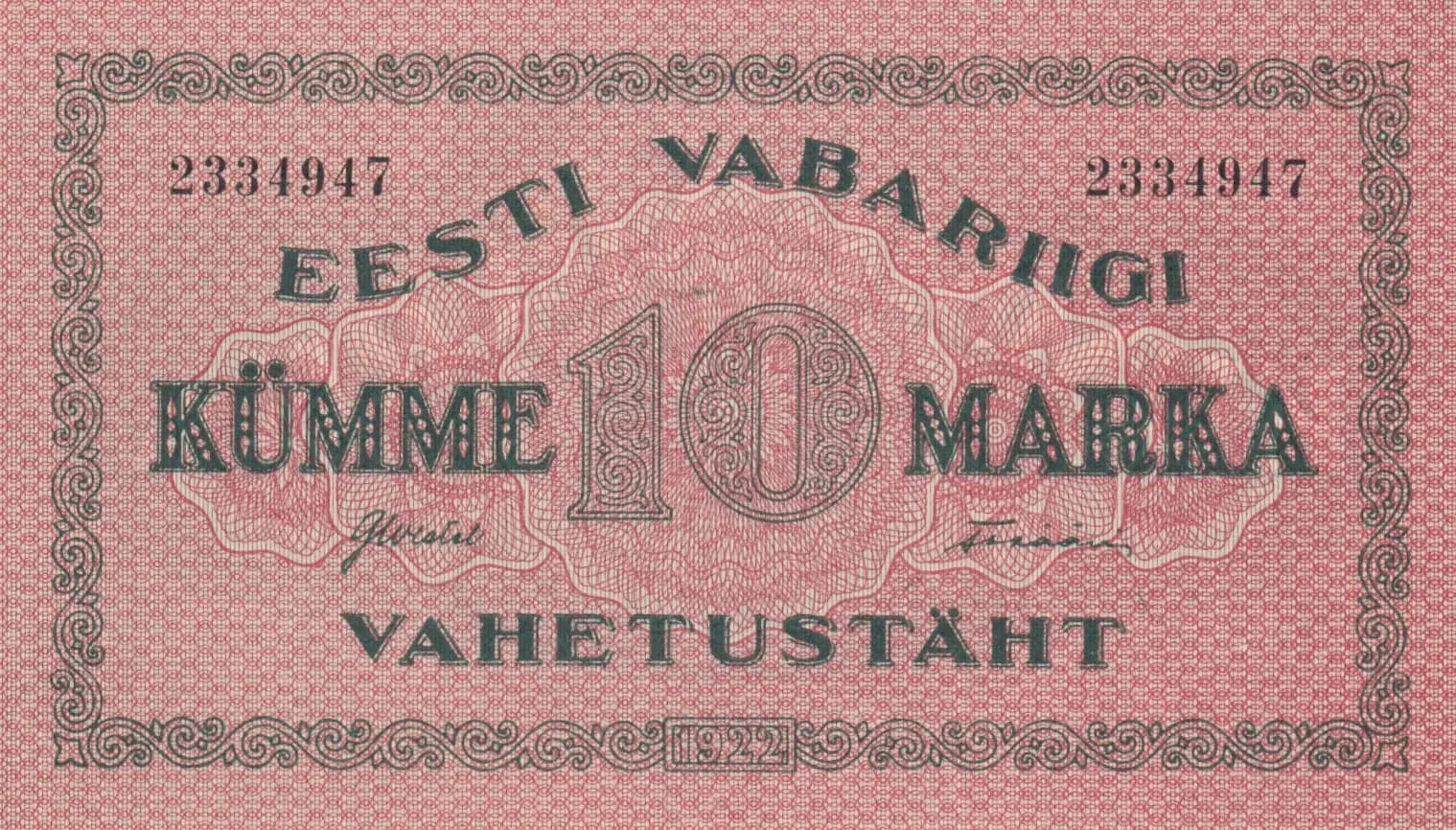
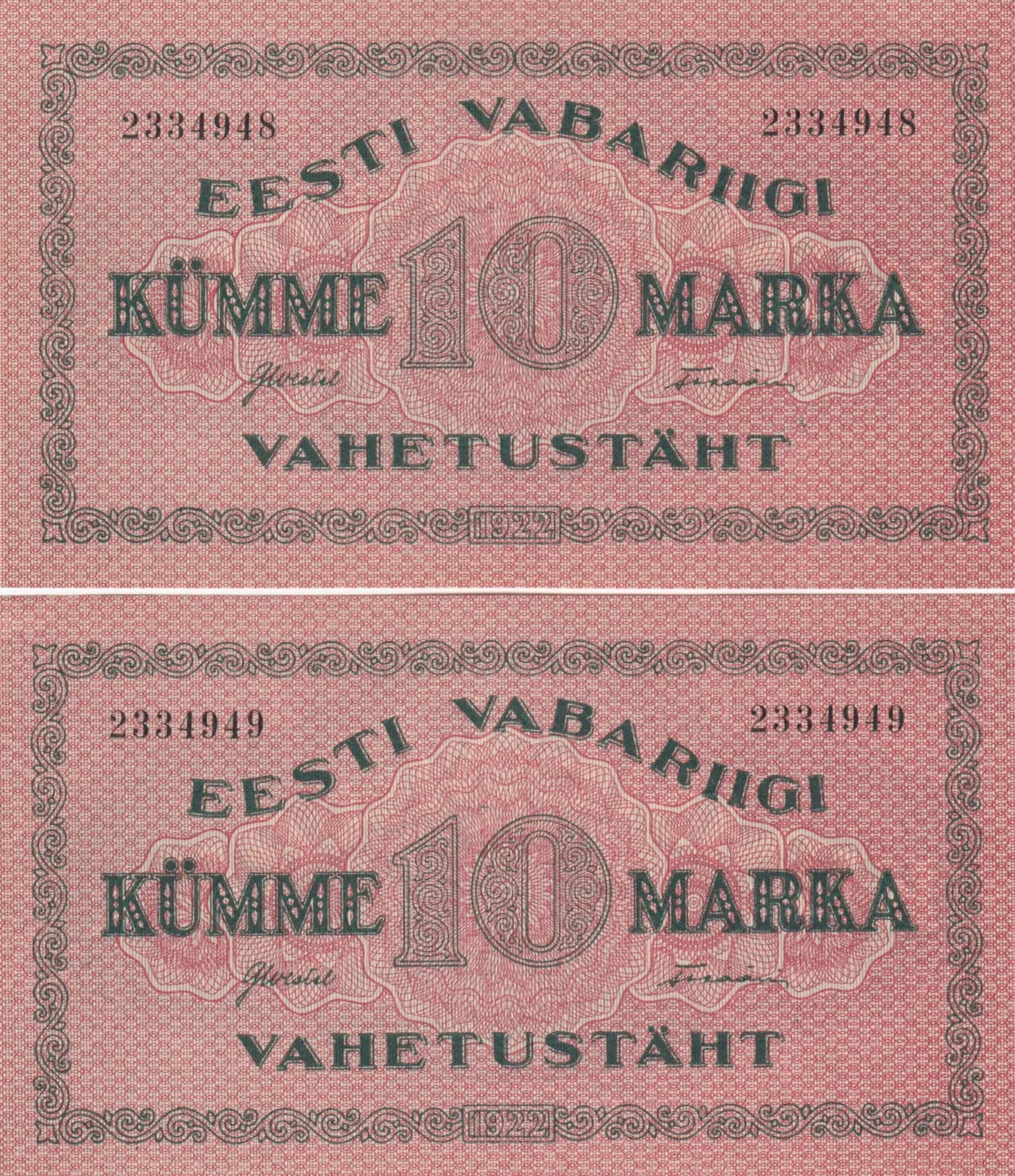
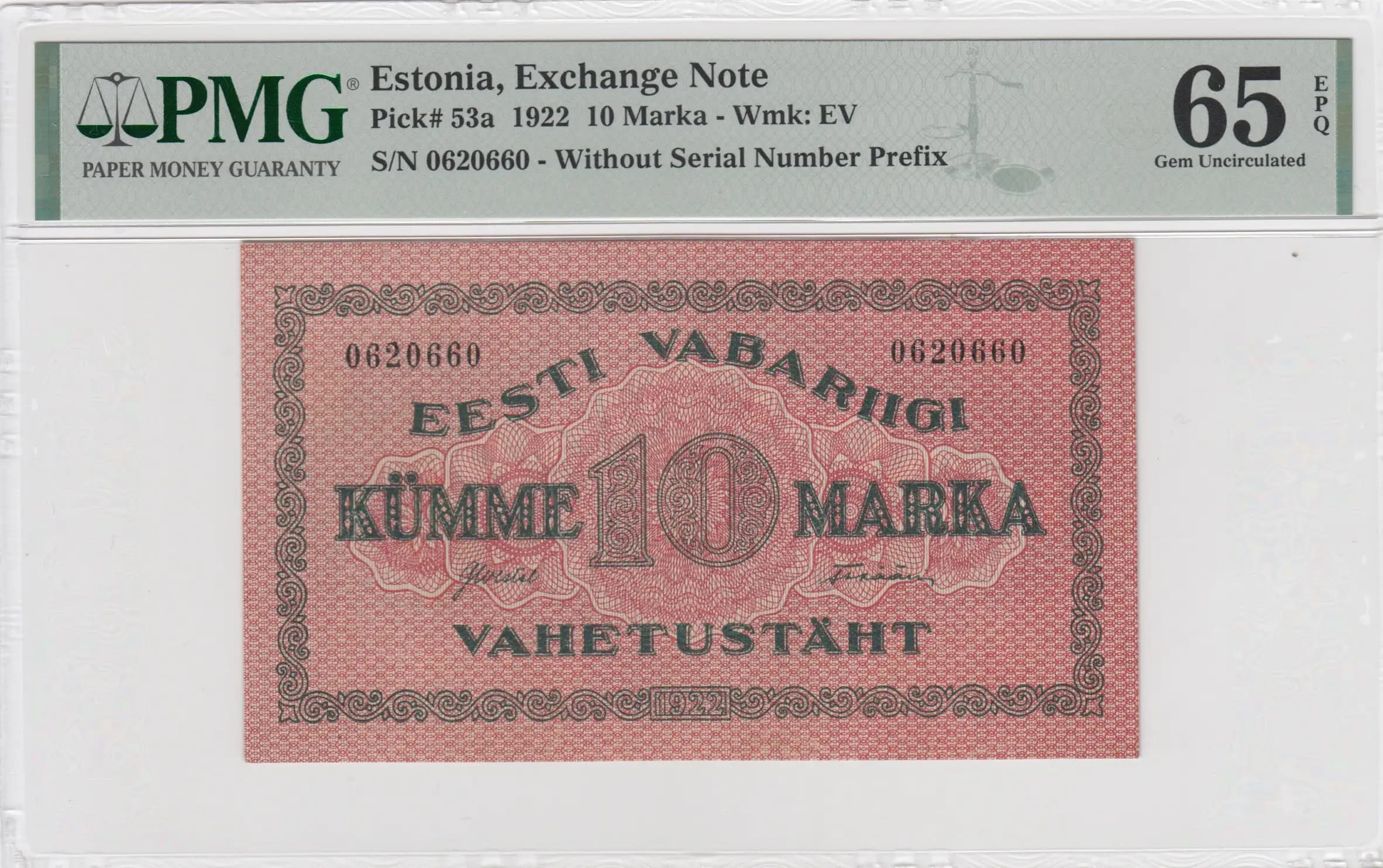
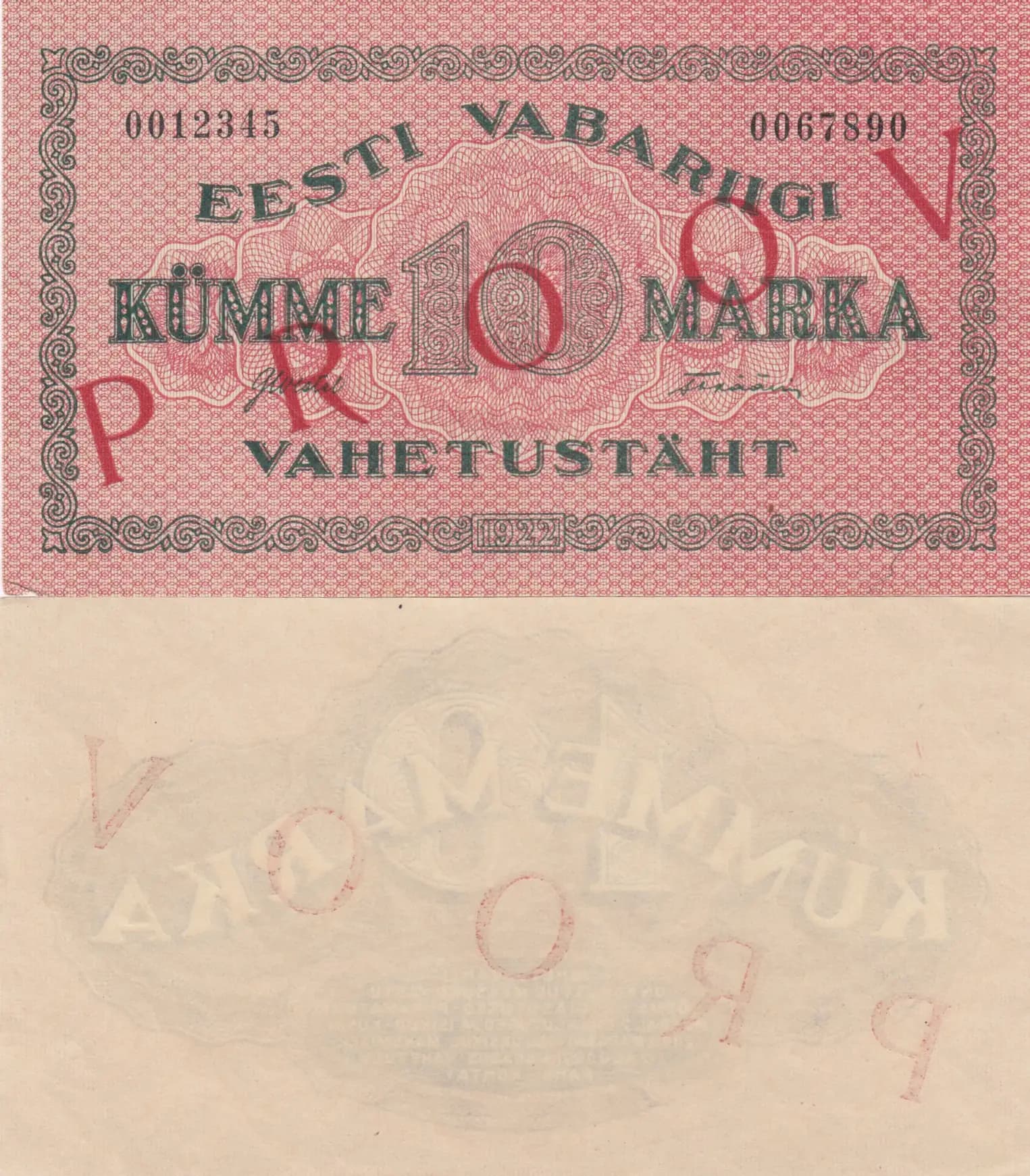
10 marka 1922 pair
Market Prices
1 saleAbout This Note
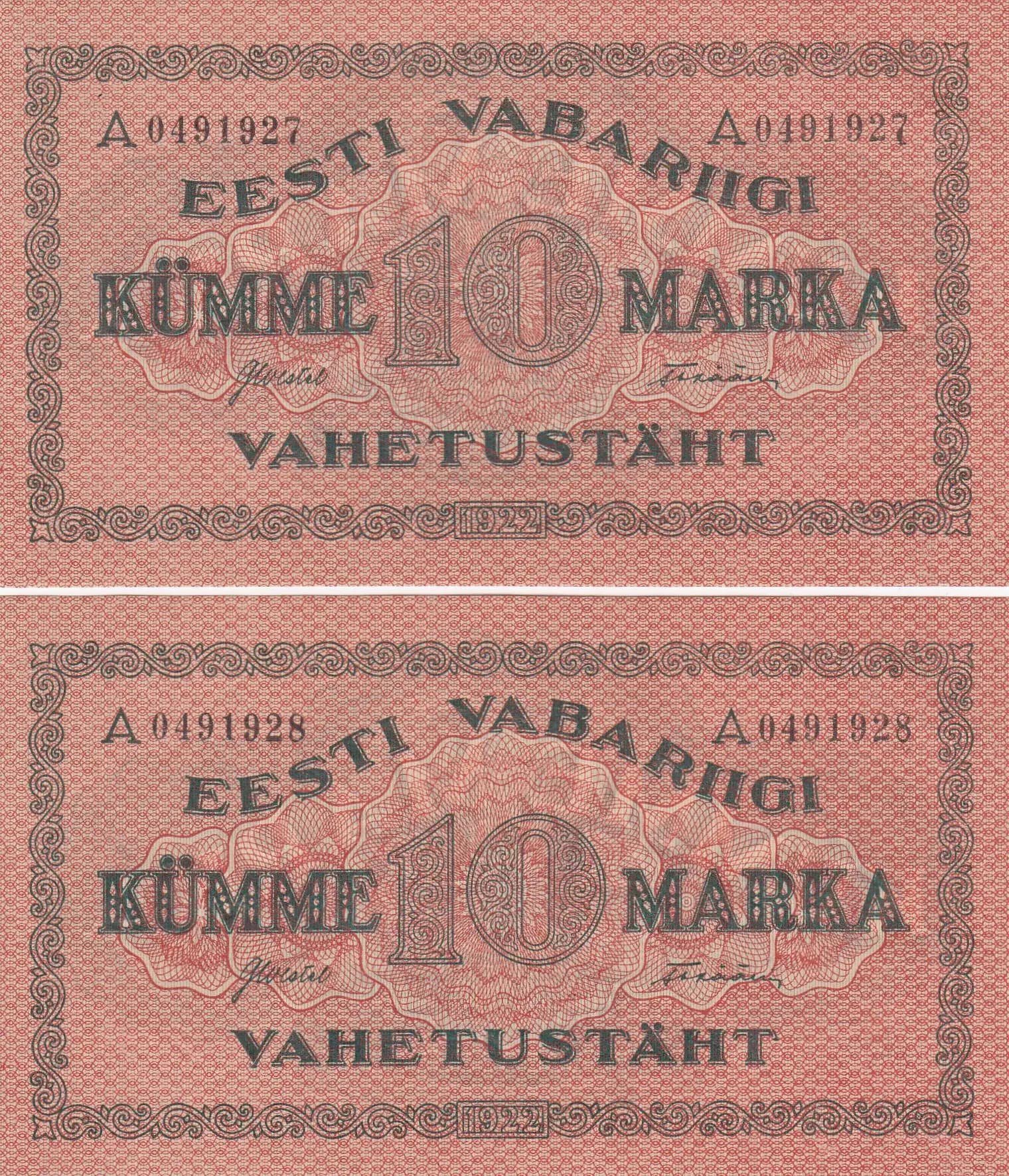
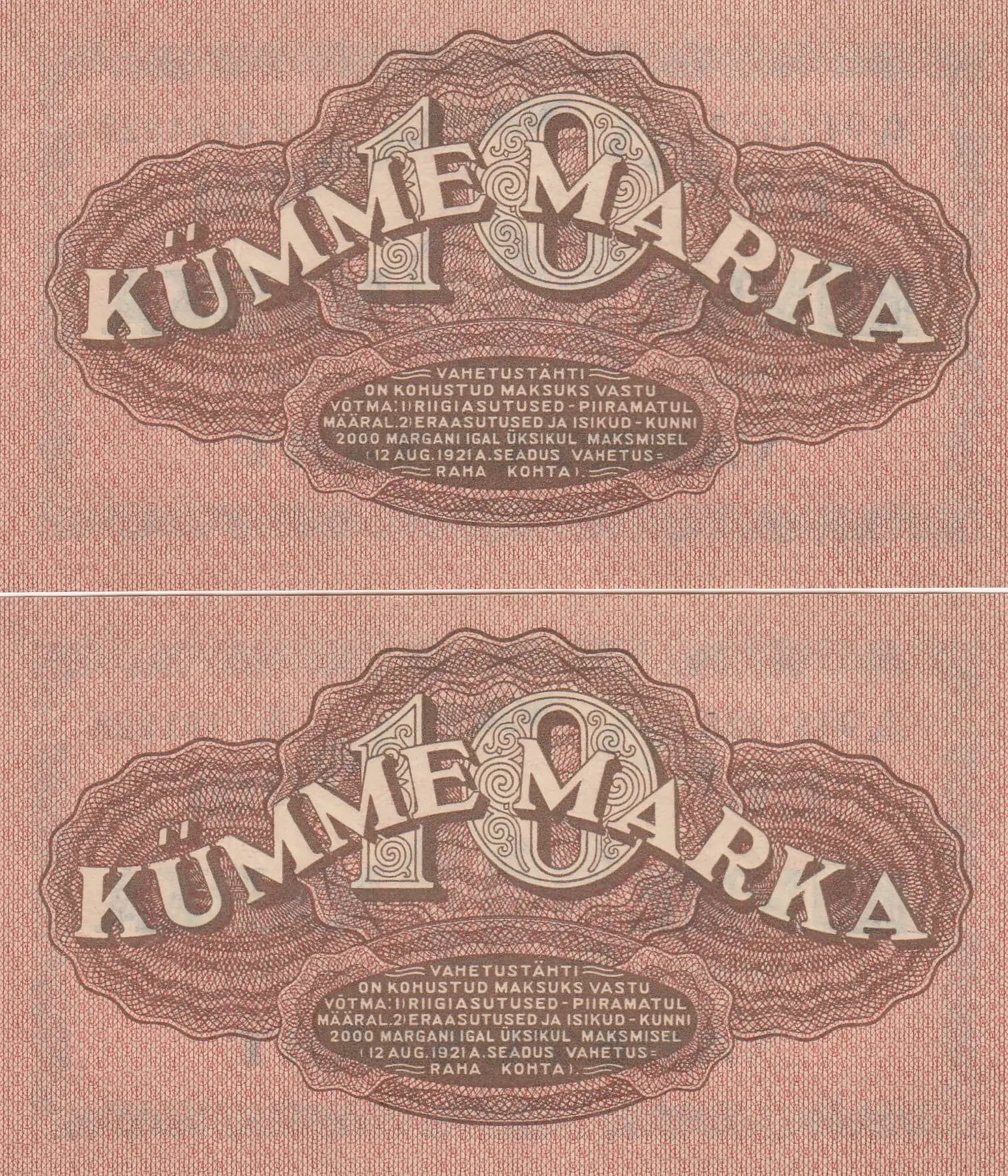
This is an exceptional pair of uncirculated Estonian 10 Marka notes from 1922, representing the early currency of the newly independent Estonian Republic. Both notes display pristine condition with vibrant pink/salmon obverses featuring ornate spiral border patterns and tan/beige reverses with fine vertical engraving, characteristic of high-quality interwar European banknote production. The pair is notable for representing a transitional period in Estonian monetary history, with text emphasizing exchange rights and legal tender status under the August 12, 1921 Exchange Law.
Common. While this is a specific Pick variety (P-53b with square watermark), Estonian 10 Marka notes from 1922 were issued in substantial quantities for their time. The eBay catalog reference shows recent sales of similar examples in EF condition for $54, with UNC catalog values listed at $90 (2016). The availability of recent sales data and the relatively modest pricing indicate active collector circulation and adequate supply. These notes were never recalled and represent standard-issue currency of a major new nation-state, supporting common classification despite their historical interest.
These notes were issued during Estonia's first years of independence following World War I, when the newly formed Estonian Republic needed to establish its own currency system separate from Russian Imperial rubles. The inscriptions referencing 'VAHETUSÕIGUSEGA' (exchange rights) and the specific legal citations reflect the transitional nature of Estonian currency in 1922, when exchange tokens and provisional notes were common as the nation stabilized its monetary system. The ornate design and emphasis on legal authority reflect Estonia's desire to project stability and legitimacy as a new European nation-state.
The obverse features a symmetrical, purely decorative design without portraits or specific landmarks, typical of many early 20th-century European currency notes. The dominant visual element is an ornate cartouche in the center containing the large numeral '10', flanked by the denomination text in Estonian. The entire field is covered with fine spiral and rosette patterns forming an intricate border frame, rendered in gray-green engraving against the pink/salmon background. The reverse employs a similar aesthetic but in tan/beige tones with fine vertical line patterns, featuring a larger ornamental shield-style cartouche containing the denomination and legal text. This design approach emphasized security through decorative complexity rather than portraits, reflecting the note's character as a temporary exchange instrument rather than a standard long-term currency note.
OBVERSE (Front): 'EESTI VABARIIGI' (Estonian Republic) — top center; 'KÜMME MARKA' (Ten Marks) — center denomination; 'VAHETUSÕIGUSEGA' (With exchange rights) — lower section; '1922' — year of issue; Serial numbers visible in corners (A0491927 and A0491928 respectively for the pair). REVERSE (Back): 'KUMME MARKA' (Ten Marks) — center; 'VAHETUSTÄHTI' (Exchange tokens/notes) — center designation; 'ON KOHUSTUD MAKSUK VASTU' (Is obligatory for payment) — legal declaration; '12 AUG.1921.A SEADUS VAHETUS' (August 12, 1921 Exchange Law) — legislative reference; Additional text relating to validity period and payment specifications for authorized institutions.
Intaglio (engraved) printing, characterized by the fine line patterns, ornate spiral designs, and sharp detail visible throughout both sides. The complex rosette elements, cartouche borders, and background patterns are consistent with high-quality engraved security printing typical of European currency printers of the early 1920s. The distinct color separation between obverse (pink/salmon with gray-green) and reverse (tan/beige with brown tones) indicates multi-plate intaglio production.
This lot represents P-53b, identified by the square watermark pattern, distinguishing it from P-53a (which features 'EV' watermark). The pair shows consecutive serial numbers (A0491927 and A0491928), both in Series A. The visual analysis confirms the characteristic pink/salmon obverse and tan/beige reverse coloration consistent with cataloged P-53b specifications. The text variants between the two notes ('VAHETUSÕIGUSEGA' vs 'VAHETUSTÄHTI') may represent minor printing run differences but both are consistent with the P-53b variety classification.