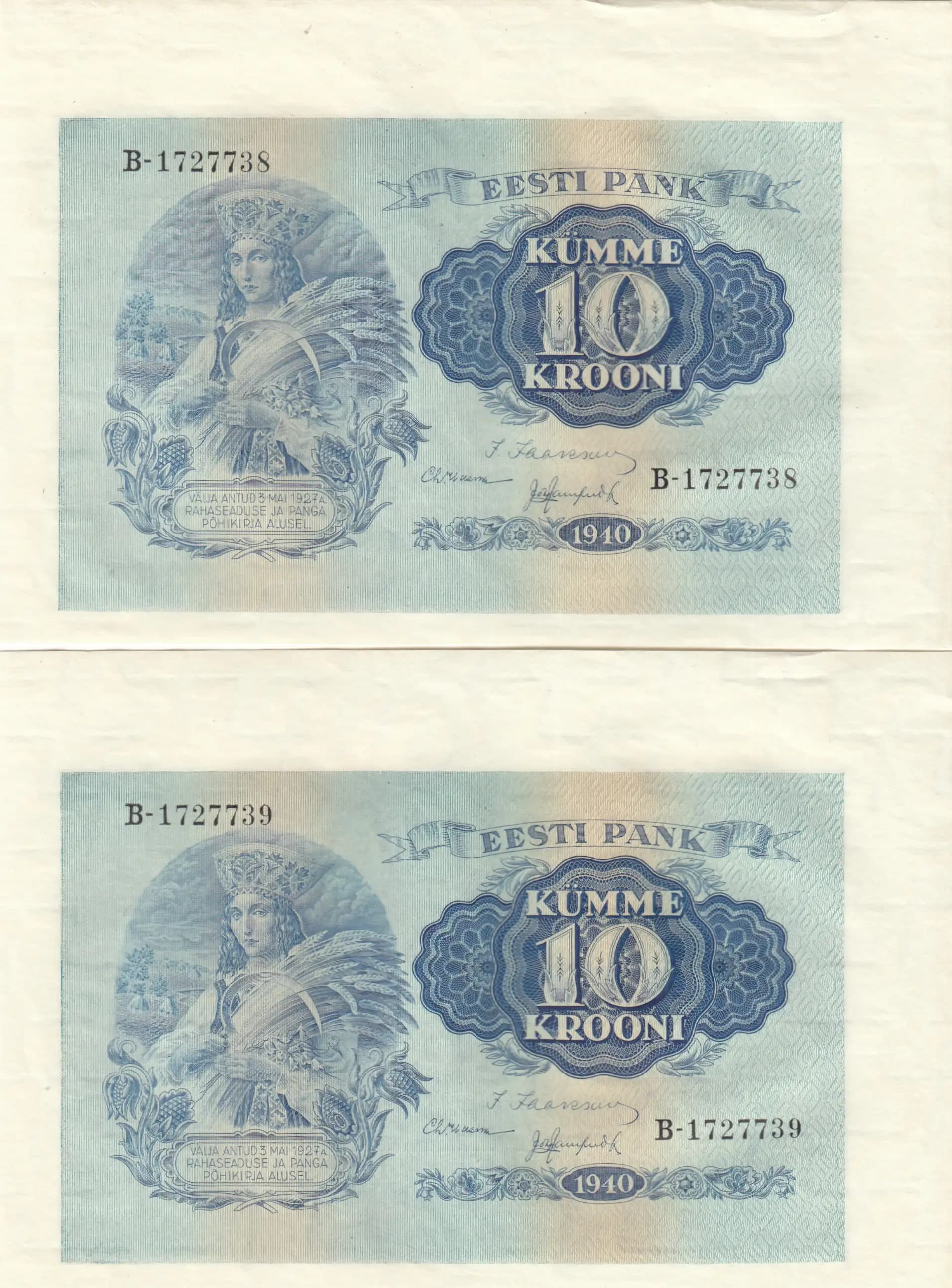
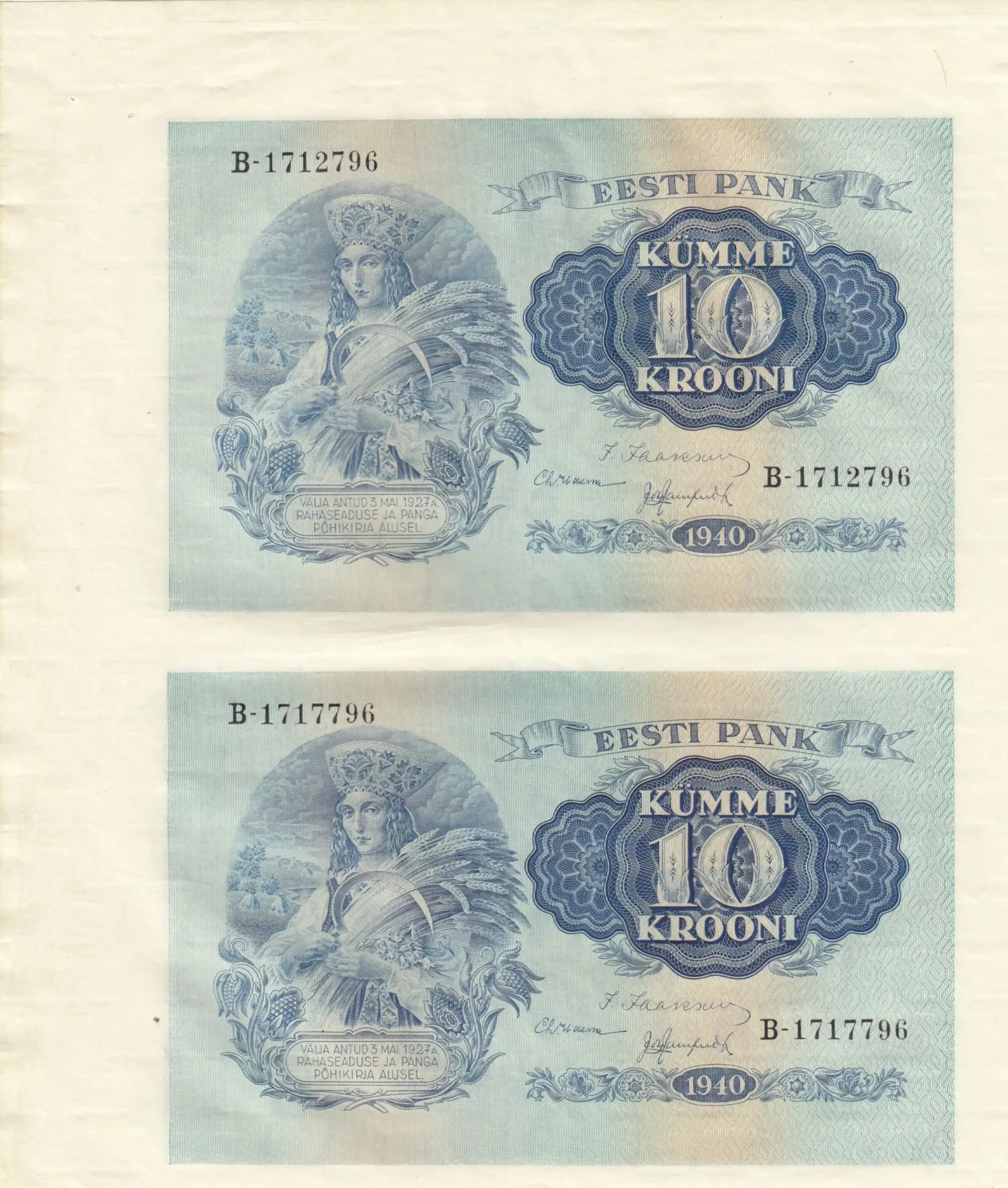
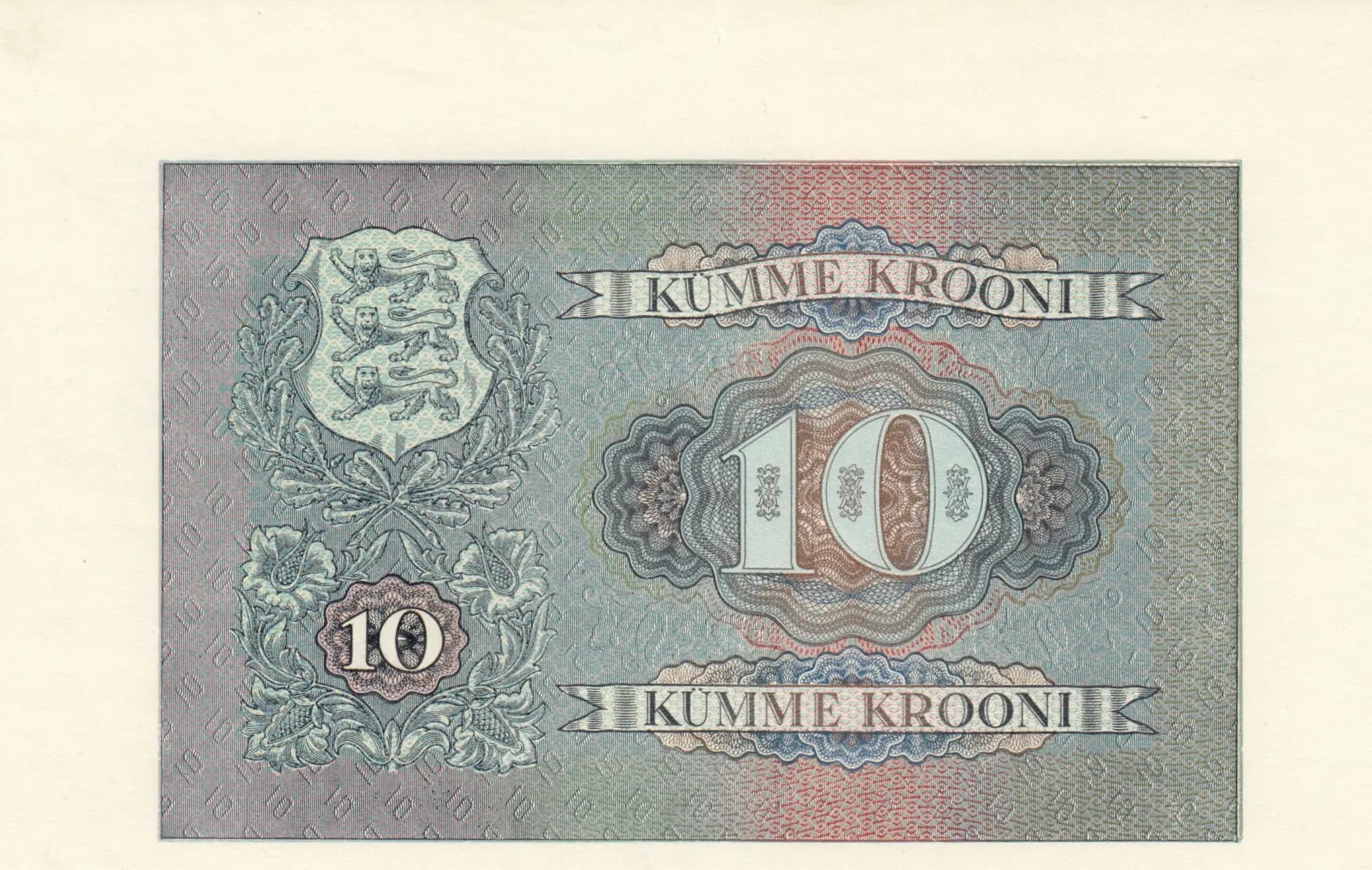
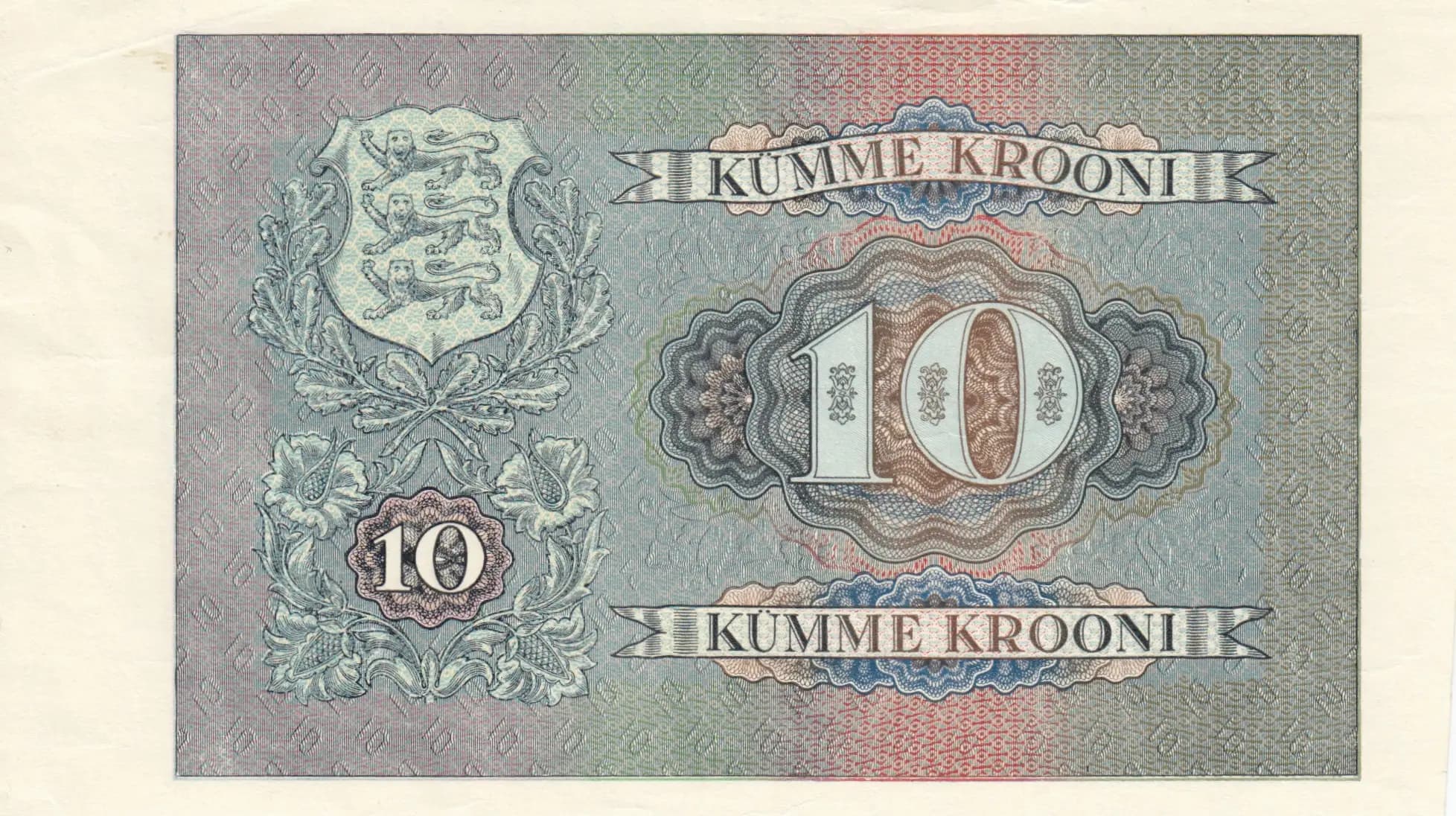
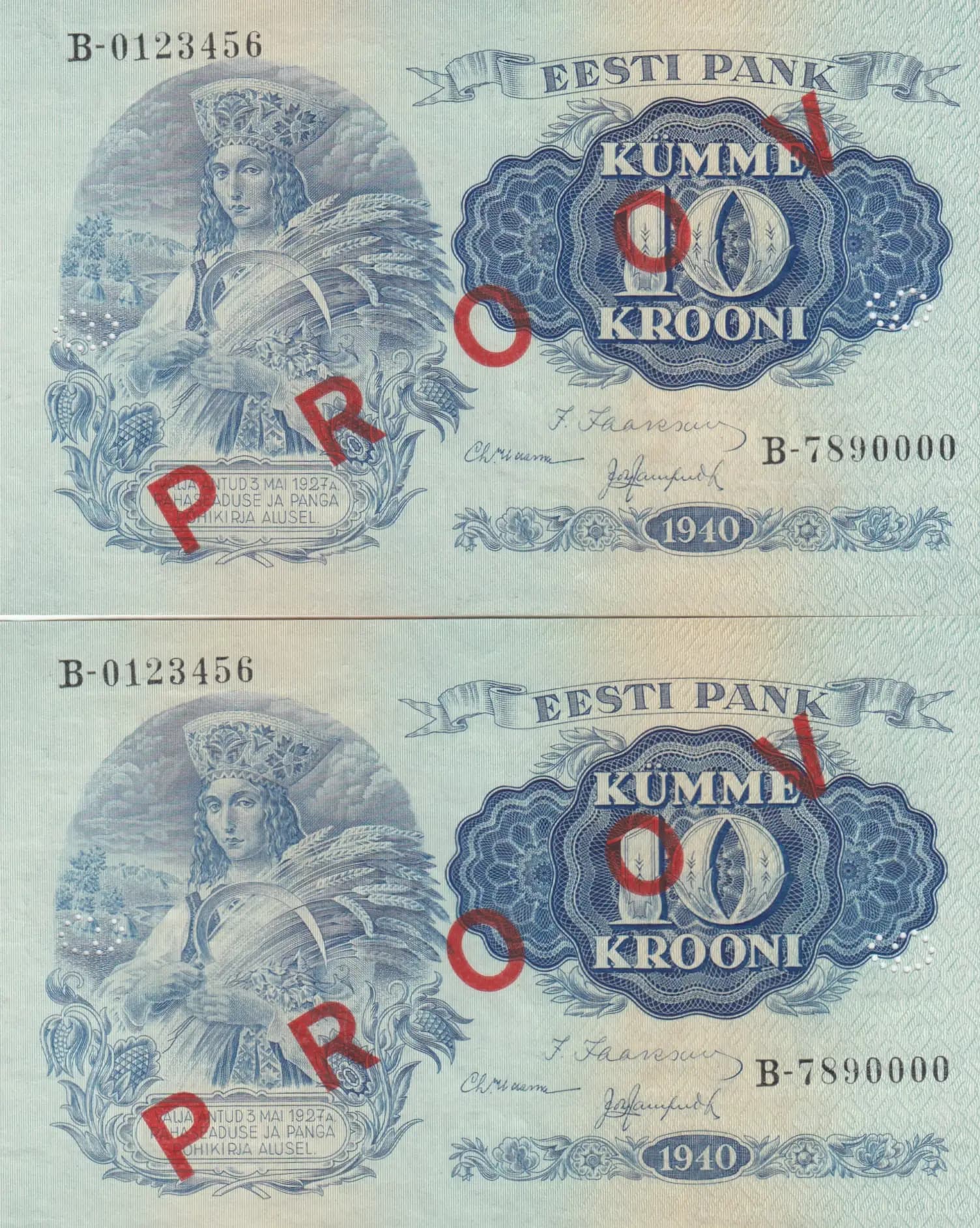
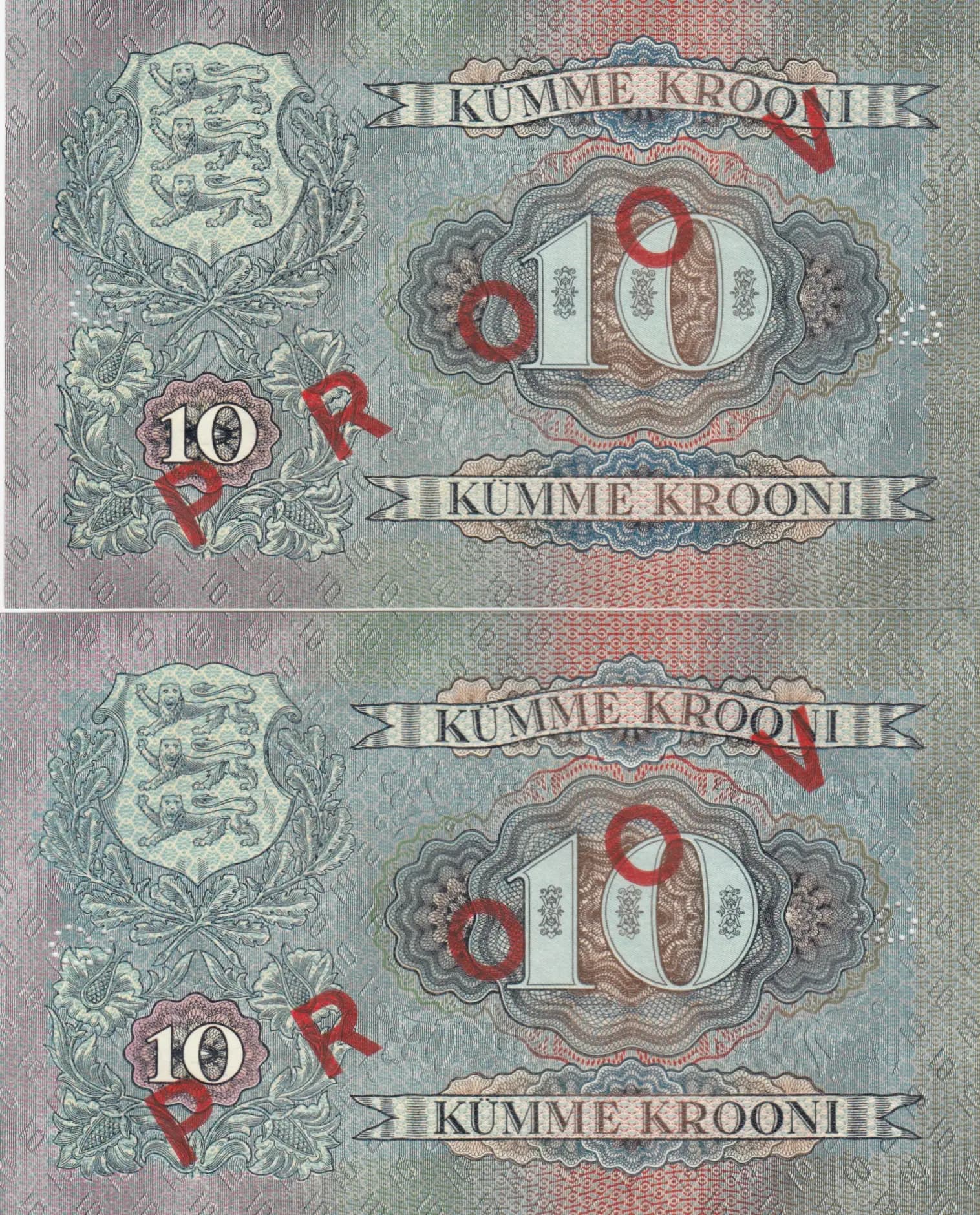
10 krooni 1940 specimen's pair
“#9”
Market Prices
1 saleAbout This Note
This is an exceptional unissued specimen pair of the Estonian 10 krooni banknote from 1940, graded in uncirculated condition. The notes feature striking Art Deco design work with a female figure in traditional Estonian dress on the obverse and the national coat of arms on the reverse, both prominently overprinted in red with 'SPECIMEN'. The pristine condition, complete absence of wear, and specimen designation make this a desirable example for collectors of interwar Estonian currency.
Scarce. While the base design (P-68) saw limited circulation due to the 1940 Soviet occupation interrupting normal distribution, specimen pairs are particularly uncommon. The catalog value of $500 UNC (2016) and eBay record of $88.32 (2009, likely a lower-grade example or single note) indicate these are above-common pieces. However, specimens were produced in small quantities and survival rates for unissued notes from this period are variable. Unissued status, specimen overprint, and the historical significance of Estonia's final independent issue all contribute to scarcity.
The 1940 10 krooni represents the final design series issued by Eesti Pank during Estonia's period of independence (1918-1940), before the Soviet occupation in June 1940. The iconography—featuring a woman in traditional kokoshnik headdress and wheat sheaves—reflects Estonian national identity and agricultural heritage during the interwar republic. The note's unissued status and specimen overprint indicate it was produced for presentation and archival purposes rather than circulation, making it a rare surviving artifact of Estonia's brief era as an independent nation.
The obverse depicts a personified female figure representing Estonia (likely 'Maarjamaa' or a similar national allegory), wearing an ornate kokoshnik—a traditional Estonian headdress—with elaborate crown-like metalwork and long flowing hair. She is dressed in traditional garments adorned with wheat and grain sheaves, symbolizing agricultural prosperity and national identity. The reverse features the official Estonian coat of arms—three lions arranged in a shield within an ornamental laurel wreath—positioned prominently to the left of a large ornate numeral '10' in a decorative cartouche. Both sides employ fine guilloché patterning and complex engraved ornamental frames in blue and white, with beige and tan tonal variations. The red 'SPECIMEN' overprint appears diagonally across both sides.
FRONT: 'EESTI PANK' (Estonian Bank); 'KUMME KROONI' (Ten Krooni); '1940' (year of issue); 'B-0123456' and 'B-7890000' (specimen serial numbers); 'SPECIMEN' (English overprint); 'TÜD 3 MAI 1927.A DUSE JA PANGA HIKIRJA AIUSEL' (By decree of May 3, 1927 of the Bank and State Seal Act); signatures in cursive. BACK: 'KUMME KROONI' (Ten Krooni); '10' (denomination numeral); 'SPECIMEN' (English overprint).
Intaglio (engraved) printing on banknote paper. The note exhibits characteristic features of high-security intaglio work including fine line engraving, complex guilloché background patterns, multiple tonal gradations achieved through varied line density, and ornate decorative frames. The precision of the fine lines and the depth of the design elements visible in the specimen indicate production by a professional security printer, likely Waterlow & Sons or De La Rue, which handled much of Estonia's banknote production during this period. The specimen overprint in red represents a separate security feature applied post-production.
This note corresponds to Pick P-68s (specimen variant). The catalog notes identify P-68a (unissued) and P-68p1 (full color print) as documented variants. This example, bearing the red 'SPECIMEN' overprint and displaying complete design elements in blue, white, and multi-color printing, represents the standard specimen production. The serial numbers visible (B-0123456 and B-7890000) are consistent with specimen issue numbering practices. No signature variations or printing differences are evident that would indicate a distinct sub-variety.