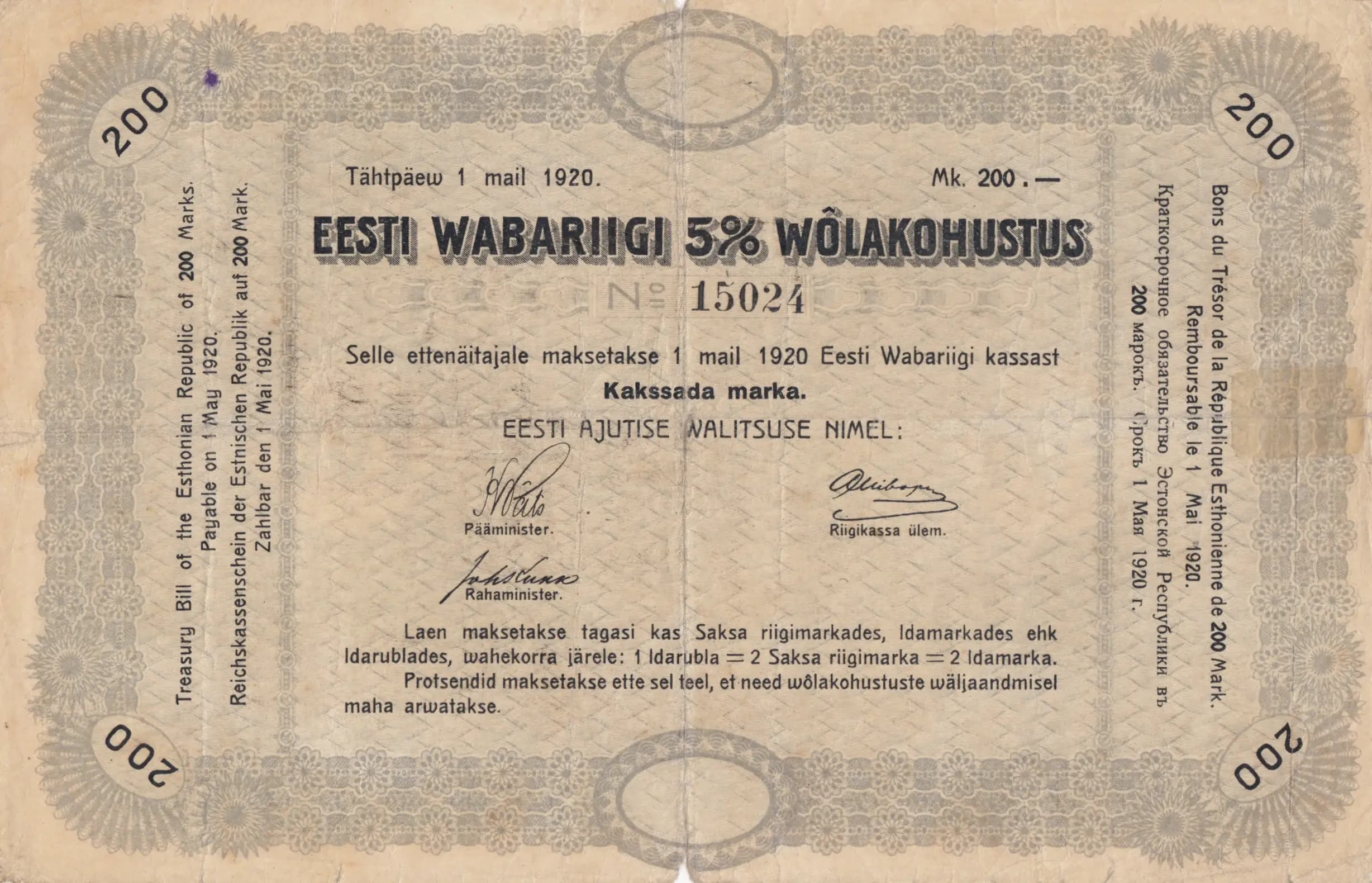
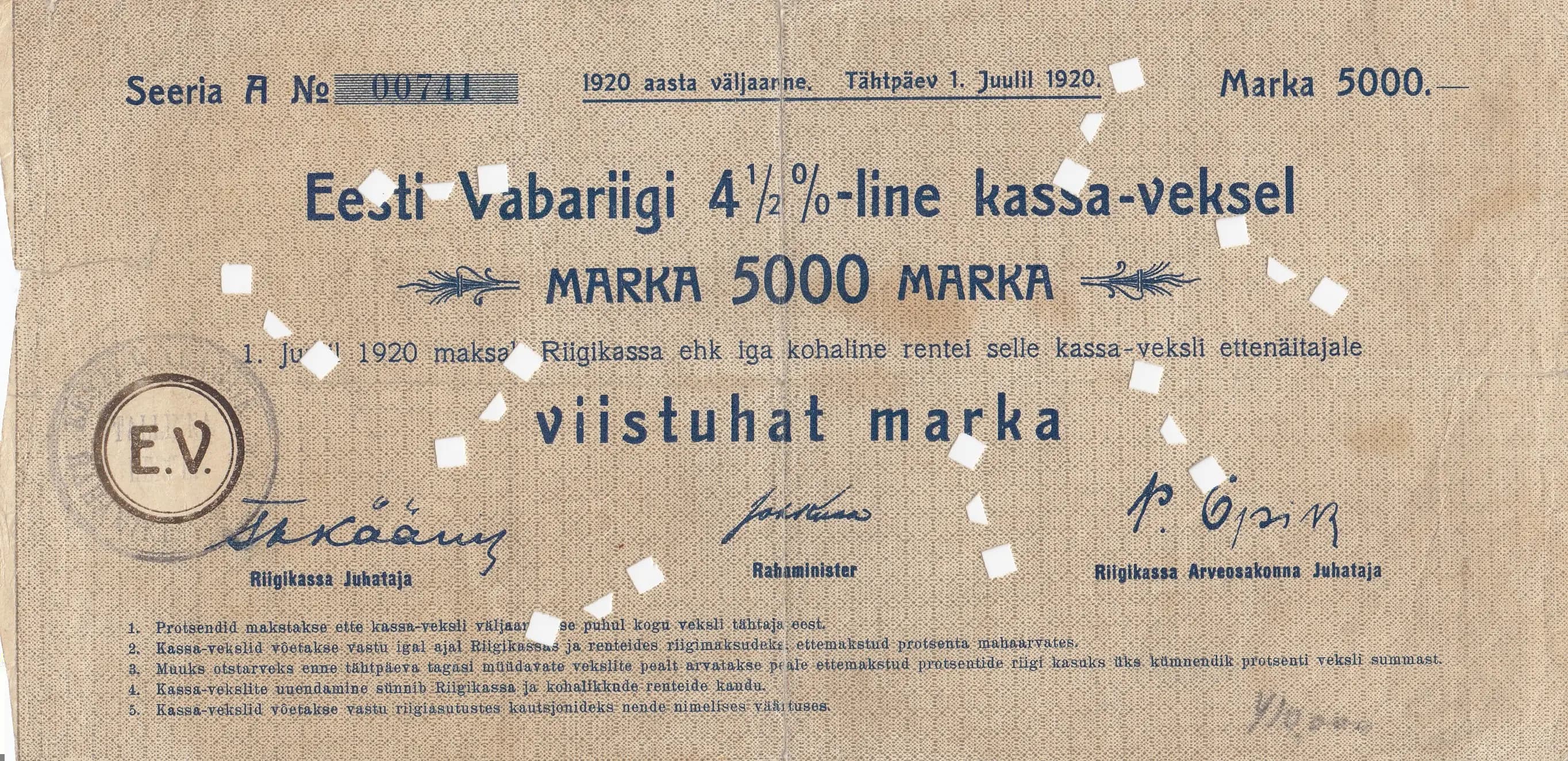
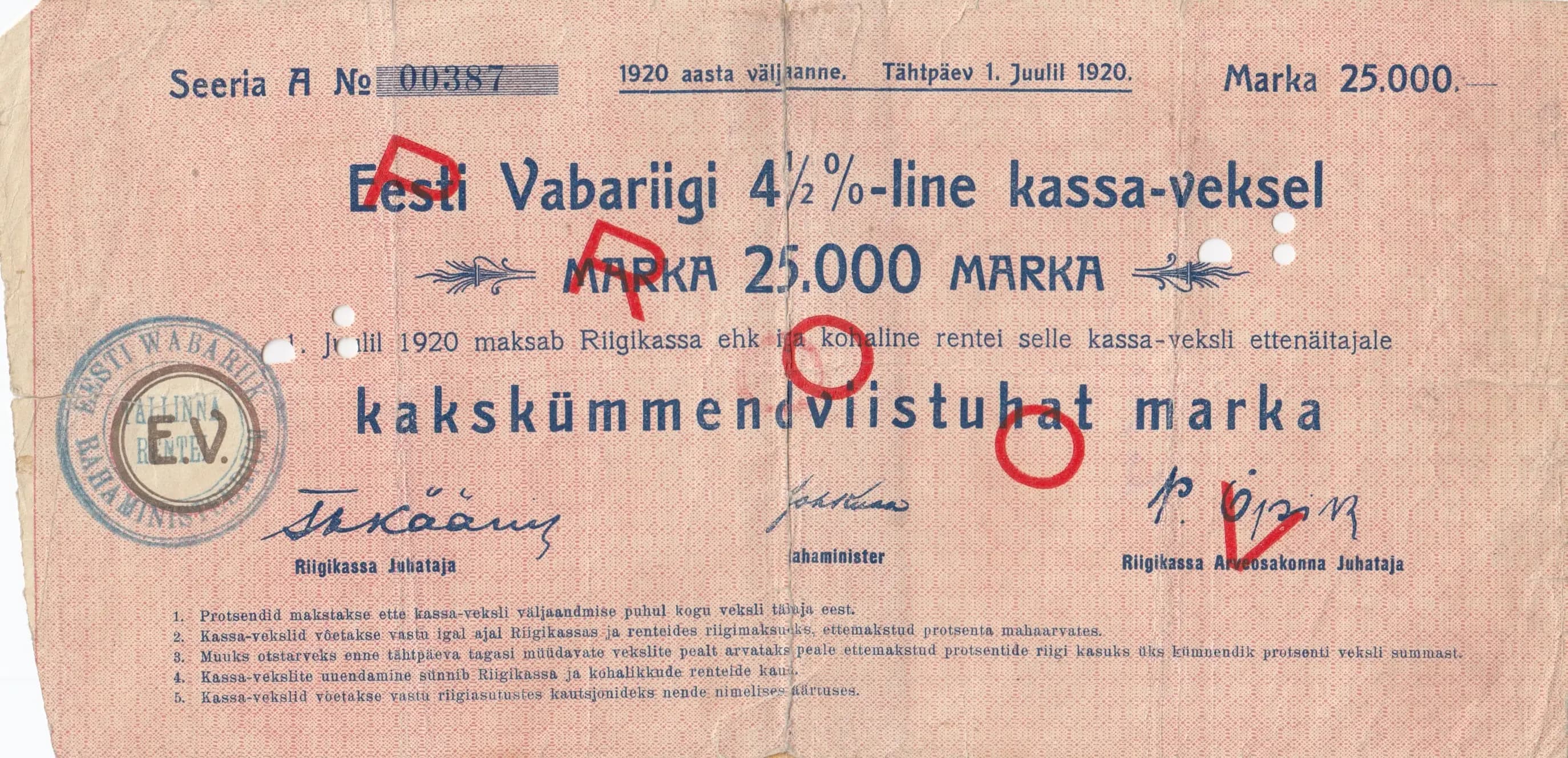
10 000 marka 1920
“serie E”
Market Prices
About This Note
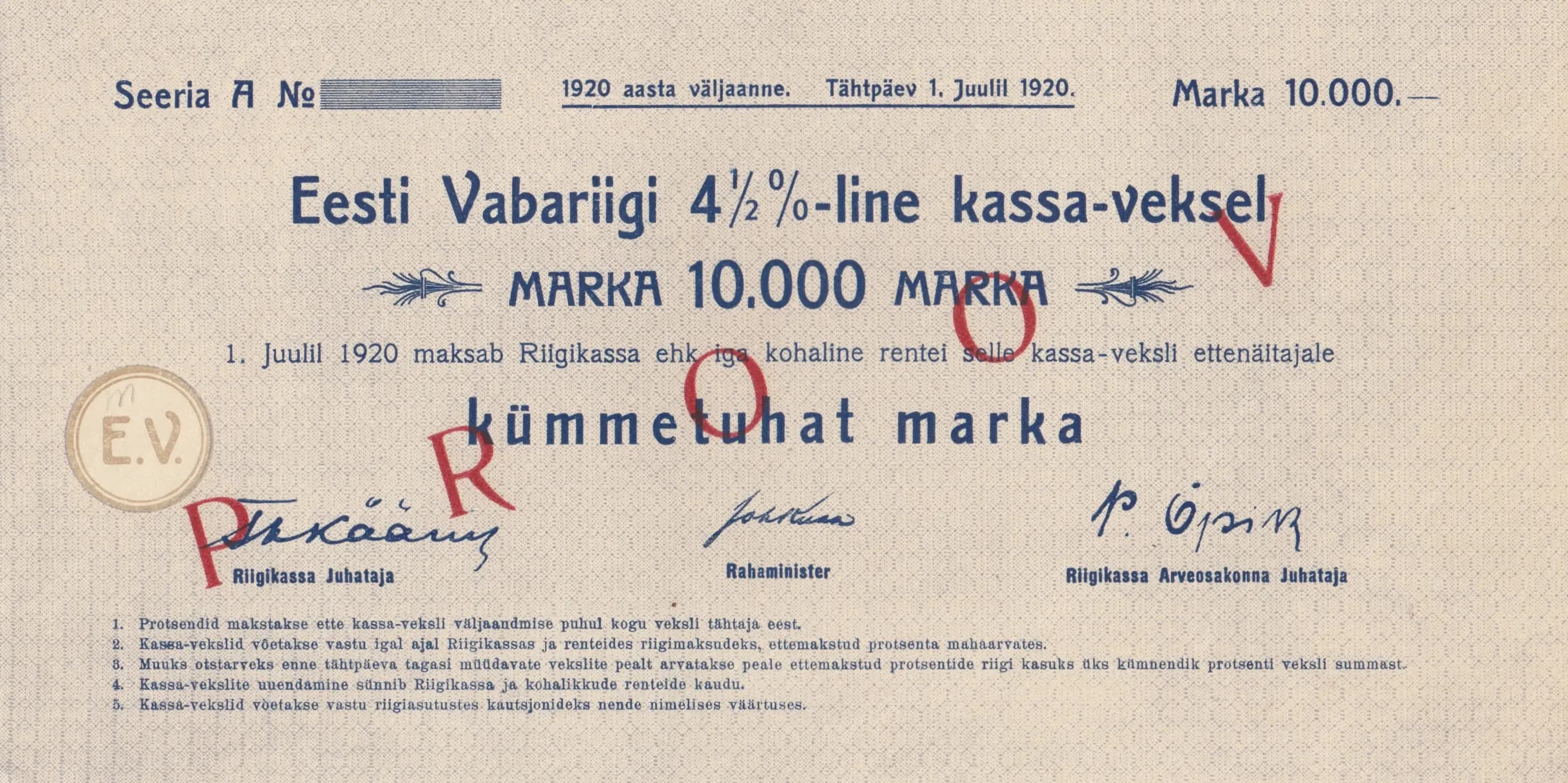
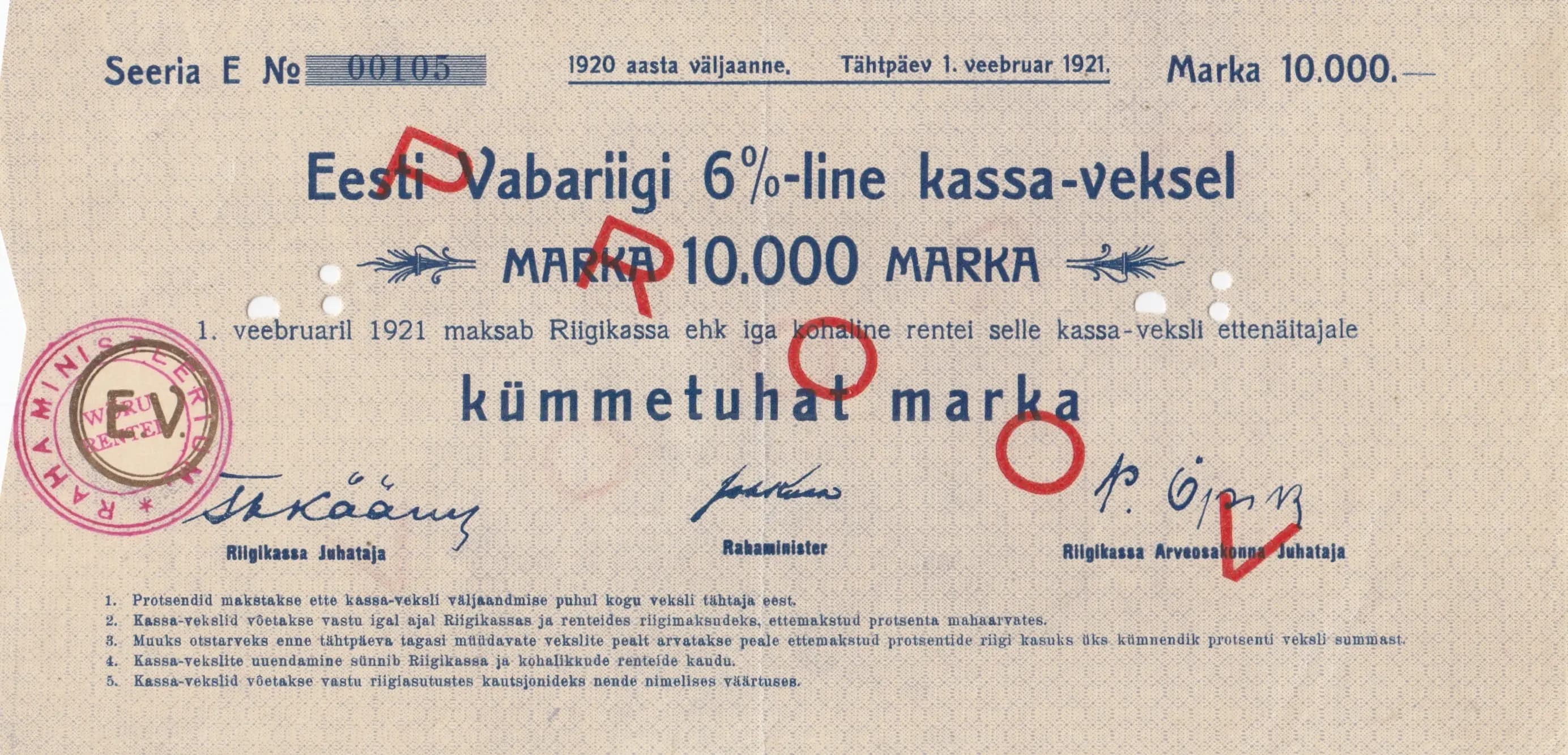
This is a 10,000 Marka Estonian Republic Treasury Bill (Kassa-veksel) from 1920, Pick P-38Ss, graded VF with Series E designation. The note is printed in tan/beige with blue and red text, featuring official government seals, multiple signatures from Treasury officials, and importantly displays 'PROOF' markings on the reverse and red administrative annotations throughout—indicating this is a specimen or proof note used for internal government purposes rather than general circulation. The presence of archival punch holes and heavy red pen markings, combined with the specimen designation, makes this an interesting historical artifact documenting Estonia's early post-independence financial instruments.
Common. The eBay price data provided shows highly variable pricing ($9.00 to $450.00 USD), which is typical of specimen and proof notes where individual examples vary significantly in desirability and condition. However, the VF-graded specimens are trading in the $54.90-$245.00 range, indicating reasonable availability. Treasury bills were issued in substantial quantities for government operations, and this particular Pick number (P-38) shows multiple variants catalogued by PMG, suggesting adequate circulation among collectors. The specimen designation and administrative markings make this variety somewhat more specialized, but the denomination and year are not noted as particularly scarce by major catalogs. Most surviving examples appear to be in institutional or serious collector hands given the archival nature of the markings.
This treasury bill was issued in 1920, during Estonia's critical early years of independence following the Russian Revolution and the Estonian War of Independence (1918-1920). The note's designation as a 6% treasury bill (Eesti Vabariigi 6%-line kassa-veksel) with a maturity date of February 1, 1921, reflects the new Estonian Republic's efforts to stabilize its finances and establish credit instruments. The official seals and multilingual administrative text demonstrate the government's formal institutional structures being established during this foundational period of the Estonian state.
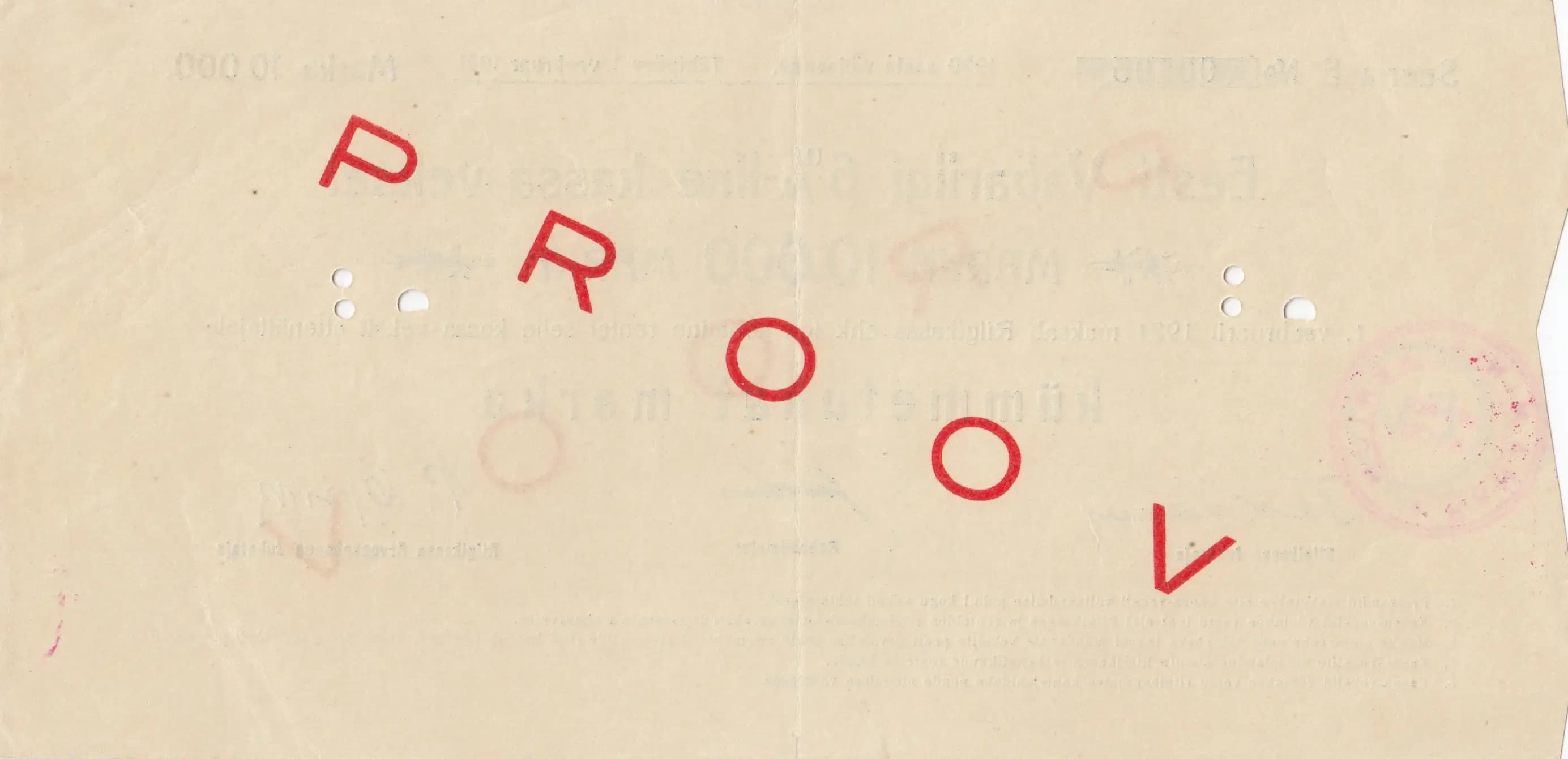
This Estonian Treasury Bill features a formal government document layout typical of early 20th-century financial instruments. The front displays the denomination prominently in both numeral (10.000) and word form (kümmetuhat marka), with the official seal of the Estonian Republic rendered as a pink/red circular stamp on the left side. The document is divided into distinct sections: the main redemption promise at top, terms and conditions enumerated at bottom in smaller text, and signature blocks for three Treasury officials positioned centrally. The color scheme of tan/beige background with blue and red printing was characteristic of period printing technology. The reverse is deliberately blank except for archival markings, consistent with specimen note preparation. The heavy red pen markings throughout—circles, underlines, and administrative annotations—indicate this was a proof or specimen note marked for official review and filing rather than intended for circulation.
FRONT: Principal Inscription: 'Eesti Vabariigi 6%-line kassa-veksel' (Estonian Republic 6% treasury bill) and 'Marka 10.000—' (10,000 Marka). Issue Details: 'Seeria E № 00105' (Series E No. 00105), '1920 aasta väljaanne. Tähtpäev 1. veebruar 1921.' (1920 year issue. Due date February 1, 1921), and 'kümmetuhat marka' (ten thousand marka). Redemption Clause: '1. veebruaril 1921 maksab Riigikassa ehk iga omanaine rentei selle kassa-veksli ettenäitajale' (On February 1, 1921, the State Treasury or any owner of interest will pay this treasury bill to the bearer). Official Signatories: 'Riigikassa Juhataja' (State Treasury Director), 'Rahandusminister' (Minister of Finance), and 'Riigikassa Arveosaojuhataja' (State Treasury Accounts Manager). Terms and Conditions (5 numbered clauses): (1) Interest paid in advance for entire bill period at issuance; (2) Bills accepted at State Treasury and tax offices for tax payments with advance interest deducted; (3) For resale before maturity, additional 0.1% per annum charged beyond prepaid interest; (4) Bills accepted as payment at government institutions and local tax offices; (5) Bills accepted as collateral in government institutions at nominal values. REVERSE: 'PROOF' or similar administrative marking in red handwriting (P R O O V arrangement).
Letterpress printing on bond paper, typical of early Estonian government securities. The sharp, precise lettering in blue and red inks shows the characteristics of mechanical type-setting and printing plates. The official seal appears to be either embossed or printed with special seal dies. The handwritten signatures and red pen markings are authentic manuscript additions applied after printing, consistent with government security procedures of the 1920 period. No intaglio or advanced security features are visible, reflecting the relatively simple security technology available to the newly-independent Estonian state.
This is Pick P-38Ss (specimen notation). The visual analysis identifies this as Series E, Serial Number 00105, with the 'PROOF' or specimen marking ('PROOV' in Estonian) on the reverse. The note carries the full series designation and administrative punch holes consistent with archival specimen preservation. P-38 is catalogued by PMG with known variants; this specific example represents the specimen version distinguished by the red 'PROOF' markings and archival handling marks. The catalog notes reference P-38A (orange color variant) as distinct from this tan/beige-colored version, indicating color variants exist within the Pick number designation.