10 000 marka 1920
“serie D”
Market Prices
About This Note
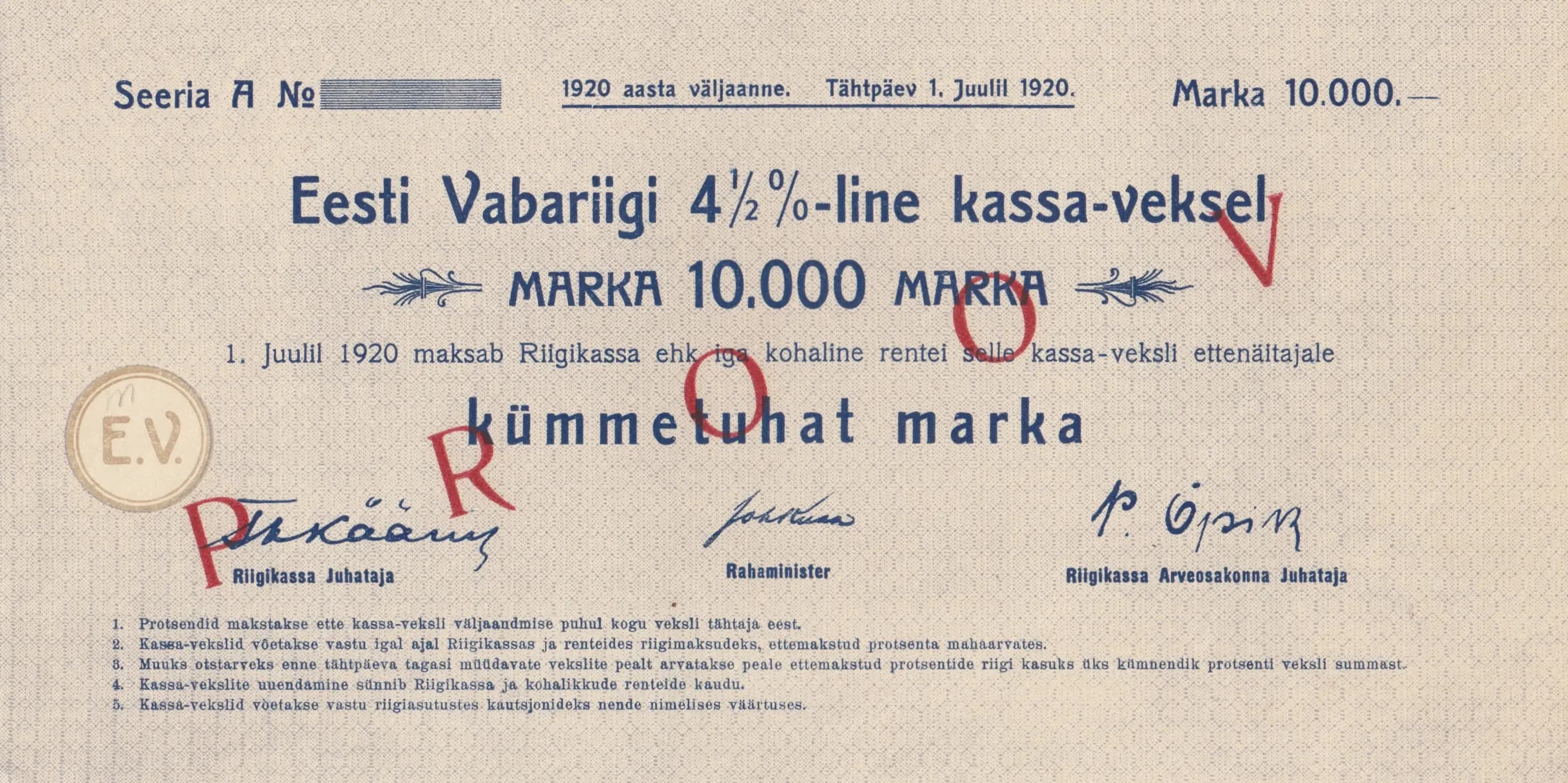
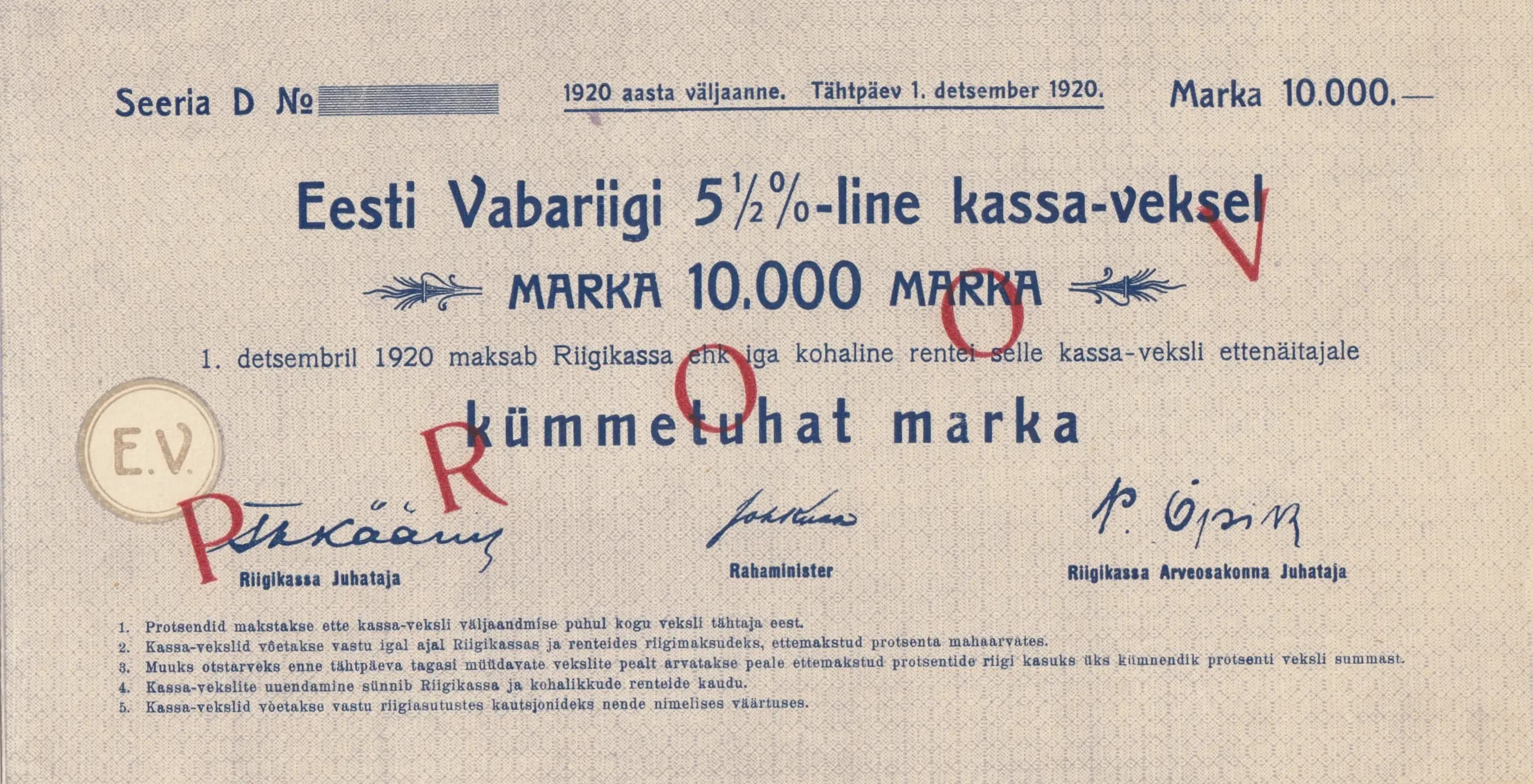
This is an Estonian Republic 10,000 Marka treasury bill (kassa-veksel) from 1920, Series D, graded EF. The note features a formal financial document layout with ornamental decorative elements, official seals including the 'E.V' circular stamp, and three signature lines representing the State Treasury leadership. A distinctive red diagonal stamp reading 'Reklaamitav marka' (Advertising marka) overlays the front, making this a particularly interesting specimen example. The aged cream-colored paper with fine crosshatch texture and visible patina is consistent with documents from this formative period of Estonian independence.
Common. While this is a specialized financial instrument from the early Estonian Republic, the eBay market price data shows a wide range from $9.00 to $450.00 USD, with most comparable sales in the $50-$150 range for similar grades. The availability of multiple listings at relatively modest prices ($15-$85 for typical grades) indicates this denomination and series circulated in reasonable quantities. Treasury bills were issued as functional financial instruments rather than limited collectibles, and survival rates appear adequate for the denomination and period. No evidence of small print runs or recall status affects its common designation.
This treasury bill was issued during the early years of the Estonian Republic, following independence from Imperial Russia in 1918. The 5½% interest-bearing note, payable December 1, 1920, represents Estonia's initial efforts to establish sovereign financial instruments and rebuild state finances after World War I and independence struggles. The formal presentation with multiple official signatures from the State Treasury (Riigikassa) and Finance Ministry reflects the new nation's commitment to establishing credible fiscal institutions and international standing during this turbulent period of Baltic state formation.
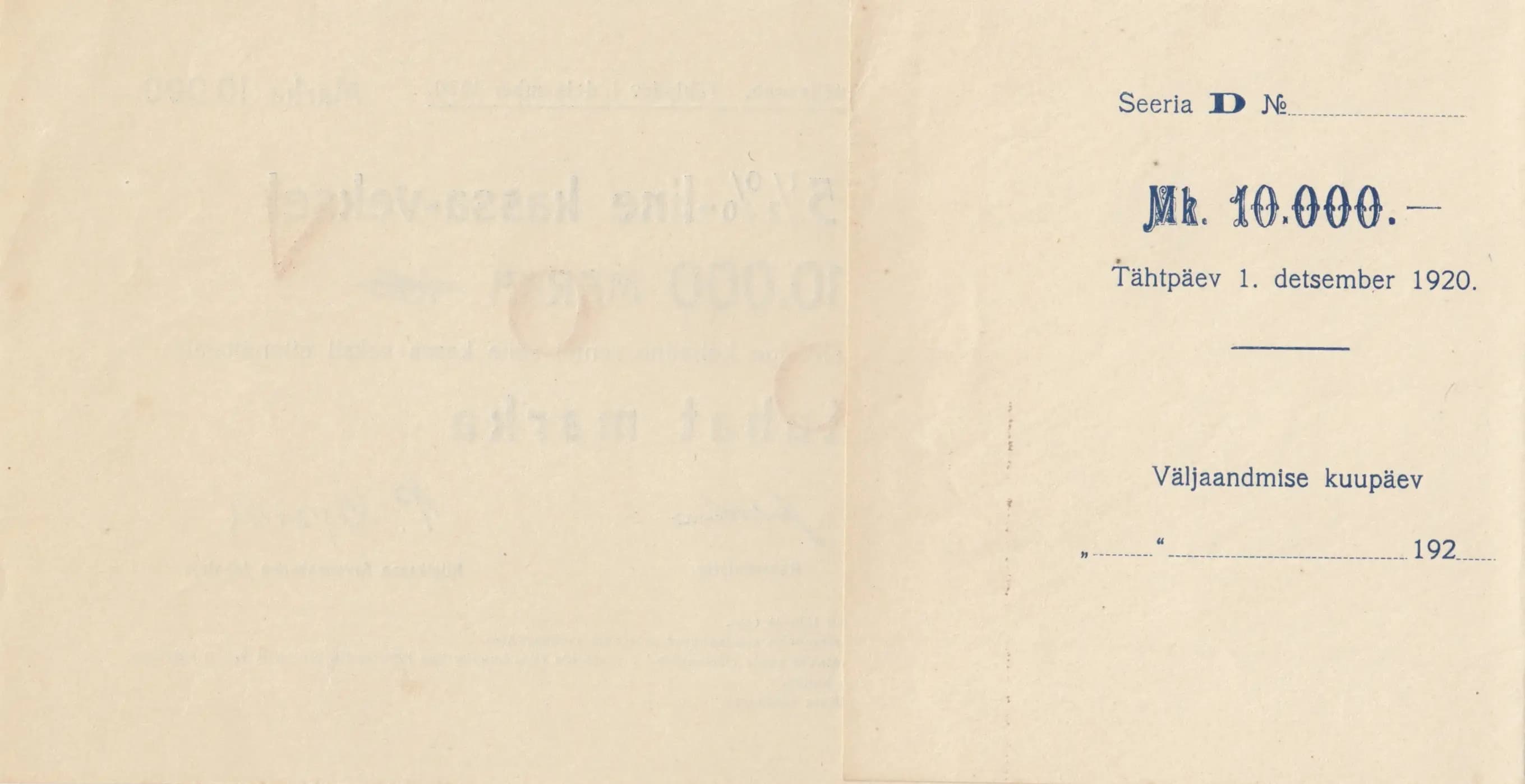
This treasury bill (kassa-veksel) employs a formal government financial document design typical of early 20th-century European fiscal instruments. The front features a centered, symmetrical layout with the denomination and issuing authority prominently displayed at the top, flanked by decorative leaf and branch motifs that lend institutional authority. The circular seal with 'E.V' (Eesti Vabariigi — Estonian Republic) initials serves as the primary governmental authentication mark. Three signature lines at the bottom represent the three key financial officers required to authorize the instrument: the Head of State Treasury, the Finance Minister, and the Head of the State Treasury Accounting Department. The red diagonal 'Reklaamitav marka' (Advertising marka) stamp indicates this is a specimen or promotional example rather than a circulating issue. The back is minimal, designed as a form document with fields for completion. The color scheme of cream paper with dark blue and red printing creates clear visual hierarchy while the fine crosshatch paper texture provides subtle security against counterfeiting.
{"front":{"title":"Eesti Vabariigi 5½%-line kassa-veksel (Estonian Republic 5½% treasury bill)","denomination":"MARKA 10.000 MARKA / Marka 10.000.— (10,000 Marka)","issue":"1920 aasta väljäanne. Tähtpäev 1. detsember 1920. (1920 issue. Due date December 1, 1920.)","paymentClause":"1. detsembril 1920 maksab Riigikassa või selle kohalik rentel selle kassa-veksli ettenäitajale kummetuhat marka (On December 1, 1920, the State Treasury or its local agent shall pay the bearer of this treasury bill ten thousand marka)","series":"Seeria D № (Series D No.)","stamp":"Reklaamitav marka (Advertising marka)","signatures":["Riigikassa Juhataja (Head of State Treasury)","Rahaminister (Finance Minister)","Riigikassa Arveosakkonna Juhataja (Head of State Treasury Accounting Department)"],"conditions":["1. Protsendid maksakse ette kassa-veksli väljäandmise puhul kogni veksli tähtjaia eest. (Interest is paid in advance from the date of issue of the treasury bill until the due date.)","2. Kassa-vekslid võetakse vastu igal ajal Riigikassas ja renteides riigimakseudeks, ettemaksitud protestena mahaarvestes. (Treasury bills are accepted at any time at the State Treasury and at tax collection offices as payment for state taxes and advance payments with protest settlement.)","3. [Terms regarding bills returned before maturity - partially legible]","4. Kassa-vekslite uiendamine sünnib Riigikassas ja kohaliakkude renteides kaidu. (Renewal of treasury bills occurs at the State Treasury and local tax offices.)","5. Kassa-vekslid võetakse vastu riiglasutustes kautsjonideks nende nimelises vaartuses. (Treasury bills are accepted in state institutions as security for their nominal value.)"]},"back":{"denomination":"Mk. 10.000.— (Marka 10,000)","series":"Seeria D № (Series D No.)","dueDate":"Tähtpäev 1. detsember 1920. (Due date December 1, 1920.)","issueDate":"Väljaandmise kuupäev (Issue date) [with blank line for completion]","yearMarking":"192 [year prefix, intended for hand-completion]"}}
This note was produced using letterpress printing on aged cream-colored bond paper with a fine crosshatch texture. The dark blue body text and denominations show the characteristic crisp impressions of letterpress typography, while the red diagonal stamp appears to have been applied as an overprint, possibly using a rubber or metal stamp. The ornamental decorative flourishes flanking the title and the circular seal are consistent with engraved or etched security printing techniques common to financial instruments of this era. The overall production quality and precision of registration suggest printing by an established security printer, though the specific printer is not identified in the visible inscriptions.
Pick catalog P-38Ns indicates this is a non-specimen note from the series, though the visual analysis confirms the presence of the red 'Reklaamitav marka' (Advertising marka) diagonal stamp, suggesting this particular example is actually a specimen or advertising copy. Series D designation is clearly visible on both front and back. External references note that P-38A exists with orange coloration versus the gray/cream observed here, indicating color varieties exist within this denomination. The incomplete year field on the back (marked '192') appears to be a design feature of this issue, intended for hand-completion at the time of issue. PMG records indicate P-38 as 200 Marka, suggesting possible catalogue discrepancy or denomination confusion with the 10,000 Marka face value observed in the visual analysis; the 10,000 Marka denomination is confirmed in both the catalog data provided and the visual inspection of the note itself.