1 punkt 1945
“w/o serial #”
About This Note
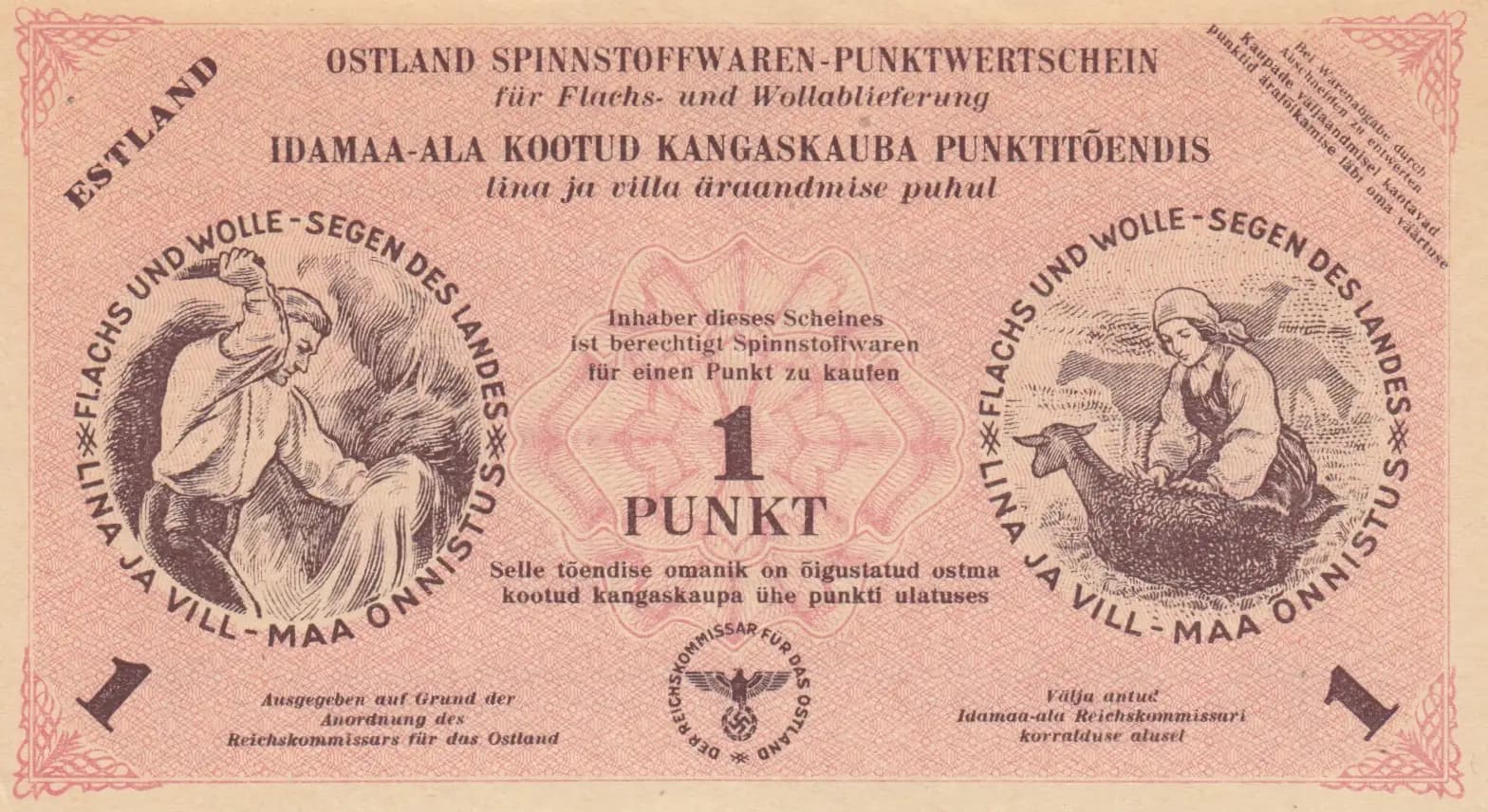
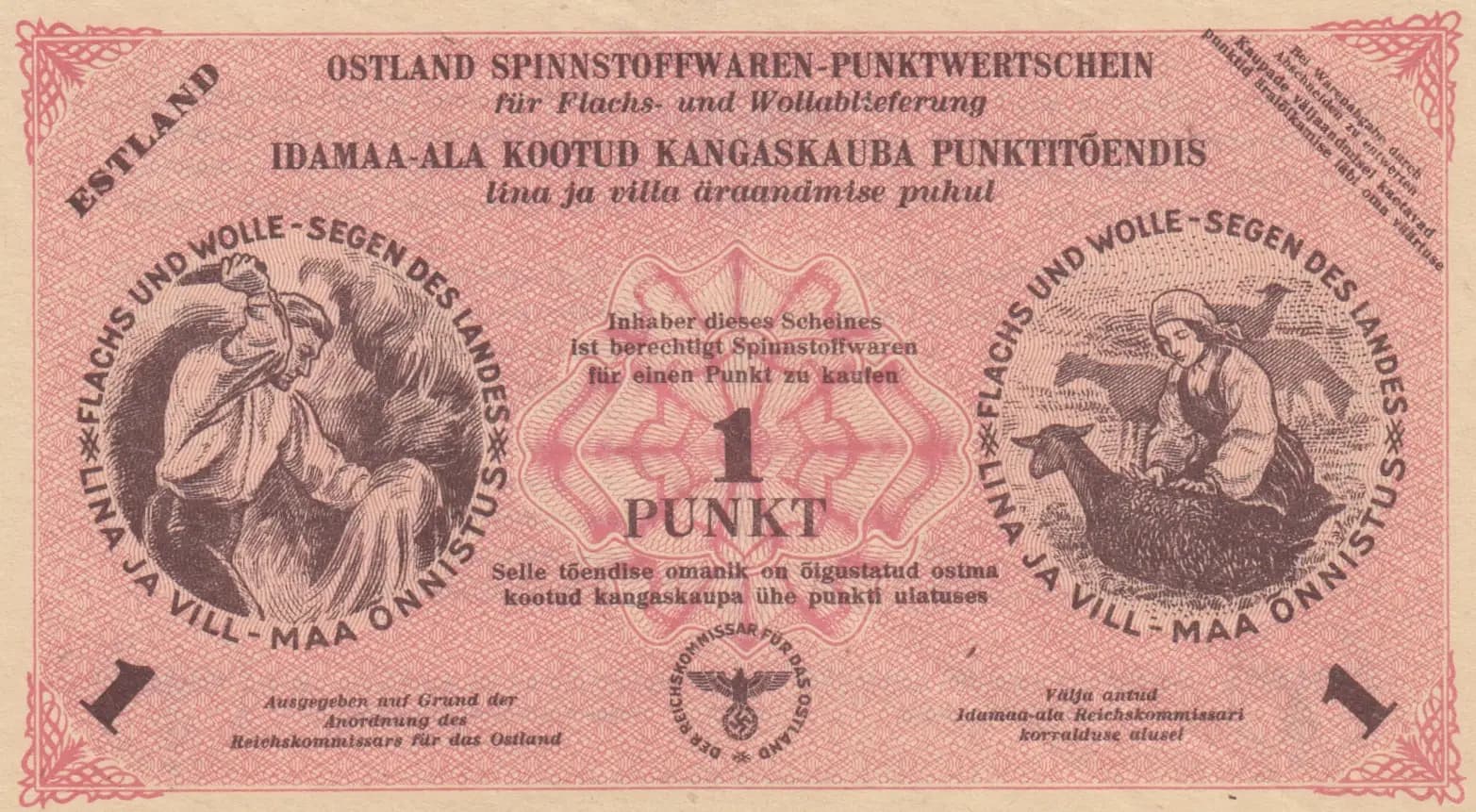
This is an exceptional UNC example of a German occupation-era textile rationing voucher issued in Estonia during 1945. The note features striking pink/rose coloring with allegorical female figures representing textile production and labor, centered around an ornate shield bearing the denomination '1 PUNKT'. The crisp, clear printing and complete absence of wear make this an outstanding specimen of this scarce wartime scrip, particularly notable for its complete bilingual German-Estonian inscriptions reflecting the dual administrative control of the Ostland territory.
Uncommon. This Pick-unlisted voucher was issued during the final months of Nazi occupation in Estonia (valid only until April 30, 1945) by a specific regional authority. The small geographic area of distribution (occupied Estonia only), the limited validity period, and the transitional nature of the wartime occupation administration all suggest a modest original print run. The fact that it remains unindexed in the standard Pick catalog indicates it exists outside mainstream collecting circles, reducing surviving examples. However, without definitive print run data or evidence of systematic destruction, it does not meet the criteria for 'rare' designation—many such occupation-era scrip notes survived in reasonable quantities despite their limited geographic scope.
Issued by German occupation authorities under the Reich Commissioner for the Ostland (the Baltic territories under Nazi control), this voucher represents the wartime rationing system for textile goods in occupied Estonia. The depiction of female allegorical figures engaged in spinning and textile work reflects Nazi-era propaganda imagery celebrating domestic labor and resource mobilization for the war effort. The note's validity period ending April 30, 1945—just weeks before Soviet re-occupation and Germany's surrender—underscores its status as a product of the final months of Nazi occupation in the Baltic region.
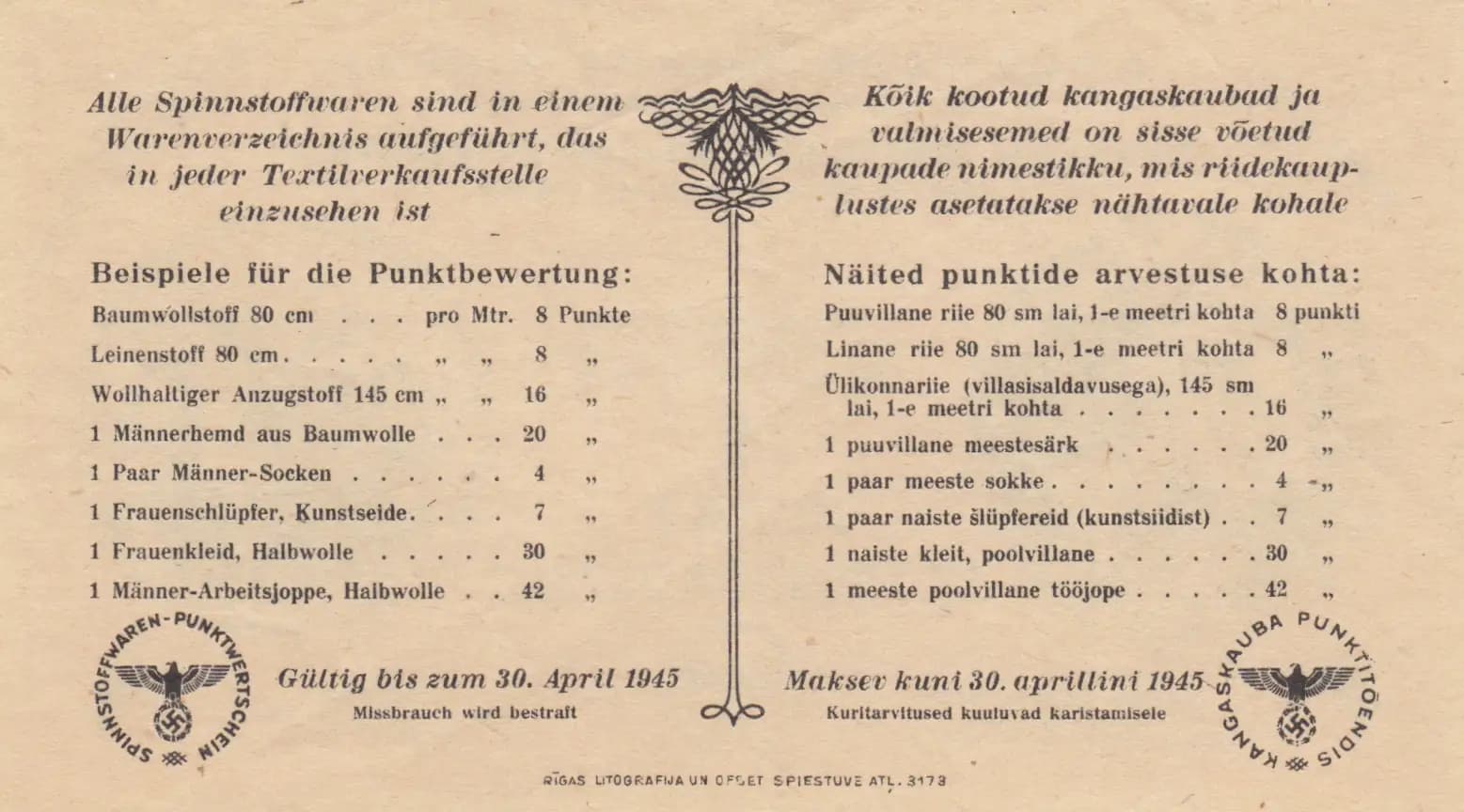
The obverse features a classical allegorical design typical of wartime German occupation currency. On the left stands a female figure in classical dress holding a spindle or distaff, symbolizing textile production and the traditional craft of spinning. The right figure is similarly robed and appears engaged with textile materials, representing the labor of textile manufacturing. These allegorical females, rendered in an Academic style consistent with Nazi-era official art, frame a central ornate heraldic shield containing the denomination '1 PUNKT' in bold type. The design is bordered with geometric patterns in a rectilinear frame. The Nazi eagle emblem with swastika appears prominently at the bottom center, asserting German state authority. The reverse contains exclusively informational content in dual-column format (German left, Estonian right) with textual descriptions of the point system, commodity pricing examples, and usage restrictions. A decorative botanical divider separates the columns, with eagle emblems flanking the base. The printing employs fine line engraving throughout, visible in the intricate border work and the detailed rendering of the allegorical figures.
FRONT SIDE: Main heading: 'OSTLAND SPINNSTOFFWAREN-PUNKTWERTSCHEIN' (Ostland Textile Goods Point Voucher) with subtitle 'für Flochs- und Wollablieferung' (for Flock and Wool Delivery). Estonian parallel text: 'IDAMAA-ALA KOOTUD KANGASKAUBA PUNKTITOENDIS' (East Land Textile Goods Point Certificate) with 'lina ja villa äraandmise punul' (for linen and wool delivery). Central denomination: '1 PUNKT' (1 Point). Authority statement: 'Ausgegeben auf Grund der Anordnung des Reichskommissars für das Ostland' (Issued pursuant to the order of the Reich Commissioner for the East Land) with Estonian equivalent 'Idamaa-ala Reichskommisari koralduse alusel'. Usage description: 'Inhaber dieses Scheines ist berechtigt Spinnstoffwaren für einen Punkt zu kaufen' (The holder of this certificate is entitled to purchase textile goods for one point) with Estonian equivalent 'Selle toendise omanik on õigustatud ostma kootud kangaskaupa ühe punkti ulatuses'. REVERSE SIDE: Information section: 'Alle Spinnstoffwaren sind in einem Warenverzeichnis aufgeführt, das in jeder Textilverkaufsstelle einzusehen ist' (All textile goods are listed in a commodity register that can be viewed at any textile retail store) with Estonian equivalent 'Kõik kootud kangaskaubad ja valmisesemed on sisse võetud kaupade nimekirku, mis ritdekauptustes asetatakse nähtavale kohale'. Point valuation examples header: 'Beispiele für die Punktbewertung' / 'Näited punktide arvestuse kohta' (Examples of point valuation). Examples listed: Cotton fabric 80cm = 8 points per meter; Linen fabric 80cm = 8 points per meter; Wool-containing suit fabric 145cm = 16 points per meter; Men's cotton shirt = 20 points; Men's socks (pair) = 4 points; Women's slip (artificial silk) = 7 points; Women's half-wool dress = 30 points; Men's half-wool work jacket = 42 points. Validity statement: 'Gültig bis zum 30. April 1945' / 'Makser kuni 30. aprillini 1945' (Valid until 30 April 1945). Warning: 'Missbrauch wird bestraft' / 'Kuritarvitused kuuluvad karistamisele' (Misuse will be punished). Printer attribution: 'RIGAS LITOGRAFIJA UN OFFSET SPIESTUVE ATL. 3173' (Riga Lithography and Offset Printing Works, catalog number 3173).
This note was produced using lithographic and offset printing methods, as confirmed by the printer's mark 'RIGAS LITOGRAFIJA UN OFFSET SPIESTUVE ATL. 3173' (Riga Lithography and Offset Printing Works) appearing on the reverse. The fine line engraving effects visible throughout the design, particularly in the border patterns and figure rendering, were likely achieved through stone lithography with careful color separation for the pink/rose primary color and brown/dark brown accent tones. The precision of the allegorical figures and the geometric borders suggests skilled lithographic craftwork typical of official occupation-era German printing operations in the Baltic territories.
This specific example is noted in the collector data as lacking a serial number ('w/o serial #'), which may represent a consistent feature of this entire issue or may indicate a printer's variety. The note is ungraded in the Pick catalog system (listed as 'P-unlisted1'), suggesting it exists as an unconfirmed or recently cataloged issue. The UNC condition grade indicates this is an exceptional specimen. No visible variations in the design elements, denominations, or authorization marks are apparent in the visual analysis; the dual-language format (German/Estonian) appears to be standard for all examples of this territorial occupation voucher.