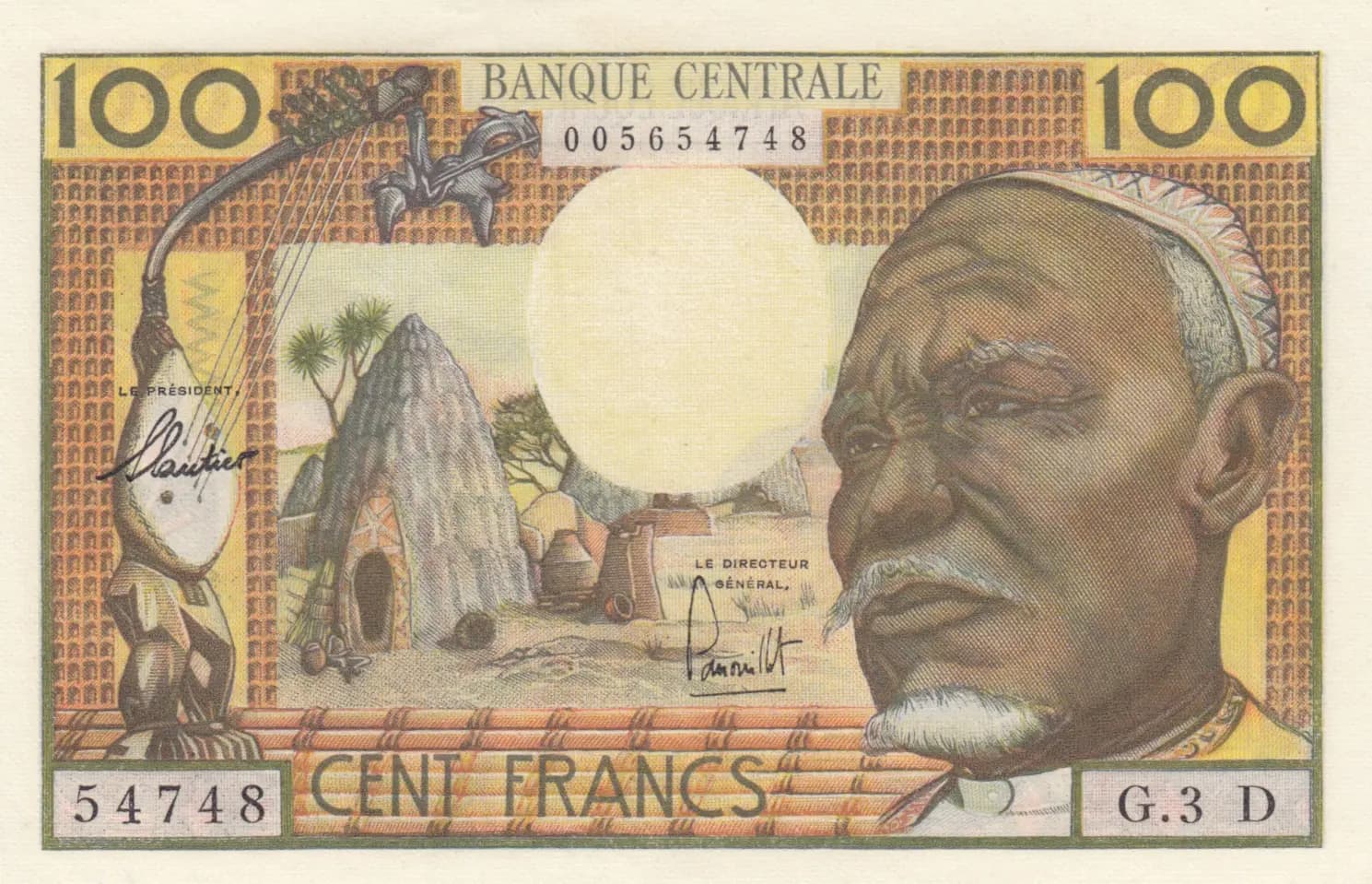
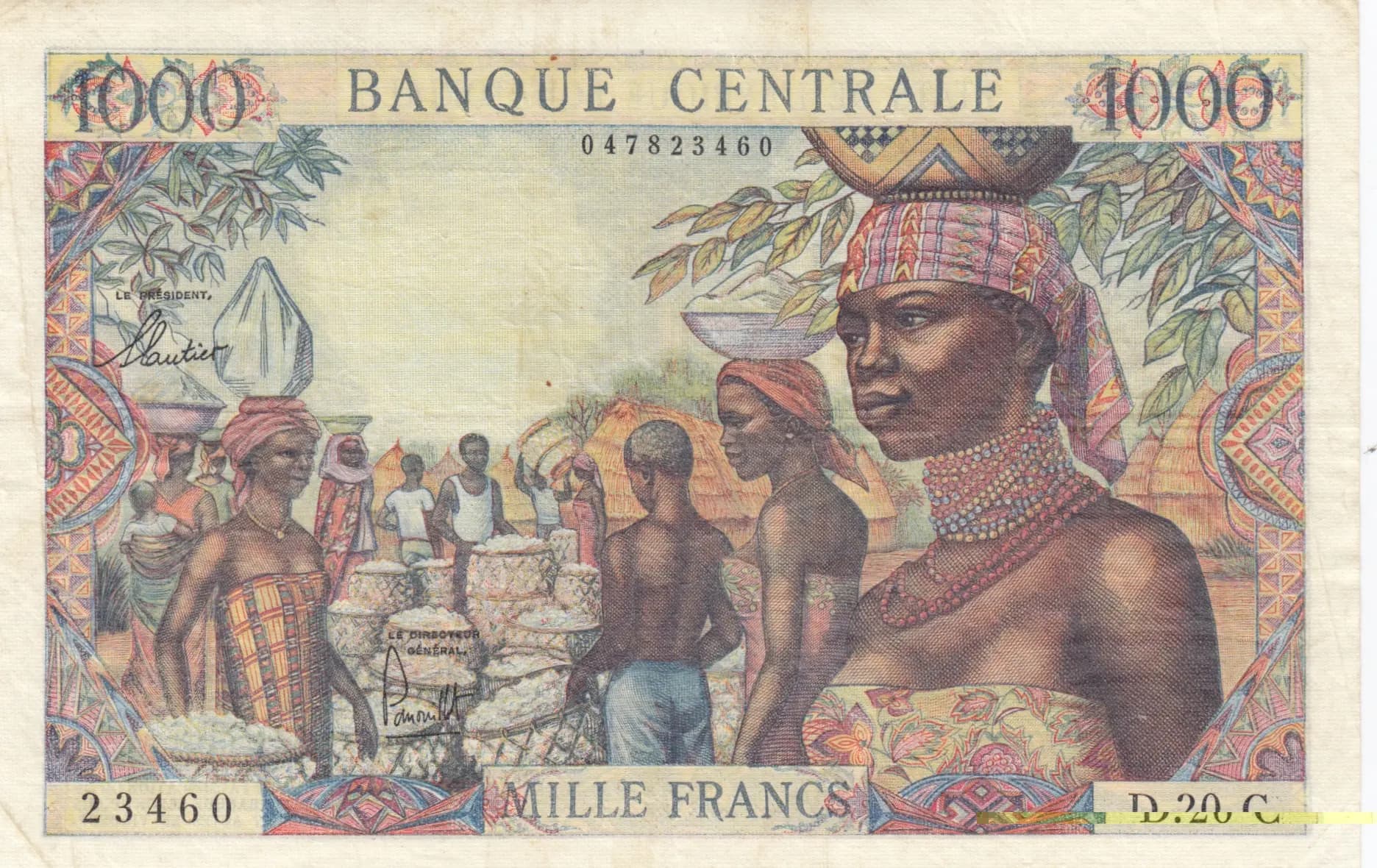
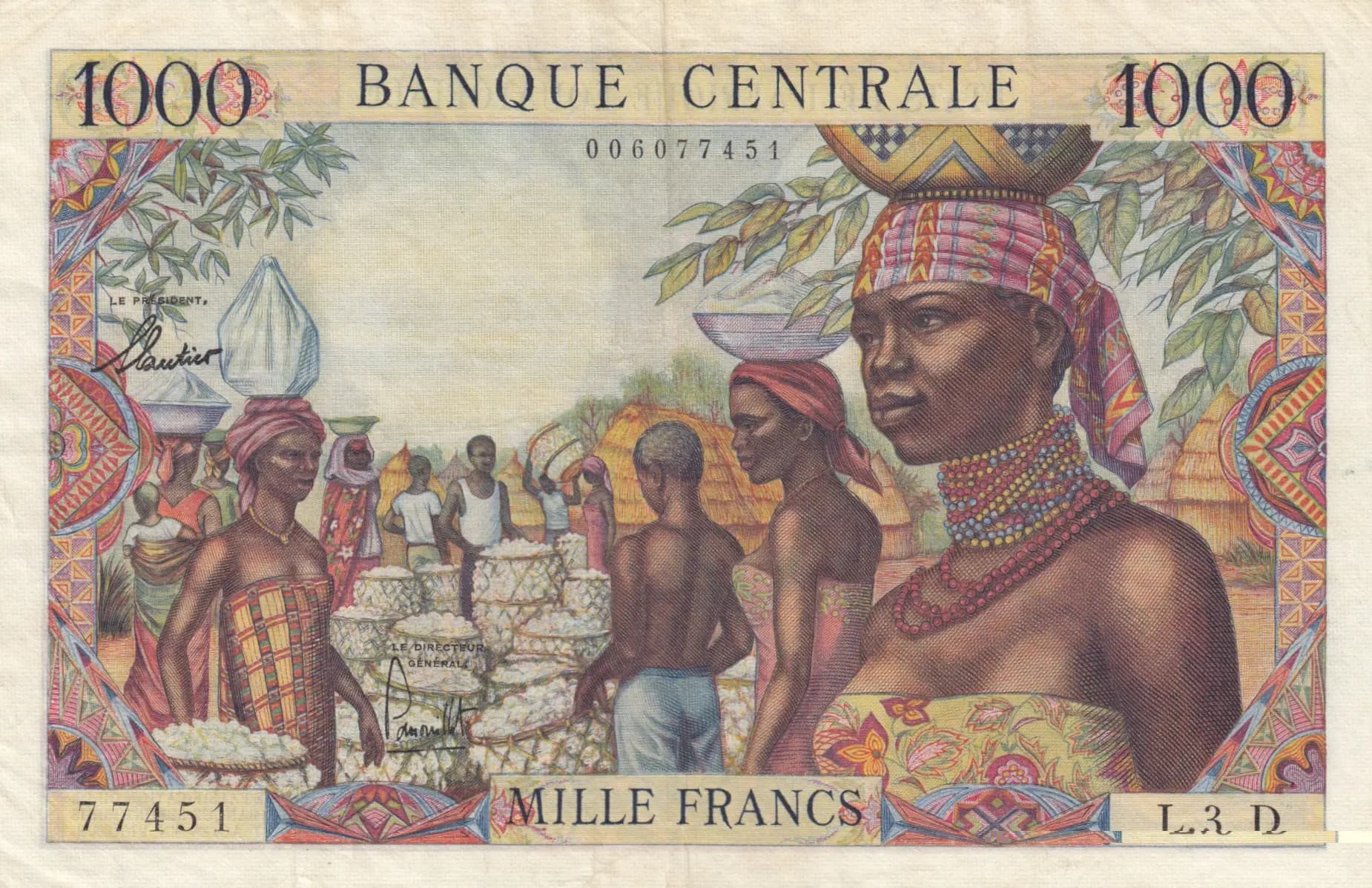
500 francs 1963
“Gabon”
About This Note
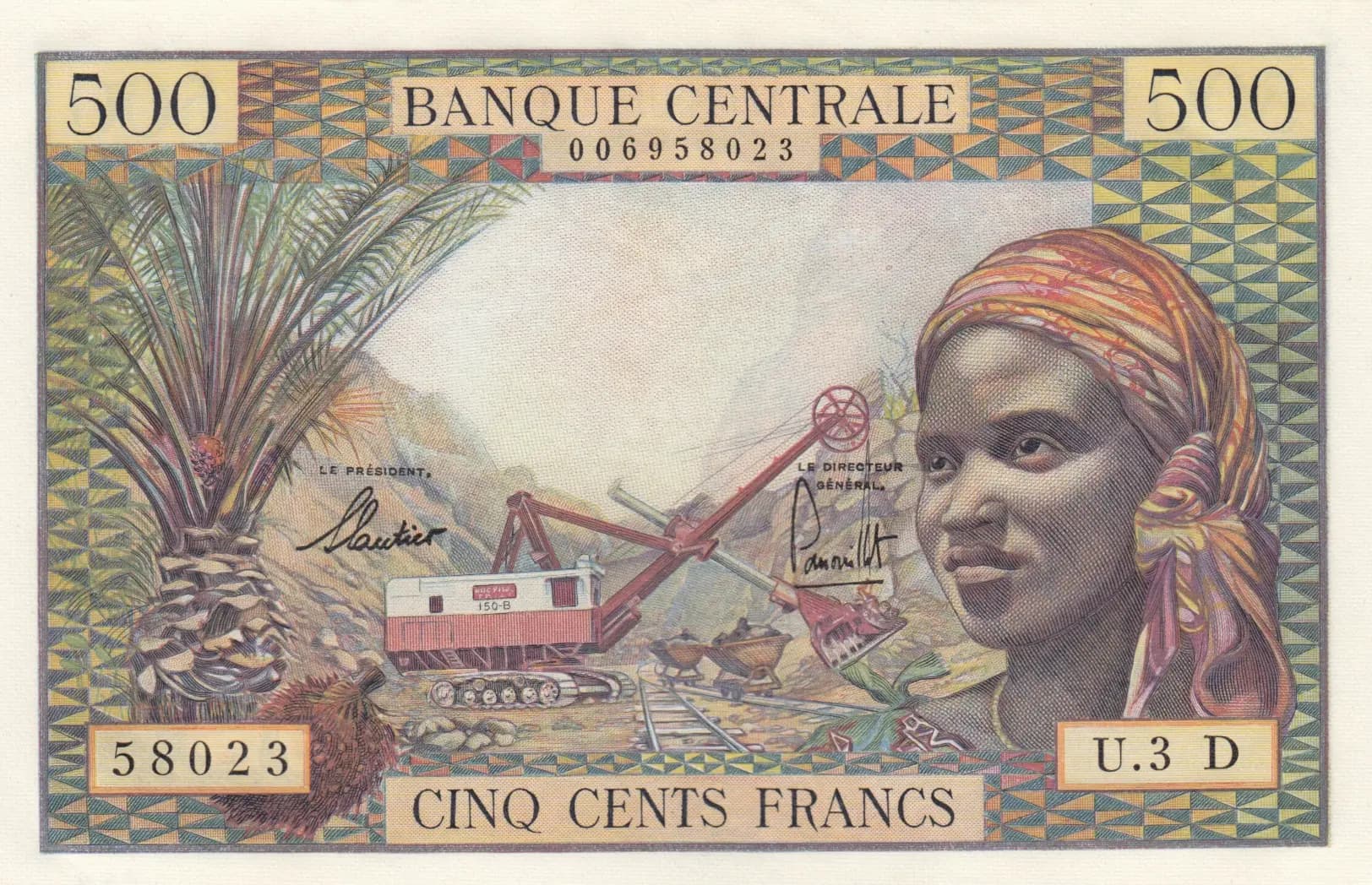
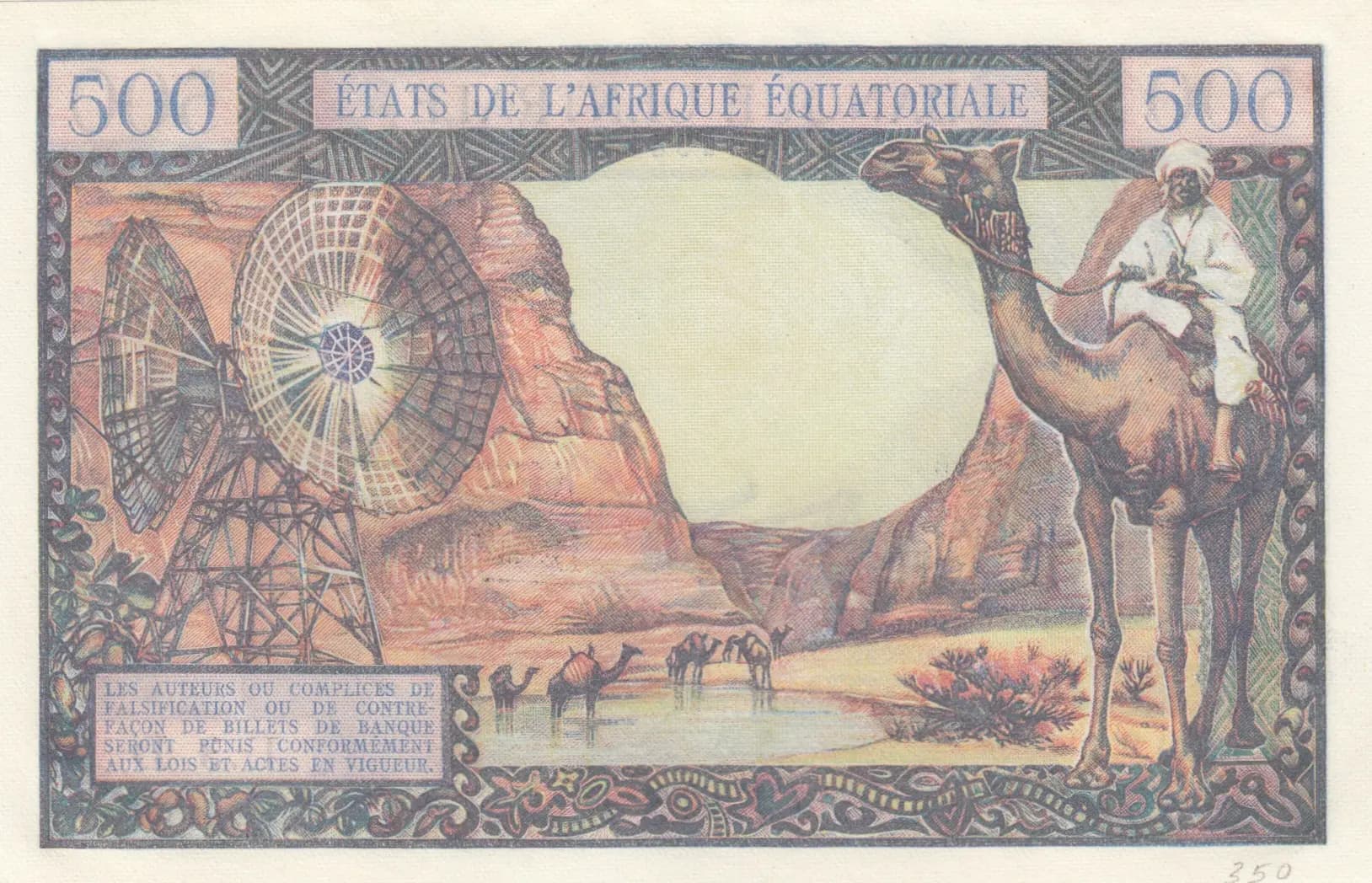
A stunning UNC example of the 500 Francs from Equatorial African States (1963), Pick P-4d with Code Letter 'D'. The obverse features an elegantly dressed woman in traditional dress alongside mining/industrial imagery and a palm tree, while the reverse depicts a modernist composition with a radio telescope array and a camel herder in a desert landscape. The note exhibits crisp printing with no circulation wear, sharp color registration across earthy tones and vibrant accents, and represents the early monetary autonomy of the Equatorial African States monetary union during its formative years.
Common. The 500 Francs denominations of the Equatorial African States (1963) circulated widely across the monetary union member states (Cameroon, Central African Republic, Chad, Congo, Equatorial Guinea, and Gabon). No evidence of small print runs, early recall, or extreme scarcity exists for Pick P-4d. The presence of multiple cataloged varieties (P-4a through P-4h) and PMG population data indicate substantial quantities survived. UNC examples command modest premiums over circulated specimens but remain readily obtainable in the current collector market.
Issued by the Banque Centrale des États de l'Afrique Équatoriale in 1963, this note commemorates the newly independent equatorial African states' economic aspirations and cultural identity. The juxtaposition of modern technology (represented by the radio telescope/satellite dish on the reverse) with traditional livelihoods (mining on the obverse, pastoral camel herding on the reverse) reflects the period's optimism about bridging traditional economies with contemporary development. The note's imagery documents the region's extractive industries and technological advancement during the post-colonial era.
The obverse portrays a woman of equatorial African origin wearing a striking orange and red patterned head wrap in three-quarter profile on the right side, paired with industrial imagery on the left depicting mining or excavation equipment (visible machinery marked '150-B'), a palm tree, and an active mining landscape. The reverse presents a modernist composition featuring a radio telescope or satellite dish array with geometric structural detail on the left, a figure in white clothing seated with or near a camel on the right side of the composition, additional camels visible in the middle distance, and arid desert terrain suggesting the broader regional geography. Both sides are framed by ornate decorative borders with repeating triangular and interlocking geometric patterns in earth tones, exemplifying the artistic style of early 1960s African banknote design.
OBVERSE: '500' (denomination), 'BANQUE CENTRALE' (Central Bank), 'CINQ CENTS FRANCS' (Five Hundred Francs), 'LE PRÉSIDENT' (The President), 'LE DIRECTEUR GÉNÉRAL' (The General Director), Serial number '00695802.3' and '58023', Series designation 'U.3 D'. REVERSE: '500' (denomination), 'ÉTATS DE L'AFRIQUE ÉQUATORIALE' (Equatorial African States), 'LES AUTEURS OU COMPLICES DE FALSIFICATION OU DE CONTRE-FAÇON DE BILLETS DE BANQUE SERONT PUNIS CONFORMÉMENT AUX LOIS ET ACTES EN VIGUEUR' (The authors or accomplices of falsification or counterfeiting of banknotes shall be punished in accordance with applicable laws and acts in force).
Intaglio (engraved) printing with multi-color registration, evident from the crisp line work, detailed portrait engraving, fine geometric border patterns, and precise color separation visible in the landscape and decorative elements. The complex background detail, fine serifs, and intricate geometric patterns are hallmarks of security-standard intaglio production. The printer for BEAEC notes of this period was typically a European security printer such as De La Rue or Bradbury Wilkinson, though definitive attribution requires archival records.
This note is cataloged as Pick P-4d, distinguished by Code Letter 'D' in the series designation. PMG has documented eight primary varieties of the 500 Francs 1963 (P-4a through P-4h), differentiated by their letter codes (A, B, C, D) appearing in the series designation field. The observed serial number format '00695802.3' with series marking 'U.3 D' confirms the P-4d classification. Specimens exist with signature variations (LE PRÉSIDENT and LE DIRECTEUR GÉNÉRAL positions) and potentially minor printer's marks, though these remain within the standard P-4d family.