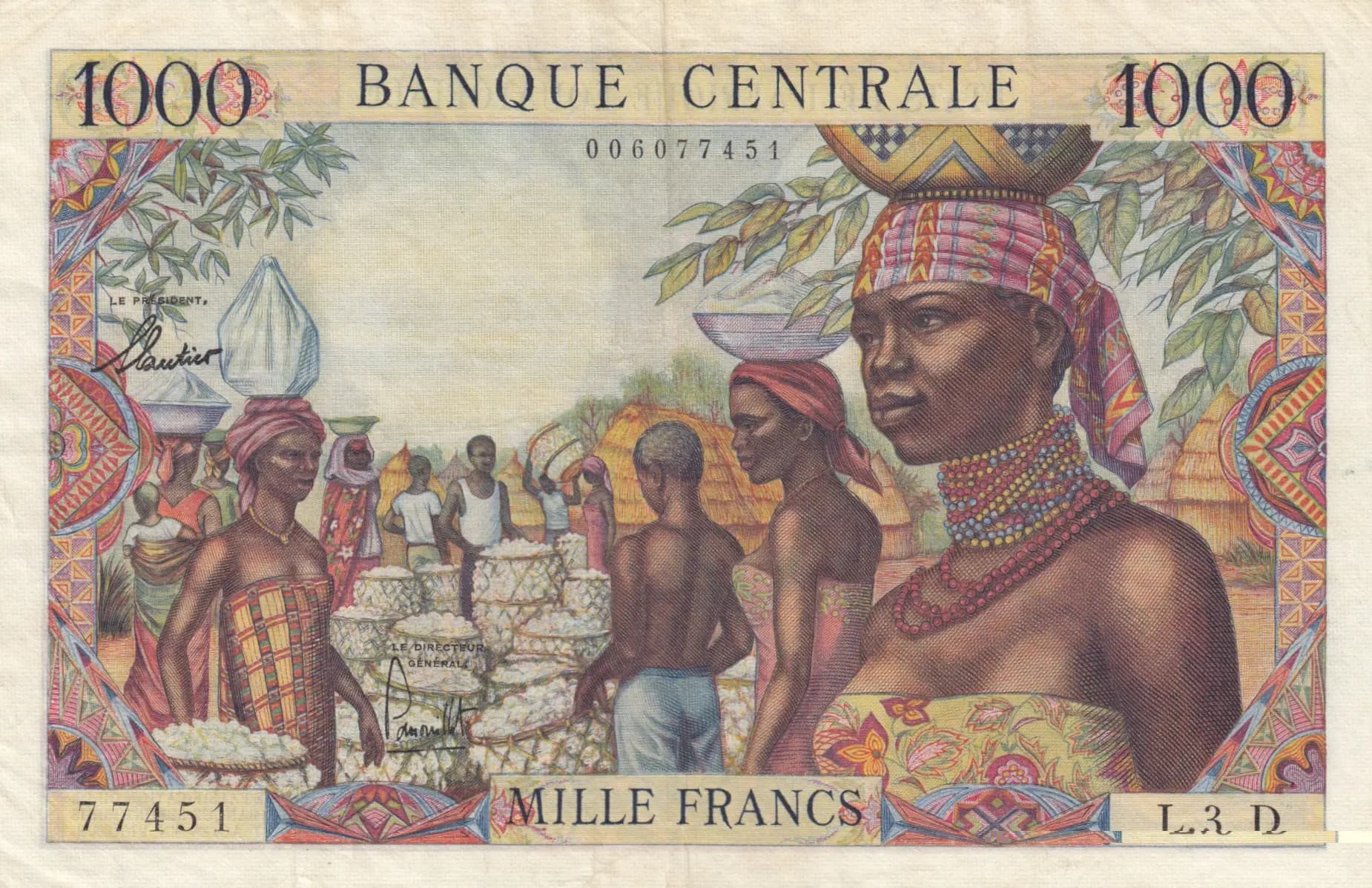
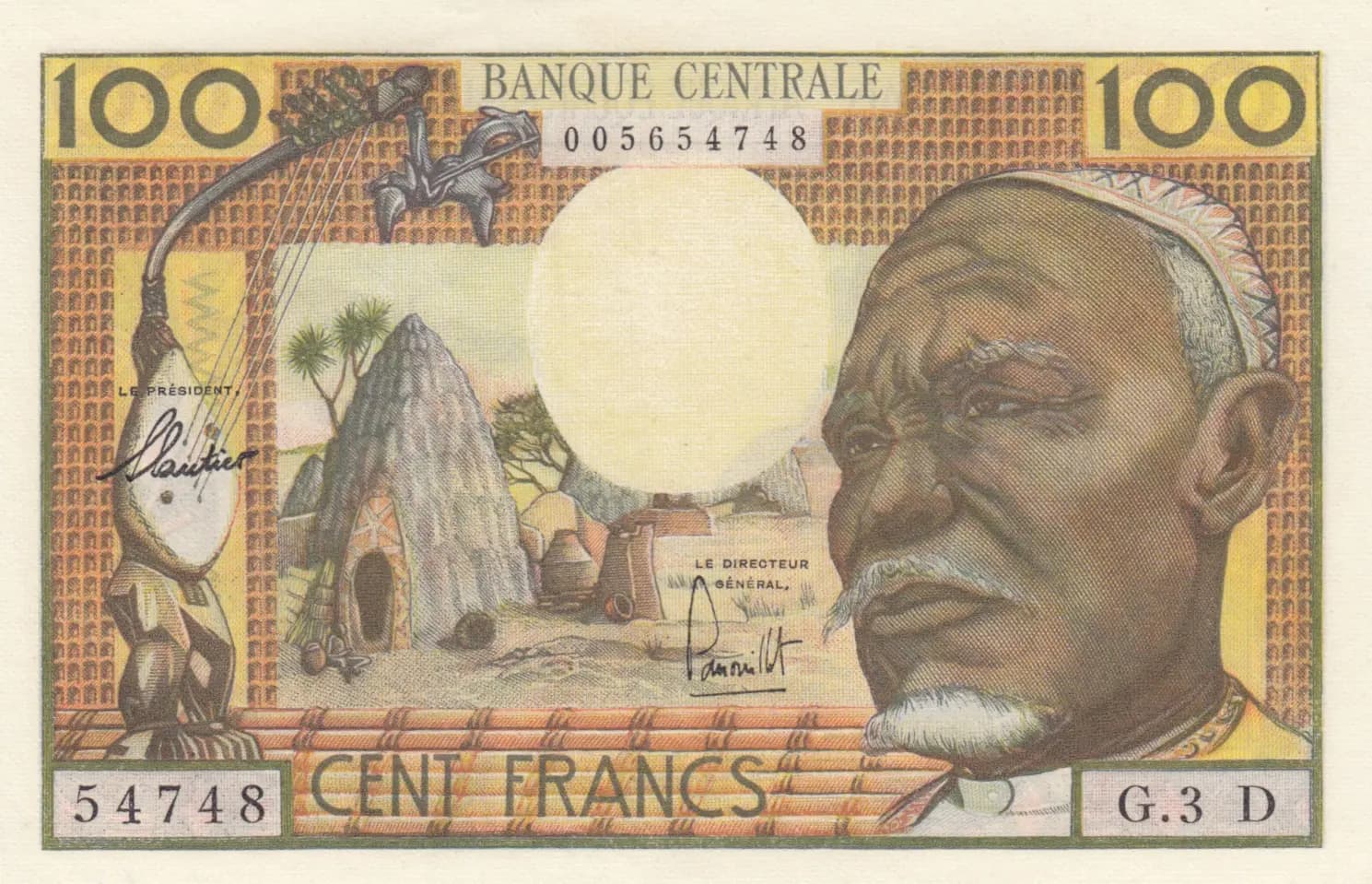
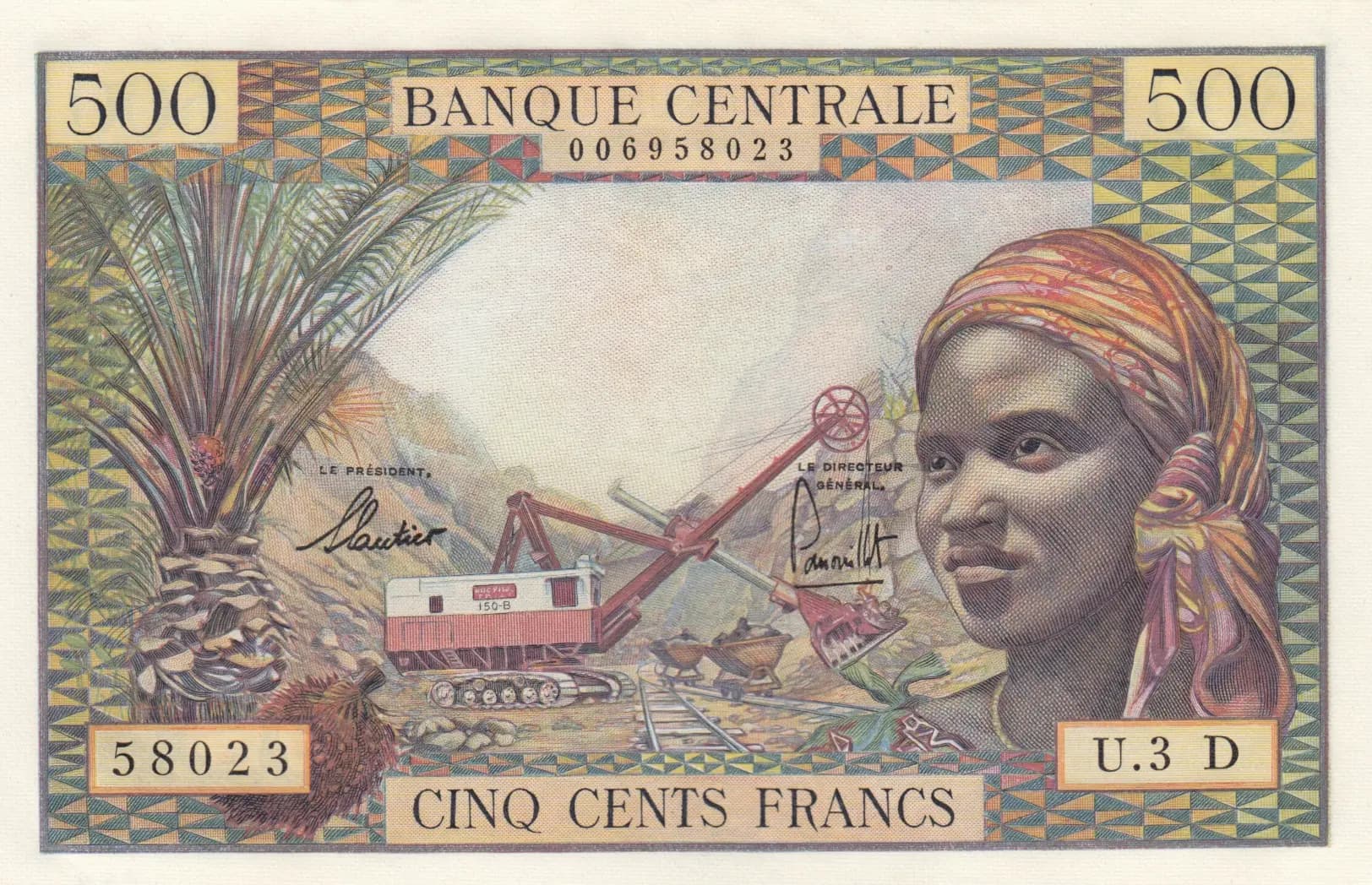
1000 francs 1963
“Congo”
About This Note
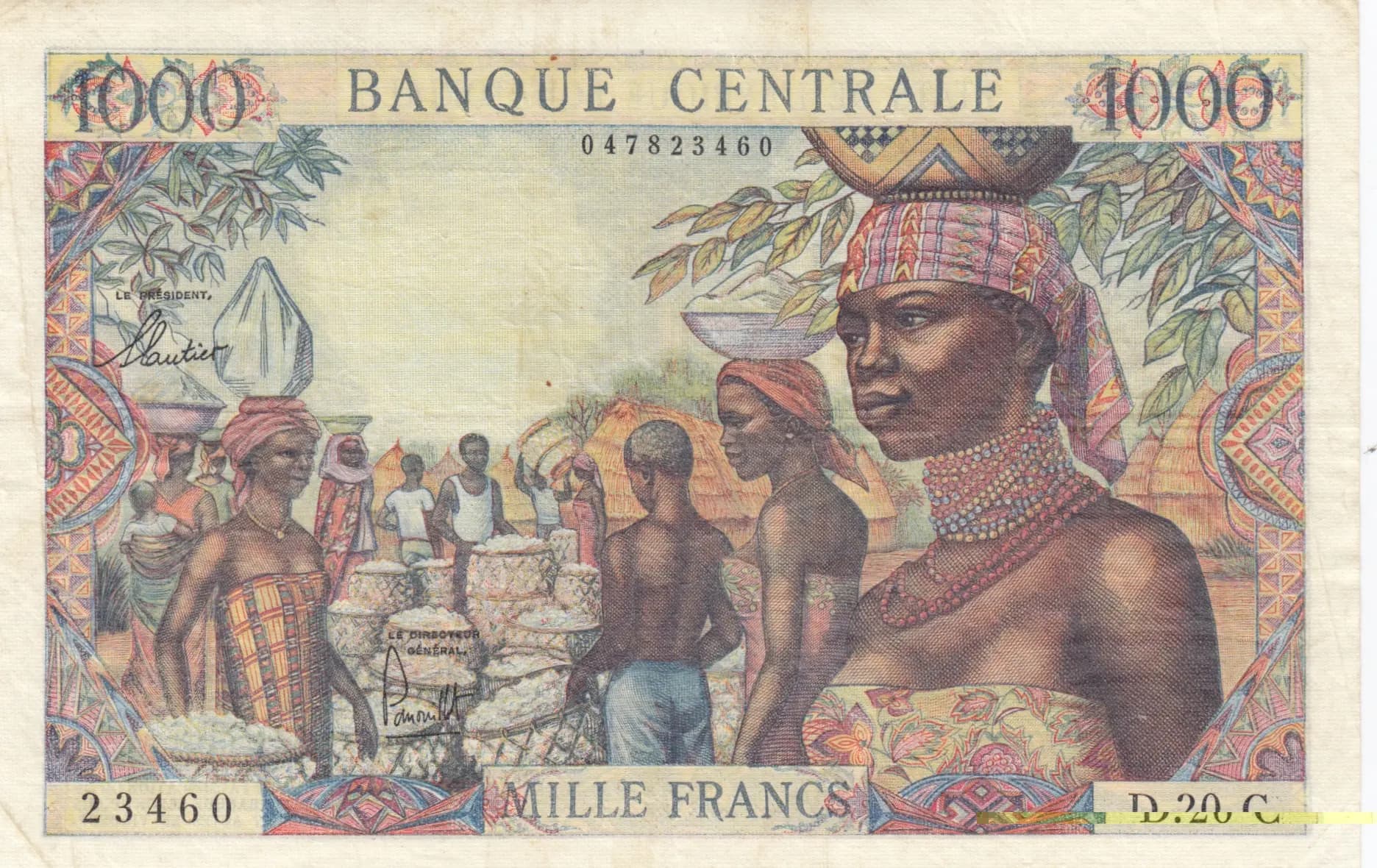
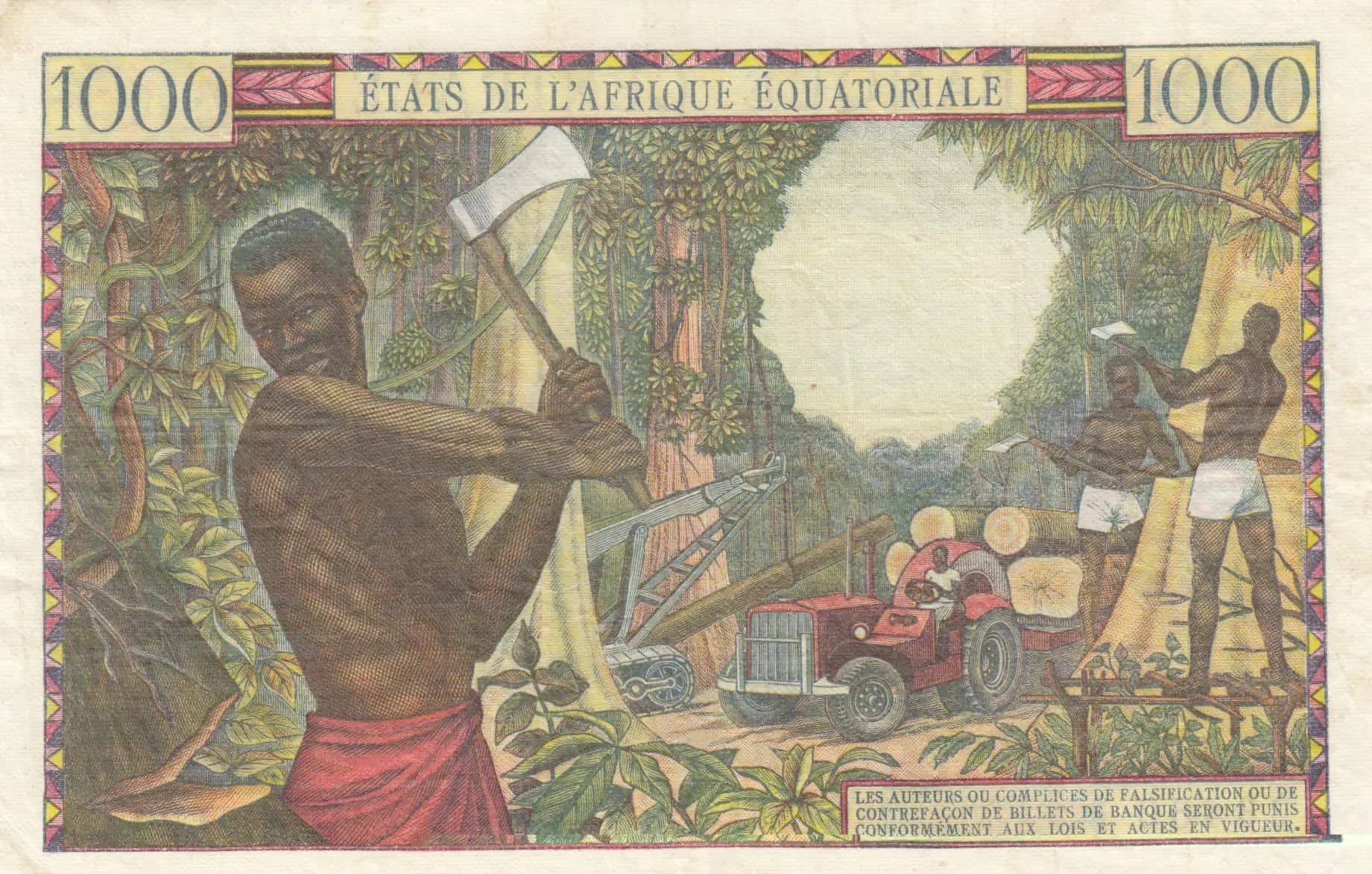
This is a Fine condition 1000 Francs banknote from the Banque Centrale des États de l'Afrique Équatoriale, issued in 1963 and catalogued as Pick P-5c with Code Letter 'C'. The note features vibrant multicolor engraving depicting African village life on the obverse and forest labor/logging activities on the reverse, characteristic of the mid-20th century Central African currency series. Light aging and foxing consistent with its age are evident, but the note remains well-preserved with clear signatures and legible serial number 047823460, making it an appealing example of early post-colonial African numismatic design.
Common. The Equatorial African States 1000 Francs series of 1963 was issued in substantial quantities across multiple territories over an extended circulation period. The existence of 13 catalogued varieties (P-5a through P-5h with lettered variants) indicates a large overall print run distributed across different code letters representing different printing periods or territories. The Fine condition grade and straightforward characteristics of this P-5c example suggest it is a readily available note in the collector market, with no documented scarcity factors such as short print runs, recall, or territorial restrictions that would elevate it above common status.
This 1000 Francs note was issued during the early years of the Equatorial African monetary union, which encompassed former French Equatorial African territories including Chad, Central African Republic, Congo, and Gabon. The obverse imagery depicting traditional village market scenes and ceremonial gatherings reflects the issuing authority's effort to celebrate indigenous African cultural heritage, while the reverse scene of mechanized logging operations with tractors symbolizes the region's economic development and resource extraction industries that were central to post-colonial development strategies. The collector notes reference to 'Congo' likely indicates this note circulated in the Congo territory of the federation during this transitional period.
The obverse presents a bustling market or village scene featuring a central male figure with distinctive red patterned headwrap and traditional beaded necklace, likely representing a village elder or leader, holding a ceremonial vessel. Background figures in traditional African dress engage in various marketplace activities around traditional thatched-roof huts, with vegetation and settlement structures visible. The composition is framed by ornate geometric border patterns in orange, blue, and red, with intricate medallion designs at the corners. The reverse depicts a logging/forestry scene dominated by a large male laborer on the left holding an axe, wearing red fabric at the waist, positioned in dense tropical forest with hanging vines and vegetation. A red tractor with operators and additional workers are shown in a forest clearing, symbolizing mechanized development and resource extraction. The reverse border features purple, yellow, and red geometric patterns. Both sides employ the full color palette characteristic of early Central African currency design, with cream/beige backgrounds and sophisticated multi-color engraving.
FRONT: 'BANQUE CENTRALE' (Central Bank); 'MILLE FRANCS' (One Thousand Francs); 'LE PRESIDENT' (The President); 'LE DIRECTEUR GÉNÉRAL' (The General Director); denomination '1000'; serial number '047823460'; designation code 'D.20 C'. BACK: 'ÉTATS DE L'AFRIQUE ÉQUATORIALE' (States of Equatorial Africa); denomination '1000'; security warning: 'LES AUTEURS OU COMPLICES DE FALSIFICATION OU DE CONTREFAÇON DE BILLETS DE BANQUE SERONT PUNIS CONFORMÉMENT AUX LOIS ET ACTES EN VIGUEUR' (The authors or accomplices of falsification or counterfeiting of banknotes will be punished in accordance with the laws and acts in force).
Intaglio (engraved) printing on multiple color plates, evidenced by the fine line work, intricate geometric patterns, and layered color application visible throughout. The crisp registration between colors and the detailed engraving of portraits and background elements are characteristic of high-quality banknote intaglio production from this era. The security features include hand-signed signatures for the President and General Director, combined with complex engraved designs. This production standard is consistent with notes produced by established security printers serving Central African states during the 1960s, likely a European security printer contracted by the Banque Centrale.
This note is specifically identified as Pick P-5c, characterized by Code Letter 'C', representing one printing period within the 1963 series. The designation code 'D.20 C' visible on the obverse appears to correlate with this Code Letter 'C' classification. The PMG population data indicates both regular (P-5c) and specimen (P-5cs) variants exist for Code Letter 'C'. The serial number 047823460 and the hand-signed signatures are standard security features. No overprints or unusual markings are evident. The note represents a standard circulating issue from the middle of the Code Letter sequence (A through D being the primary series, with E through H representing later printings or territories).