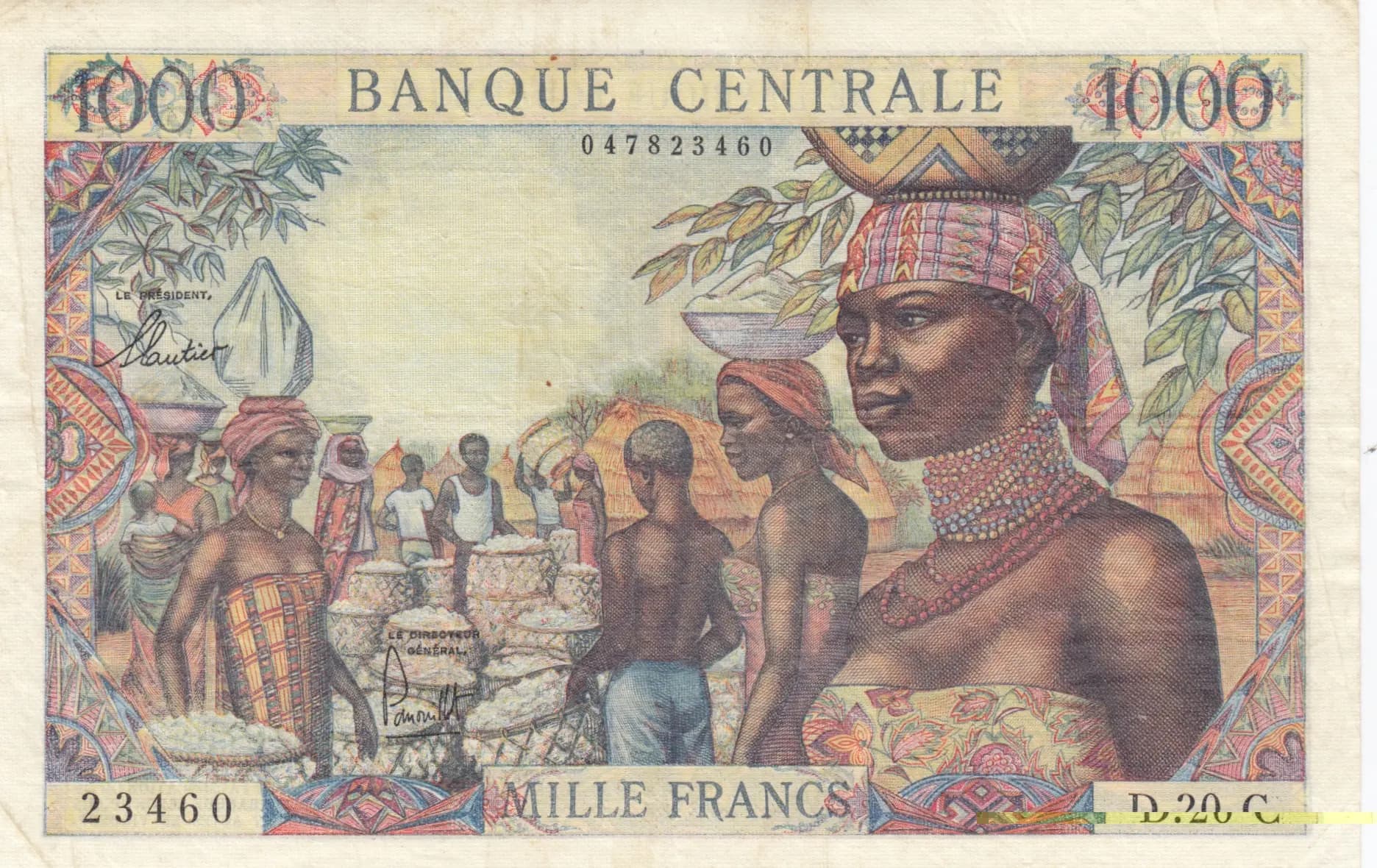
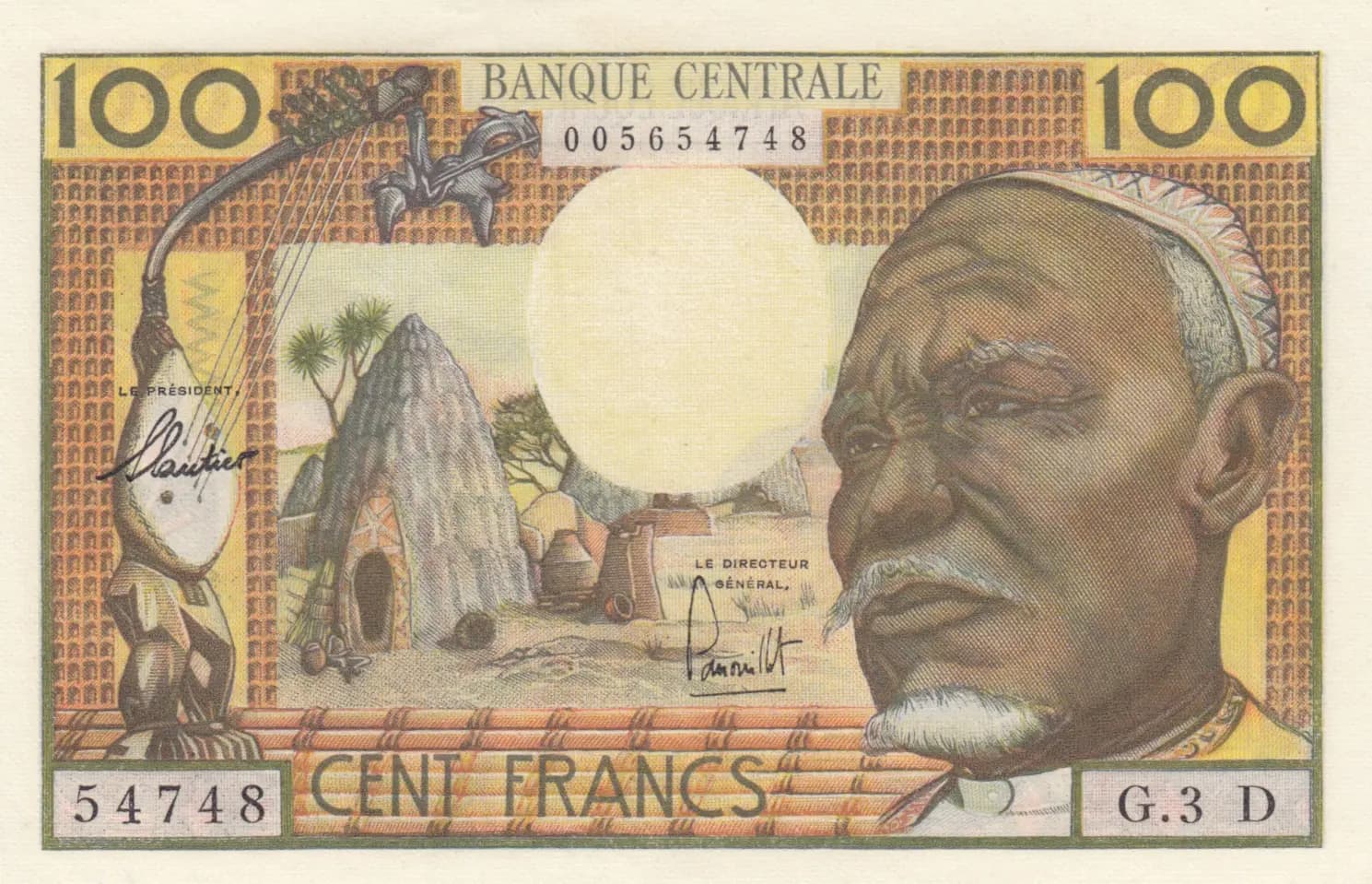
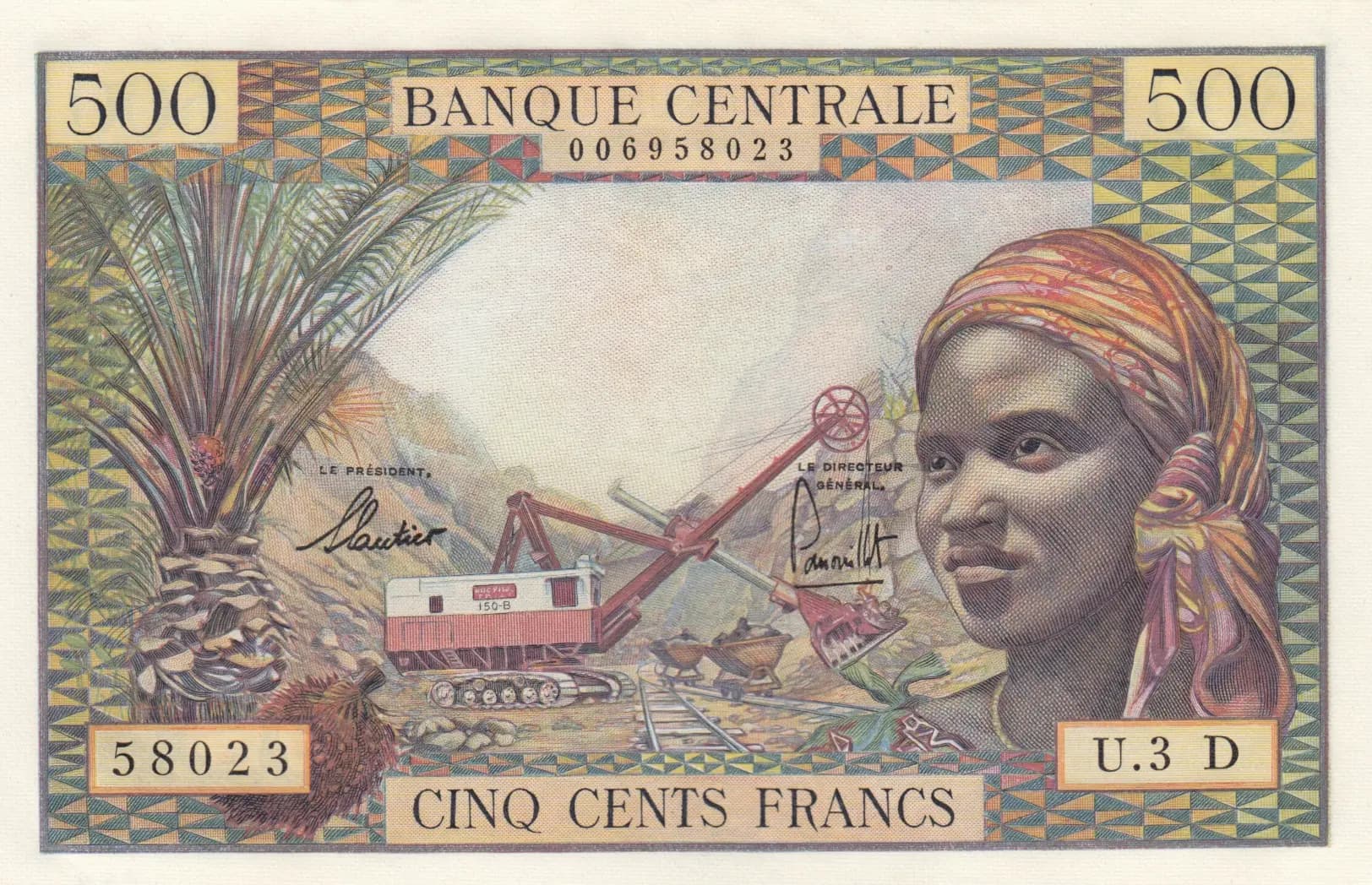
1000 francs 1963
“Gabon”
About This Note
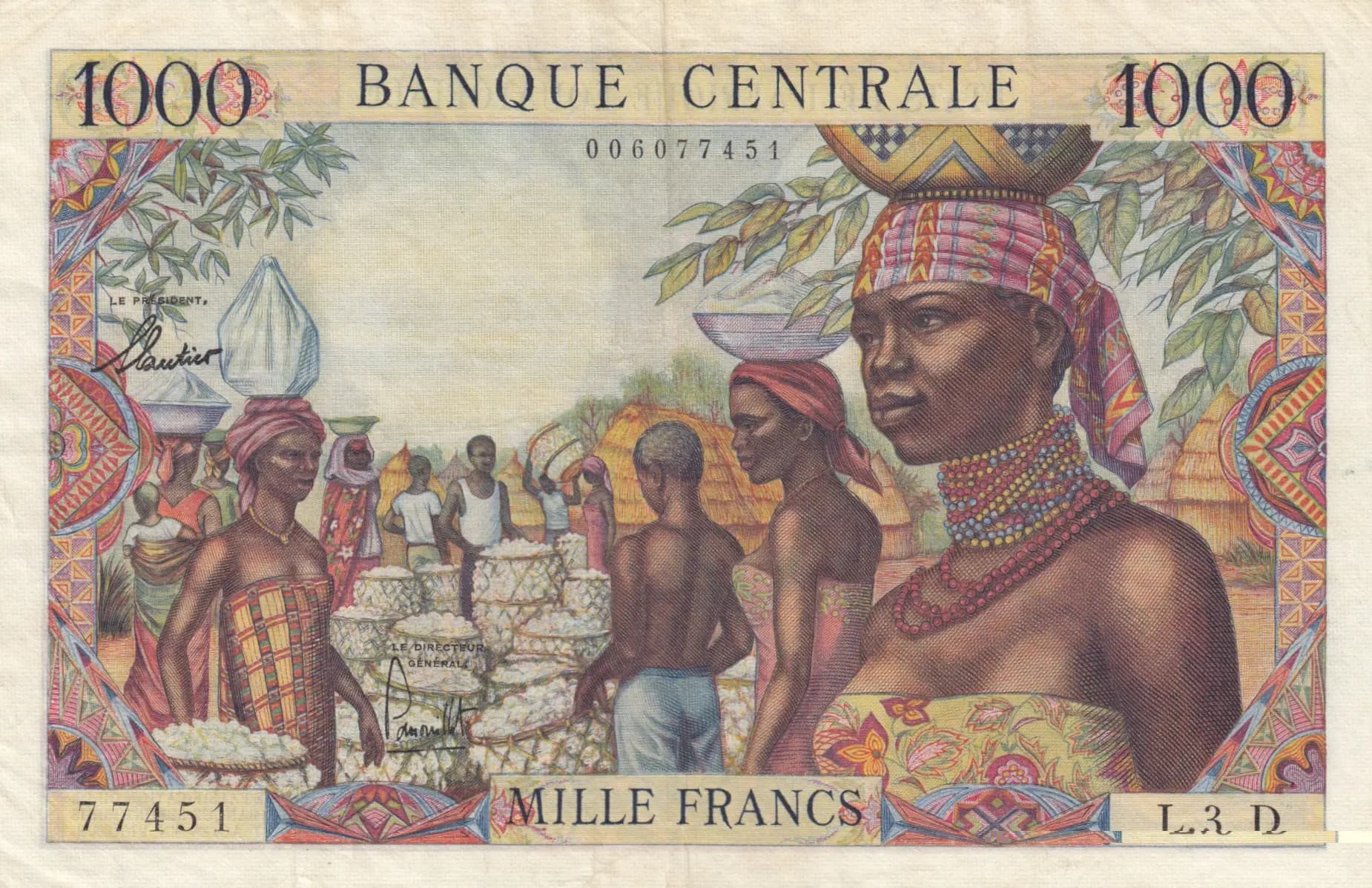
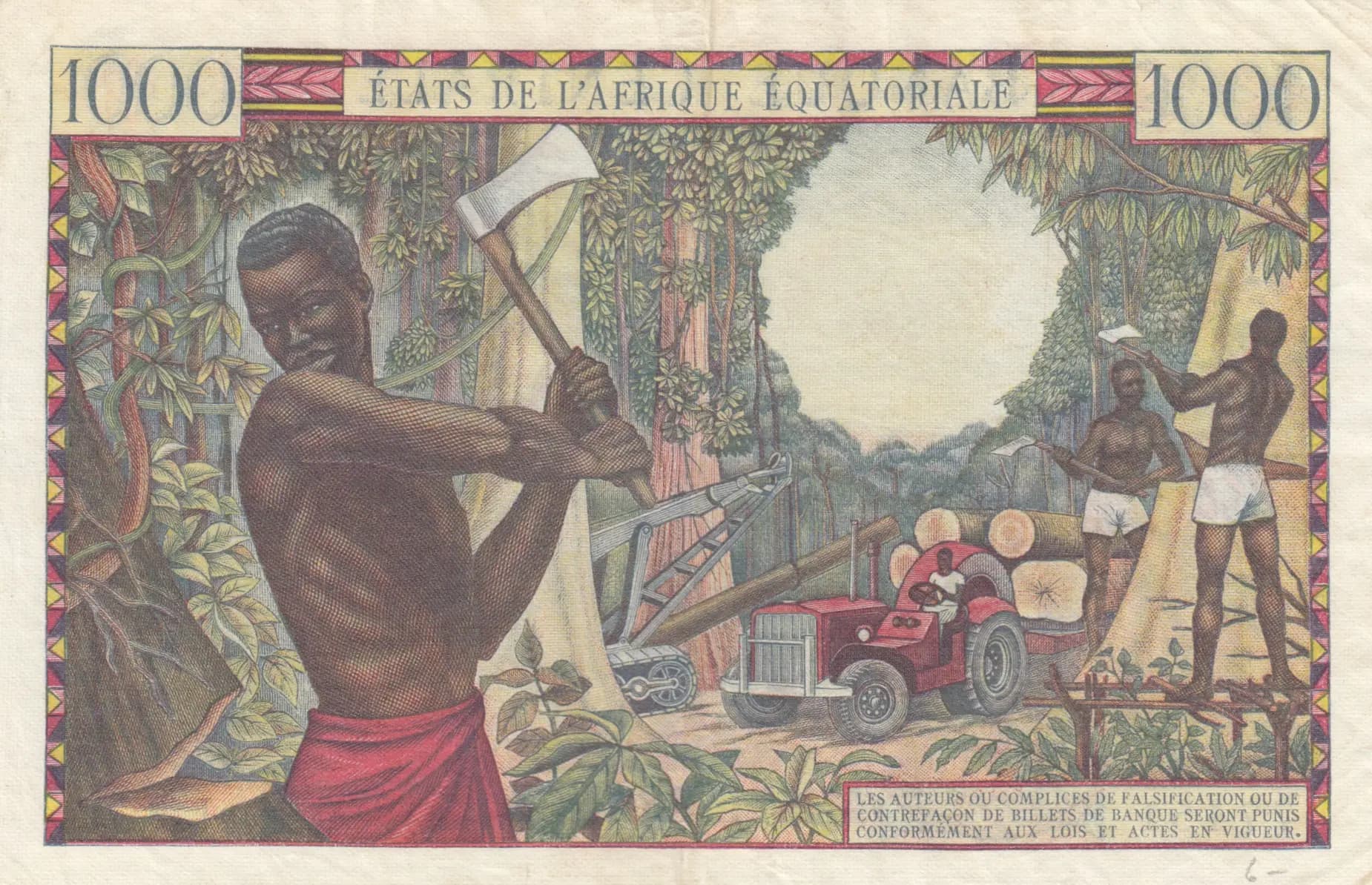
This is a VF-graded 1000 Francs note from the Banque Centrale des États de l'Afrique Équatoriale, issued in 1963 (Pick-5d, Code Letter D variant). The note displays vibrant original color with a cream/beige field contrasted by distinctive pink, orange, and gold decorative borders featuring geometric motifs. The obverse depicts an ethnographic scene of cotton harvesting with multiple African figures in traditional dress, while the reverse shows a labor scene with logging/forestry activities in a tropical setting. Despite its age, the note exhibits good preservation with only minor creasing and toning consistent with proper storage.
Common. The 1000 Francs denomination from the Banque Centrale des États de l'Afrique Équatoriale (1963, Pick-5 series) represents a standard mid-range denomination from a note-issuing authority with a multi-year circulation span. With 13 recorded PMG variants across multiple code letters (A through D), the series shows evidence of substantial print runs across different production batches. Pick-5d specifically (Code Letter D) falls within the normal distribution of variants for this issue. Notes from this series and denomination regularly appear in collector markets at modest price points, consistent with common circulated issues from the 1960s African states.
This banknote was issued during the early years of the Banque Centrale des États de l'Afrique Équatoriale, which served the former French Equatorial African federation (comprising Gabon, Republic of the Congo, Central African Republic, and Chad) during a period of post-independence transition. The thematic imagery—cotton harvesting on the obverse and logging on the reverse—reflects the economic foundation of equatorial Africa during this era, highlighting the primary export industries and colonial-era labor practices that dominated the regional economy in the early 1960s.
The obverse features an ethnographic vignette depicting cotton harvesting in an equatorial African setting. A prominent male figure dominates the right side of the composition, wearing distinctive traditional dress including a pink/red patterned head wrap and multiple beaded necklaces, shown shirtless. A female figure in profile wearing a pink head covering appears on the left, with several background figures in various traditional garments engaged in cotton-related labor. Cotton plants are visible throughout the composition, establishing the economic theme. The reverse depicts a complementary labor scene showing logging or timber extraction activities in a dense tropical forest setting. A shirtless male worker wielding an axe or felling tool occupies the left foreground, with a red tractor visible in the middle distance on a cleared pathway, surrounded by other workers and dense tropical vegetation. Both sides are framed by an ornate decorative border featuring repeated diamond and cross-like geometric motifs in yellow, orange, pink, and gold tones, characteristic of the BEAC note design aesthetic of this period.
FRONT SIDE: 'BANQUE CENTRALE' (Central Bank); 'MILLE FRANCS' (One Thousand Francs); '1000' (denomination, appears twice); 'LE PRESIDENT' (The President) with signature 'Lauriol'; 'LE DIRECTEUR GENERAL' (The General Director); Serial number '006077451' and variant marking 'L.3.D'. BACK SIDE: 'ETATS DE L'AFRIQUE ÉQUATORIALE' (States of Equatorial Africa); '1000' (denomination, appears twice); Legal notice: 'LES AUTEURS OU COMPLICES DE FALSIFICATION OU DE CONTREFAÇON DE BILLETS DE BANQUE SERONT PUNIS CONFORMEMENT AUX LOIS ET ACTES EN VIGUEUR' (The authors or accomplices of falsification or counterfeiting of banknotes will be punished in accordance with applicable laws and regulations in force).
This note exhibits characteristics of intaglio engraving (recess printing), the standard security printing method used by the Banque Centrale des États de l'Afrique Équatoriale for this series. The fine detail visible in the vignettes, the sharp decorative borders, and the crisp line work of the signatures and text are consistent with high-quality intaglio production. The color separation and multi-color printing technique used to produce the vibrant pink, orange, and gold border elements, combined with the base cream field, indicates professional security printing from this era. The printer for this series was Bradbury Wilkinson and Company, a premier security printer of the period.
This note is identified as Pick-5d based on the Code Letter 'D' visible in the designation 'L.3.D' on the obverse. The PMG population data indicates this is one of eight base variants (5a through 5h) plus specimen variants (5as, 5bs, 5cs, 5ds) for the 1000 Francs denomination. The serial number 006077451 and the signature of 'Lauriol' as President are consistent with the standard printing of this variant. The 'L.3.D' marking likely indicates the printing batch or plate position identifier used during the production run. No known overprints, color variations, or error characteristics have been observed in this specimen.