25 piastres 1978
Market Prices
18 salesAbout This Note
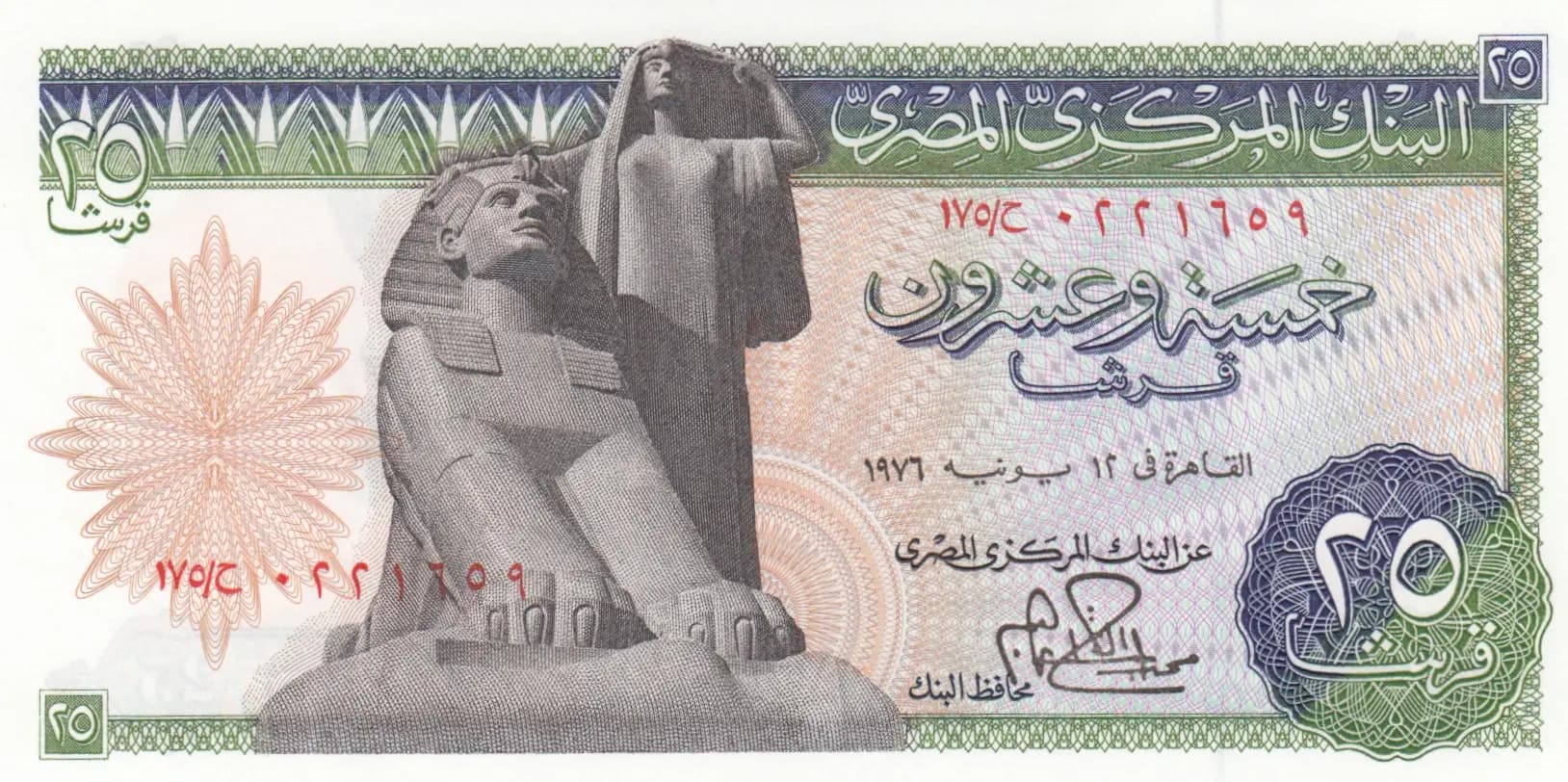
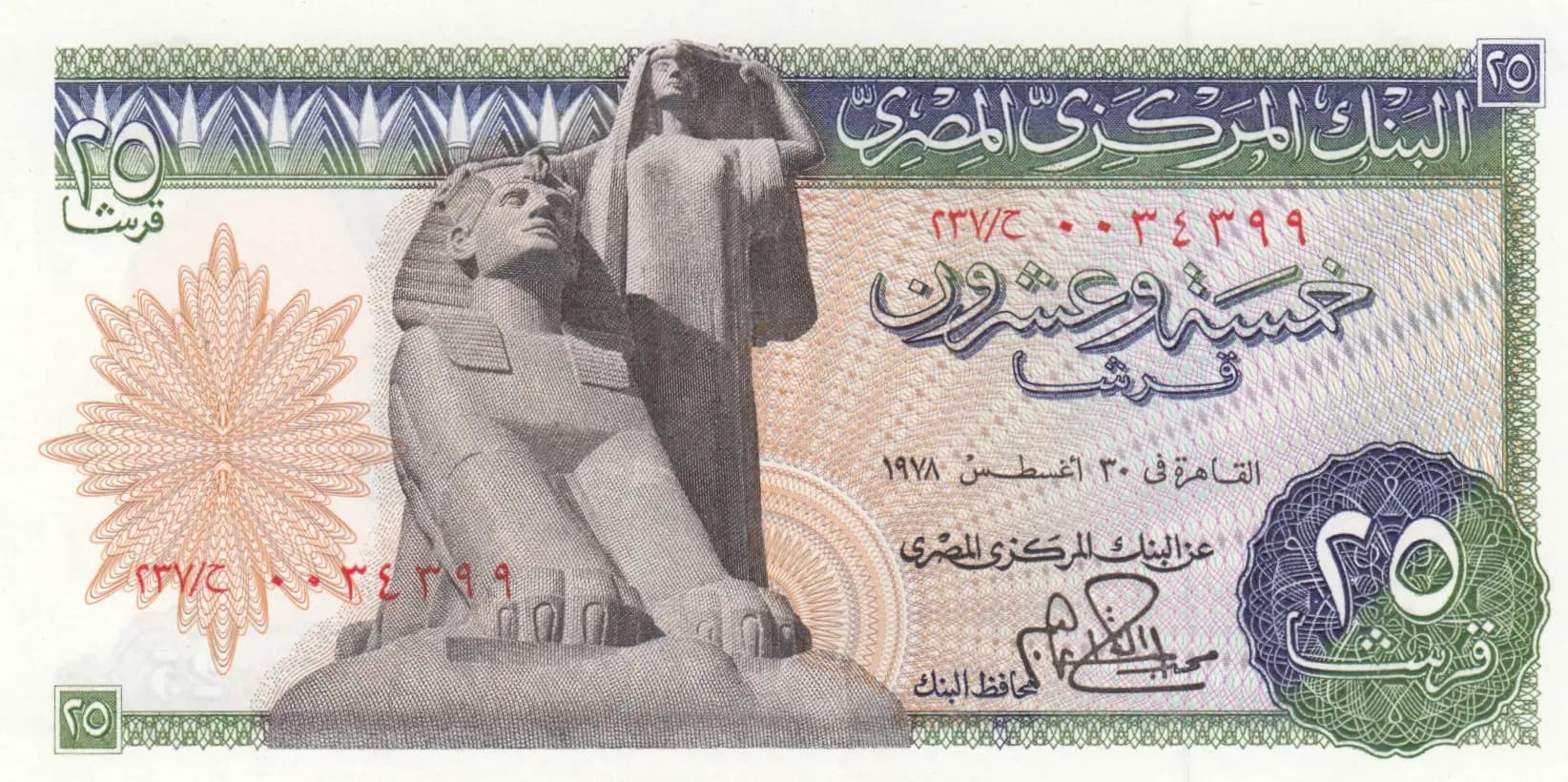
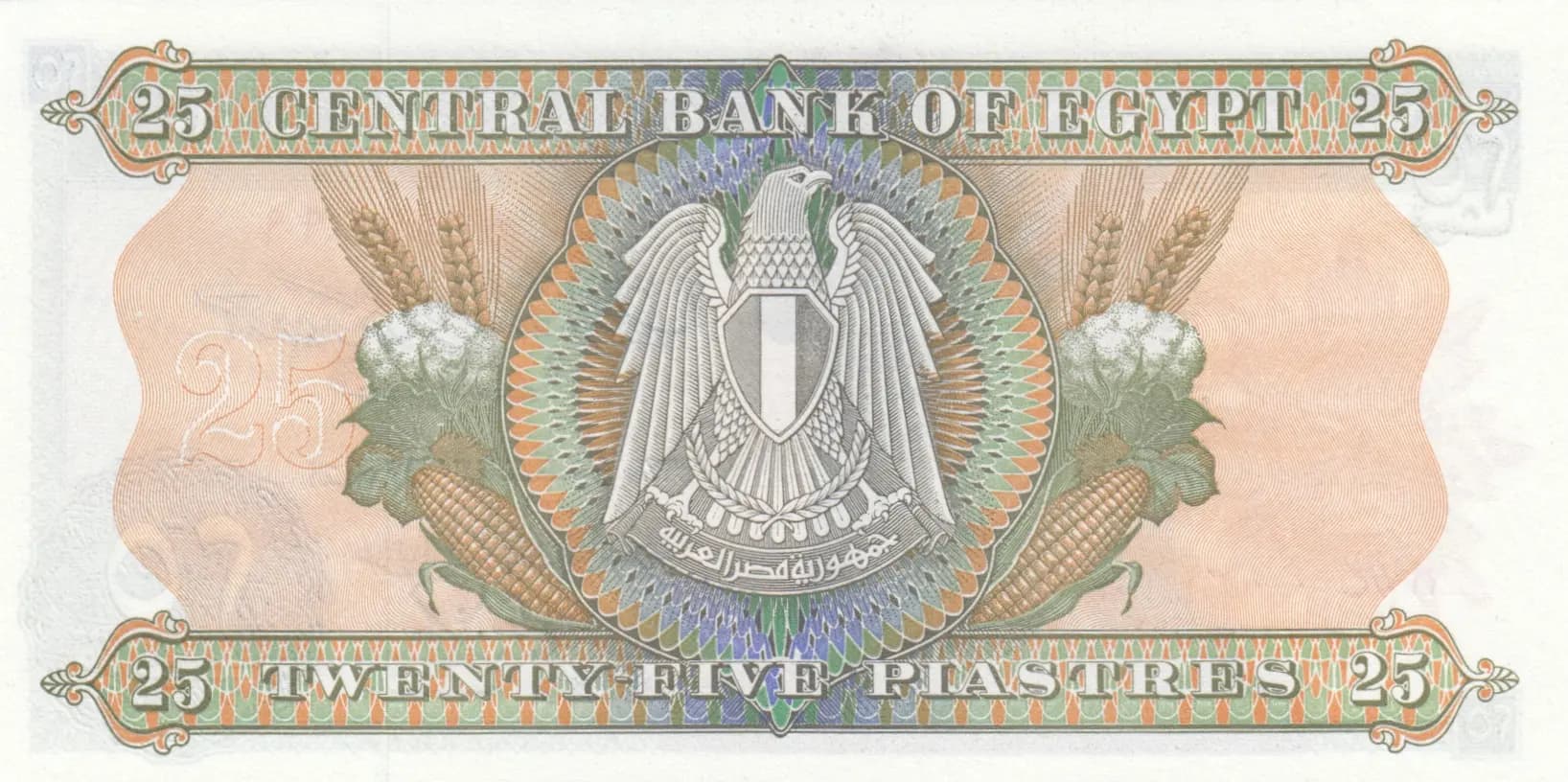
This is a stunning uncirculated example of Egypt's 25 piastres note from 1978 (Pick P-47c), featuring exceptional crisp printing and pristine condition with no signs of wear, folds, or damage. The obverse showcases a striking engraved composition of the Sphinx of Giza paired with Mahmoud Mokhtar's monumental 'Egypt's Renaissance' statue in green and cream tones, while the reverse displays the Egyptian national emblem—a spread-winged eagle with shield—surrounded by decorative wheat motifs in blue, green, and orange. This note represents a significant period in modern Egyptian currency design, blending ancient pharaonic symbolism with mid-20th century national pride and artistic achievement.
Common. This note was issued during a standard multi-year circulation period (1976-1978) by the Central Bank of Egypt as a regular-issue denomination. Market data from realbanknotes.com shows consistent eBay sales with numerous examples in PMG grades (65-66) selling in the $12-$37 range, with catalogue values of $5 UNC as of 2019. The steady supply of examples in high grades on the secondary market, combined with moderate pricing well below $50, confirms this as a common circulating issue despite its artistic merit. No known printing restrictions, recalls, or short-run varieties have been documented for Pick P-47c.
Issued during 1976-1978 by the Central Bank of Egypt, this 25 piastres note commemorates Egypt's cultural and political identity during the post-Sadat era, a period of national reconstruction following the 1973 October War. The front's dual imagery—the Great Sphinx representing Egypt's ancient pharaonic heritage and Mokhtar's 'Egypt's Renaissance' sculpture symbolizing modern Egyptian revival—reflects the nation's desire to connect its glorious past with contemporary aspirations. The reverse's eagle emblem and wheat stalks underscore themes of national sovereignty, prosperity, and agricultural abundance central to Egypt's identity as an Arab republic.
The obverse features two central engraved monuments: the Great Sphinx of Giza on the right and the limestone sculpture 'Egypt's Renaissance' by renowned Egyptian sculptor Mahmoud Mokhtar on the left—the latter depicting a draped female figure representing Egypt's awakening. Both statues are rendered in fine intaglio engraving against a subtle background, framed by ornate geometric and floral borders with a prominent lotus motif on the left side. The reverse displays the national emblem of the Arab Republic of Egypt—a spread-winged eagle with a centralized shield—positioned within an elaborate circular decorative frame of layered patterns in blue and green. Wheat or grain stalks in muted tones flank the eagle, symbolizing agricultural prosperity. Denomination numerals appear in ornate frames at all four corners on both sides.
Front side: 'البنك المركزي المصري' (Central Bank of Egypt), 'خمسة وعشرون فلس' (Twenty-five piastres), '١٩٧٨' (1978), with serial number '٢٦٣٩٩' appearing twice in Arabic numerals. Back side: 'CENTRAL BANK OF EGYPT' (English), 'TWENTY-FIVE PIASTRES' (English), 'جمهورية مصر العربية' (Arab Republic of Egypt in Arabic), with denomination '25' appearing in all four corners. Both sides include bilingual (Arabic/English) text reflecting Egypt's international banking standards of the period.
Intaglio (steel engraving) printing, the standard security printing method for Egyptian banknotes of this period. The fine detail visible in the engraved line work on both the monumental sculptures (obverse) and the national emblem with decorative patterns (reverse), combined with the crisp registration and depth of impression, indicates professional security printing by Egypt's central bank printing facility. The precision of the geometric borders and floral motifs reflects high-quality intaglio reproduction typical of Central Bank of Egypt production standards from this era.
This specific example shows a 1978 date in Arabic numerals (١٩٧٨) on the obverse and bears serial number component '٢٦٣٩٩' in red text. The note is designated as P-47c in the Pick catalog, indicating it is the third cataloged variety of the 25 piastres issue from this series. The visual analysis notes bilingual inscriptions (Arabic and English) and the presence of an archaic Egyptian scribe watermark as standard security features. No signature varieties, overprints, or exceptional printing anomalies are apparent from the images provided; this appears to be a standard circulation variety from the 1978 printing run.