10 piastres 1961
Market Prices
9 salesAbout This Note
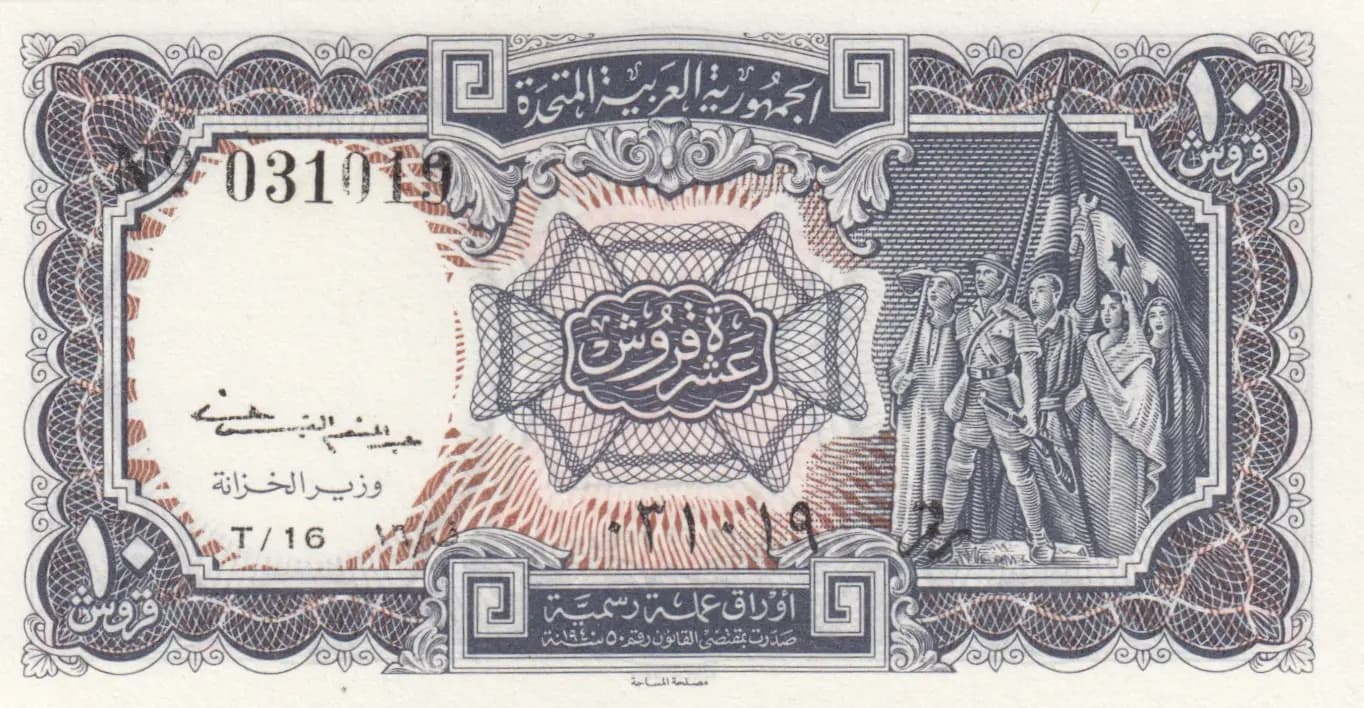
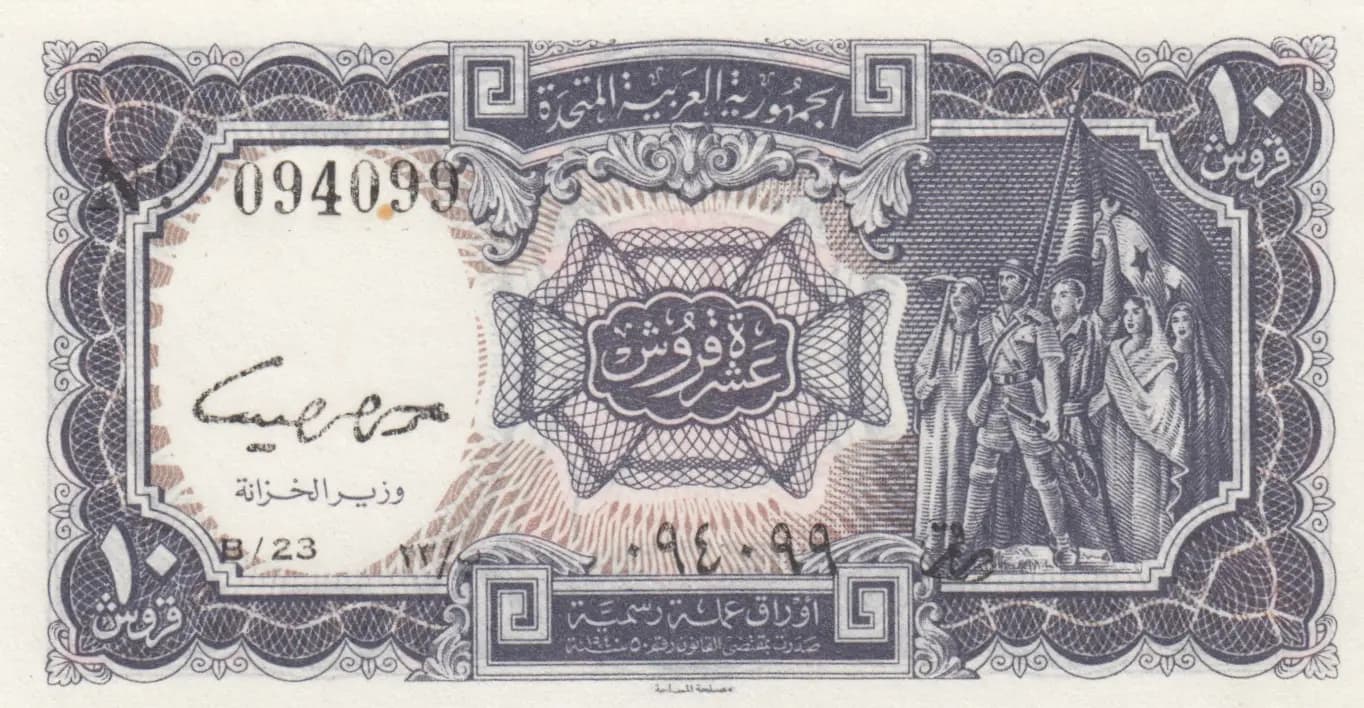
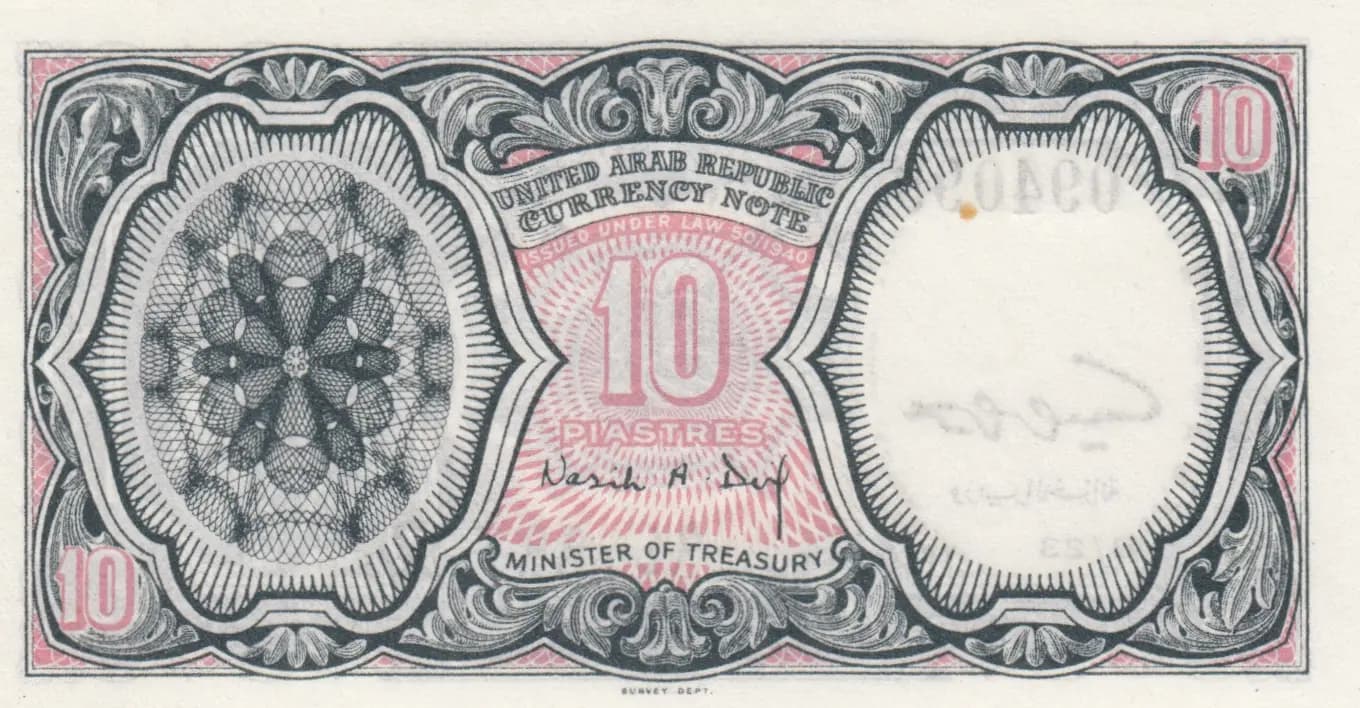
This is an uncirculated 10 piastres note from the United Arab Republic (Egypt), issued in 1961 under Pick catalog number P-181d. The note features exceptional engraving quality with ornate geometric and floral borders in dark purple/navy blue and cream on the front, and dark gray/black with pink on the reverse. The front displays a classical scene with multiple robed figures in formal dress, while both sides showcase intricate rosette patterns with fine mesh work characteristic of high-security printing from this era. Despite some minor age-related foxing, the note remains in excellent preservation with crisp printing and well-defined security features, representing a fine example of mid-20th century Egyptian currency design.
Common. This Pick 181d note shows typical market pricing consistent with other circulated and uncirculated examples of this issue, with recent comparable sales in the $5-15 range for UNC specimens. The 1961 date of this note falls within the standard issue period (L. 1940, issued 1961-1970), indicating substantial print runs. The United Arab Republic issued multiple varieties of this 10 piastres denomination with varying flag designs and text elements (P-175, P-177, P-178, P-181d, P-183, P-184), further indicating this was not a limited issue. Catalog values of $15 UNC from 2019 data confirm this as a standard collector item rather than a scarce variety.
This note was issued during the period of the United Arab Republic (1958-1971), when Egypt and Syria were united under President Gamal Abdel Nasser's pan-Arab nationalist vision. The classical figures depicted on the front likely represent symbols of Egyptian heritage and continuity, reflecting the new republic's emphasis on modern Arab identity rooted in ancient civilization. The bilingual design—with both Arabic and English inscriptions—demonstrates Egypt's positioning within international commerce while maintaining its Arabic cultural identity during this pivotal post-colonial period.
The front of the note features an elaborate classical scene depicting multiple figures in ceremonial robes arranged in a formal composition on the right side, symbolizing Egyptian statesmanship and classical heritage. The design is framed by ornate geometric borders with scrollwork flourishes in the corners. The central motif is an intricate rosette or star pattern with fine mesh work, serving both aesthetic and security purposes. The back maintains symmetrical balance with two identical ornate rosette patterns positioned on the left and right sides, separated by a central text panel. Throughout the design, fine geometric patterns and grid work are employed as anti-counterfeiting measures. The color scheme—dark purples and creams on the obverse, dark grays with pink accents on the reverse—creates strong visual contrast and aids in note authentication.
Front side: 'جمهورية مصر العربية' (Arab Republic of Egypt), 'عشرة قروش' (Ten piastres), 'وزير الخزانة' (Minister of Treasury), serial number '0940999', and series designation 'B/23'. Back side: 'UNITED ARAB REPUBLIC', 'CURRENCY NOTE', '10 PIASTRES', 'MINISTER OF TREASURY', signature of official 'Darish A. Duff', and 'SURVEY DEPT.' (Survey Department printer attribution).
This note was produced using intaglio (engraved) printing, as evidenced by the exceptional depth, clarity, and fine line work visible in the intricate rosette patterns, geometric borders, and portrait figures. The Survey Department of Egypt, credited as the printer on the reverse, utilized multiple color intaglio printing to achieve the precise registration visible between the dark blue/purple primary colors and the secondary pink and cream tones. The fine mesh patterns in the rosette designs and the detailed scrollwork throughout the borders are characteristic of high-security intaglio engraving. The crisp definition of even the finest decorative elements confirms the use of steel plate engraving rather than lithographic or offset printing methods.
This note is specifically identified as P-181d, characterized by a flag with two stars without small text line at the upper center on the front (positioned between the issuer's name and denomination value). This distinguishes it from related varieties: P-177 and P-178 which have similar two-star flags but include a text line; P-183 which lacks the text line but has different flag design; and P-175 and P-184 which feature entirely different flag designs. The series designation 'B/23' and serial number '0940999' are visible on this specimen. No overprinted pattern appears on the watermark area, distinguishing this from the overprinted variant referenced under Egypt P-171.