10 piastres 1940
Market Prices
4 salesAbout This Note
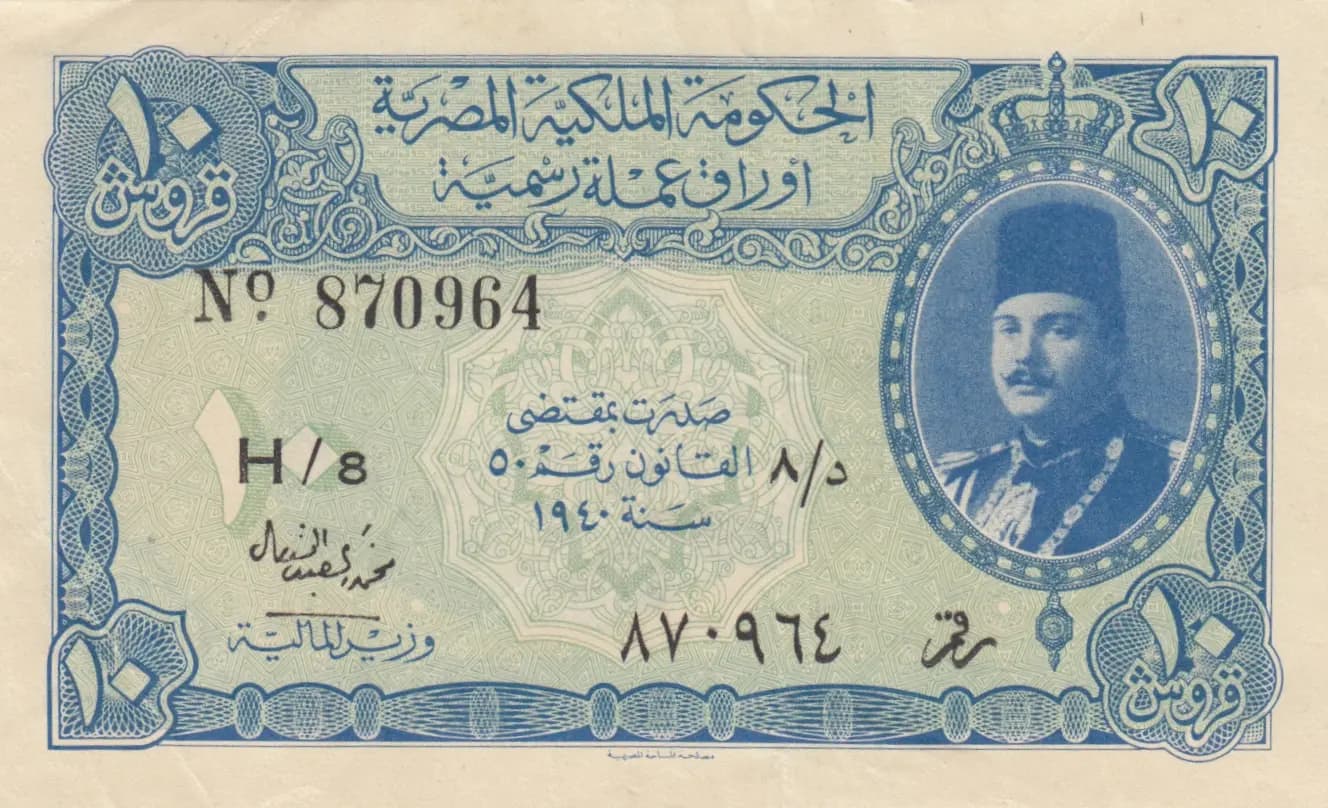
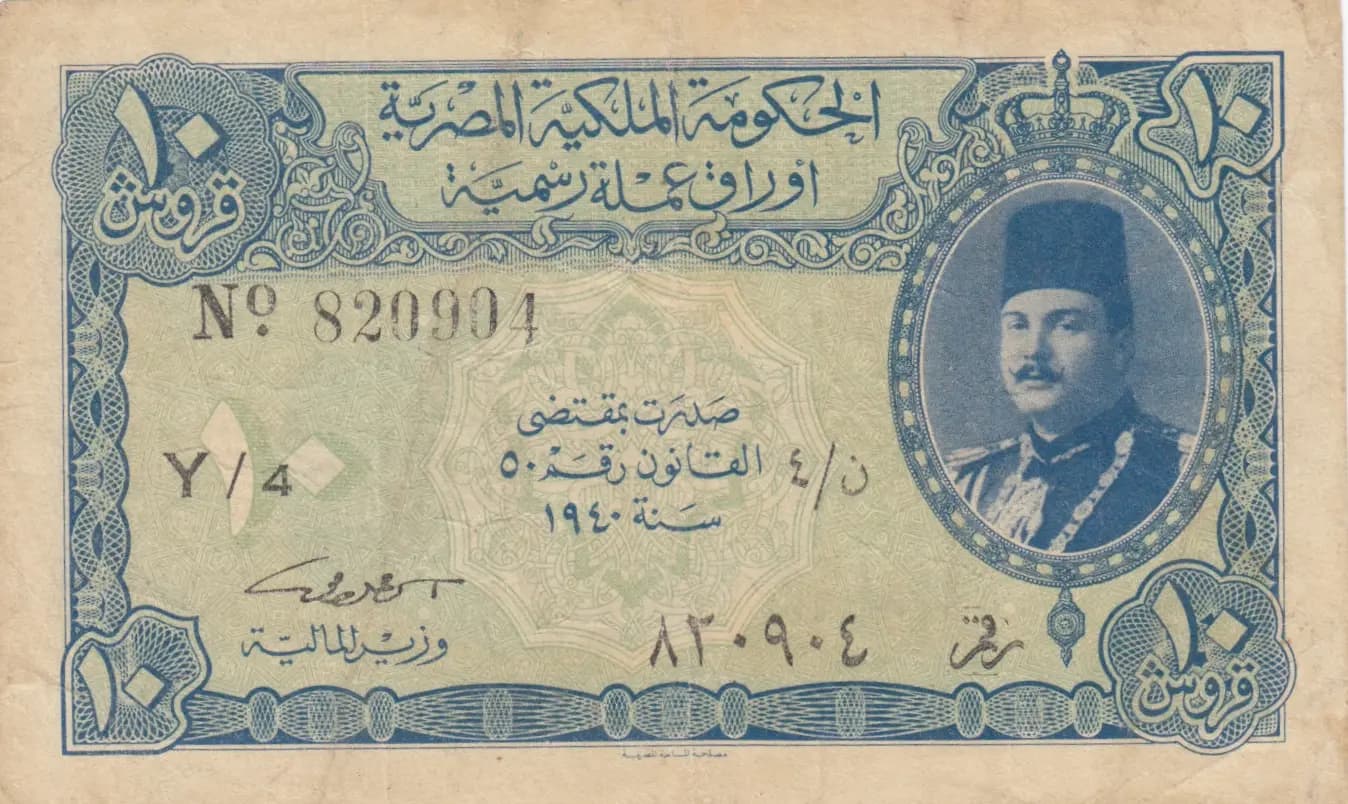
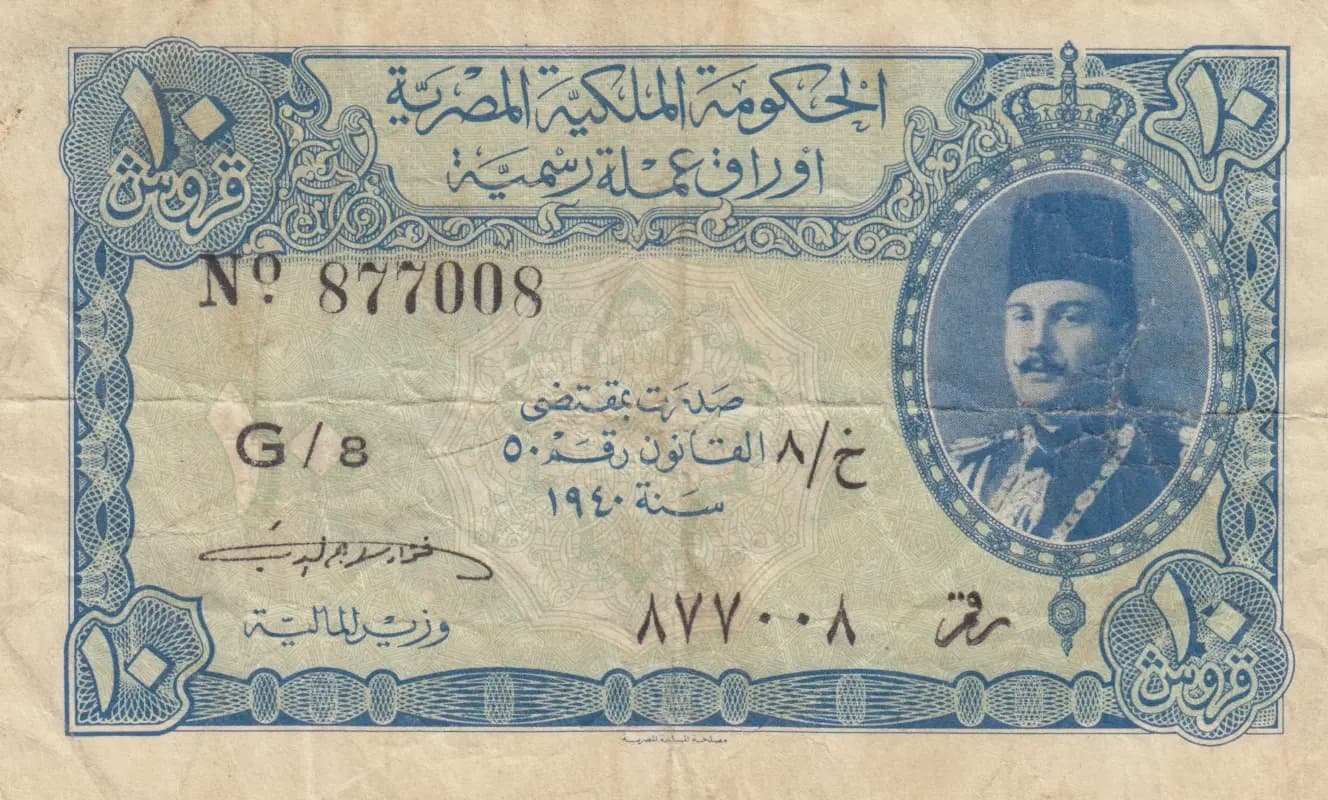
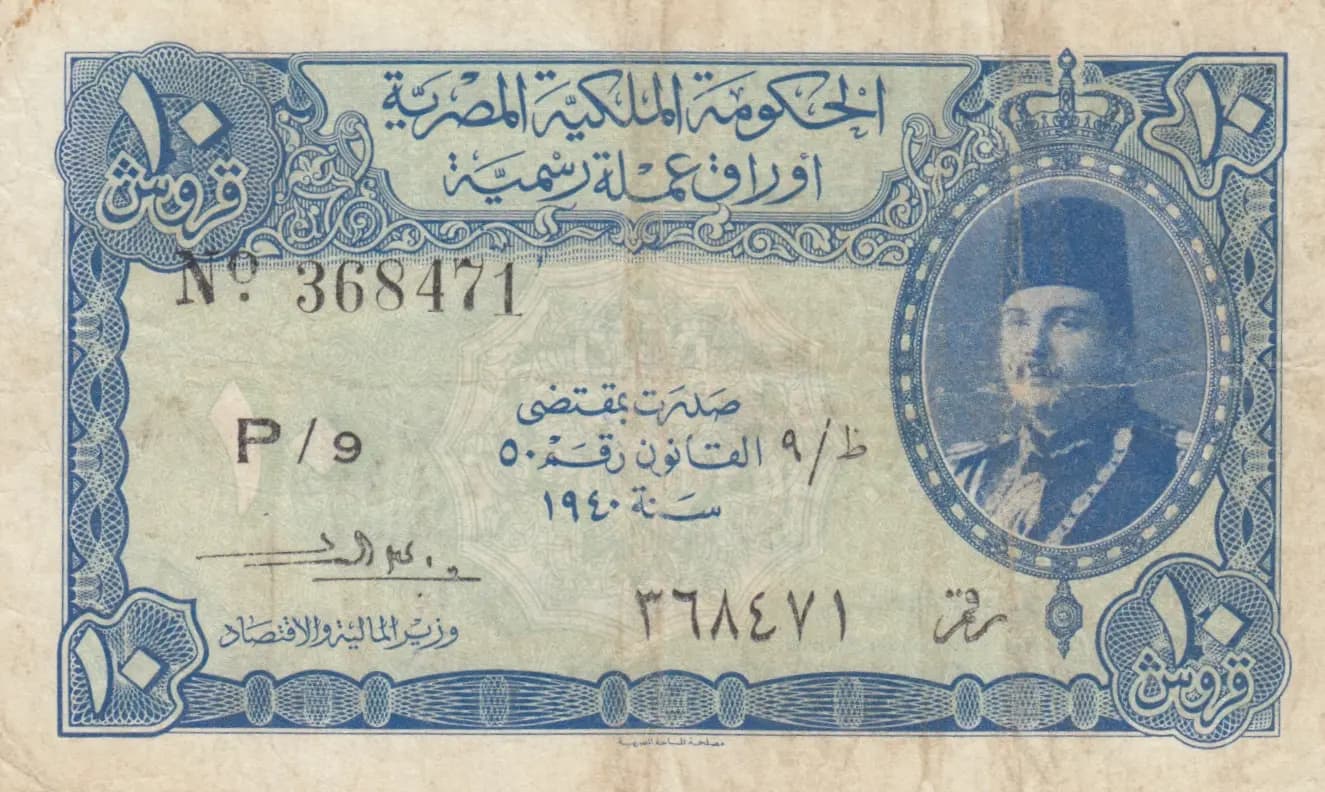
This Egyptian 10 Piastres note from 1940 (Pick P-168b) features a striking portrait of King Farouk I in traditional dress within an oval frame on the obverse, rendered in blue on green underprint with intricate ornamental borders. The note exhibits heavy foxing, creasing, and age-related discoloration throughout both sides, consistent with its Fair condition grade and decades of circulation or storage. The visual evidence of authentic period printing, royal symbolism (crown, crescent moon), and dual-language inscriptions (Arabic and English) makes this an important example of Egyptian Royal Government currency from the pre-Nasser era.
Common. While this is a legitimate Royal Government of Egypt banknote from 1940, the eBay auction data provided shows F-graded examples selling in the $11–$67 range with modest bidding activity (5–8 bids), indicating steady but not exceptional collector demand. The 2016 catalog value for VG condition ($20) and the consistent reappearance of examples in the market suggest adequate circulation of this note. Most 1940s Egyptian piastre notes were issued in substantial quantities to support commerce during the wartime period, and this denomination remains readily available to collectors. The Pick P-168b designation indicates this is one of two known varieties, but neither is particularly scarce.
This note was issued in 1940 under Law No. 50, during the reign of King Farouk I when Egypt remained a constitutional monarchy under British influence. The Royal Egyptian Government's emphasis on dual Arabic and English inscriptions reflects Egypt's political situation during World War II, while the formal portrait and ministerial signatures underscore the note's role as an instrument of state authority. The denominator in both currencies and the official imagery served to legitimize Farouk's rule during a period of significant geopolitical tension in the Middle East.
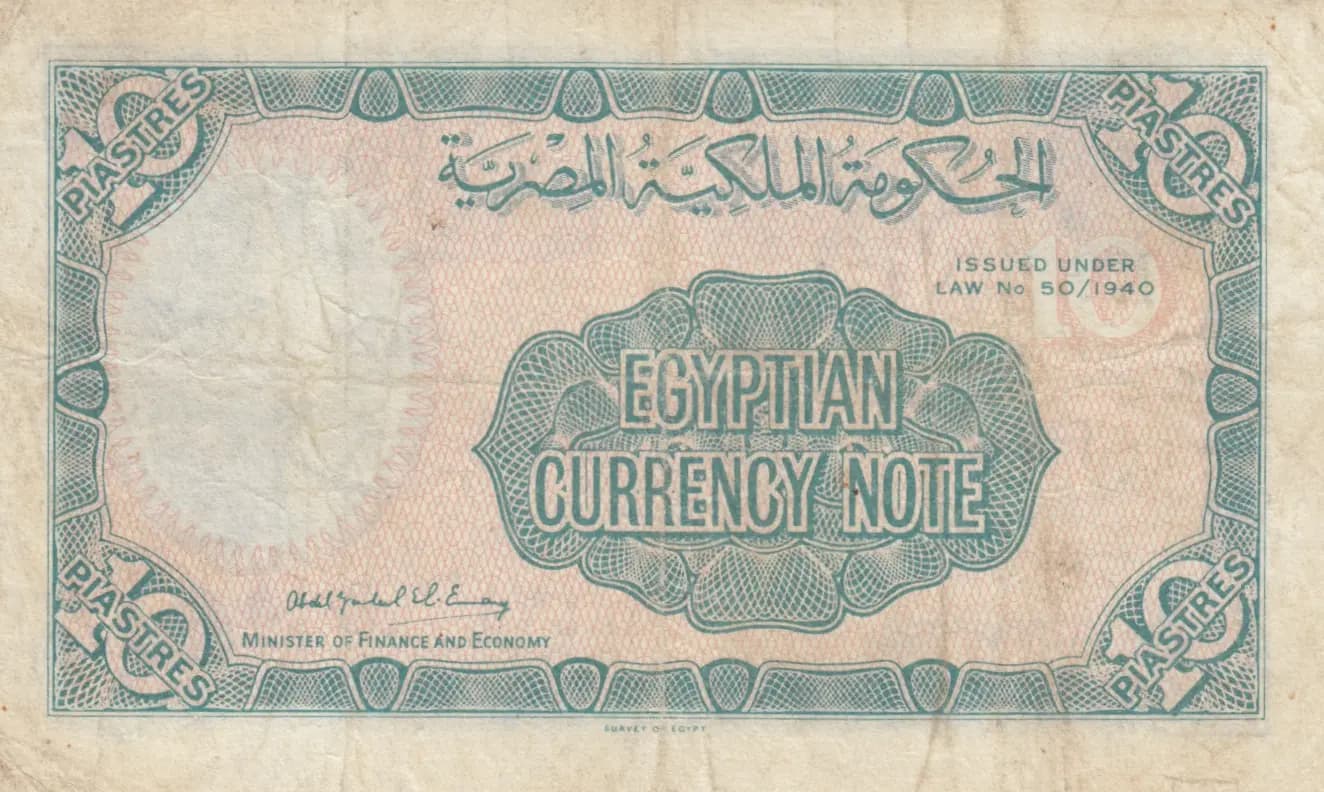
The obverse features a formal portrait of King Farouk I positioned in profile facing left within a decorative oval frame on the right side, depicted wearing a traditional Egyptian fez and formal dress befitting a monarch. The portrait is executed in the classical engraved style characteristic of mid-20th-century state currency. A royal crown symbol appears in the top right corner, while crescent moon symbols are integrated into the ornate corner designs—references to both royal and Islamic authority. The entire note is framed by intricate geometric and floral patterns in blue with cream/beige background, demonstrating advanced security printing techniques. The reverse features symmetrical decorative corner medallions and maintains the green/teal coloring with cream and pink/salmon undertones, creating visual distinction between obverse and reverse without compromising the design's unified royal aesthetic.
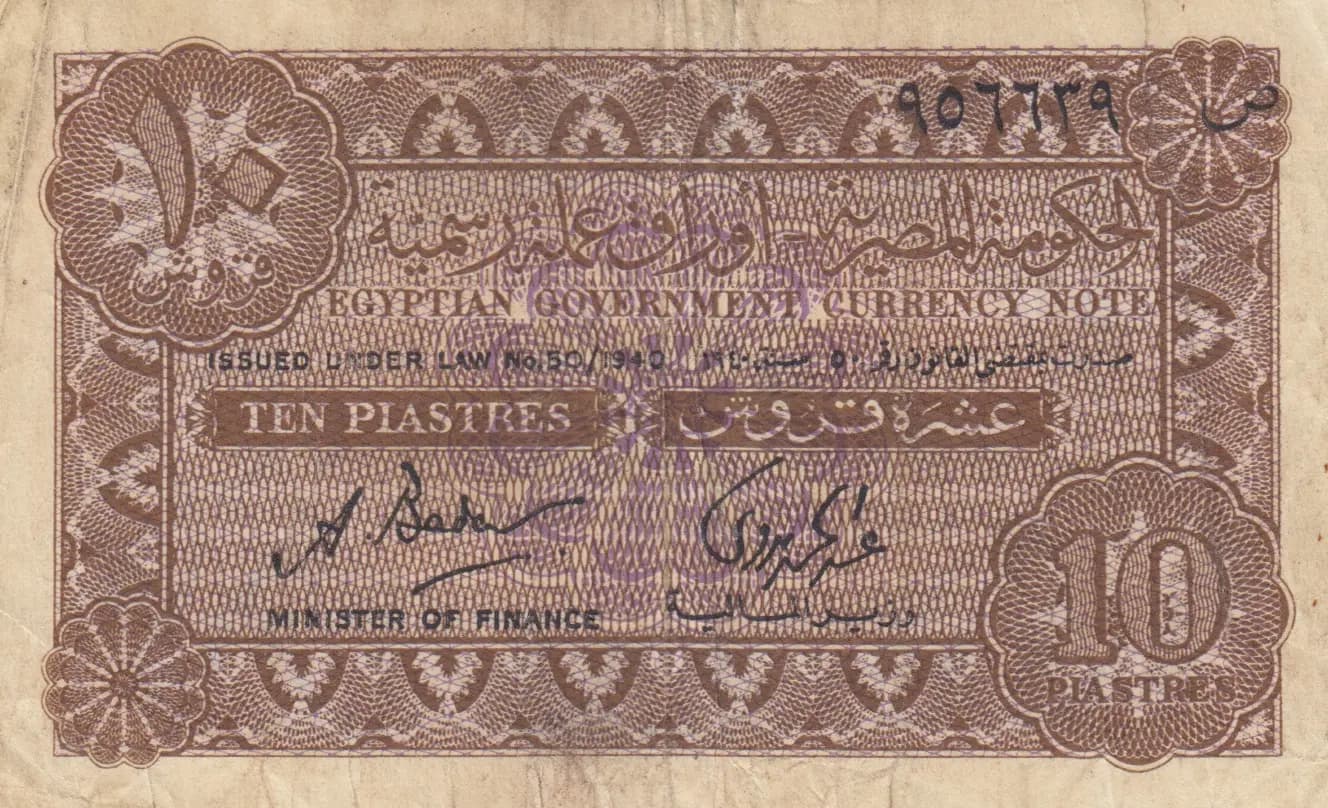
FRONT SIDE: Arabic: 'الحكومة الملكية المصرية اوراق نقدية' (The Royal Egyptian Government Currency Notes); 'رقم' (Number) with serial 368471; 'صيغة قيقية' (Genuine form); 'طـ/9 الماثـون رقم. ٥٠' (Law No. 50); 'سـنـة ١٩٤٠' (Year 1940); 'وزير المالية والاقتصاد' (Minister of Finance and Economy); Arabic numerals 2684471. English/Latin: P/9. BACK SIDE: Arabic: 'الحكومة الملكية المصرية' (The Royal Egyptian Government); signature 'عبد الرحمن الفايومي' (Abd al-Rahman al-Faiyumi). English: 'ISSUED UNDER LAW No 50/1940'; 'EGYPTIAN CURRENCY NOTE'; 'MINISTER OF FINANCE AND ECONOMY'.
Intaglio (engraved) printing on banknote stock, executed by the Survey of Egypt as listed in the catalog data. The fine line work, intricate geometric border designs, and ornamental security patterns visible throughout both sides are hallmarks of traditional intaglio/engraving techniques employed for high-security currency production. The precise detail in the royal portrait and the complexity of the background patterning confirm professional currency-grade engraving. The color separation between obverse (blue on green) and reverse (green on light orange) reflects period offset printing capabilities combined with intaglio security elements.
This note is cataloged as Pick P-168b, one of two varieties for the 10 Piastres 1940 issue (P-168a and P-168b variants are listed in the PMG population report). The signature title 'MINISTER OF FINANCE AND ECONOMY' appears on the back, and the signature of Abd al-Rahman al-Faiyumi is visible in the visual analysis. Signature varieties are noted in the realbanknotes.com reference, suggesting that different ministerial signatures or title variations distinguish P-168a from P-168b. Serial number and printer designations (P/9 visible on the observed example) may also indicate specific printing runs or signature combinations. Without access to side-by-side comparison of P-168a, the exact distinguishing characteristics of P-168b cannot be definitively stated from this analysis alone, but signature/ministerial variations are the most likely determinant.