5 shillings 1961
Market Prices
1 saleAbout This Note
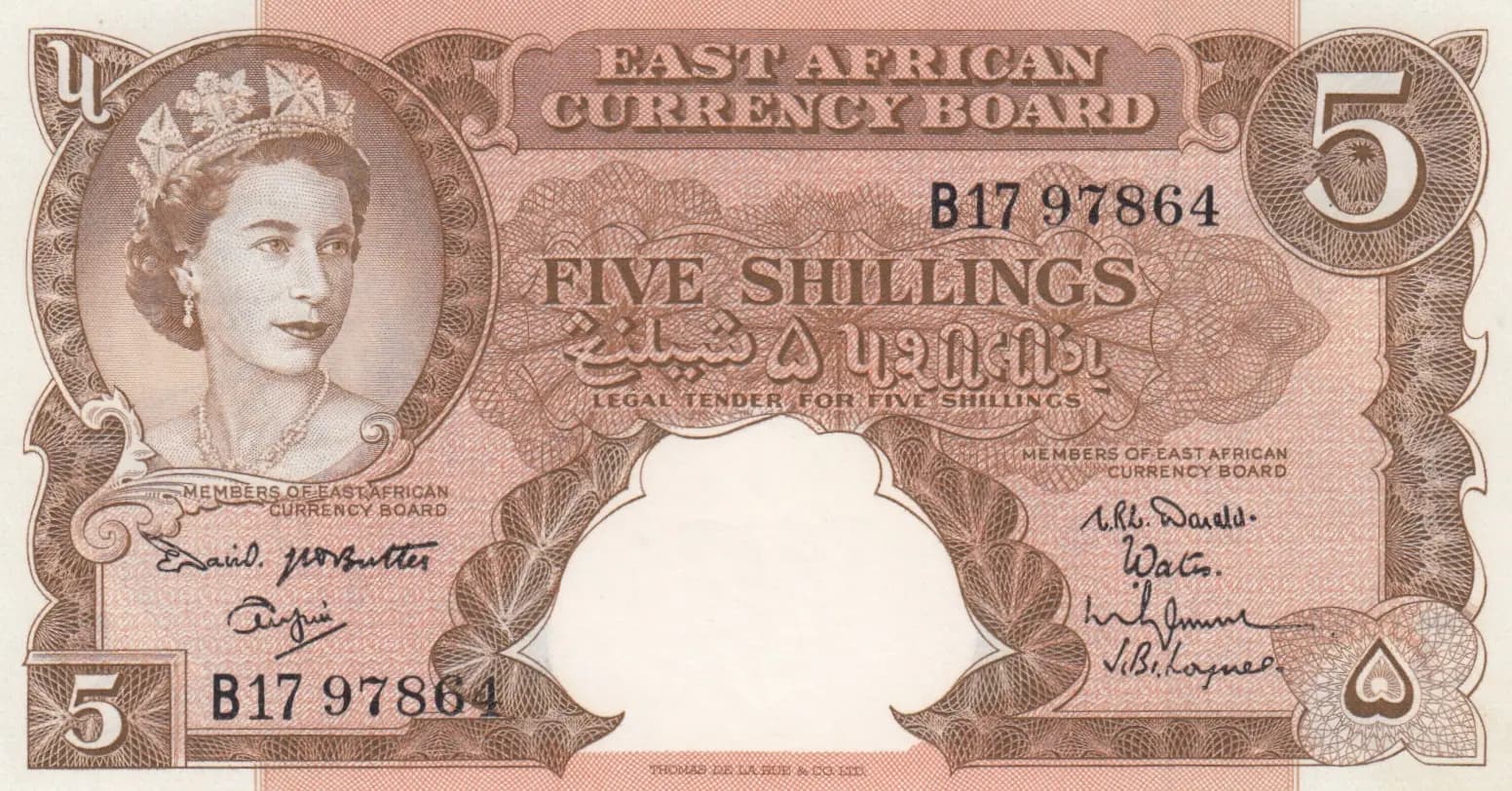
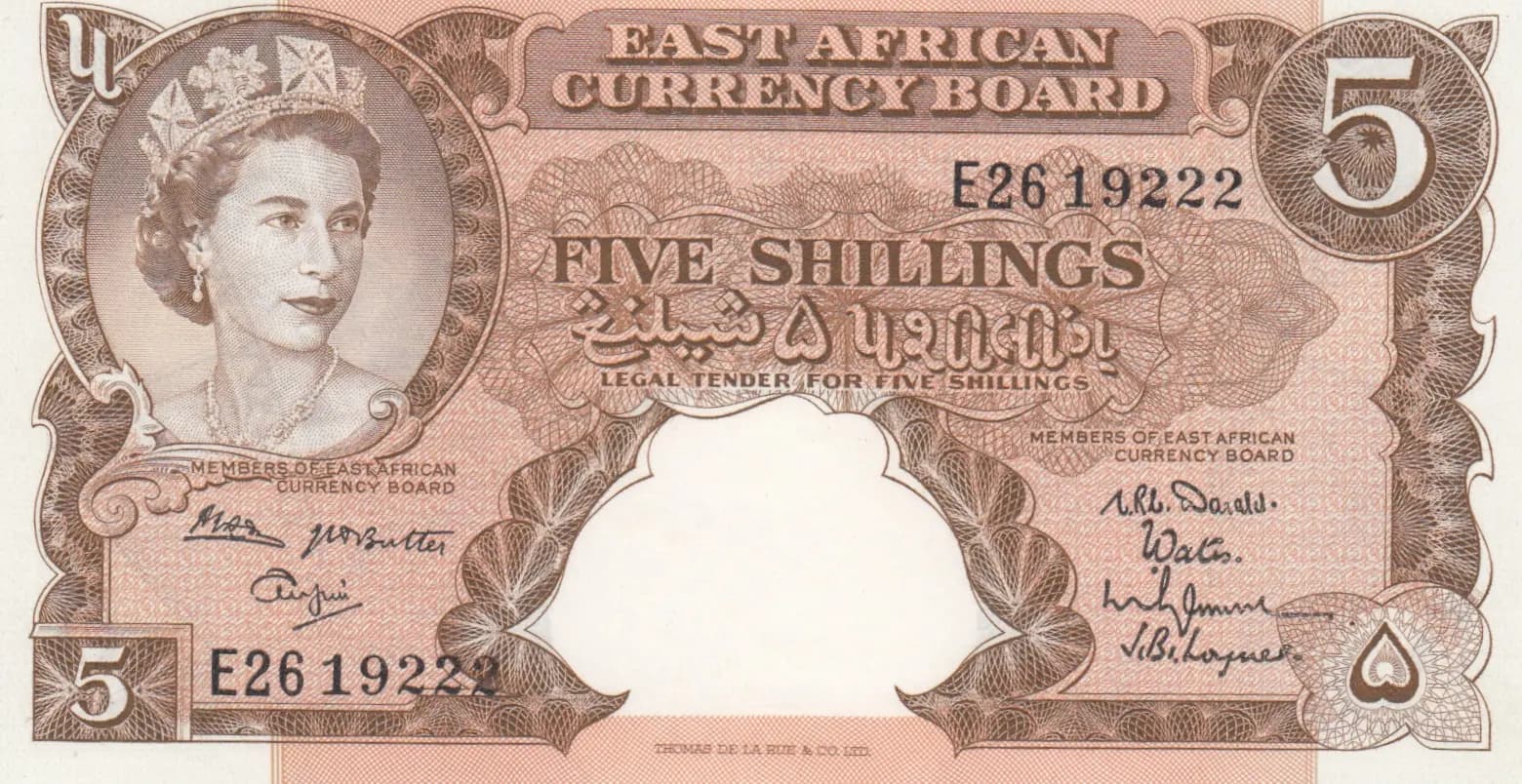
An exceptional uncirculated example of the East African Currency Board's 5 Shillings from 1961, featuring a portrait of Queen Elizabeth II in profile on the obverse. The note displays the characteristic brown coloration on light red underprint with crisp, sharp engraving throughout, ornate scrollwork borders, and bilingual inscriptions in English and Arabic reflecting the multicultural East African region. This is a historically significant note representing the early monetary independence of East Africa, with catalogue values reaching $200 in UNC condition.
Common. While the note is historically significant, the East African Currency Board issued these notes in substantial quantities during its operational period (1961-1963) across Kenya, Tanzania, and Uganda. The catalogue value of $200 in UNC condition reflects collector demand for high-grade examples of early post-independence African currency rather than scarcity of the note itself. VF examples regularly appear on secondary markets at modest prices ($15-20 range per eBay historical data), indicating adequate supply. The uncirculated condition grade and variant P-41b designation make this specific example more desirable than circulated specimens, but the base note type remains common in the broader numismatic market.
Issued during 1961-1963 by the East African Currency Board, this note represents a pivotal moment in East African monetary history following Kenya's path toward independence. The prominent portrait of Queen Elizabeth II reflects the region's Commonwealth ties during this transitional period, while the bilingual English-Arabic inscriptions demonstrate the cosmopolitan nature of East African commerce and the significant Arab trading communities along the coast. The note was printed by Thomas de la Rue, London, the premier security printer of the era, ensuring the highest standards of anti-counterfeiting measures available at the time.
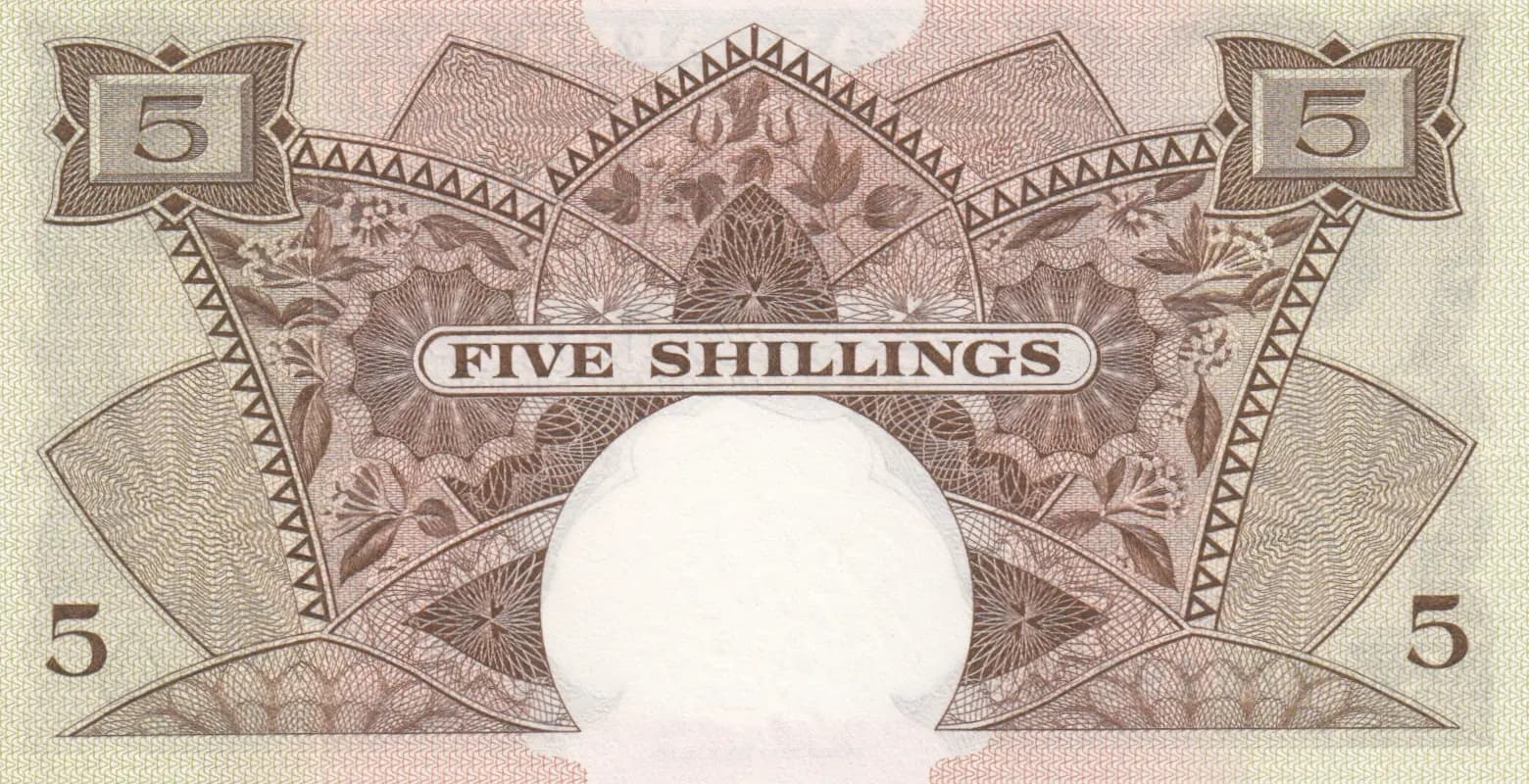
The obverse features a left-facing profile portrait of Queen Elizabeth II at the upper left, depicted in formal attire with earrings, rendered in the classical style typical of Commonwealth currency of the period. The portrait is framed within an ornate oval cartouche. The reverse displays an elaborate decorative pattern composition featuring shield-shaped frames containing the numeral 5 positioned in all four corners, with a large central white oval space (typical of the era's design practices), surrounded by intricate floral fan-like designs, geometric triangle pattern borders, and diamond-shaped ornamental elements. The overall color scheme of brown on light red underprint creates a warm, sophisticated appearance characteristic of 1960s African currency design. Multiple signature lines are visible on the obverse (three at left, four at right according to the catalog data).
Front side: 'EAST AFRICAN CURRENCY BOARD' (issuing authority); 'FIVE SHILLINGS' (denomination in English); 'شيلنج خمسة' (Five Shillings in Arabic); 'LEGAL TENDER FOR FIVE SHILLINGS' (legal declaration); 'MEMBERS OF EAST AFRICAN CURRENCY BOARD' (institutional reference); Serial number 'E26 19222' appearing at top and bottom. Back side: 'FIVE SHILLINGS' (denomination); '5' (numeral denomination) appearing in shield-shaped frames in all four corners.
Intaglio engraving, executed by Thomas de la Rue, London. The note exhibits the hallmark characteristics of high-quality steel plate engraving: fine crosshatching throughout, intricate geometric and floral patterns, sharp, crisp line work, and complex ornamental borders. The security features include the fine engraving patterns, multiple serial number placements, multilingual text, and elaborate background designs—all standard anti-counterfeiting measures of Thomas de la Rue's security printing practice in the early 1960s.
This note is identified as Pick P-41b variant, distinguished from P-41a by Nairobi origin designation. The specific variety is characterized by three signatures at the left and four signatures at the right, with the leftmost signature identified as A. L. Adu. The serial number format 'E26 19222' is consistent with East African Currency Board numbering conventions. The catalog references indicate this 1962-dated specimen represents the standard regular issue type of the series, with the ND (No Date) notation in some references reflecting printing variations across the 1961-1963 issuance period.