5 francs 1928
About This Note
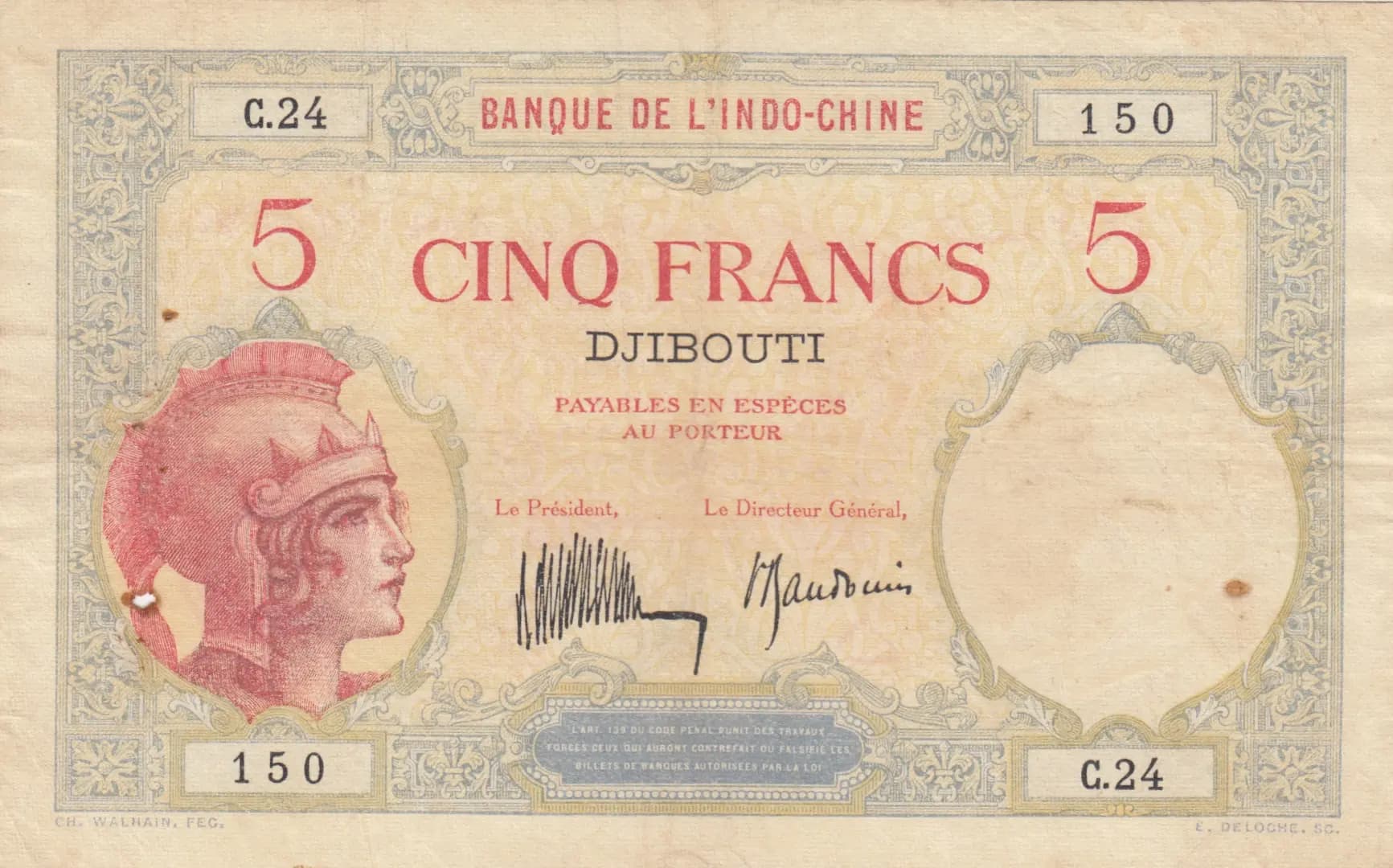
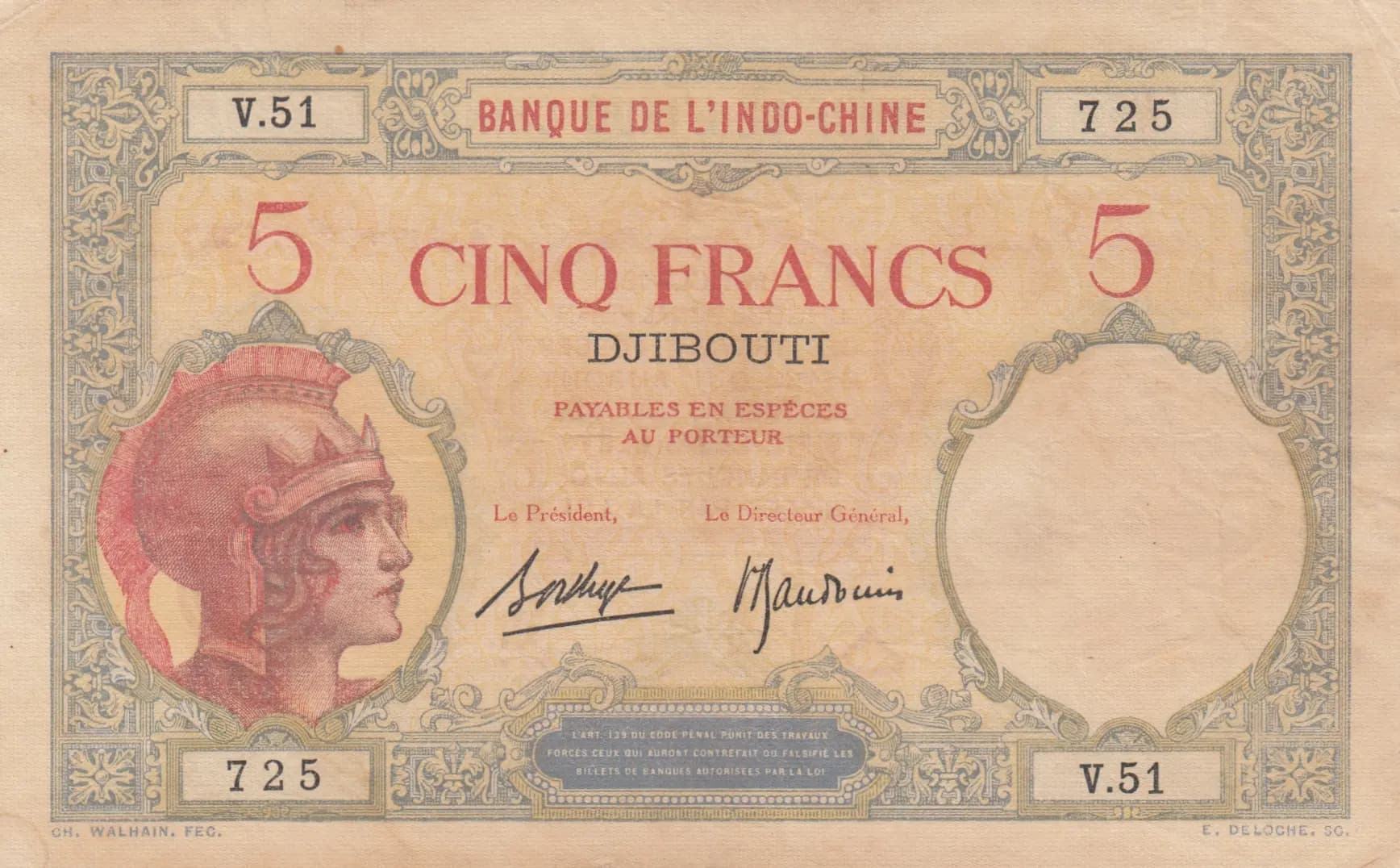
This is a VF-grade 5 Francs banknote from the Banque de l'Indo-Chine, specifically issued for circulation in Djibouti in 1928. The note features an exceptionally ornate decorative border with geometric and floral patterns in red, gray, and black on a cream background, along with a classical helmeted profile portrait on the obverse. The well-preserved condition, sharp engraving detail, and presence of handwritten signatures by bank officials make this an attractive example of early 20th-century French colonial currency.
Common. The Banque de l'Indo-Chine operated for several decades and issued substantial quantities of currency across multiple territories including Djibouti. The Pick catalog identifies this as P-6b, indicating it is a catalogued standard issue rather than a short-lived or emergency emission. Notes from this series appear with reasonable regularity on the numismatic market. VF condition examples are desirable but not exceptionally scarce, and the note does not exhibit characteristics of a rare emission (small print run, recall, or limited territorial distribution).
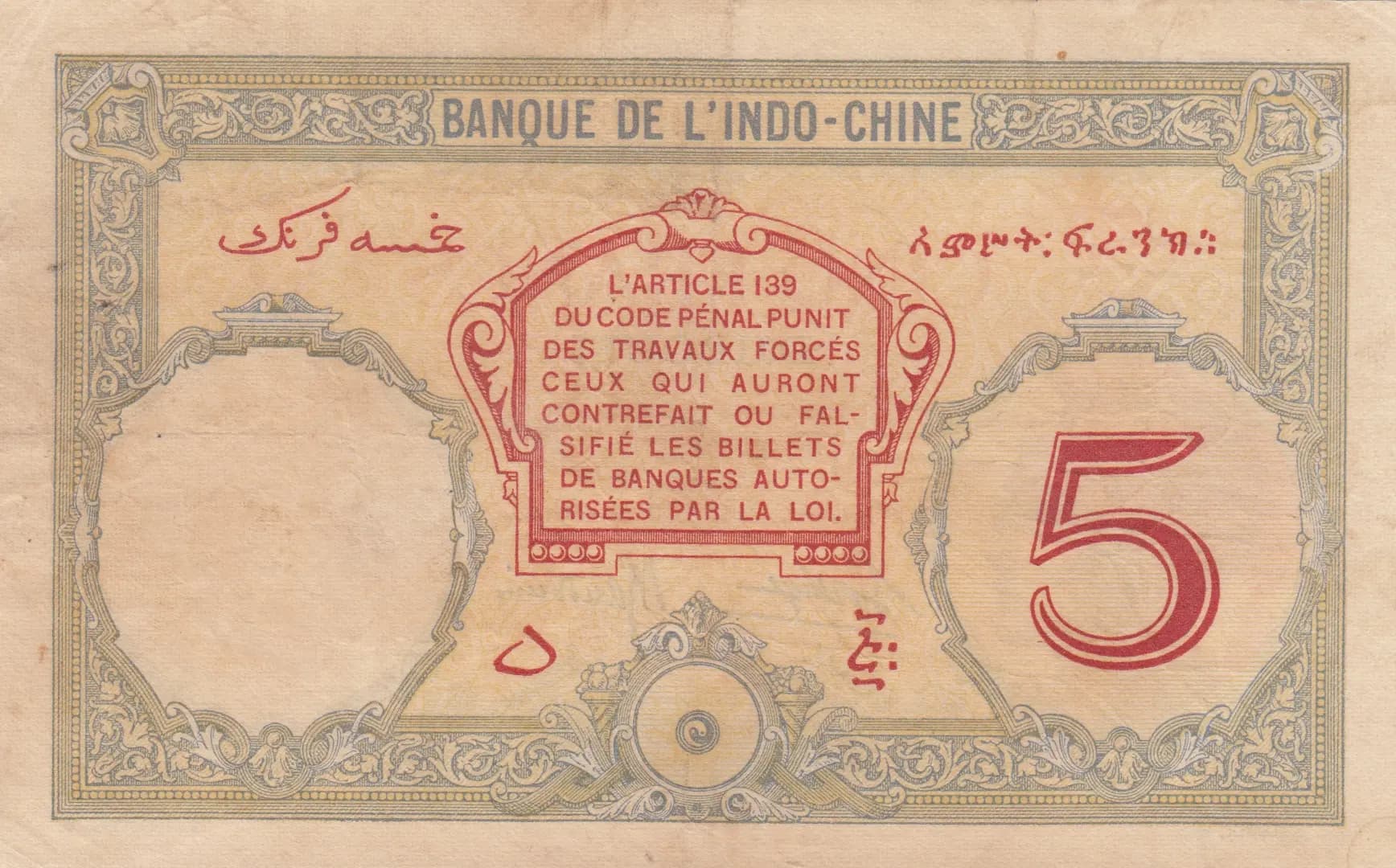
This banknote represents the monetary authority of the Banque de l'Indo-Chine during France's colonial period, when the institution oversaw currency for multiple French possessions including French Somaliland (Djibouti). The presence of Amharic script on the reverse, alongside French legal text, reflects Djibouti's unique cultural and geographic position as a French territory bordering the Abyssinian sphere. The classical helmeted figure depicted on the obverse exemplifies the belle époque aesthetic preferred by French colonial banking institutions during this era.
The obverse features a classical male bust wearing a Corinthian or Athenian-style helmet, rendered in red/pink tones on the left side of the note—a symbolic representation of Greco-Roman civilization often employed by French institutions to convey authority and legitimacy. The reverse focuses on a formal legal warning cartouche with an ornamental architectural frame, emphasizing the gravity of counterfeiting penalties. Both sides employ an identical elaborate frame composed of geometric interlocking patterns and floral scrollwork, creating a unified visual security design. The large red denomination numeral '5' appears prominently on both sides. The bilingual presentation (French and Amharic) on the reverse is unique to Djibouti-specific issues, distinguishing this from Indo-Chine notes for other territories.
FRONT: 'BANQUE DE L'INDO-CHINE' (Bank of Indo-China); 'CINQ FRANCS' (Five Francs); 'DJIBOUTI' (Djibouti); 'PAYABLES EN ESPÈCES AU PORTEUR' (Payable in cash to bearer); 'Le Président' (The President); 'Le Directeur Général' (The General Director); 'CH. WALHAIN, FEC.' (Engraver: Ch. Walhain); 'E. DELOCHE, GC.' (Printer/Engraver: E. Deloche); Serial reference 'V.51' and number '725'. BACK: 'BANQUE DE L'INDO-CHINE' (Bank of Indo-China); 'L'ARTICLE 139 DU CODE PÉNAL PUNIT DES TRAVAUX FORCÉS CEUX QUI AURONT CONTREFAIT OU FALSIFIÉ LES BILLETS DE BANQUES AUTORISÉES PAR LA LOI' (Article 139 of the Penal Code punishes with hard labor those who will have counterfeited or falsified banknotes authorized by law); 'ድጂቡቲ ፍራንክ' (Djibouti Franc in Amharic); 'ፈ:' (Abbreviation in Amharic).
This note was produced using fine-line intaglio engraving, as evidenced by the precise, detailed decorative borders, the sharp definition of the helmeted portrait, and the crisp rendering of text throughout. The engraver credit 'CH. WALHAIN, FEC.' and printer credit 'E. DELOCHE, GC.' appear on the front, indicating professional security printing by established European printing houses. The technique allowed for the creation of the complex geometric and floral security patterns visible on both sides, which served as anti-counterfeiting measures during this period.
This note is identified as Pick 6b, which denotes a specific printing variety of the 1928-1938 Djibouti 5 Francs issue. The presence of serial number 'V.51' with numerical designation '725' and the particular engraver (Walhain) and printer (Deloche) credits indicate this is from the standard production run. Varieties of this Pick number typically relate to serial number prefixes and signature combinations; the handwritten signatures visible on this example represent the authorized officials at time of issuance. No overprints are visible, confirming this as the base Djibouti issue rather than a restrike or emergency variant.