20 francs 1928
About This Note
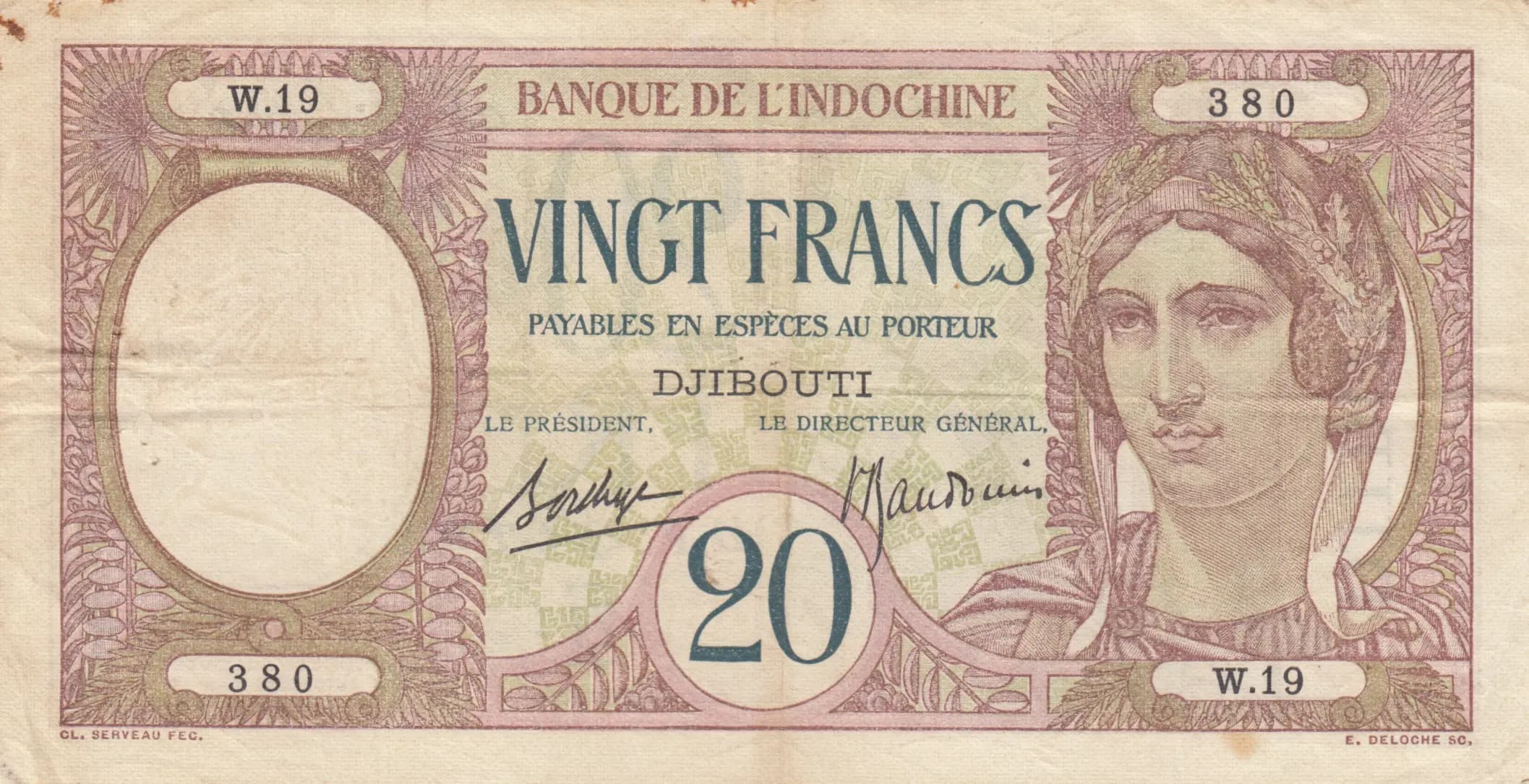
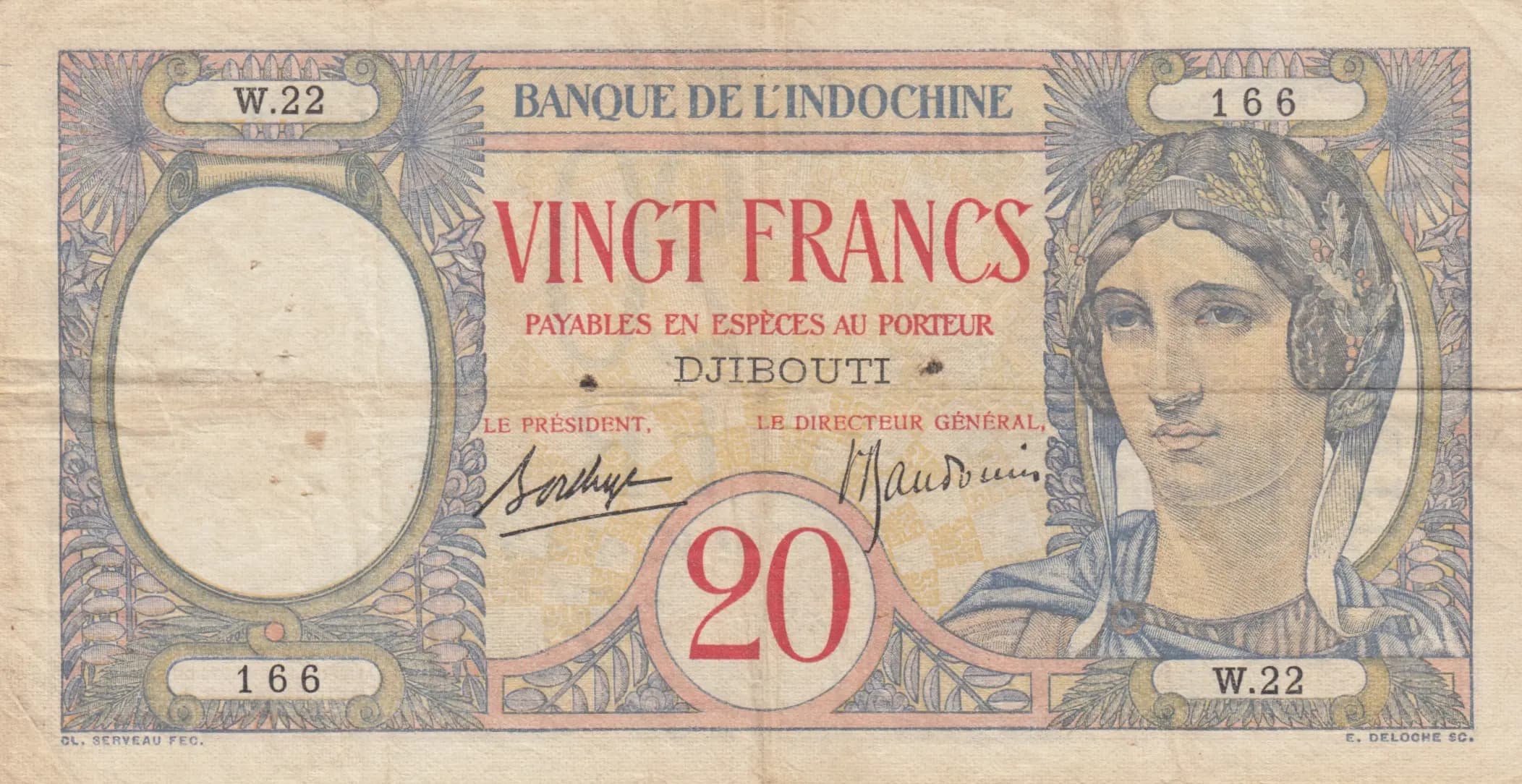
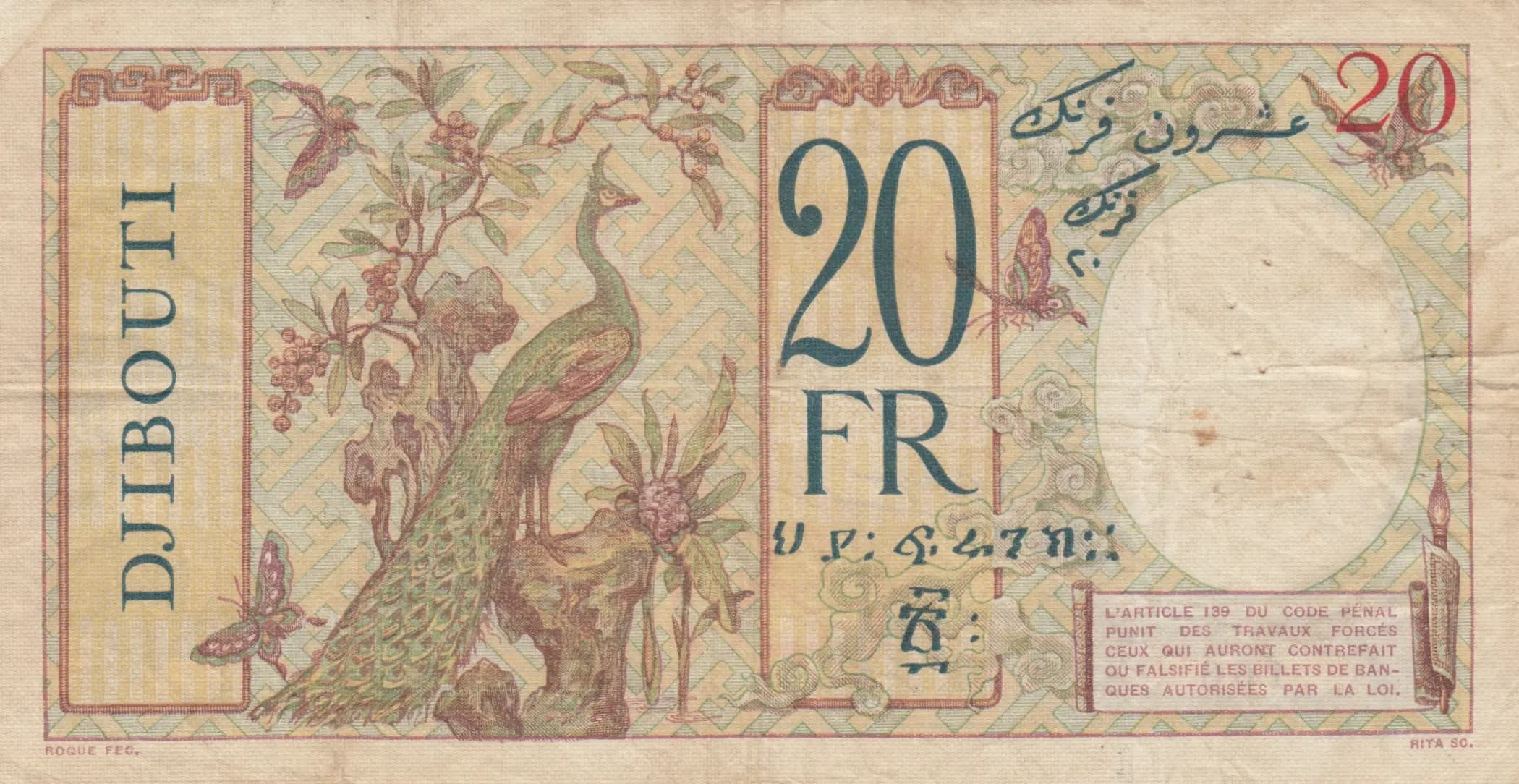
This is a 1928 Banque de l'Indochine 20 francs note from Djibouti (Pick P-7A), featuring an elegant Art Deco design with a portrait of a woman in traditional head covering on the obverse and an ornate peacock surrounded by botanical flourishes on the reverse. The note exhibits moderate to heavy aging consistent with Fair condition, displaying visible creasing, horizontal fold lines, foxing, and staining throughout, which is typical for a note nearly a century old that has seen circulation. The bilingual French and Arabic inscriptions and the presence of both European and colonial design elements make this an interesting example of inter-war French colonial currency.
Common. The Banque de l'Indochine issued these notes in standard quantities for colonial circulation during the 1928-1938 period. P-7A is the standard catalog variety (identified by the blue numeral '20'), and notes from this series appear regularly in the market. The Fair condition grade and visible circulation wear indicate this was not a carefully preserved specimen, suggesting adequate original production volumes. No evidence of restricted mintage, short-term issue, or recall exists for this Pick number.
Banque de l'Indochine issued this note during the 1928-1938 period when Djibouti was a French colonial territory strategically positioned on the Red Sea. The iconography—combining a woman in local dress with a peacock motif—reflects the French colonial aesthetic of the era, which romanticized and exoticized colonial possessions in their currency design. The presence of Arabic script alongside French demonstrates the multilingual, multicultural nature of French colonial possessions in East Africa and the Indian Ocean region.
The obverse features an allegorical female portrait representing Indochina or a colonial muse, depicted wearing a draped head covering or turban, positioned on the right side in classical engraved style. She is flanked by an empty oval cartouche on the left, likely reserved for serial numbers. The large denomination '20' is centrally positioned within a red circular frame, a design element characteristic of this issue. Ornamental radiating fan patterns occupy all four corners, with elaborate scrollwork and decorative borders framing the entire composition in red and blue-gray inks. The reverse showcases a magnificent peacock in full display plumage, rendered in fine detail among flowering vines, scrollwork, and botanical elements including roses and foliage. An empty circular frame on the right side mirrors the obverse design. The denomination appears as '20 FR' with Arabic script providing the translation. Fine legal warning text regarding counterfeiting penalties occupies the lower portion. Both sides employ classical colonial-era aesthetic principles combining European artistic traditions with orientalist imagery.
FRONT: 'Banque de l'Indochine' (Bank of Indochina), 'Vingt Francs' (Twenty Francs), 'Payables en Espèces au Porteur' (Payable in cash to bearer), 'Djibouti', 'Le Président' (The President), 'Le Directeur Général' (The General Director), serial reference numbers 'W.22' and '166'. BACK: 'Djibouti', '20 FR' (20 Francs), 'عشرون فرنك' (Twenty francs in Arabic), 'L'Article 139 du Code Pénal punit des travaux forcés ceux qui auraient contrefait ou falsifié les billets de banques autorisées par la loi' (Article 139 of the Penal Code punishes with hard labor those who shall have counterfeited or falsified banknotes authorized by law), 'Rogue Fec.' (engraved/created by Rogue), 'Rita Sc.' (engraved by Rita).
Intaglio (engraved) printing, evidenced by the fine, detailed line work, precise border work, the raised engraved appearance of the portraits and illustrations, and the characteristic quality of the engraved signatures. The bilingual composition and multi-color layering (red and blue-gray on cream background) indicates multiple engraved plates were used in succession. The engravers' marks 'Rogue Fec.' and 'Rita Sc.' on the reverse confirm the intaglio technique. The printer is identified through the engravers rather than a security printer mark on this note.
This is identified as Pick P-7A, characterized by the blue numeral '20' on the lower center of the front. Catalog references indicate P-7B exists as a related variety with a different color numeral (likely red, based on the external reference noting 'different colors of numeral 20'). The visual analysis confirms the presence of the red circular frame around the '20' and blue-gray engraved elements. Serial reference numbers visible are 'W.22' and '166', though individual serial numbers are not fully visible in the provided images. No date is printed on the note itself (ND designation), consistent with Banque de l'Indochine practice for this series issued across the 1928-1938 period.