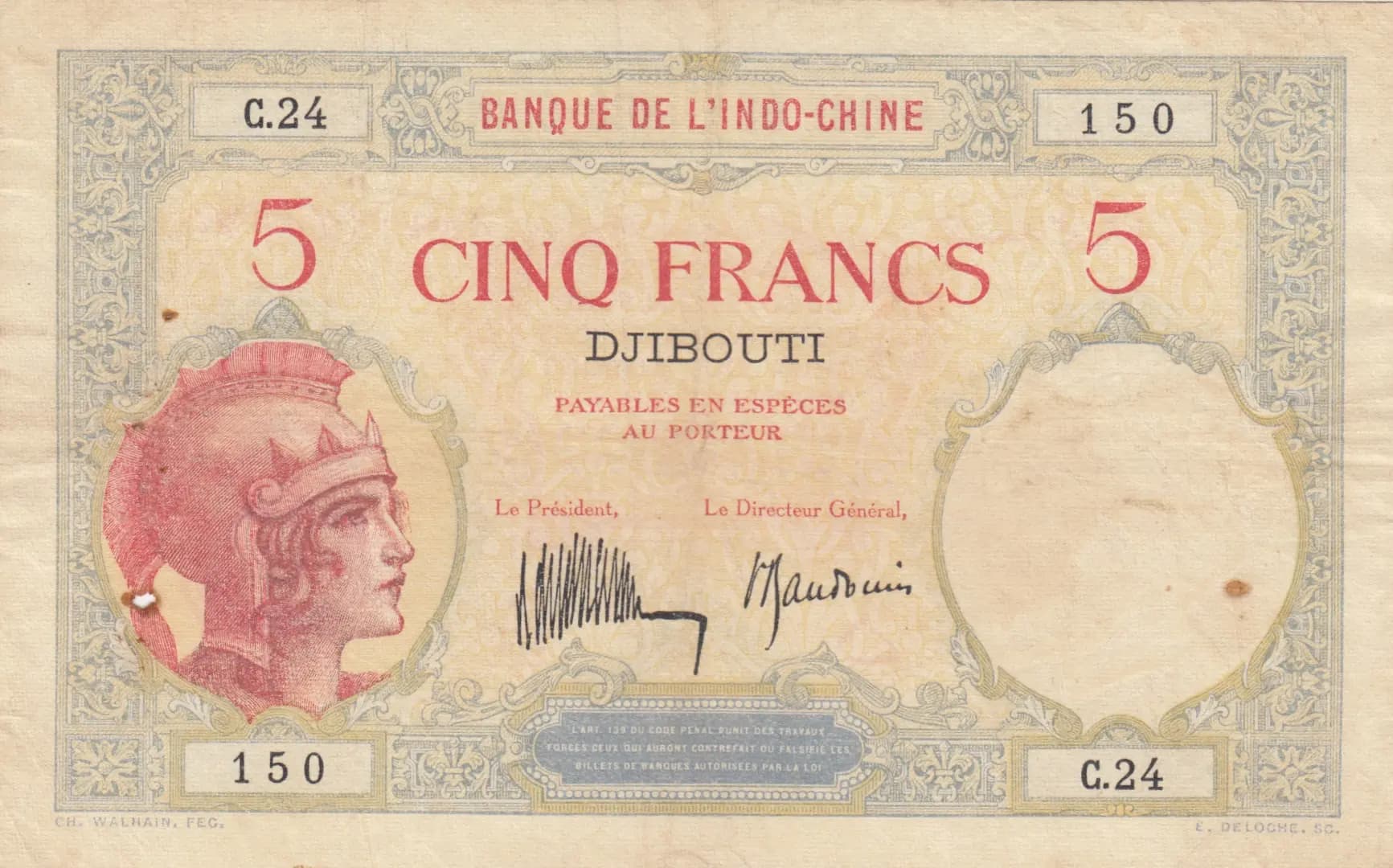
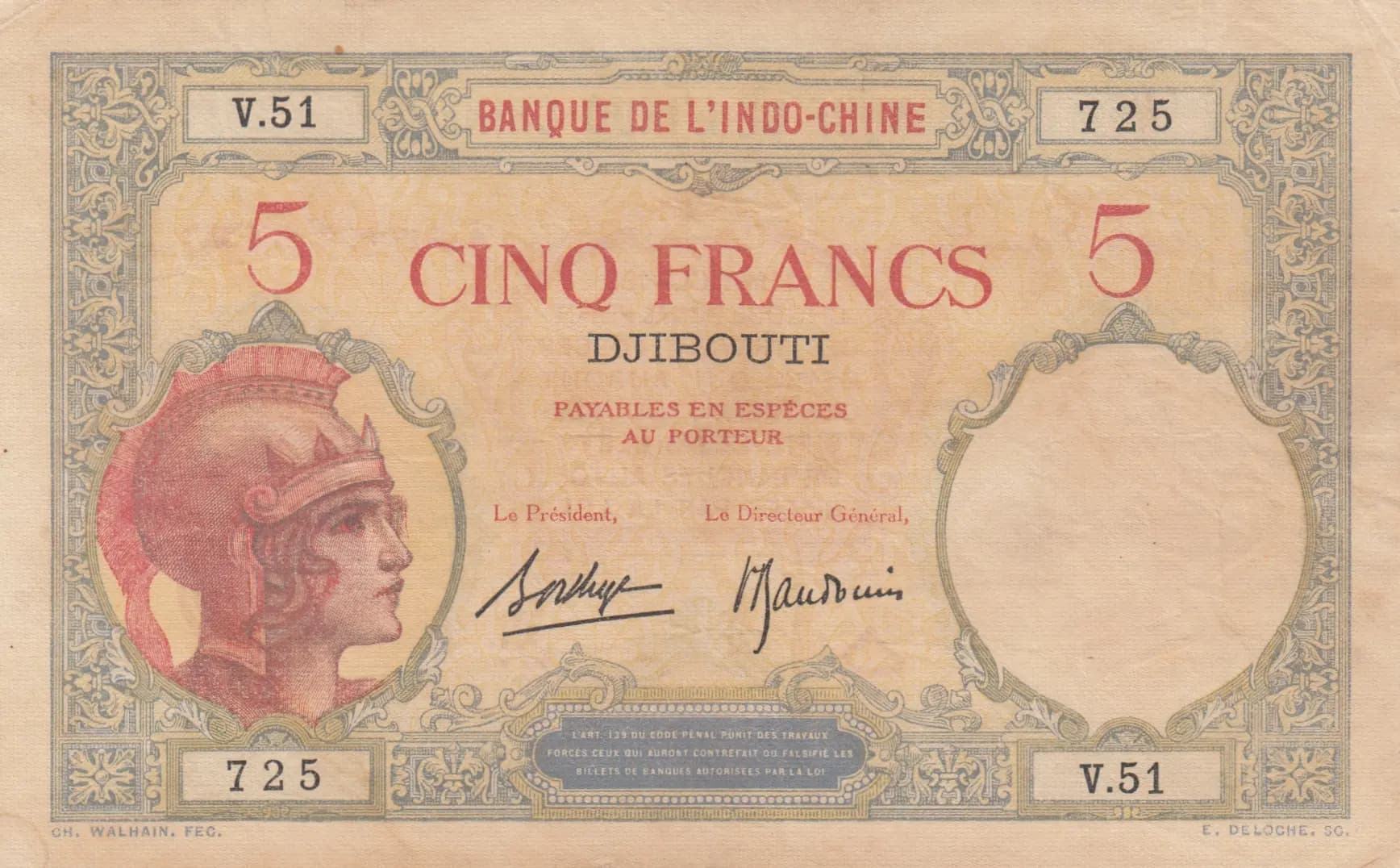
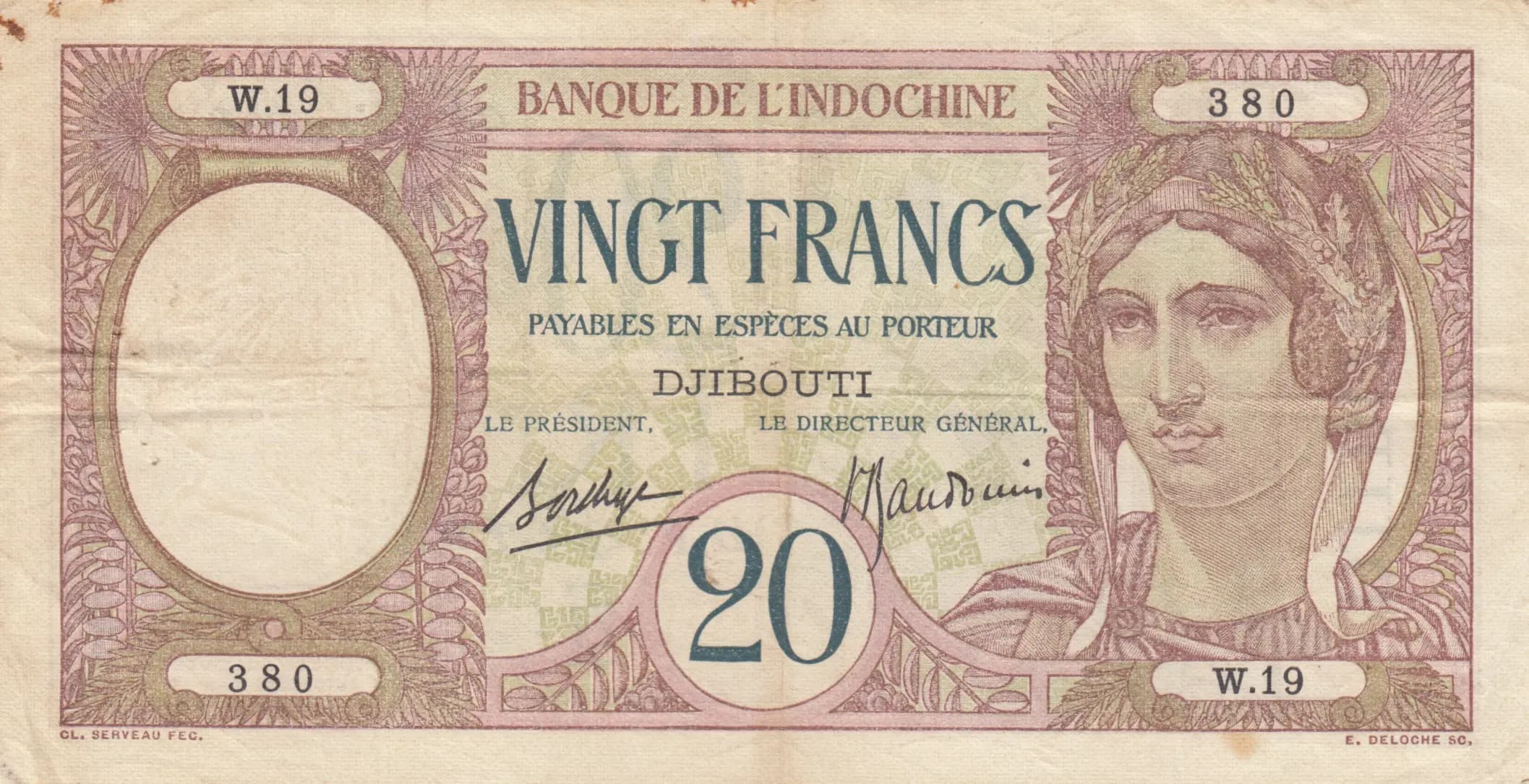
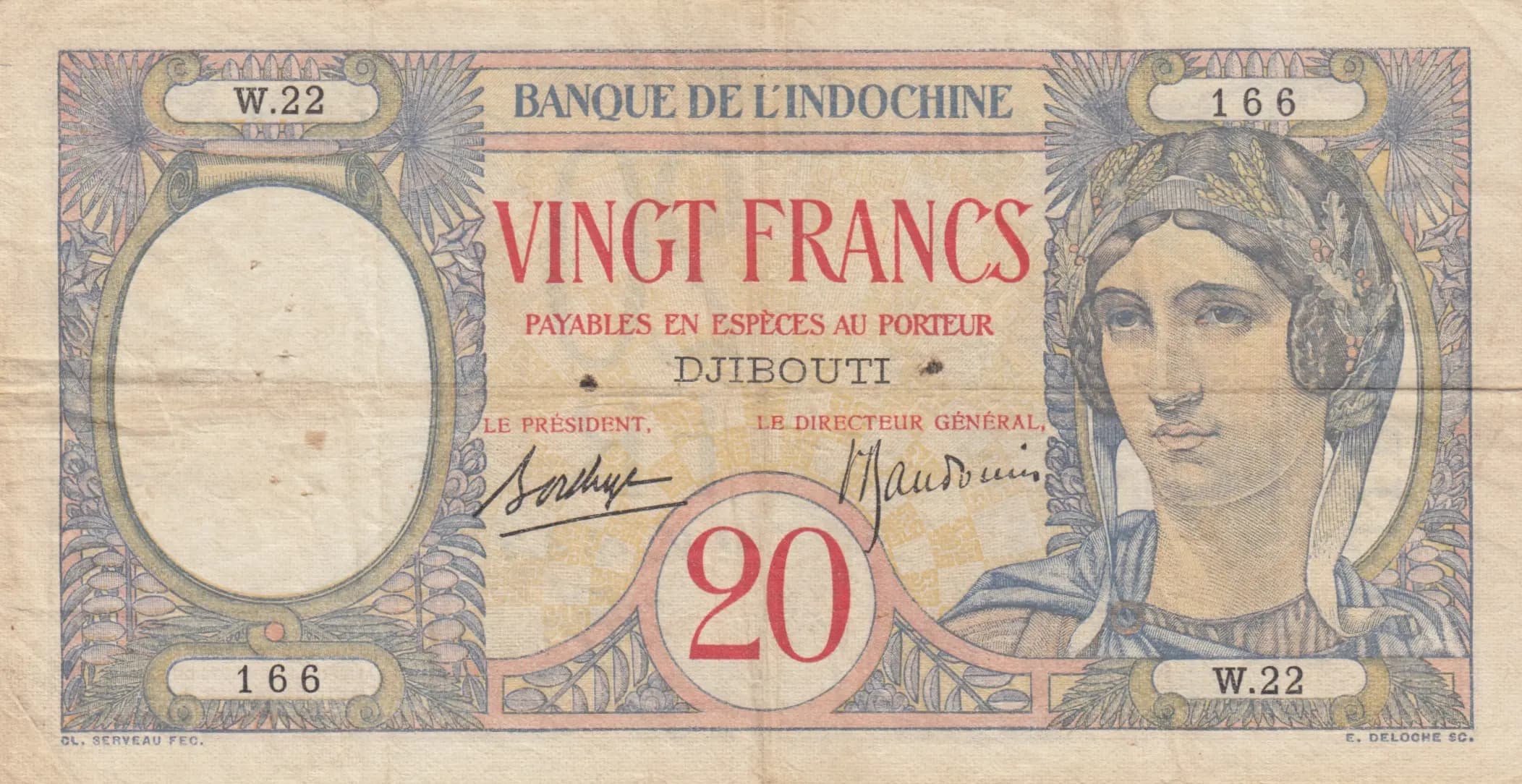
20 francs 1945
About This Note
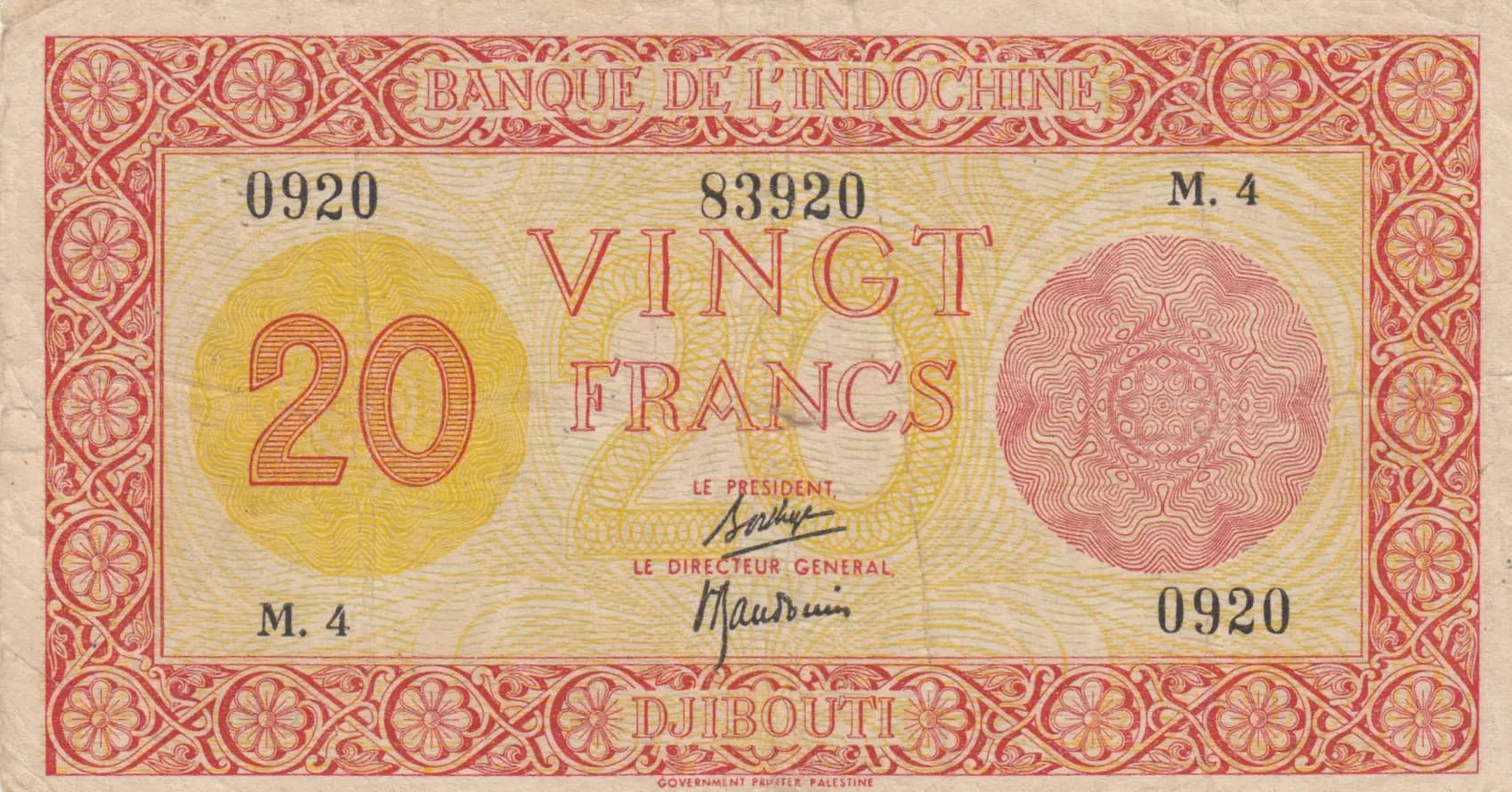
This 1945 Banque de l'Indochine 20 Francs note from Djibouti (Pick P-15) presents an exceptional example of mid-20th century French colonial currency design, featuring striking red and gold ornate borders with floral rosettes and symmetrical geometric patterns. The note displays the characteristic intaglio engraving quality typical of Government Printer Palestine production, with two handwritten signatures (LE PRÉSIDENT and LE DIRECTEUR GÉNÉRAL) prominently featured. In Fine condition with light age-related yellowing and minimal wear, this circulated example retains excellent detail in its decorative elements and architectural imagery.
Common. The Banque de l'Indochine 20 Francs Djibouti note (P-15) was produced in substantial quantities during 1945 and remains widely available to collectors today. No evidence of limited print runs, early recalls, or scarcity in the marketplace exists. Notes of this type and condition typically trade at modest valuations ($15-30 range), confirming common circulation status.
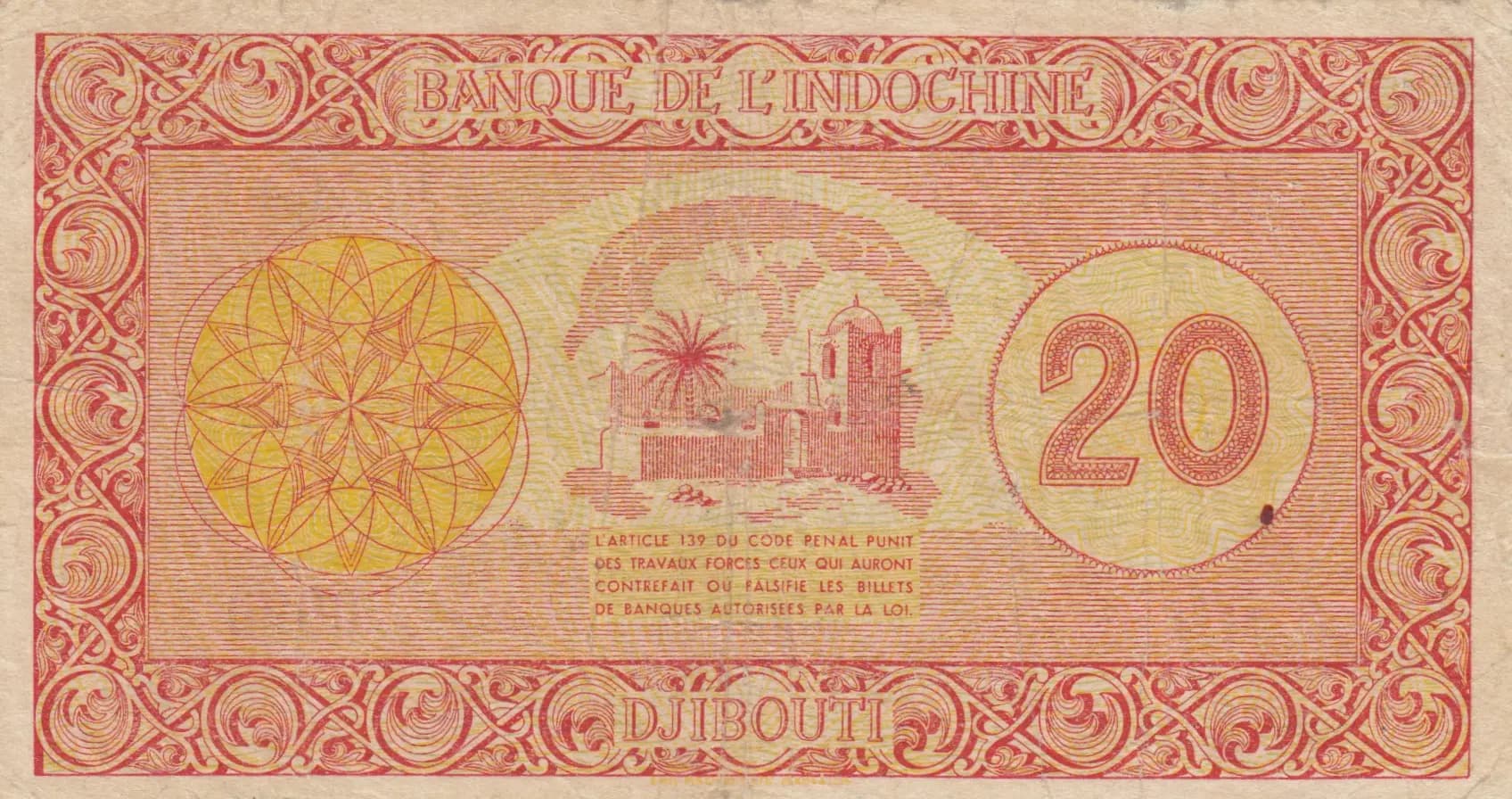
Issued by the Banque de l'Indochine during the final year of World War II, this note represents French colonial monetary authority in Djibouti, a strategic territory controlling access to the Red Sea. The reverse depicts an Islamic architectural structure with minaret and palm tree, reflecting Djibouti's geographical and cultural context within French Somaliland. The printing by the Government Printer in Palestine—a British-controlled territory at the time—underscores the complex logistics of wartime currency production outside metropolitan France.
The obverse features a formal colonial design dominated by an ornate red and gold floral border with elaborate rosette patterns in the upper corners. Large yellow circular medallions containing the denomination '20' flank the center, which displays 'VINGT FRANCS' in red capitals with the two official signatures below. Serial numbers appear at top and bottom. The reverse presents a more visually interesting composition with a central architectural monument—a building or mosque structure with a prominent minaret and palm tree rendered in fine horizontal line work—flanked by yellow geometric circular patterns. The entire design employs elaborate guilloche patterning and fine engraving characteristic of high-security banknote production. The color scheme remains consistent across both sides: red, yellow, cream, and gold tones on the noted paper stock.
FRONT SIDE: 'BANQUE DE L'INDOCHINE' (Bank of Indochina), 'VINGT FRANCS' (Twenty Francs), 'LE PRÉSIDENT' (The President), 'LE DIRECTEUR GÉNÉRAL' (The General Director), 'M. 4' (designation marking), 'DJIBOUTI' (location), 'GOUVERNMENT PRINTER PALESTINE' (printer attribution), Serial numbers: '0920' and '83920'. REVERSE SIDE: 'BANQUE DE L'INDOCHINE' (Bank of Indochina), 'DJIBOUTI' (location), 'L'ARTICLE 139 DU CODE PÉNAL PUNIT DES TRAVAUX FORCÉS CEUX QUI AURAIENT CONTREFAIT OU FALSIFIÉ LES BILLETS DE BANQUES AUTORISÉES PAR LA LOI' (Article 139 of the Penal Code punishes with forced labor those who would have counterfeited or falsified banknotes authorized by law), Denomination: '20' (Twenty).
Intaglio (engraved) printing executed by the Government Printer, Palestine. The note exhibits the characteristic fine line patterns, guilloche borders, and detailed engraved architectural elements typical of this security printing method. The horizontal line-work patterns visible throughout both sides, particularly in the architectural scene and geometric medallions, are hallmarks of intaglio production. Multiple signature blocks and denomination circles were likely produced using separate engraved plates combined in the final impression.
This specific example shows the 'M. 4' designation marking visible in both upper right and lower left positions, which corresponds to a particular plate or series variant. The serial numbers '0920' and '83920' suggest this note from the middle range of the production run. Two distinct signatures are present (LE PRÉSIDENT and LE DIRECTEUR GÉNÉRAL), which may represent a particular administrative pairing, though multiple signature varieties are known for this issue. No overprints are visible. This example does not appear to represent any particularly scarce or premium variety.