20 francs 1928
About This Note
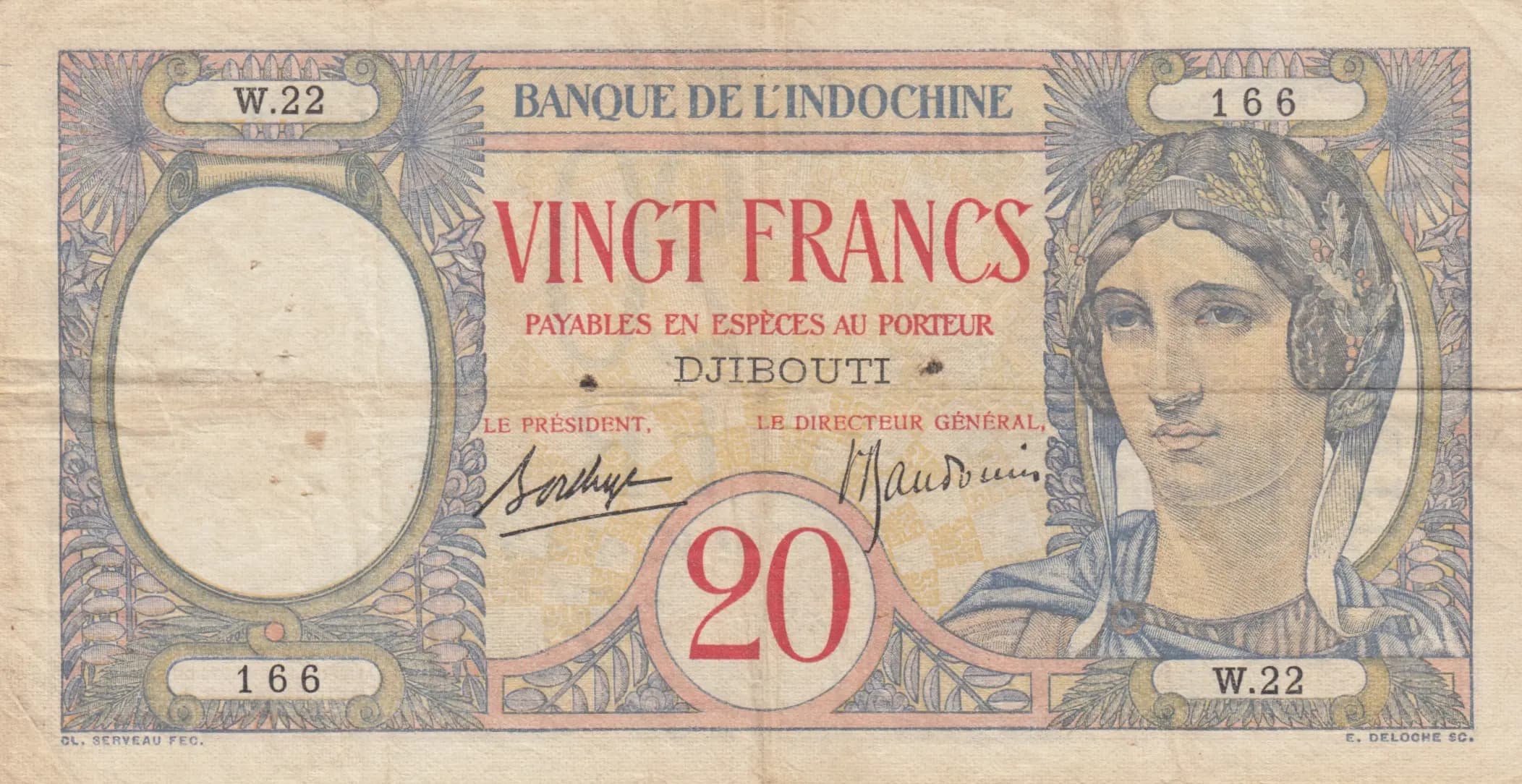
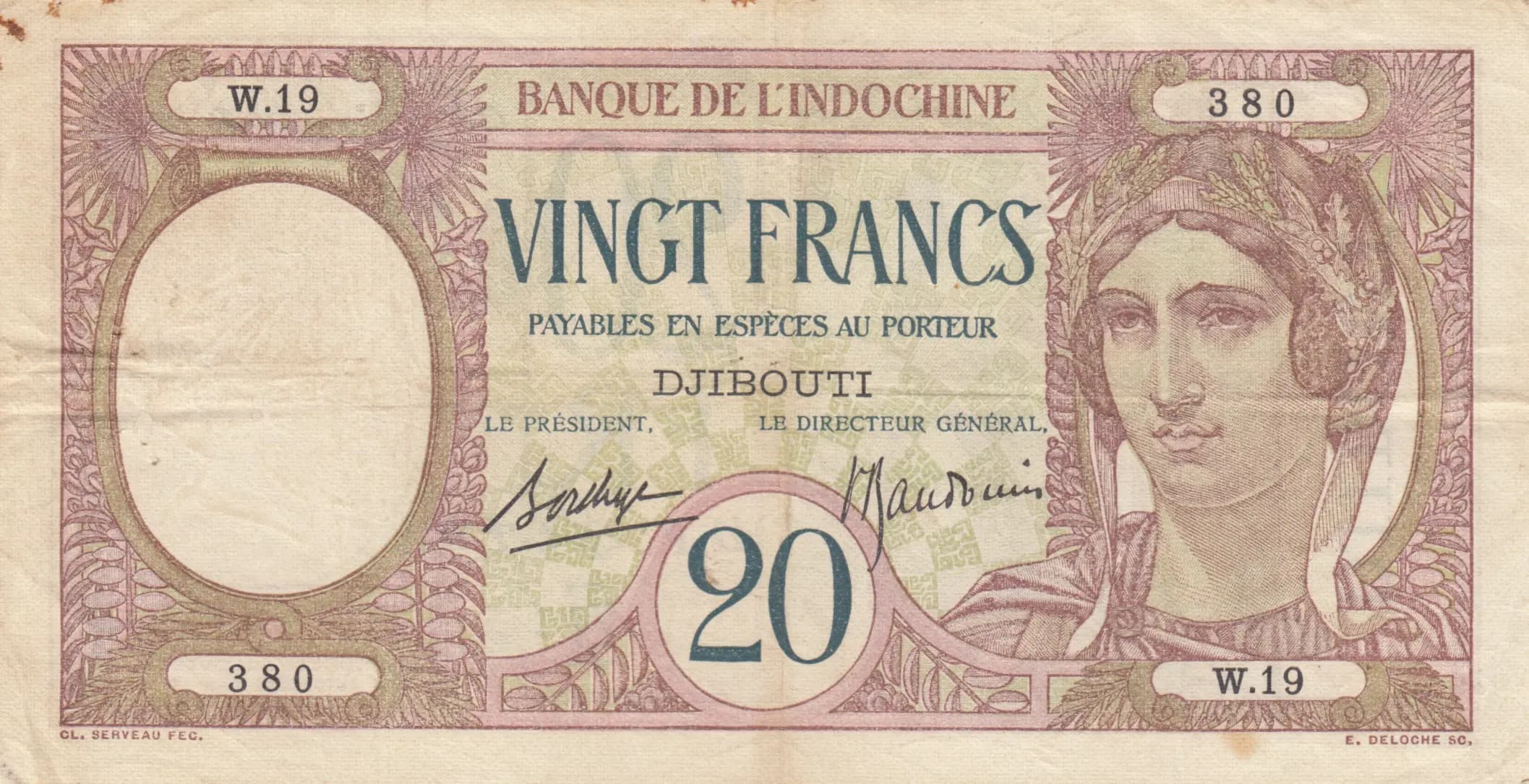
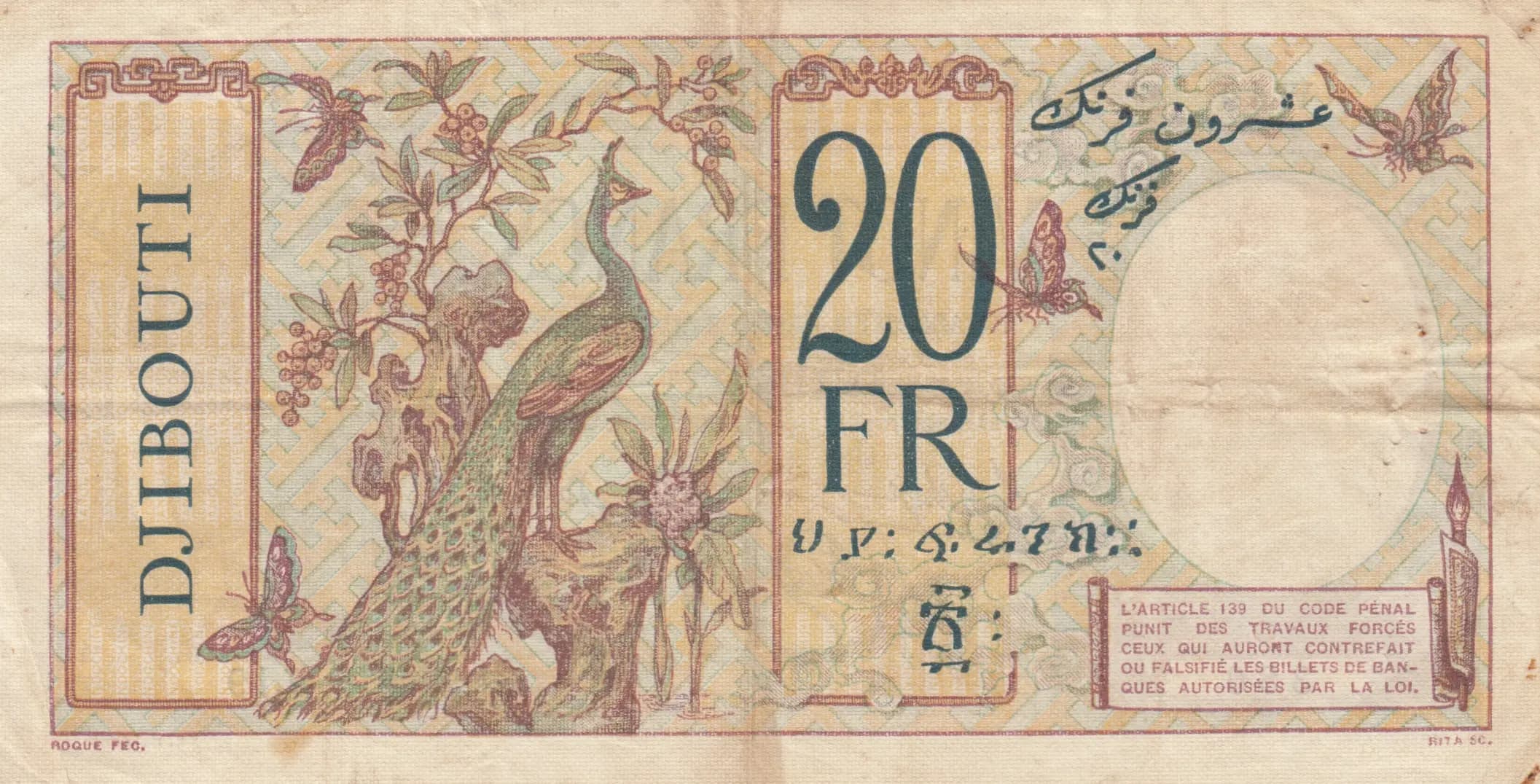
A VF-grade 1928 Banque de l'Indochine 20 francs note from Djibouti (Pick P-7b), featuring the distinctive blue numeral '20' that characterizes this variety. The note displays classical engraving with a draped female portrait on the obverse and an elaborate peacock design surrounded by ornamental foliage on the reverse. Despite significant age-related foxing, browning, and creasing consistent with circulation, the intricate line work and decorative borders remain well-preserved, making this an attractive example of French colonial currency from the interwar period.
Common. The Banque de l'Indochine issued 20 franc denominations across multiple French colonial territories between 1928 and 1938 in substantial quantities to facilitate colonial commerce. The P-7b variety, distinguished by the blue numeral '20', was part of routine circulation in Djibouti and other French possessions. While individual notes of this age show wear and aging, the Pick P-7b denomination and variety remain readily available to collectors in the market at modest valuations. VF-grade examples are neither particularly scarce nor commanding premium prices, consistent with typical colonial-era French banknotes that were produced in volume.
This note was issued by the Banque de l'Indochine, the primary French colonial banking institution established to facilitate commerce across French Indochina and French colonial possessions in Africa and the Pacific. The 1928 issue reflects the post-WWI economic stabilization period and was used in Djibouti (then French Somaliland) to support colonial trade and administration. The allegorical female portrait and peacock imagery were common iconographic choices in French colonial currency, symbolizing prosperity, civilization, and the exotic wealth of colonial territories.
The obverse features a neoclassical allegorical female portrait in profile facing left, rendered in a classical style with pulled-back hair and draped garments, positioned within an oval frame on the right side of the note. The left side contains an empty oval frame, likely a security watermark area. The design employs ornate borders with radiating sunburst patterns in the corners and elaborate floral and geometric ornamentation throughout. The reverse showcases a detailed peacock as the central motif, depicted facing right with elaborately rendered tail feathers and decorative plumage, surrounded by ornamental flowering plants, vines, and foliage in a lush garden setting. The entire composition employs fine engraved line work with a color palette dominated by mauve and purple tones on the obverse, and cream, rust-red, green, and blue-gray accents on the reverse. The denomination '20' appears prominently in the lower center on both sides, with the blue numeral being the distinguishing feature of the P-7b variety.
FRONT: 'Banque de l'Indochine' (Bank of Indochina); 'Vingt Francs' (Twenty Francs); 'Payables en espèces au porteur' (Payable in cash to bearer); 'Djibouti'; 'Le Président' (The President); 'Le Directeur Général' (The General Director); signatures 'Sorby' and 'Maurrain'; engraver marks 'CL. Serveau fec.' (CL. Serveau made it) and 'E. Deloche sc.' (E. Deloche engraved); reference 'W.19' and '380'. BACK: 'Djibouti'; '20 FR'; 'L'Article 139 du Code Pénal punit des travaux forcés ceux qui auraient contrefait ou falsifié les billets de banques autorisées par la loi.' (Article 139 of the Penal Code punishes with forced labor those who have counterfeited or falsified banknotes authorized by law); engraver marks 'Nogue fec.' (Nogue made it) and 'Rita sc.' (Rita engraved).
Intaglio engraving (rotogravure), the standard security printing method for French colonial banknotes of this era. The note exhibits the characteristic fine line work, intricate detail, and depth associated with intaglio printing, as evidenced by the complex border patterns, detailed peacock rendering, and crisp portraiture. Multiple engravers are credited—Serveau and Deloche on the obverse, Nogue and Rita on the reverse—indicating the collaborative workshop process typical of Banque de l'Indochine currency production. The banknote was likely produced by Banque de l'Indochine's authorized French security printer, consistent with French colonial currency standards of the period.
This is the P-7b variety of the Djibouti 20 francs 1928 issue, specifically identified by the blue-colored numeral '20' in the lower center on the obverse. The Pick catalog distinguishes this from P-7a, which features a numeral '20' in a different color. Related issues with identical designs but overprints for other French colonial territories exist: New Caledonia P-37 (with 'Nouméa' overprint) and New Hebrides P-6 (with 'Nouvelles Hébrides' stamp), as well as Tahiti P-12 (with 'Papeete' overprint), all sharing the same allegorical female portrait and peacock design template. The signatures of Sorby (President) and Maurrain (General Director) are specific to this issue.