1000 francs 1952
About This Note
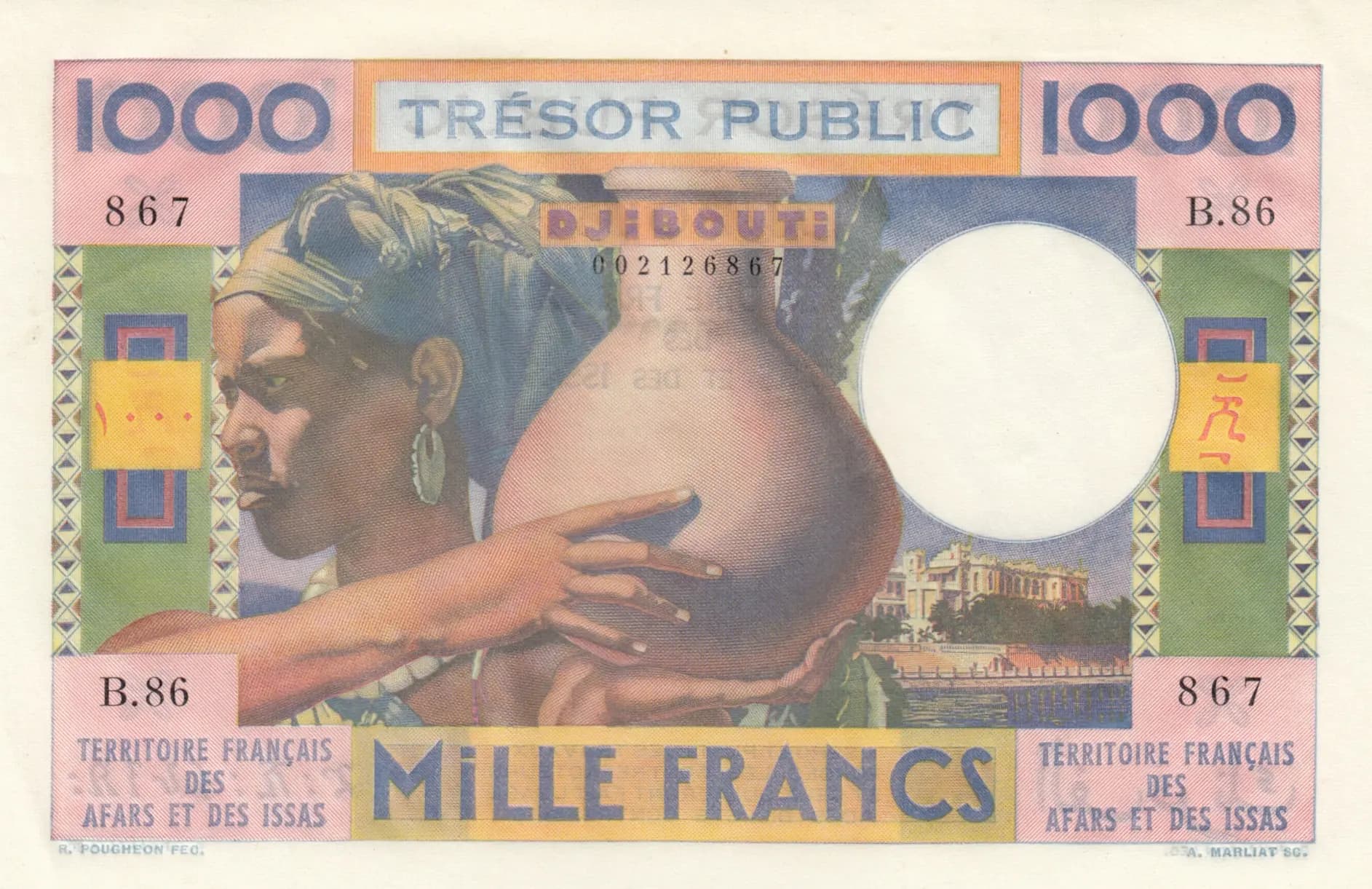
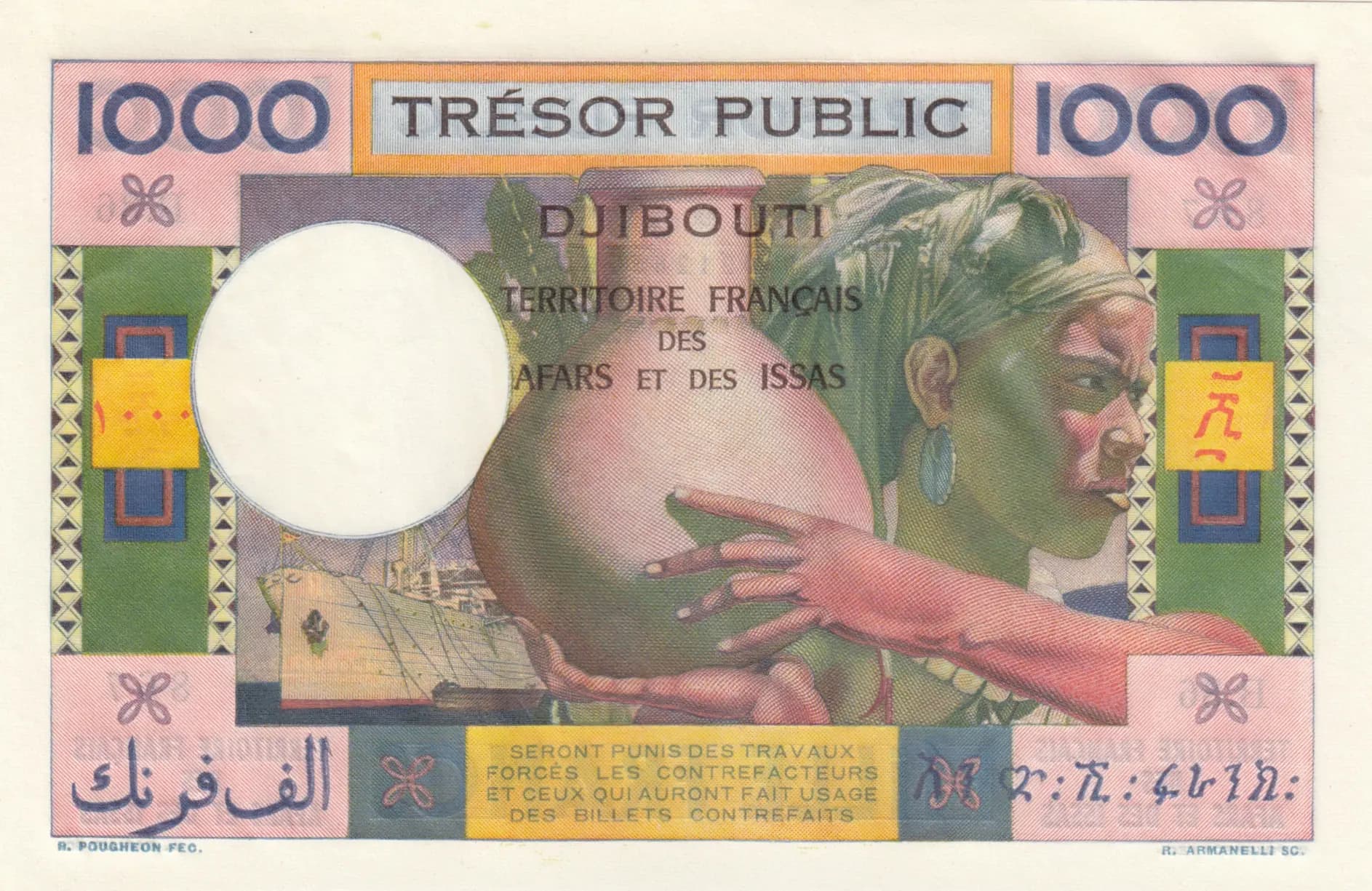
This is an uncirculated 1000 Francs banknote from 1952 issued by the Trésor Public of the Côte Française des Somalis (French Somaliland), graded UNC with crisp, vibrant colors and excellent preservation. The note features striking portraits of an African woman on the obverse and man on the reverse, each holding or associated with significant objects, framed by distinctive geometric patterns in green, yellow, red, and blue. The fine line engraving and well-preserved color palette make this an attractive example of French colonial currency design from the early post-war period.
Common. This is a standard issue banknote from a French colonial territory with no recorded print restrictions or recalls. The Pick 28 1000 Francs from 1952 represents regular circulation currency from the period and appears with reasonable frequency in the collector market. UNC examples trade at modest valuations, typically in the $15-35 range depending on dealer markup, which is consistent with common colonial-era banknotes. No specific scarcity indicators are present in the catalog data or visual observations.
This banknote was issued during the period when French Somaliland (later Djibouti) was administered as a French colonial territory, officially styled as the 'Territoire Français des Afars et des Issas' as inscribed on the note. The colonial-style architecture and sailing vessel depicted in the vignettes reflect the European colonial presence and maritime commerce that defined this period. The inclusion of Arabic and Ge'ez/Amharic script alongside French inscriptions demonstrates the multicultural character of the territory and the French colonial administration's acknowledgment of local linguistic diversity.
The obverse features a portrait of an African woman depicted in left profile, adorned with earrings and traditional head covering, holding a large spherical jug or vessel—likely representing local pottery or domestic craftsmanship. Behind her is a colonial-era fortified building, reflecting the French administrative and military presence. The reverse displays a portrait of an African man in right profile, also wearing patterned head covering and earrings, with a colonial sailing vessel visible in the background, symbolizing the maritime trade networks. Both sides are framed by striking vertical borders of geometric patterns comprising green, yellow, red, and blue squares, with diamond-pattern ornamental borders throughout. Large circular white vignette spaces appear on the right (obverse) and left (reverse), likely intended for watermark or additional security features. The color palette—predominantly pink, blue, orange, green, yellow, brown, and tan—creates a vibrant, distinctly colonial aesthetic typical of French Somaliland currency design.
{"front":{"French":"TRÉSOR PUBLIC (Public Treasury) | DJIBOUTI | MILLE FRANCS (One Thousand Francs) | TERRITOIRE FRANÇAIS DES AFARS ET DES ISSAS (French Territory of the Afars and the Issas) | B. FOUCHEON FEC. (B. Foucheon made [this]) | A. MARLIAT SC. (A. Marliat engraved [this])","numerals":"1000 | 867 | B.86"},"back":{"French":"TRÉSOR PUBLIC (Public Treasury) | DJIBOUTI | TERRITOIRE FRANÇAIS DES AFARS ET DES ISSAS (French Territory of the Afars and the Issas) | SERONT PUNIS DES TRAVAUX FORCES LES CONTREFACTEURS ET CEUX QUI AURONT FAIT USAGE DES BILLETS CONTREFAITS (Counterfeiters and those who use counterfeit notes will be punished with forced labor) | B. FOUCHEON FEC. (B. Foucheon made [this]) | R. ARMANELLI SC. (R. Armanelli engraved [this])","Arabic":"الفرنك (The franc)","Ge'ez/Amharic":"ፍራንክ (Franc)","numerals":"1000"}}
This banknote was produced using fine line engraving, as evidenced by the intricate detail work, precise geometric patterns, and the crisp reproduction of portraiture and ornamental elements visible throughout both sides. The credits to engravers A. Marliat and R. Armanelli, along with designer B. Foucheon, confirm the traditional intaglio printing methods employed by French colonial currency printers. The consistent line work and color register across the geometric borders and security features indicate professional-grade security printing typical of Bank of France or contracted security printers handling French colonial currency production.
The observed note exhibits the following specific identifiers: Serial number prefix 'B.86' visible on the obverse, and internal numbering '867'. The engravers credited are A. Marliat (obverse) and R. Armanelli (reverse), with designer B. Foucheon noted on both sides. These represent the primary identifying marks for this variety. No overprints, date variations, or signature varieties are evident in the UNC example examined. The standard Pick 28 designation encompasses this design and printing configuration.