1000 korun 1945 specimen
Market Prices
16 salesAbout This Note
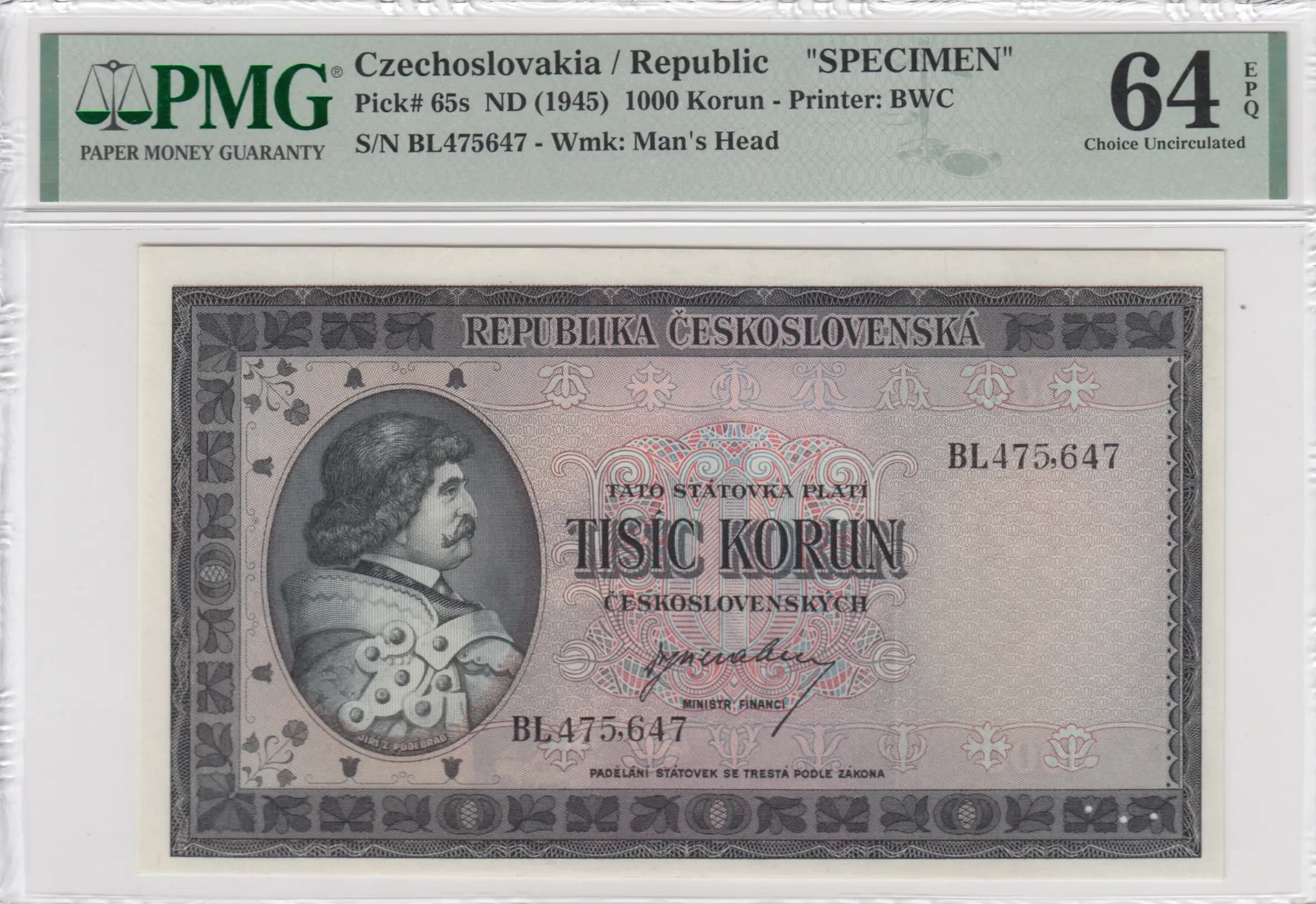
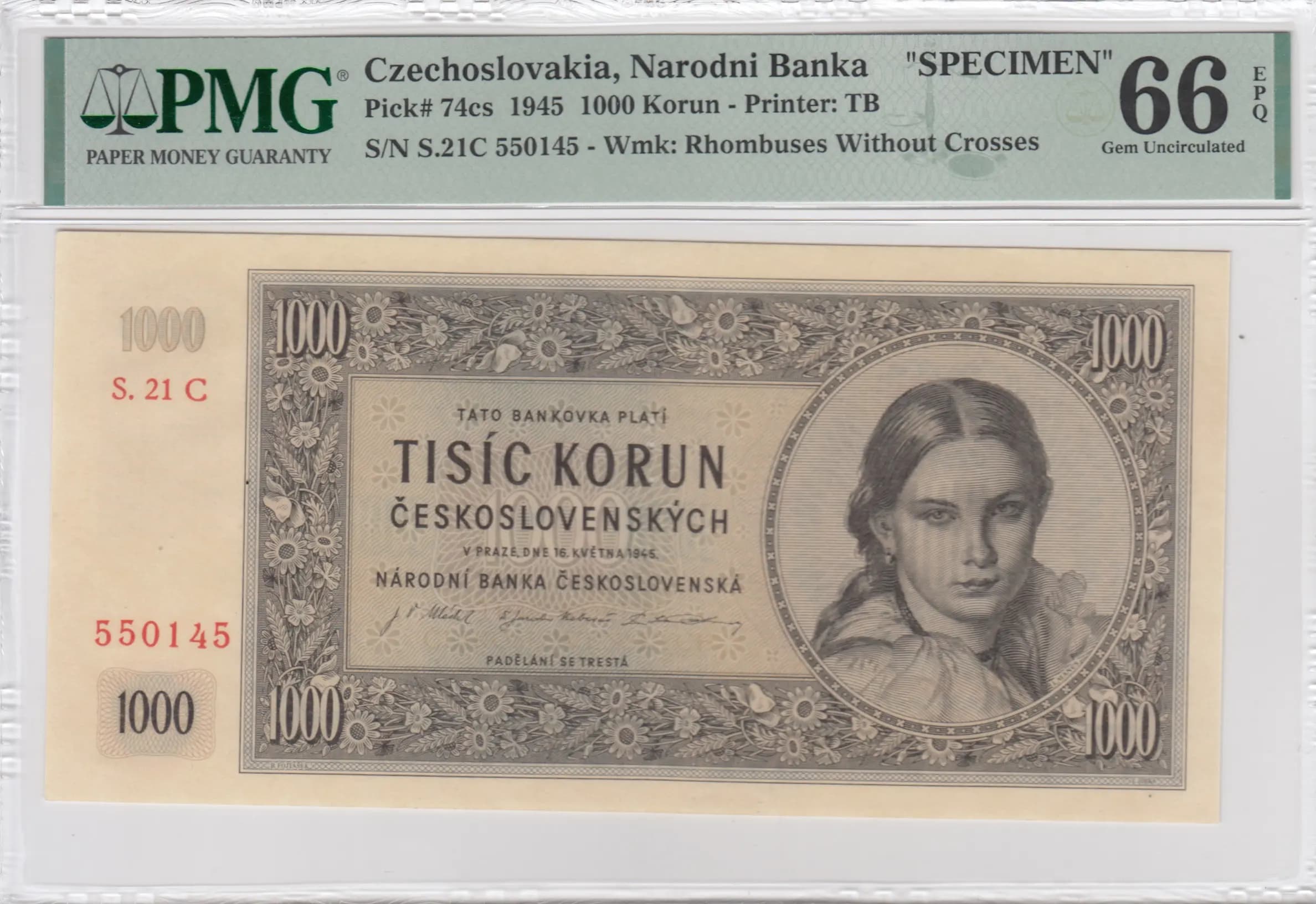
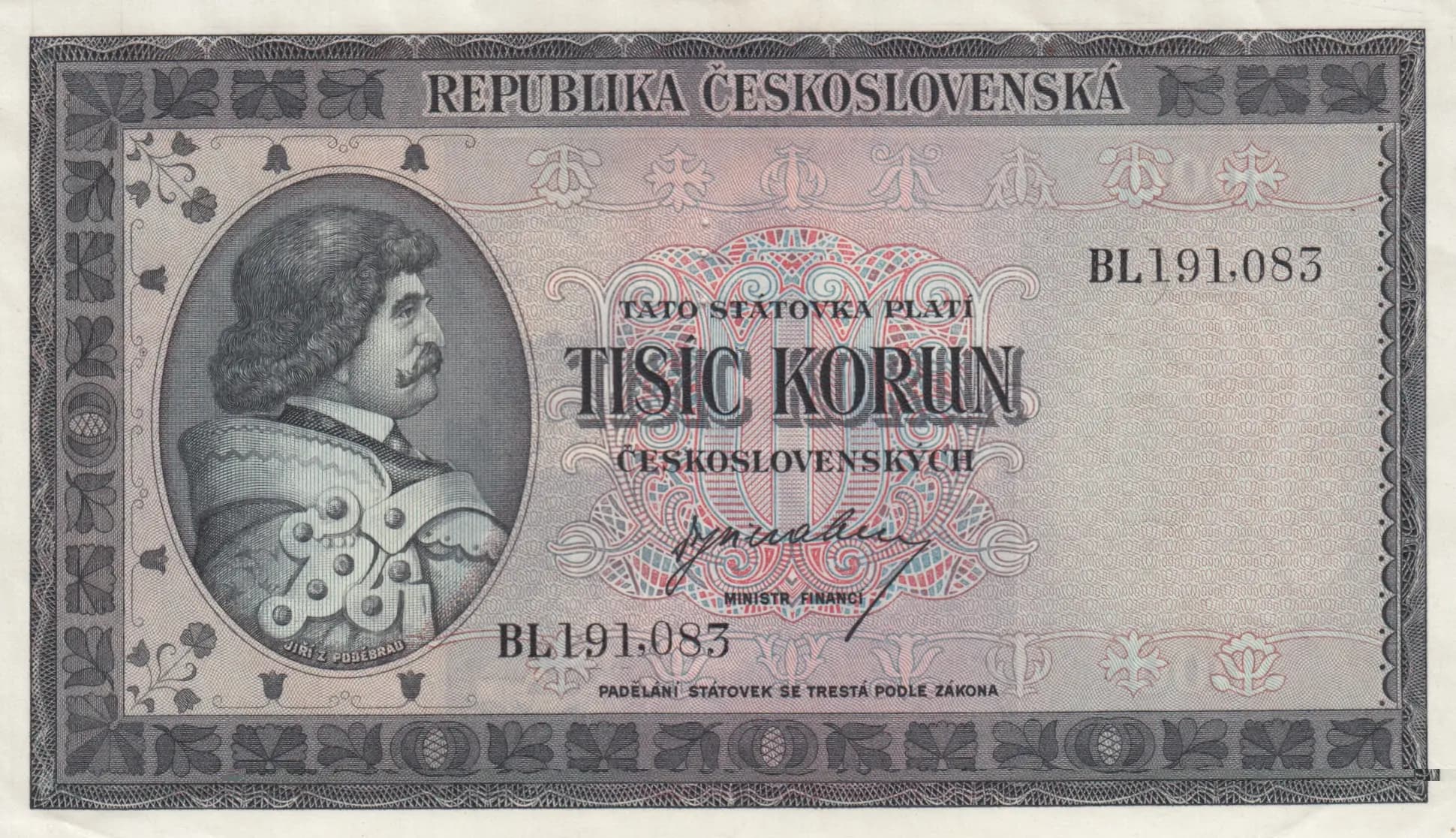
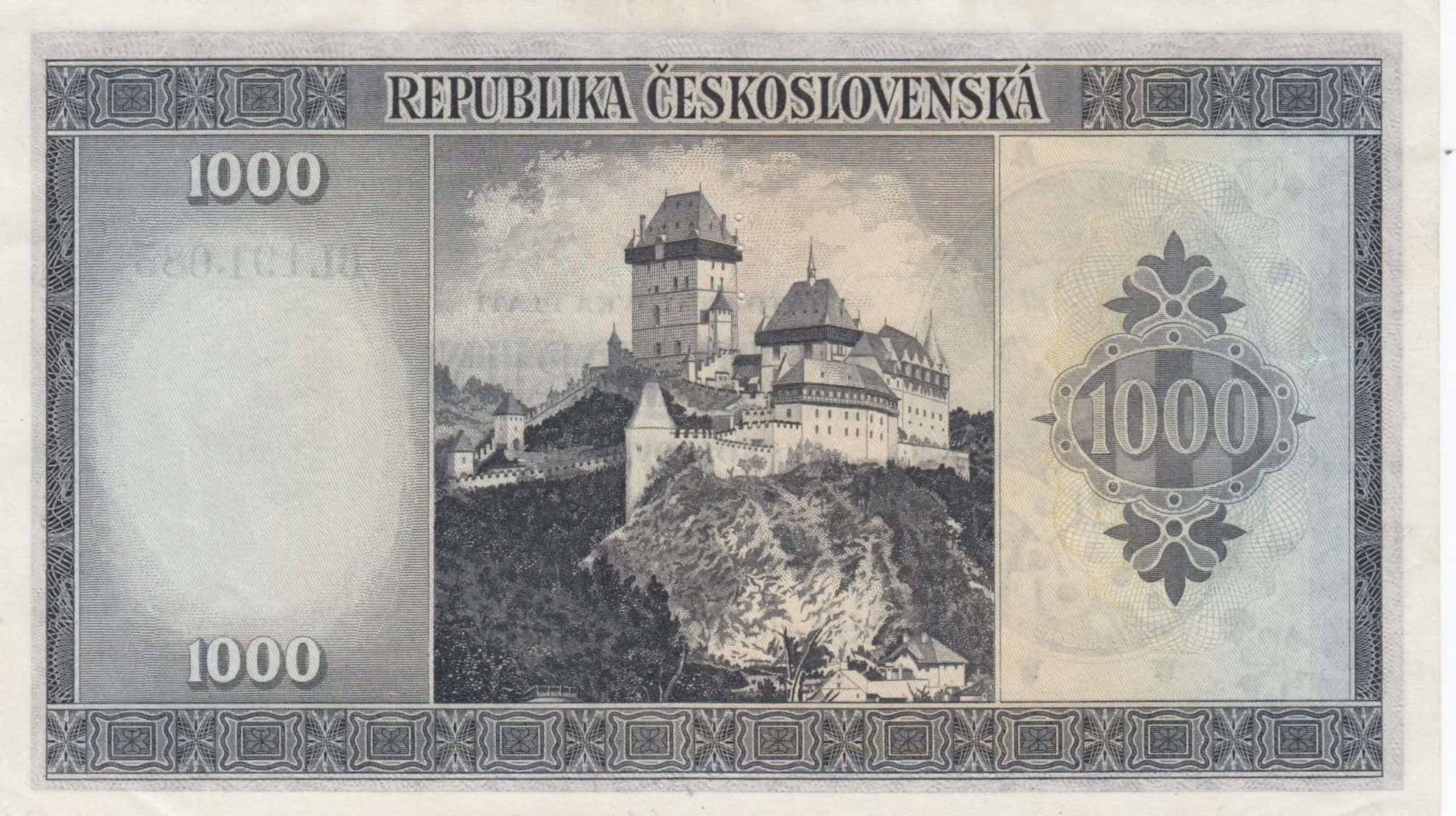
This is a 1000 Korun specimen note from Czechoslovakia issued in 1945, graded AU, featuring exceptional clarity and crisp engraving throughout. The obverse displays a dignified portrait of King Jiří z Podebrad within an ornate oval frame, while the reverse showcases the iconic Karlštejn Castle rendered in fine detail on its hilltop setting. As a specimen note (indicated by perforation markings), this represents a formal presentation piece from the Bradbury Wilkinson printing house, notable for its exceptional security engraving and the historical significance of being issued during the restoration of Czechoslovak independence.
Common. The secondary market data provided shows consistent sales of this note in UNC/AU grades across multiple sales spanning 2014-2023, with prices typically ranging from $17.50 to $102.50, with most clustering in the $40-60 range. Catalogue values (2016) list UNC at $9, confirming this as a widely available note. The 1945 Czechoslovak series had substantial print runs, and specimen notes were produced in regular quantities as formal presentation pieces. The absence of any rarity designation in PMG population reports and the consistent eBay transaction history indicate this is a standard collector note rather than a scarce variety.
This 1945 note was issued following Czechoslovakia's liberation and restoration of independence after World War II, marking the reestablishment of the Czechoslovak Republic under its legitimate government. King Jiří z Podebrad, depicted on the obverse, was a 15th-century Hussite king symbolizing Czech national identity and sovereignty, making his selection particularly resonant for a nation reclaiming its independence. Karlštejn Castle, featured prominently on the reverse, stands as one of Central Europe's most iconic medieval fortifications and a symbol of Czech cultural heritage, reinforcing national pride during this critical period of reconstruction.
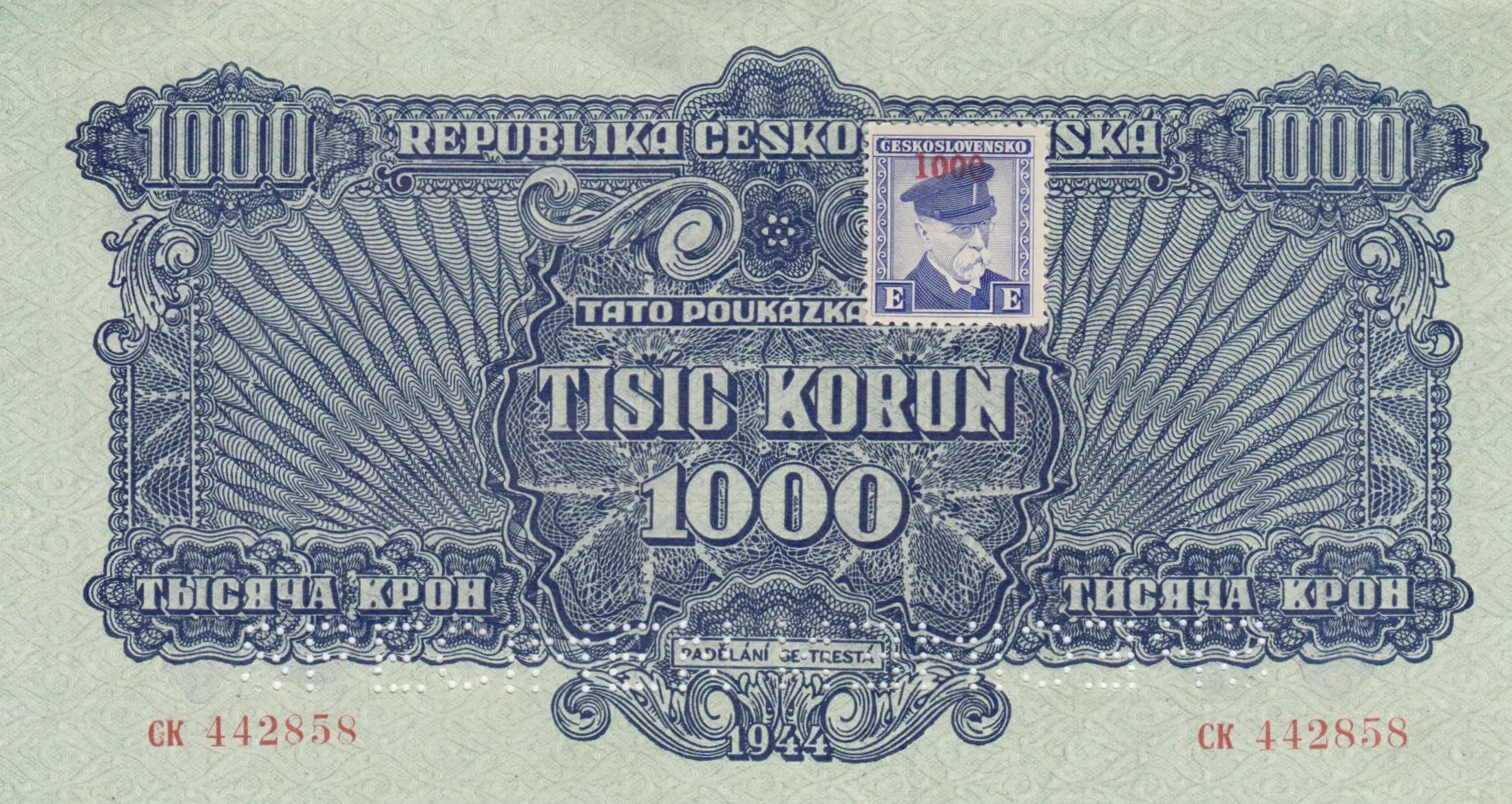
The obverse presents a classical engraved portrait of King Jiří z Podebrad in profile facing right, positioned within an ornamental oval cartouche on the left side of the note. The subject wears formal period attire with a buttoned coat, rendered with exceptional fine-line engraving detail characteristic of security currency production. Surrounding the portrait are elaborate decorative elements including floral border patterns, geometric rosette designs, and ornamental scroll work distributed across the top and bottom margins. The reverse features a detailed landscape illustration of Karlštejn Castle (Karlstein), a UNESCO-recognized medieval fortress situated on a hillside with multiple towers, spires, and defensive walls rendered in fine engraved detail and surrounded by forested landscape. Large denomination numerals '1000' appear in the corners within ornamental ovals, with a decorative border comprising geometric cross-and-square patterns and floral flourishes framing the central castle image. The color scheme is predominantly black, gray, and cream on multicolor underprint with selective red accents in ornamental details.
FRONT: 'REPUBLIKA ČESKOSLOVENSKÁ' (Czechoslovak Republic) — 'TISÍC KORUN ČESKOSLOVENSKÝCH' (One Thousand Czechoslovak Crowns) — 'MINISTR FINANCÍ' (Minister of Finance) — 'PADELÁNÍ STÁTOVEK SE TRESTÁ PODLE ZÁKONA' (Counterfeiting banknotes is punishable by law) — Serial number 'BL191.083'. BACK: 'REPUBLIKA ČESKOSLOVENSKÁ' (Czechoslovak Republic) — '1000' (denomination, repeated in corners).
Engraved intaglio printing by Bradbury Wilkinson & Co., New Malden, the pre-eminent British security printer of the era. The note exhibits the characteristic fine line-work, subtle shadings, and intricate detail that distinguish professional security engraving from other printing methods. The absence of a visible printer imprint reflects the practice of some contracts with foreign security printers during the immediate post-war period. The specimen designation is indicated through perforation markings (3 holes or 'S' or 'SPECIMEN' perforation), a standard security printer convention for sample/demonstration notes not intended for circulation.
This note is catalogued as Pick P-65s, denoting it as a specimen variant. The PMG population report identifies two main varieties: P-65a (regular issue) and P-65s (specimen issue, this note). The specimen designation is physically indicated by perforations. The serial number observed (BL191.083) suggests the block letter 'BL' designation format. No unusual overprints, signature varieties, or date variations are evident in the visual analysis. This represents the standard specimen issue of the 1945 denomination without known sub-varieties.