50 banica 1942
Market Prices
4 salesAbout This Note
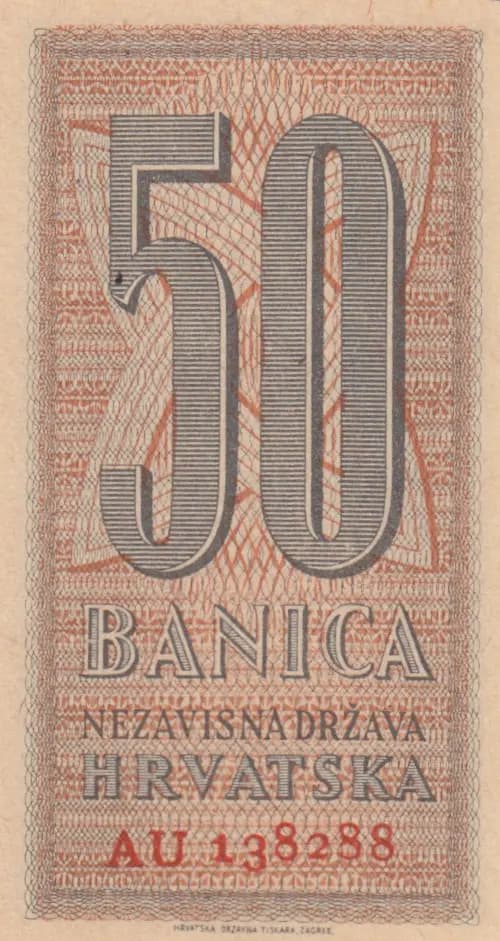
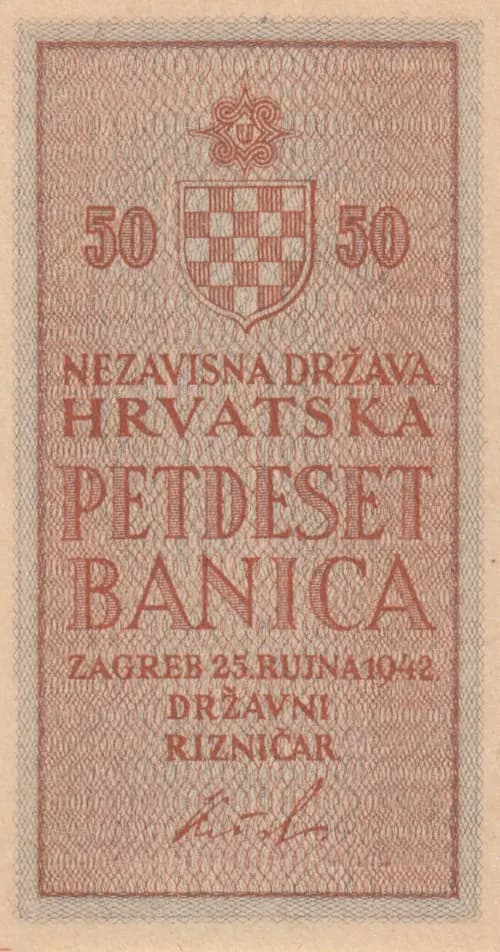
This is an uncirculated example of the Croatian 50 Banica note from 1942, issued by the Nezavisna Država Hrvatska (Independent State of Croatia). The note features a striking design with the large denomination '50' composed of horizontal striping on the obverse in red-orange and tan tones, while the reverse displays the characteristic checkered shield of the Croatian coat of arms at top center. In UNC condition with sharp details and no signs of handling, this note represents a well-preserved example of World War II-era Croatian currency.
common. While this note was issued by a short-lived wartime state (1941-1945), the 50 Banica denomination appears to have been produced in sufficient quantities to remain generally available to collectors. The documented eBay price history shows UNC examples selling for $10-20.50 in the 2012-2017 period, with catalog valuations at $10 UNC (2016), which are consistent with common banknotes. The PMG population data shows limited professional grading activity but does not indicate scarcity. This is a historically interesting note but not rare in collector terms.
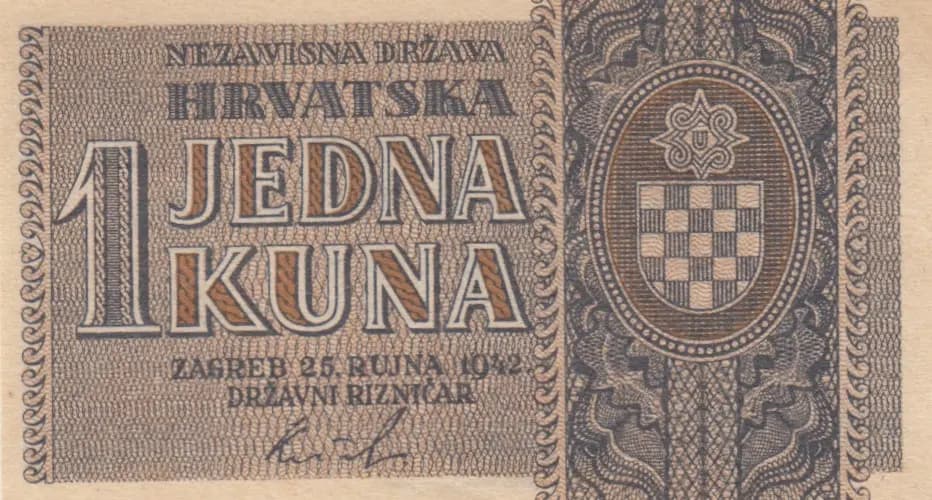
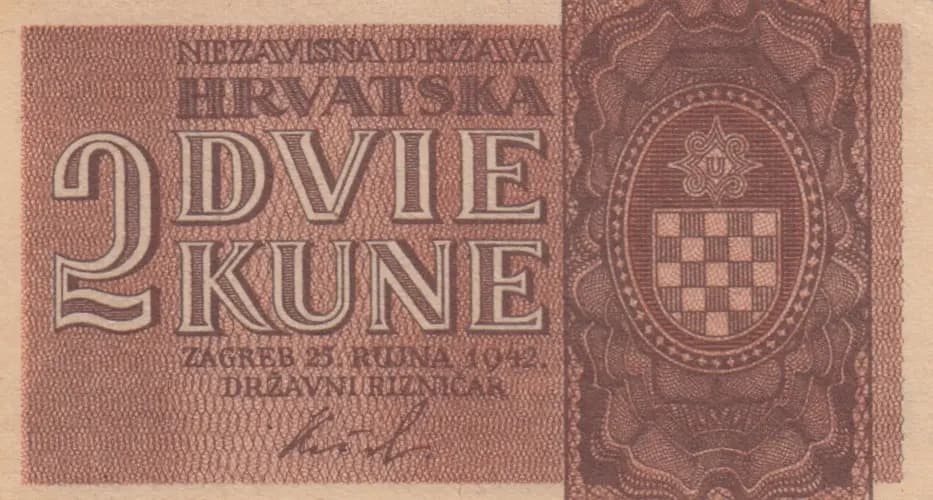
This banknote was issued on September 25, 1942, by the Independent State of Croatia (NDH), a German-aligned puppet state that existed during World War II (1941-1945). The prominent heraldic coat of arms featuring the characteristic checkered shield (šahovnica) on the reverse is the defining symbol of Croatian national identity and sovereignty. The formal inscription 'Državni Rizničar' (State Treasurer) and Zagreb date reflect the administrative apparatus of this short-lived but symbolically significant state.
The obverse features a large, centrally-positioned '50' rendered with fine horizontal line work creating a striped pattern, outlined in black with decorative flourishes, set against a repeating geometric background in red-orange tones. The reverse displays the shield of the Croatian coat of arms (šahovnica—the characteristic red and white checkered pattern) positioned prominently at top center, crowned with an ornamental element, flanked by denomination numerals, with administrative and dating inscriptions arranged below. Both sides employ a fine geometric pattern background as a security measure. The overall design emphasizes heraldic authority and national symbolism rather than portraiture.
OBVERSE: 'BANICA' (Banica—the currency denomination), 'NEZAVISNA DRŽAVA HRVATSKA' (Independent State of Croatia), 'AU.138288' (Serial number). REVERSE: '50' (Denomination), 'NEZAVISNA DRŽAVA HRVATSKA' (Independent State of Croatia), 'PEFDESET BANICA' (Fifty Banica), 'ZAGREB 25.RUJNA 1942' (Zagreb, September 25, 1942), 'DRŽAVNI RIZNIČAR' (State Treasurer), '4/4' (Signature designation/authority mark).
Letterpress/relief printing, executed by Hrvatska Državna Tiskara (Croatian State Printing House) in Zagreb. The technique is evident from the crisp registration of the geometric patterns, the clean line work of the numerals, and the sharp impression of the heraldic design. The fine parallel line backgrounds and intricate numeral composition suggest high-quality security printing standards typical of official state currency production during this period.
Pick catalog lists this as P-6b, with a known variant P-6a also recorded for the 50 Banica denomination. The observed specimen exhibits the double-letter serial number prefix format ('AU') noted in the community catalog references as characteristic of this issue. The specific serial number AU.138288 places this within the regular production run. No overprints, date variations, or signature variants are visible; this appears to be a standard regular issue from the September 25, 1942 release.