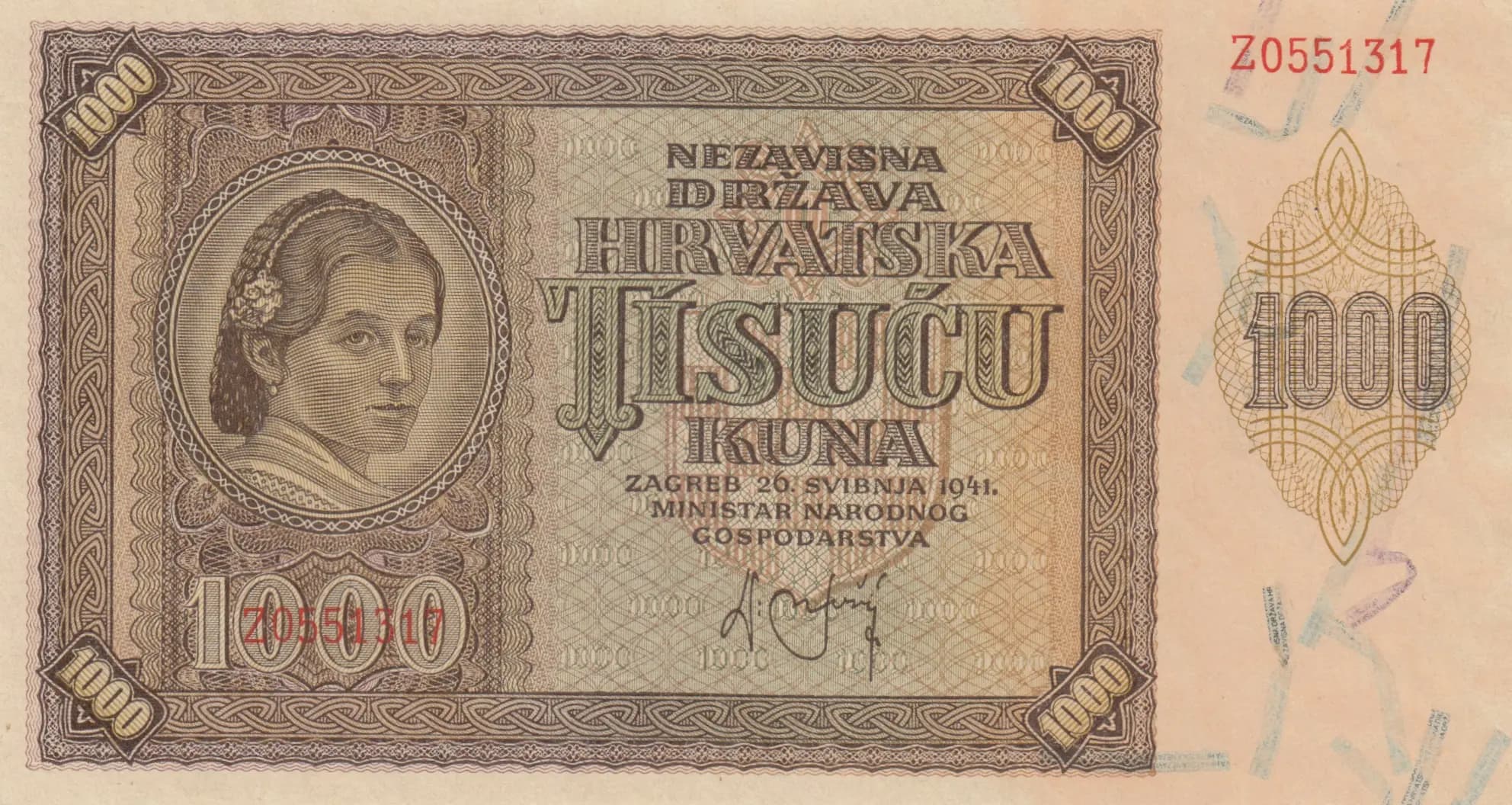
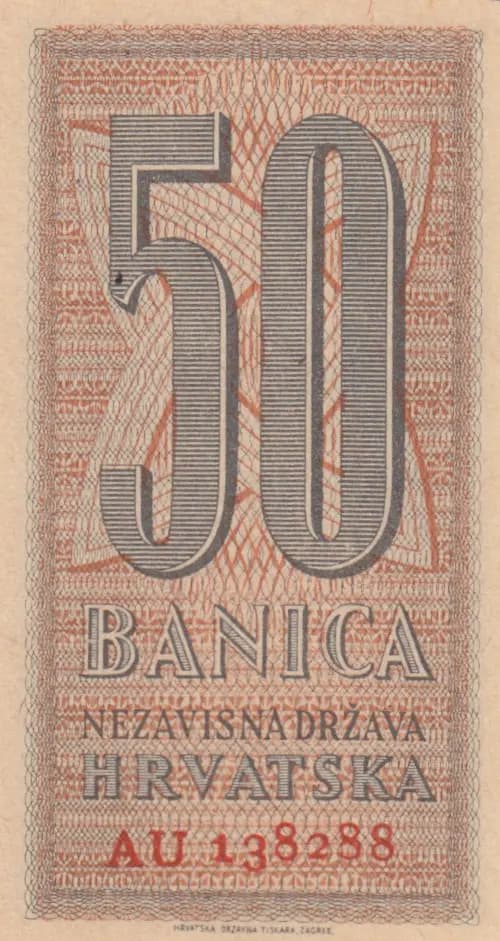
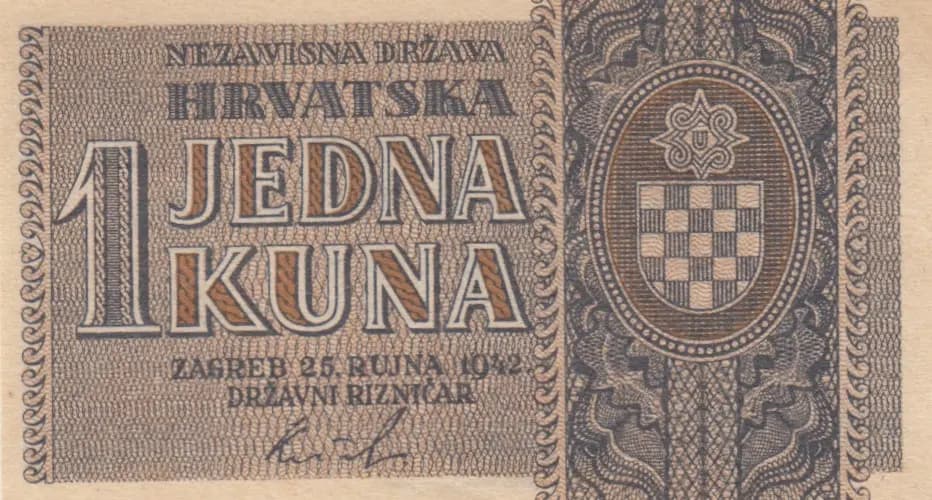
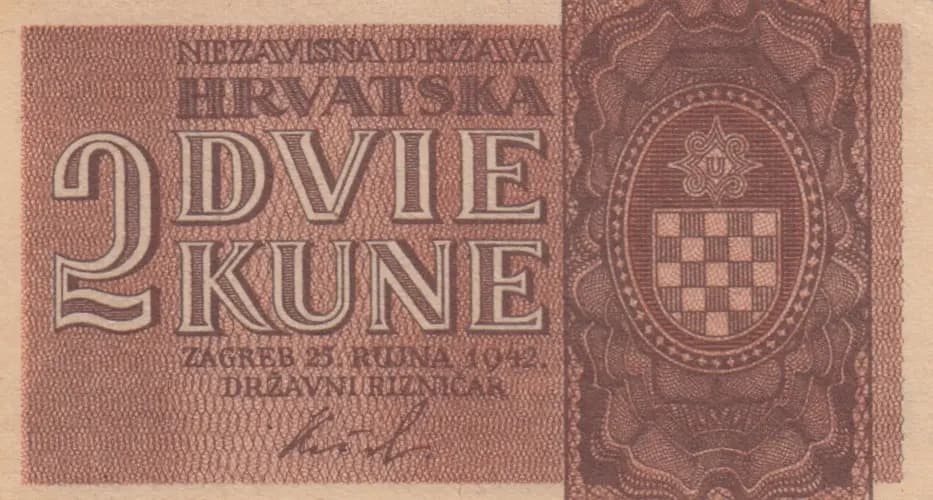
10 kuna 1941
Market Prices
9 salesAbout This Note
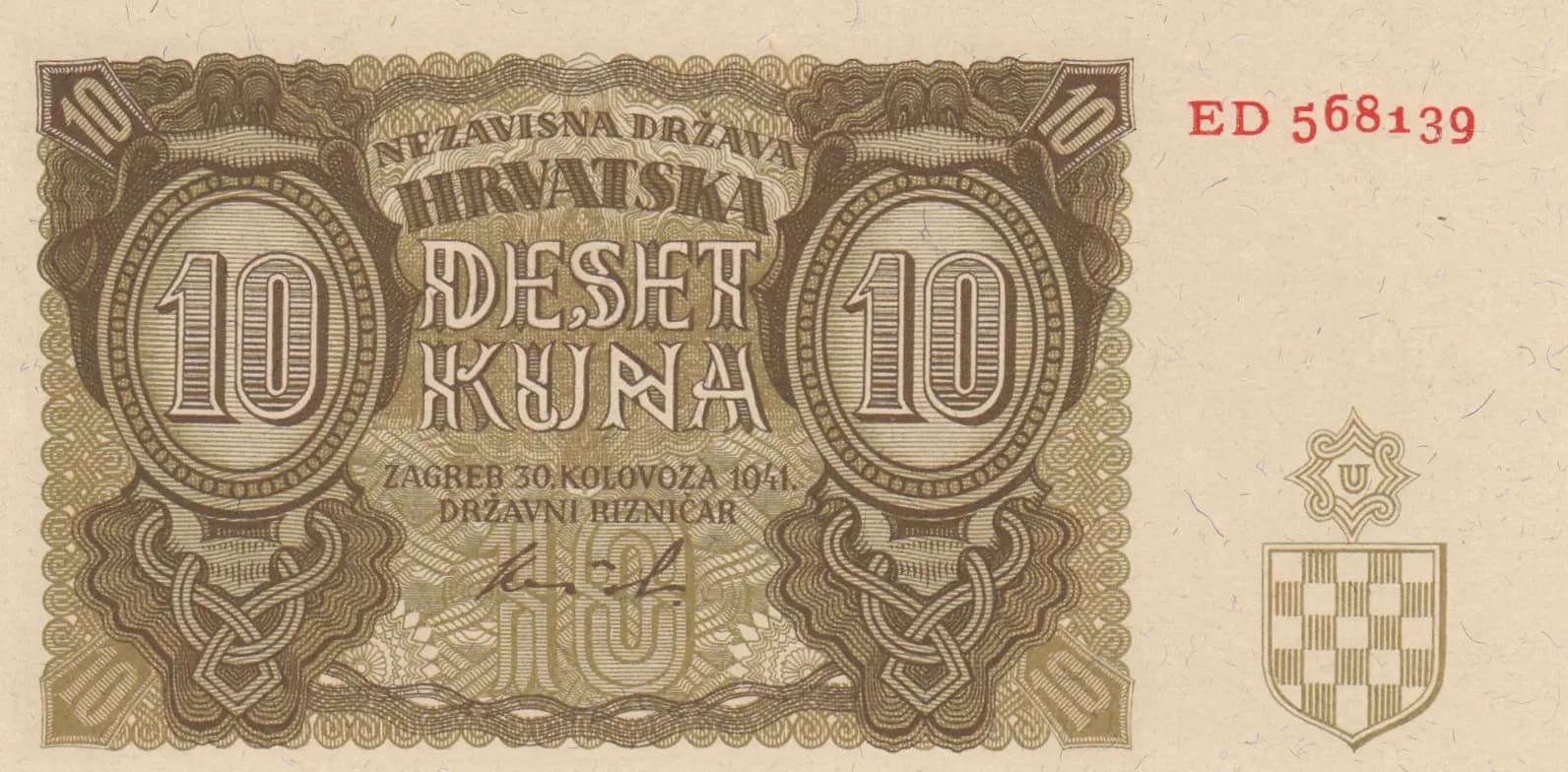
This 10 Kuna banknote from the Independent State of Croatia (Nezavisna Država Hrvatska) represents a historically significant piece of World War II-era currency, issued on 30 August 1941. The note exhibits excellent preservation with light aging consistent with its 1940s origin, clear printing throughout, and no visible damage—characteristics befitting its UNC grade. The ornate baroque-style decorative design and central coat of arms showcase the period's aesthetic while serving as a tangible artifact of a short-lived wartime state.
Common. Despite its historical significance as wartime currency from a short-lived state, this denomination and variety remain readily available in the collector market. eBay price tracking shows consistent sales activity with UNC examples typically realizing $15-$27 USD, with most transactions falling well below $50. A 2016 catalog valuation of $15 for UNC condition, combined with multiple regular sales at modest prices, indicates this is a common issue despite its historical context. Wartime Croatian currency from this period saw substantial production runs and remains frequently encountered in numismatic commerce.
Issued during the Croatian puppet state's existence under Axis control (1941-1945), this banknote represents the monetary system of the Nezavisna Država Hrvatska, established following the German invasion of Yugoslavia. The coat of arms shield featuring the characteristic checkered pattern (šahovnica) on the front and the formal state insignia reflect the nationalist symbolism employed by the regime. The Zagreb date and 'Državni Blagajnik' (State Treasurer) inscription underscore this note's role in legitimizing the short-lived independent state's financial administration during wartime.
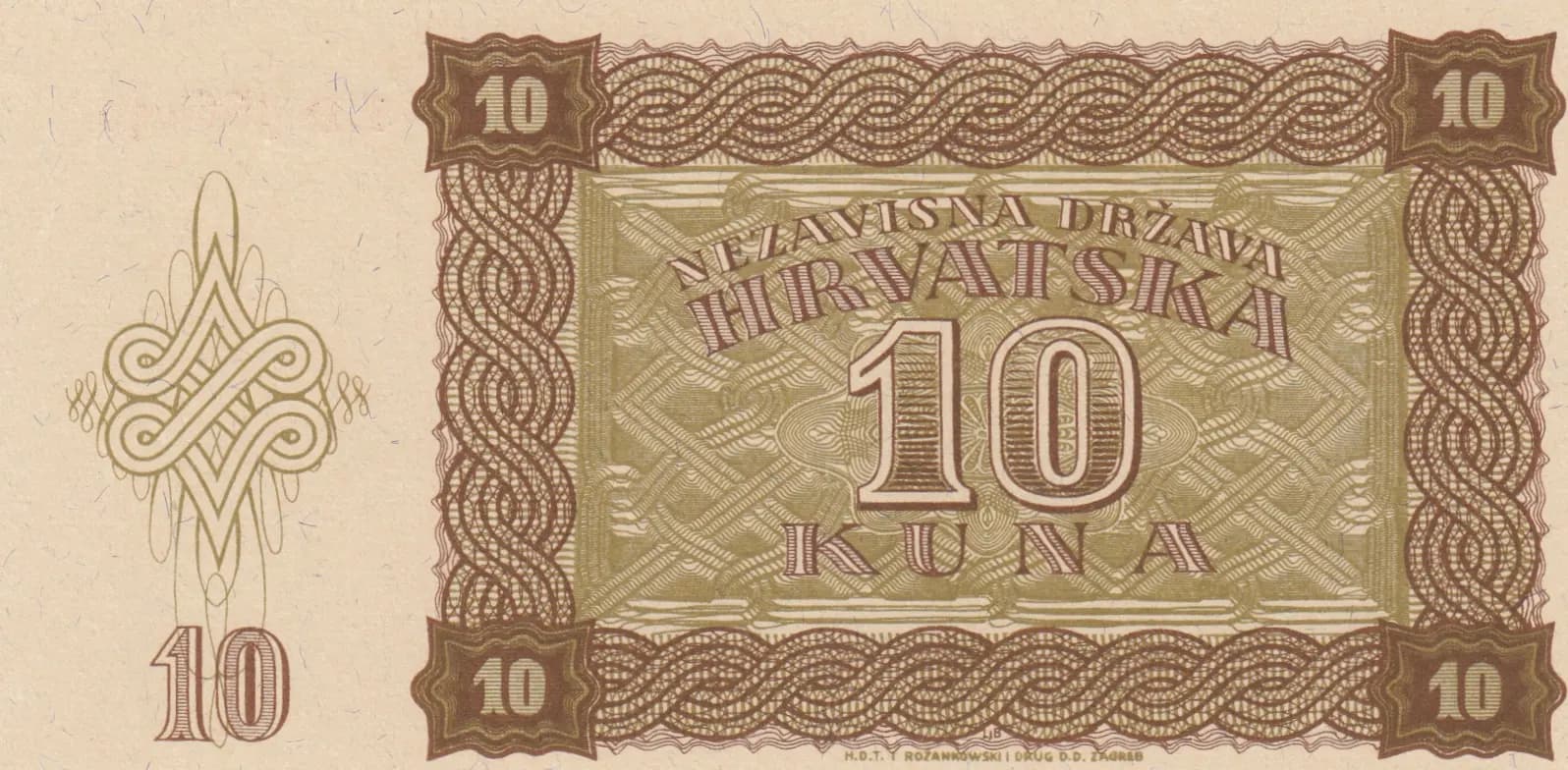
The banknote features an elaborate classical design with no portrait elements, instead emphasizing heraldic and ornamental symbolism typical of mid-20th-century European state currencies. The front displays the Croatian coat of arms (the šahovnica shield with its characteristic checkerboard pattern) prominently positioned on the right side, flanked by large oval-framed numerals '10' on both left and right margins. The reverse presents an ornamental geometric cross or flower motif on the left side with corner numerals in baroque frames and repeating cable/rope pattern borders forming the outer frame. The dominant color palette of browns, tans, creams, and sepia tones creates a monochromatic effect typical of wartime-era emergency currency, while the intricate line engraving provides visual security and authenticity markers.
FRONT SIDE: 'Nezavisna Država Hrvatska' (Independent State of Croatia) — the issuing authority; 'Deset Kuna' (Ten Kuna) — denomination; 'Zagreb 30. Kolovoza 1941' (Zagreb 30 August 1941) — place and date of issue; 'Državni Blagajnik' (State Treasurer) — authorizing official; Serial number 'ED 568139' printed in red ink. BACK SIDE: 'Nezavisna Država Hrvatska' (Independent State of Croatia); 'Kuna' (Kuna) — denomination; 'H.D.T.T Rozanowski i Drug D.D. Zagreb' (H.D.T.T Rozanowski and Co. Ltd., Zagreb) — printer attribution.
Intaglio engraving (line engraving) throughout, executed by H.D.J. i Rozankowski i Drug D.D., Zagreb, the official state printer. The security features include fine detailed line work, complex geometric and floral patterns, ornate decorative borders, and multi-layered engraved elements visible in both the corner frames and border designs. The serial number was applied in red ink as a separate printing step, typical of banknote production methodology of the period.
This note is catalogued as Pick P-5b, with P-5a representing a variant of the same base denomination. The specific variety appears to be distinguished by minor design or printing details; however, without direct comparison imagery or definitive catalog notes clarifying the P-5a/P-5b distinction, the exact differentiating characteristics cannot be determined from the visual analysis alone. The serial number prefix 'ED' and the date of 30 August 1941 are consistent with the standard issue parameters for this Pick number. No overprints, signatures variations, or unusual serial features are evident in the present specimen.