2 kuna 1942
Market Prices
3 salesAbout This Note
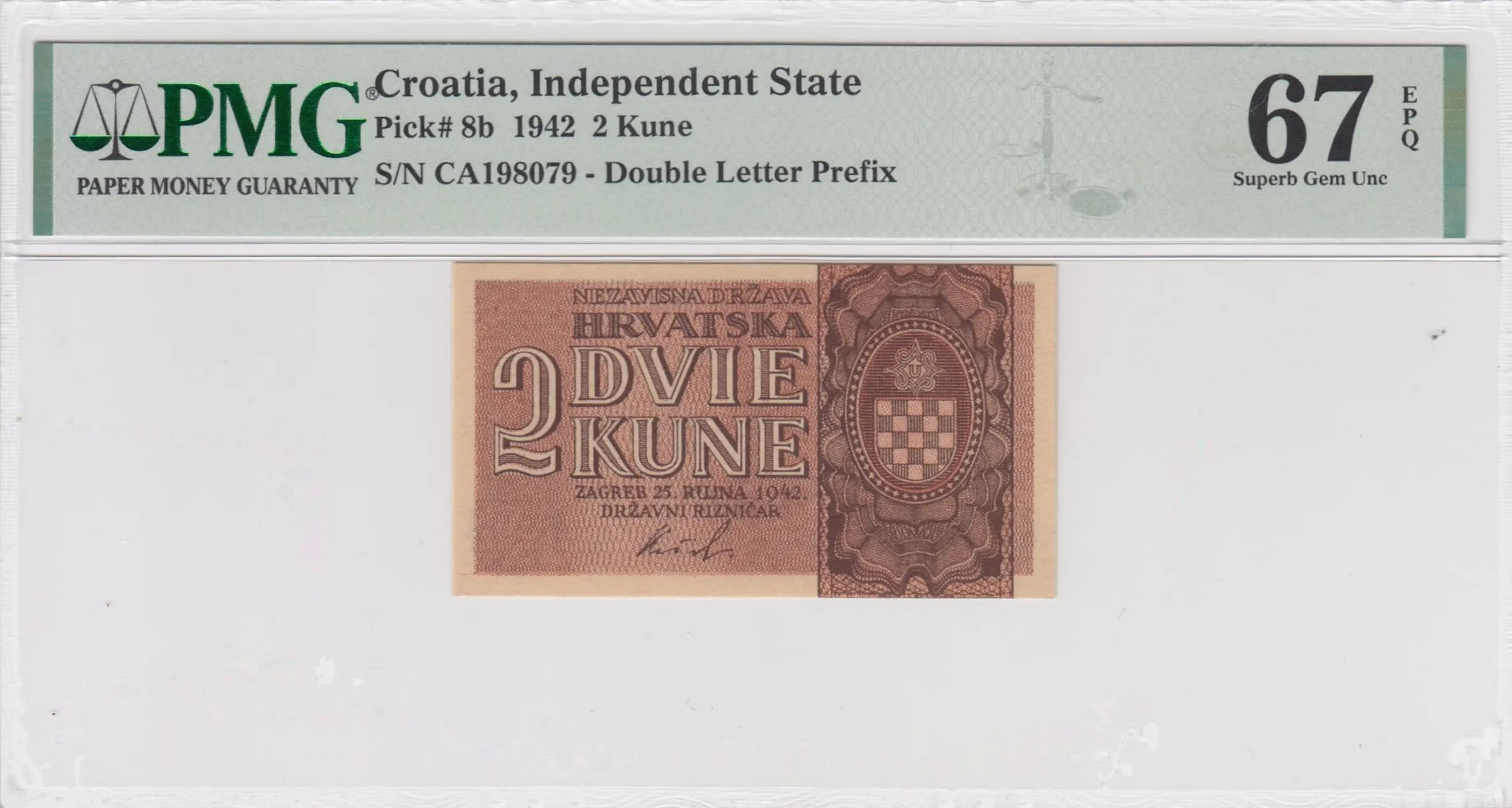
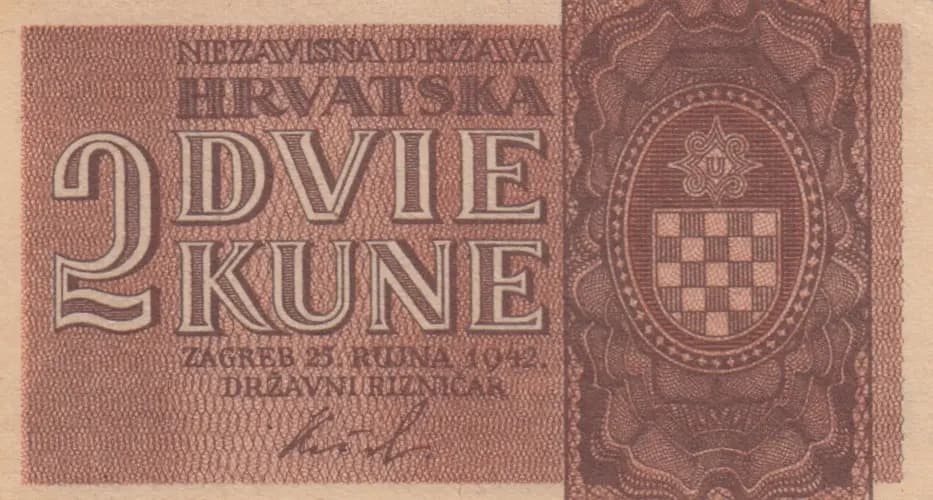
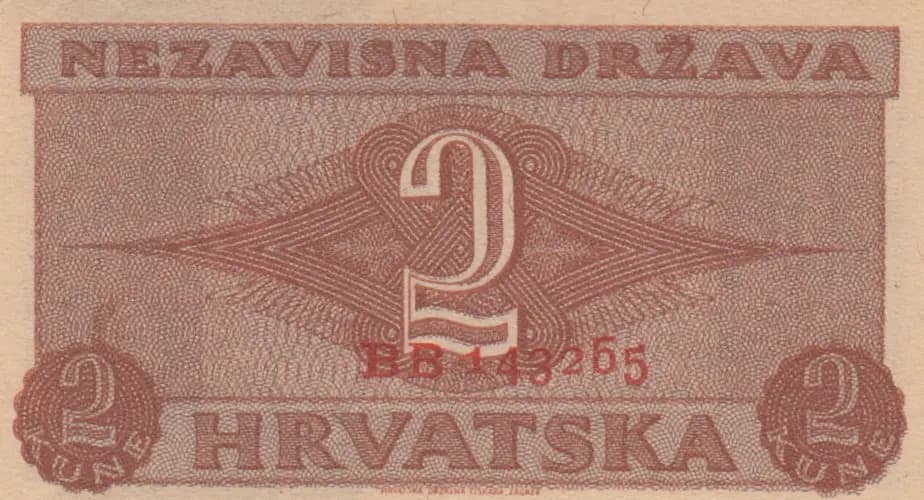
A striking 2 Kuna note from the Nezavisna Drzava Hrvatska (Independent State of Croatia) issued on 25 September 1942, presented in uncirculated condition. The front features a large decorative numeral '2' alongside the prominent Croatian coat of arms (šahovnica checkerboard) within an ornate oval cartouche, while the reverse displays an elegant radiating-line design centered on the denomination numeral. The reddish-brown engraved design showcases fine line work and cross-hatching throughout, with no visible wear, creases, or damage consistent with its UNC grade.
Common. The catalog value of $8 UNC (as of 2016) and the eBay market data showing UNC sales in the $13–$20 range indicate this is a frequently encountered note in collectors' markets. The Nezavisna Drzava Hrvatska issued currency in substantial quantities during its four-year existence, and 2 Kuna notes were a standard denomination. No evidence of a small print run, early recall, or extreme scarcity appears in the PMG population data (which catalogues multiple variants including P-8a and P-8b) or pricing history. This represents a typical World War II-era puppet state currency note rather than a numismatic rarity.
This note was issued during the World War II era by the Nezavisna Drzava Hrvatska (Independent State of Croatia), a puppet state under Axis control from 1941 to 1945. The prominence of the Croatian šahovnica (checkered shield) on the front represents the national symbolism of this short-lived state, serving as a direct assertion of Croatian sovereignty during a period of external domination. The 25 September 1942 issue date places this note in the latter half of the state's existence, reflecting the wartime currency needs of the regime.
The obverse (front) features a large, ornately styled numeral '2' on the left side, paired with the coat of arms of the Nezavisna Drzava Hrvatska—a shield bearing the characteristic red-and-white checkered pattern (šahovnica) set within an elaborate oval cartouche with decorative borders. The reverse displays a more geometric design, with a prominent central numeral '2' surrounded by radiating lines in a sunburst pattern, creating visual movement and depth. Both sides employ finely engraved linework, cross-hatching, and background patterns in the reddish-brown color scheme typical of 1940s European currency design. The šahovnica shield is the primary national symbol and the most distinctive heraldic element on this note.
Front: 'HRVATSKE DRZAVE' (Croatian State) / 'HRVATSKOGA' (Croatian) / 'DVIJE KUNE' (Two Kuna) / Decorative numeral '2'. Back: 'NEZAVISNA DRZAVA' (Independent State) / 'HRVATSKA' (Croatia) / '2' (denomination) / '1942.255' (date reference code, where 255 represents the day in Julian calendar format—approximately 12 September in the Gregorian calendar, or a cataloging reference).
Intaglio (copperplate) engraving, confirmed by the catalog printer Hrvatska Drzavna Tiskara (Croatian State Printing House) in Zagreb. The fine line work, detailed cross-hatching, radiating line patterns, and overall depth of impression visible in both the visual analysis and the catalog data are characteristic of high-quality intaglio printing. No additional security features such as watermarks, color-shifting inks, or holograms are evident, consistent with 1942 printing standards.
This note is cataloged as Pick-8b, indicating a known variety distinction within the 2 Kuna issue. The catalog lists both P-8a and P-8b variants. Without additional documentation or the image of a P-8a example for direct comparison, the specific distinguishing feature of the P-8b variety (such as signature differences, date variations, or subtle design changes) cannot be definitively identified from the visual analysis alone. Serial numbers, if visible in the original note, would also help confirm the specific variety, but these are not clearly detailed in the provided analysis.