1000 kuna 1943
Market Prices
79 salesAbout This Note
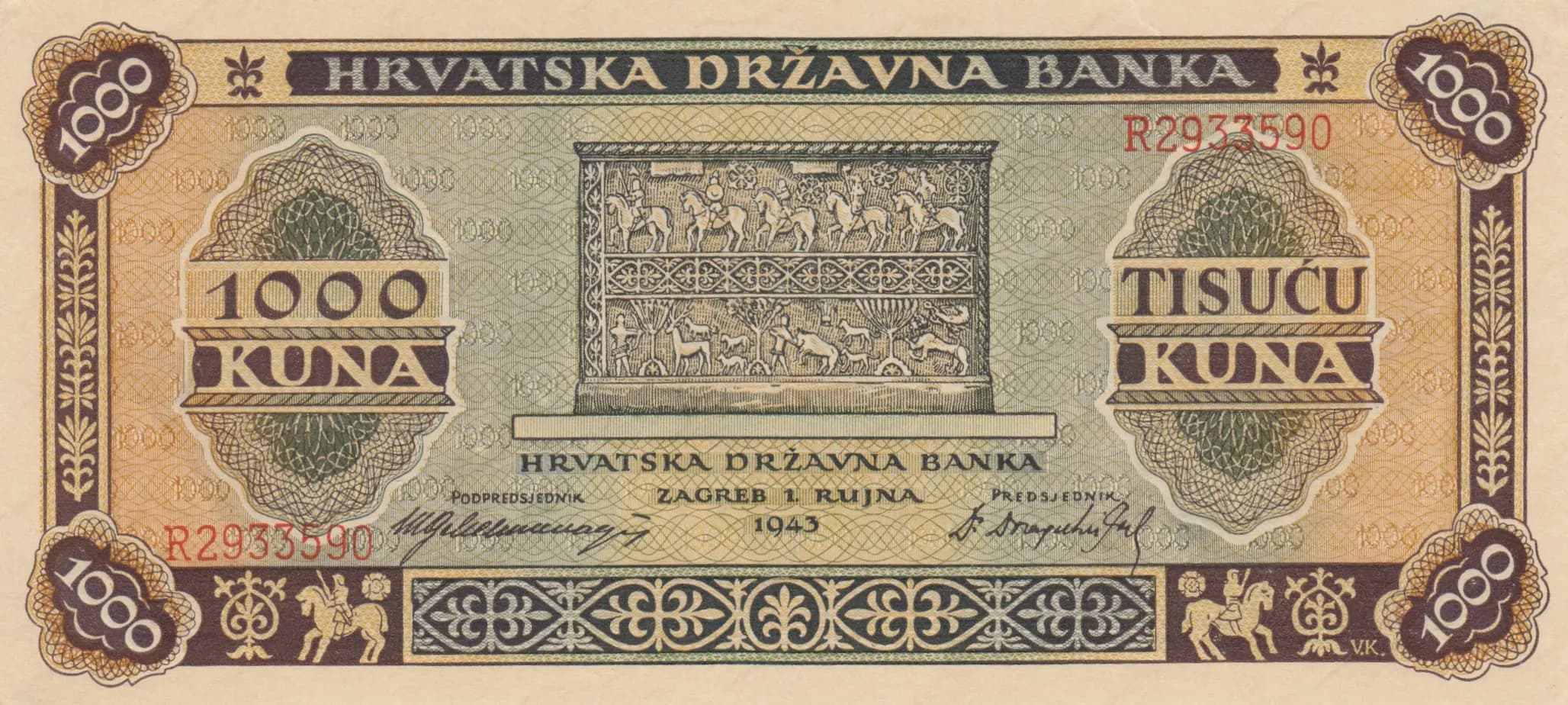
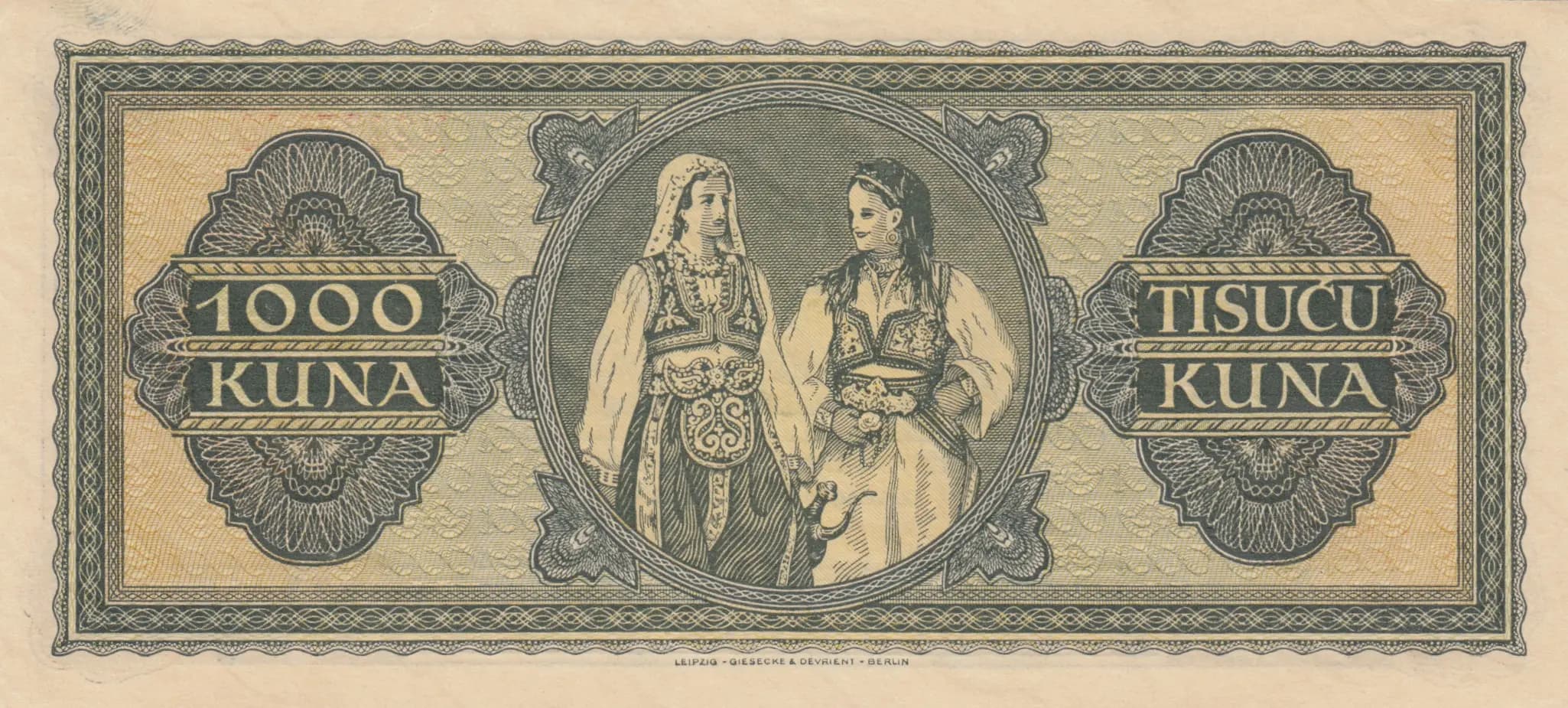
This is an outstanding example of the 1000 Kuna note issued by Hrvatska Državna Banka in 1943, graded AU by condition standards. The note displays pristine preservation with sharp detail throughout its ornate engraved design, featuring a classical relief frieze on the obverse and traditional Croatian women in folk costume on the reverse. The exceptional clarity of the fine line work and complete absence of wear make this an excellent specimen for collectors of WWII-era Balkan currency or Croatian numismatic history.
Common. eBay market data shows consistent sales across all recent years (2013-2025) with typical prices ranging from $4-$70 depending on condition grade and PMG certification level. Notes in AU/AUNC condition regularly sell for $10-$15 without grading, and PMG 66-67 examples sell for $30-$55. The steady availability and relatively modest price points indicate healthy supply. This note was issued by an official state bank during a recognized (if controversial) historical period and was not recalled, suggesting substantial surviving quantities.
This note was issued during 1943 by the Croatian State Bank (Hrvatska Država Banka) under the Independent State of Croatia, a Nazi puppet state established during World War II. The reverse depicts two women in traditional Croatian folk dress with elaborate embroidered vests and decorative headdresses, reflecting the nationalist cultural iconography promoted by the regime. The classical narrative relief carving on the obverse represents the state's attempt to legitimize itself through appeals to historical and cultural heritage.
The obverse features an ornate baroque-style design with elaborate floral and geometric borders framing a central narrative relief scene depicting multiple classical or historical figures in a detailed engraved composition, rendered in dark brown on cream and green underprint tones. The reverse displays two women in traditional Croatian folk costume with embroidered vests, decorative headdresses, and jewelry within a circular medallion frame, surrounded by ornamental geometric and floral border work. Both sides employ decorative cartouches with shell-fan motifs containing the denomination. The entire design demonstrates the sophisticated engraving techniques characteristic of Giesecke & Devrient's high-security currency production, with fine line work and repeated geometric patterns serving as anti-counterfeiting measures.
Front side: 'HRVATSKA DRŽAVA BANKA' (Croatian State Bank); '1000 KUNA' and 'TISUĆU KUNA' (one thousand kuna - denomination in both numeric and written form); '1943' (year of issue); 'ZAGREB I RIJINA' (Zagreb and Rijina, administrative centers); 'PREDSJEDNIKA' (President) and 'POPRESDJEDNIKA' (Vice President - signature lines). Reverse side: '1000 KUNA' and 'TISUĆU KUNA' (denomination repeated); 'LEIPZIG · GIESECKE & DEVRIENT · BERLIN' (printer attribution - Giesecke & Devrient printing company, Leipzig and Berlin offices). Serial number: R2933590 (seven-digit alphanumeric).
Intaglio engraving and printing by Giesecke & Devrient (noted on reverse as 'Leipzig · Giesecke & Devrient · Berlin'). The note exhibits classical banknote engraving with fine line work throughout, multiple color printing (dark brown primary design on yellow and green underprint base), and intricate decorative patterns. The detailed portraiture, fine line work, and security patterns are all characteristic of premium intaglio security printing.
Pick catalog P-12 identifies a single documented variant for this base number. The observed specimen features serial number R2933590 with the R-prefix format. The note shows the standard 1943 issue date with Giesecke & Devrient printing attribution. No overprints or date variations are apparent in this example. The seven-digit serial numbering and signature block configuration are consistent with the standard P-12 issuance.