1000 francs 1964
Market Prices
23 salesAbout This Note
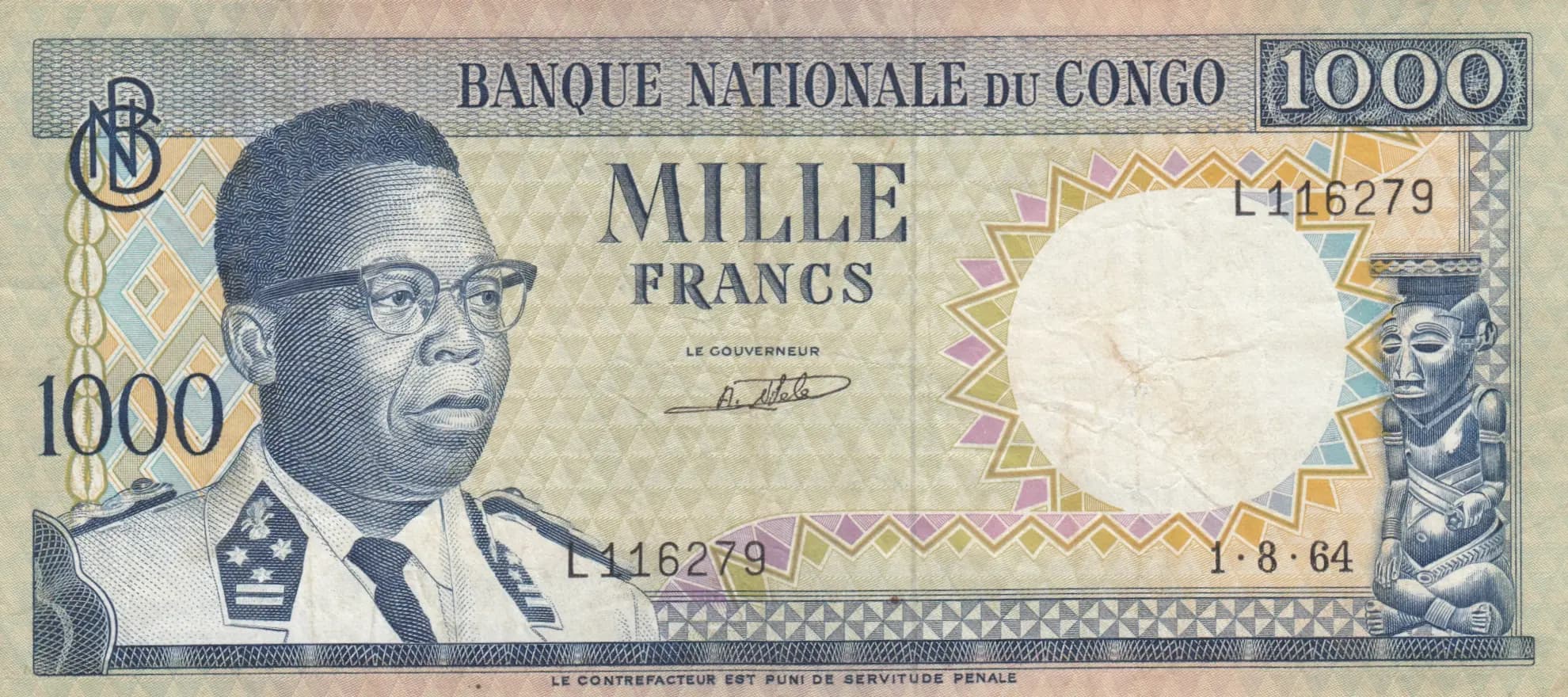
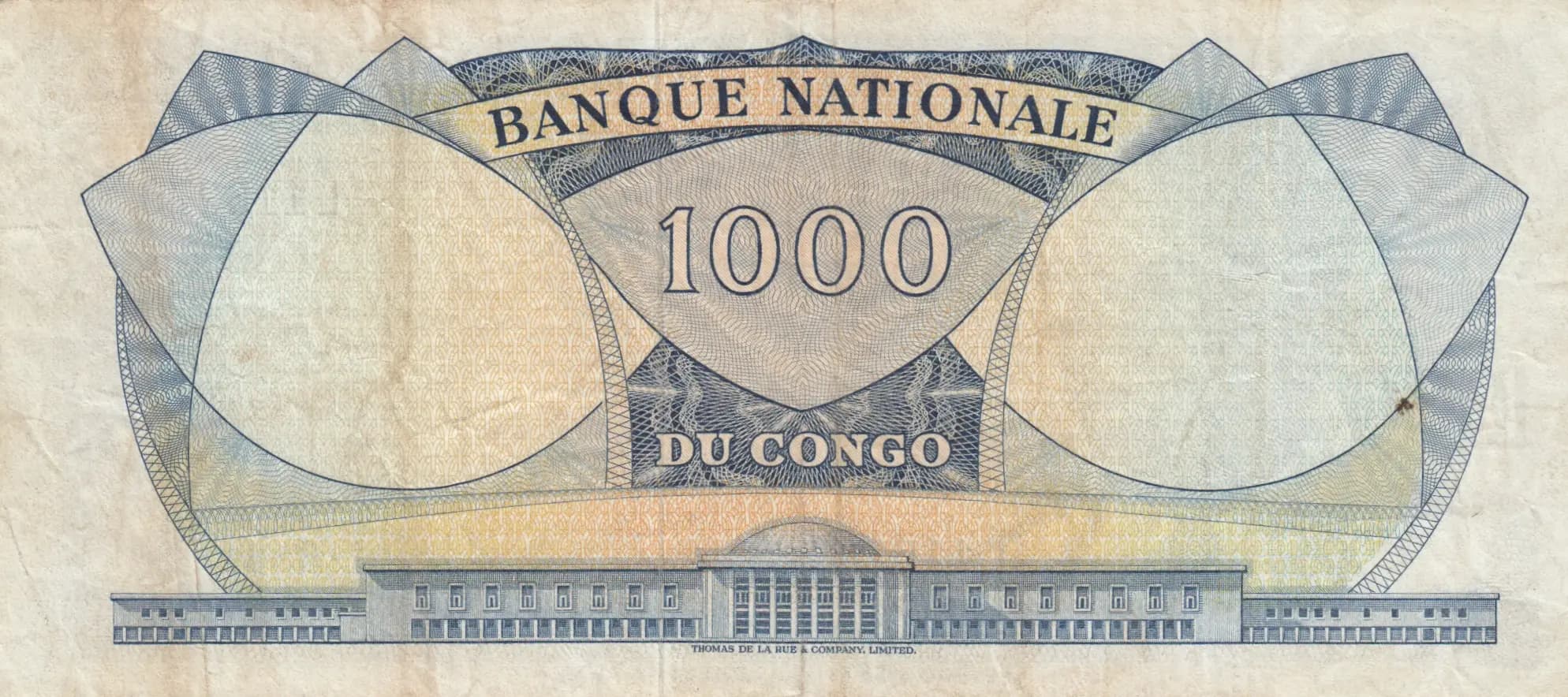
This 1000 Francs note from the Banque Nationale du Congo (1964) features an impressive portrait of President Joseph Kasavubu in military dress on the obverse, paired with a detailed architectural rendering of the National Assembly building on the reverse. The note displays natural aging consistent with circulation and handling, with visible creasing particularly in the center area, placing it solidly in the Very Fine condition grade specified. The fine line engraving work and ornate geometric patterns demonstrate the high-quality printing standards of Thomas de la Rue, making this an excellent example of early Congo banknote design.
Common. Market data from eBay sales over an extended period shows consistent availability with VF-graded examples regularly selling in the $5-$25 range, with catalog values (2019) placing VF at $30 and UNC at $150. Multiple sales transactions across numerous years indicate sustained market availability rather than scarcity. The print run for this series was substantial and the note remains readily obtainable in collector markets.
This note was issued during the critical early years of the Democratic Republic of Congo, shortly after independence from Belgium in 1960. President Joseph Kasavubu, depicted prominently on the obverse, served as the first elected president of the newly independent nation and his portrait symbolized the nation's sovereignty and transition to self-governance. The National Assembly building depicted on the reverse represents the institutional foundation of the fledgling republic's democratic structures during this tumultuous period of Congo's history.
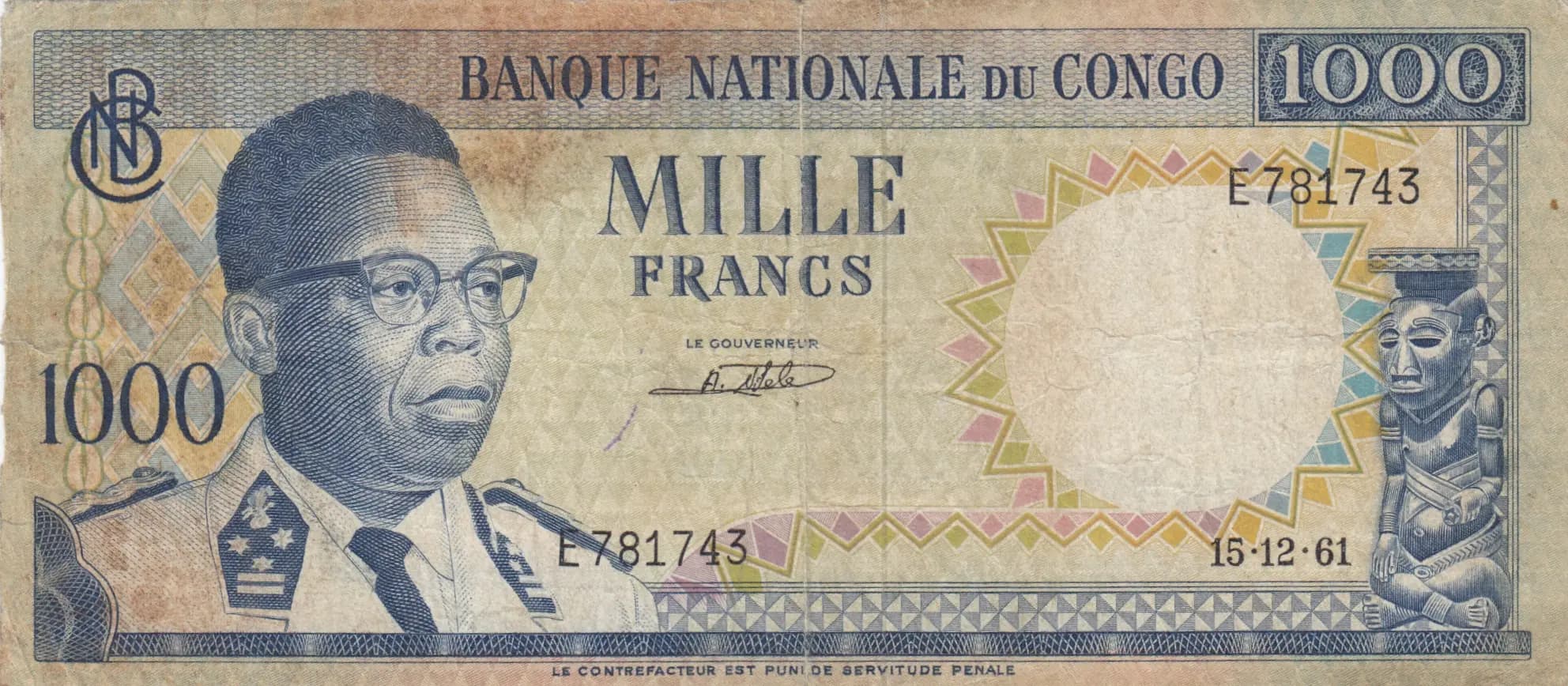
The obverse features a portrait of President Joseph Kasavubu positioned at left, depicted wearing eyeglasses and formal military uniform complete with starred insignia and decorative braiding indicating his rank and office. The right side displays a traditional African carved wooden mask or figure, representing indigenous cultural heritage. Ornate geometric patterns in earth tones frame the design. The reverse presents a symmetrical institutional building—the National Assembly of Kinshasa—rendered in detailed classical architectural style with regularly-spaced windows and formal proportions, flanked by large decorative curved shield or vessel shapes forming an ornate geometric composition. The entire note employs fine line engraving with complex guilloche patterns as security measures.
FRONT SIDE: 'Banque Nationale du Congo' (National Bank of Congo) | '1000' (denomination) | 'Mille Francs' (One thousand francs) | 'Le Gouverneur' (The Governor - title above signature line) | 'L416279' (serial number) | '1·8·64' (date: August 1, 1964) | 'Le Contrefacteur est puni de servitude penale' (Counterfeiting is punished by penal servitude). BACK SIDE: 'Banque Nationale' (National Bank) | '1000' (denomination) | 'Du Congo' (Of Congo) | 'Thomas de la Rue & Company, Limited' (printer attribution).
Intaglio (line engraving) printing executed by Thomas de la Rue & Company, Limited of London—one of the world's premier security printers. The fine detail visible in the portrait, the ornate geometric borders, the architectural rendering, and the complex guilloche patterns are all characteristic of intaglio processes. The multicolored underprint (beige, blue-grey, cream, gold/yellow, and pink tones) indicates color separation work typical of high-security banknote production of this era.
This note is identified as Pick-8 (P-8), the 1000 Francs denomination from 1964, issued by Banque Nationale du Congo and printed by Thomas de la Rue (TDLR). The PMG population report indicates both P-8a and P-8s varieties exist for this Pick number. The visual analysis confirms the '1·8·64' date notation and serial number 'L416279' with prefix 'L'. The obverse inscription '1·8·1964' (August 1, 1964) corresponds to the later issue date mentioned in catalog references, distinguishing it from the 1961 variant. No overprints, replacement notes, or error characteristics are apparent from visual analysis.