20 francs 1962
“15.05.62”
Market Prices
24 salesAbout This Note
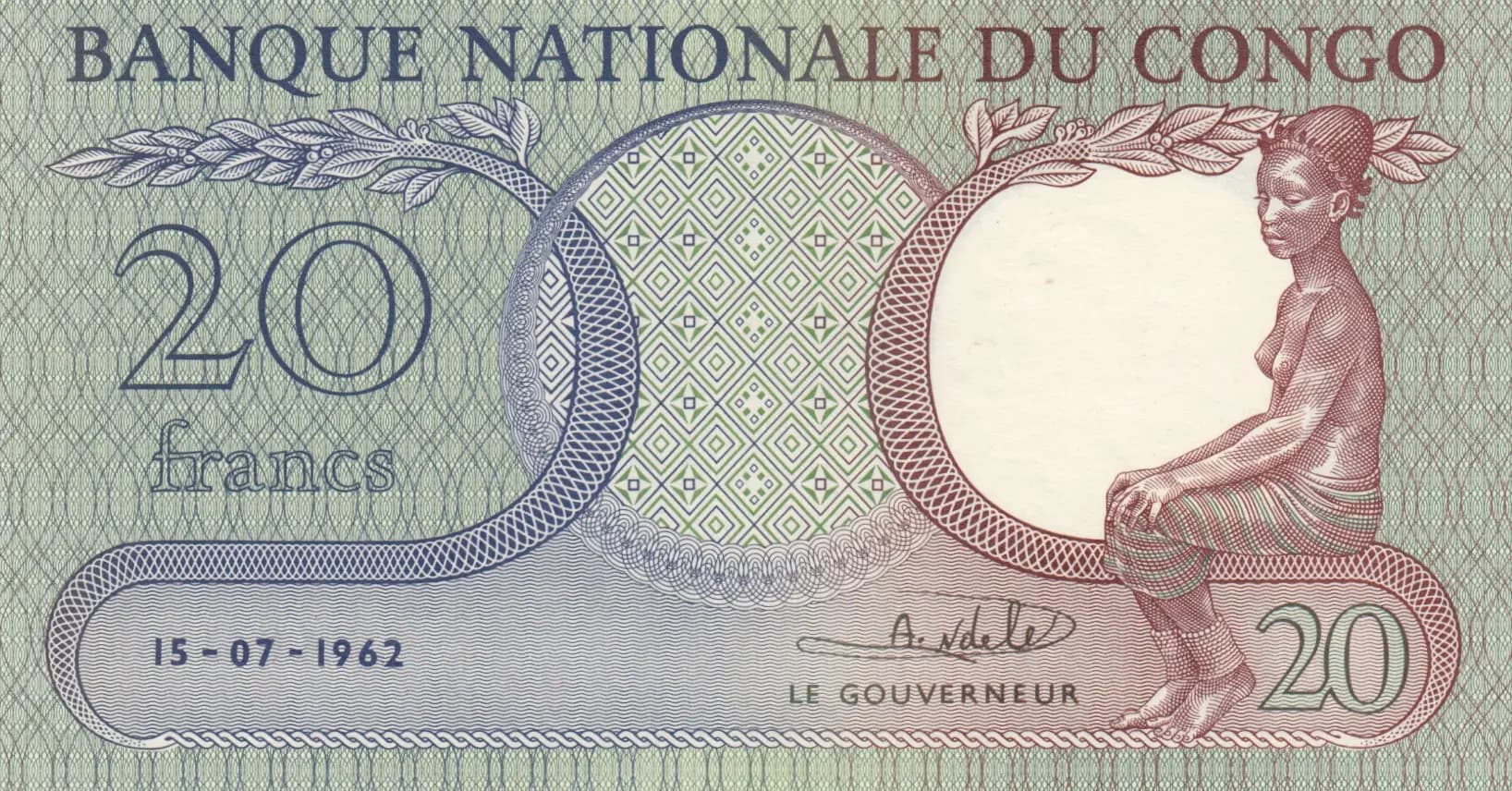
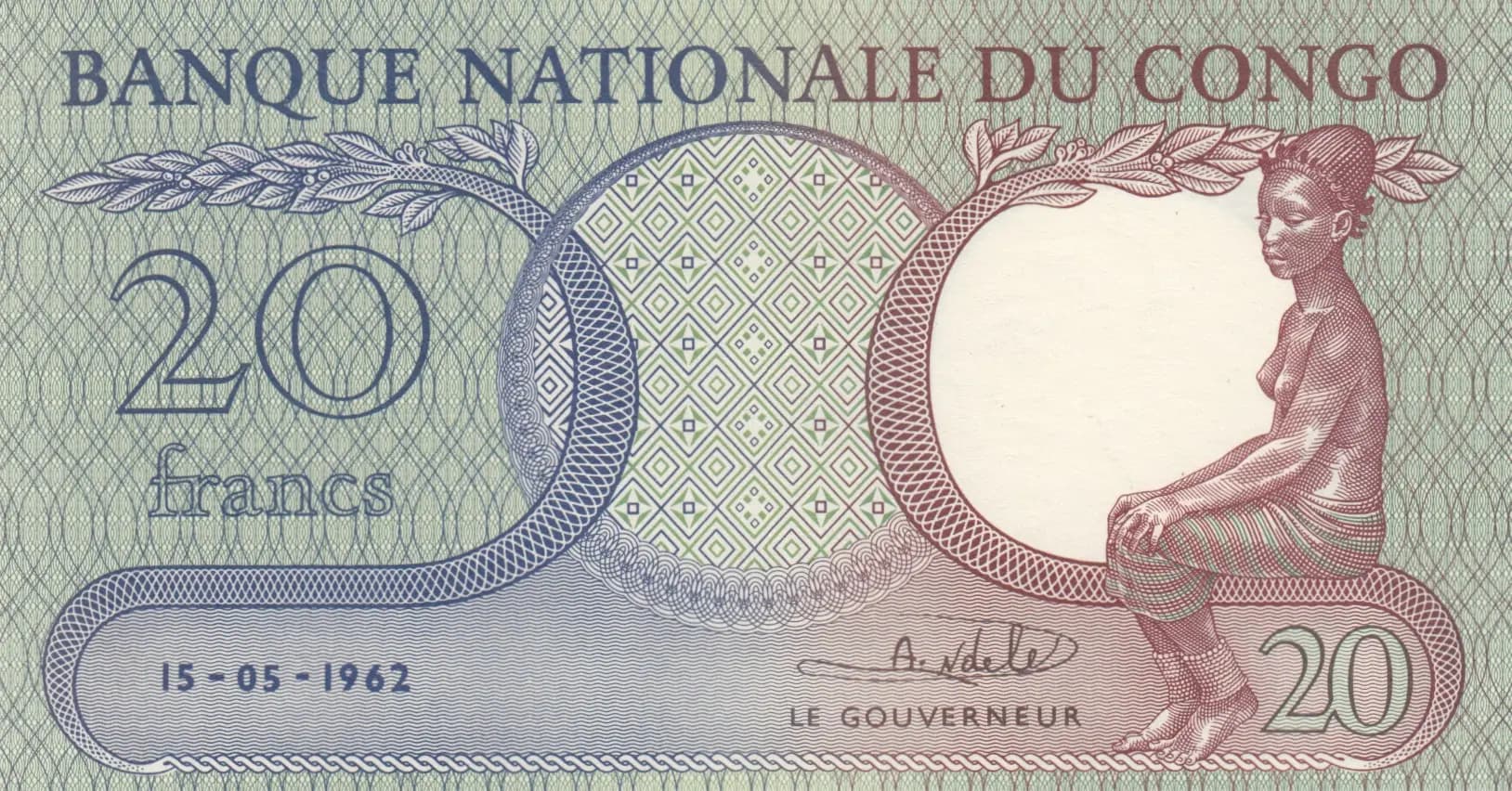
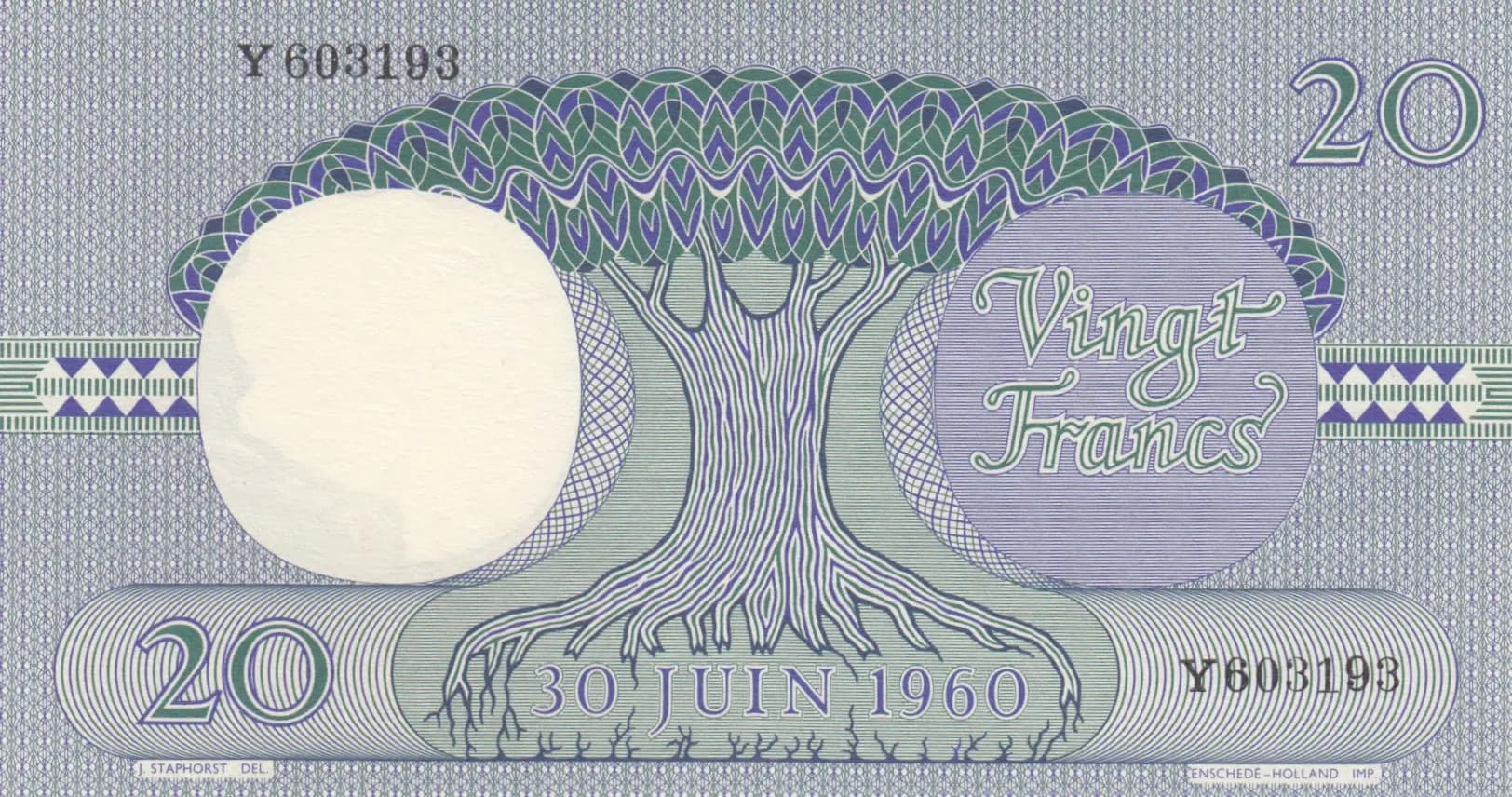
This is a pristine, uncirculated example of the Democratic Republic of Congo's 20 Francs note from 1962, issued by the Banque Nationale du Congo on 15 May 1962. The note displays exceptional crispness with vibrant color printing in blue-gray, pale green, and reddish-brown tones on the obverse, featuring an elegant classical female portrait wearing a laurel wreath, while the reverse showcases a striking stylized tree with detailed root systems commemorating Congo's independence (30 June 1960). The fine engraving work and crisp condition make this an attractive example for collectors of early post-colonial African currency.
Common. The eBay market data shows consistent sales activity across multiple condition grades spanning over a decade (2012-2024), with UNC examples selling in the $70-112.50 range and lower grades (VF, EF) selling for $13-35. The 2019 catalog value of $80 UNC and $15 VF, combined with regular market transactions, indicates this note was produced in reasonable quantities and remains readily available to collectors. Despite its historical significance as an early post-colonial issue, the regular circulation of auction results and the modest price levels typical of common banknotes confirm this as a standard, non-scarce issue.
This note was issued just two years after the Democratic Republic of Congo gained independence from Belgium on 30 June 1960, a date prominently featured on the reverse. The feminine portrait adorned with a laurel wreath symbolizes classical ideals of wisdom and victory, reflecting the young nation's aspirations during a tumultuous political period. The stylized tree on the reverse serves as a national symbol, connecting the note's design to Congo's natural wealth and identity as a newly sovereign state still establishing its monetary authority.
The obverse features a classical female portrait in profile facing right, representing Liberty or national sovereignty, crowned with a laurel wreath—a motif borrowed from Western numismatic tradition to convey dignity and authority. The portrait is framed within an ornate oval medallion with intricate geometric cross-hatching and decorative leaf patterns providing security through fine-line engraving complexity. The reverse is dominated by a large, detailed stylized tree with naturalistic root systems and canopy foliage, flanked by two blank circular medallions (likely intended for official seals or signatures). The denomination appears prominently in large numerals on both sides. The overall design language reflects European banknote aesthetics typical of Enschede's work while incorporating symbolic imagery meaningful to Congo's post-independence identity.
Front side: 'BANQUE NATIONALE DU CONGO' (National Bank of Congo), '20' and 'francs' (denomination), '15-05-1962' (issue date: 15 May 1962), 'LE GOUVERNEUR' (The Governor). Back side: 'Vingt Francs' (Twenty Francs), '30 JUIN 1960' (30 June 1960 — independence date), 'STAPHORST DEL' (Staphorst designed/drawn), 'ENSCHEDE - HOLLAND IMP' (Enschede, Holland imprinted/printed). Serial numbers visible: Y608193 and Y908198.
Intaglio engraving (line engraving), as evidenced by the crisp, fine-line details visible throughout both sides—particularly in the cross-hatching backgrounds, portrait rendering, and tree foliage. The note was printed by Enschede (Joh. Enschedé en Zonen) of Haarlem, Netherlands, one of the world's premier security printers. The intricate geometric patterns and layered fine-line work served as sophisticated anti-counterfeiting measures for the period.
This example is dated 15-05-1962 (15 May 1962), falling within the known issuance period of 1961-1962 for Pick 4. The catalog references variants P-4a and P-4s, both with printer JEZ (Enschedé), suggesting differences may relate to signature variants or minor design changes within the 1961-1962 series. The serial number Y608193 on this note's obverse and the observed inscription 'STAPHORST DEL' credit the designer. Without additional comparative specimens, the exact variety classification cannot be definitively determined from the visual analysis alone, though this note clearly belongs to the main P-4 group issued by Banque Nationale du Congo.