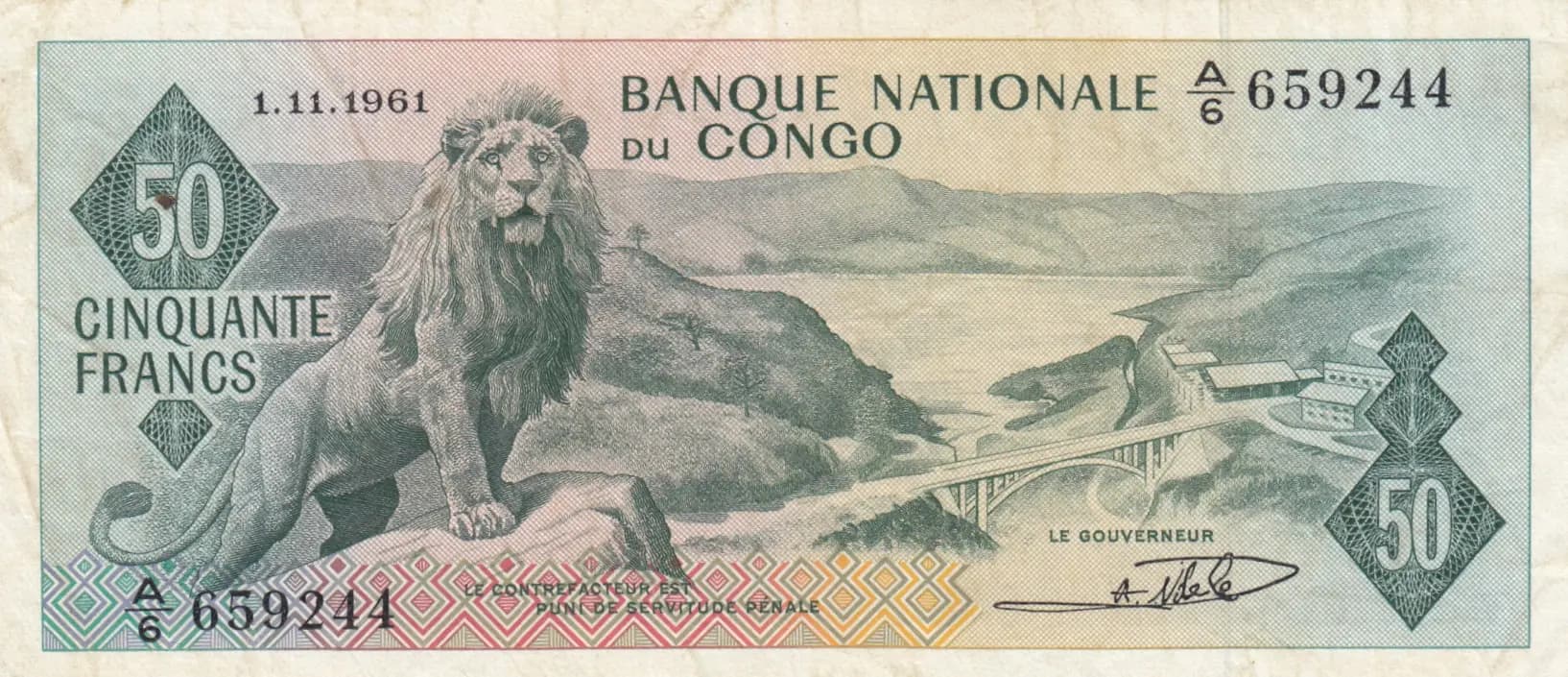
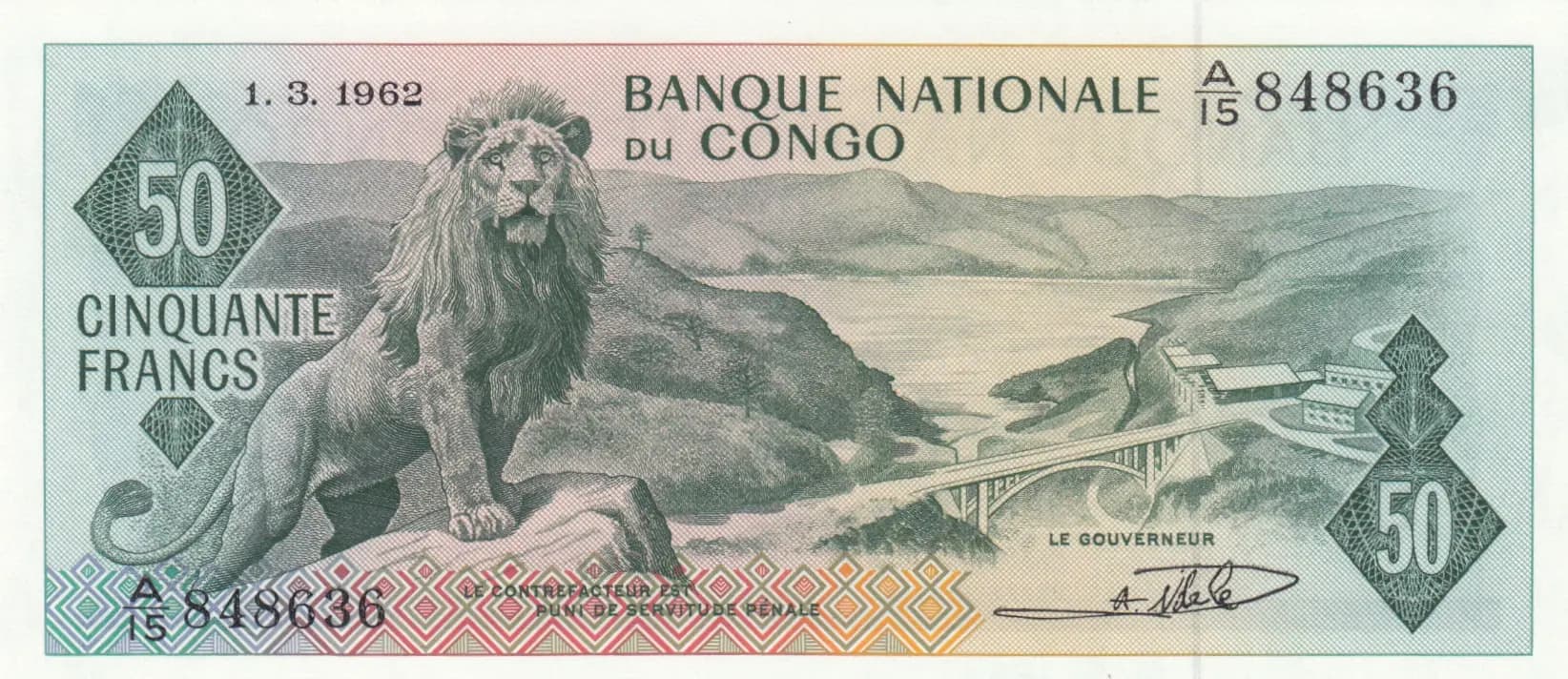
50 francs 1962
“1.02.62”
Market Prices
38 salesAbout This Note
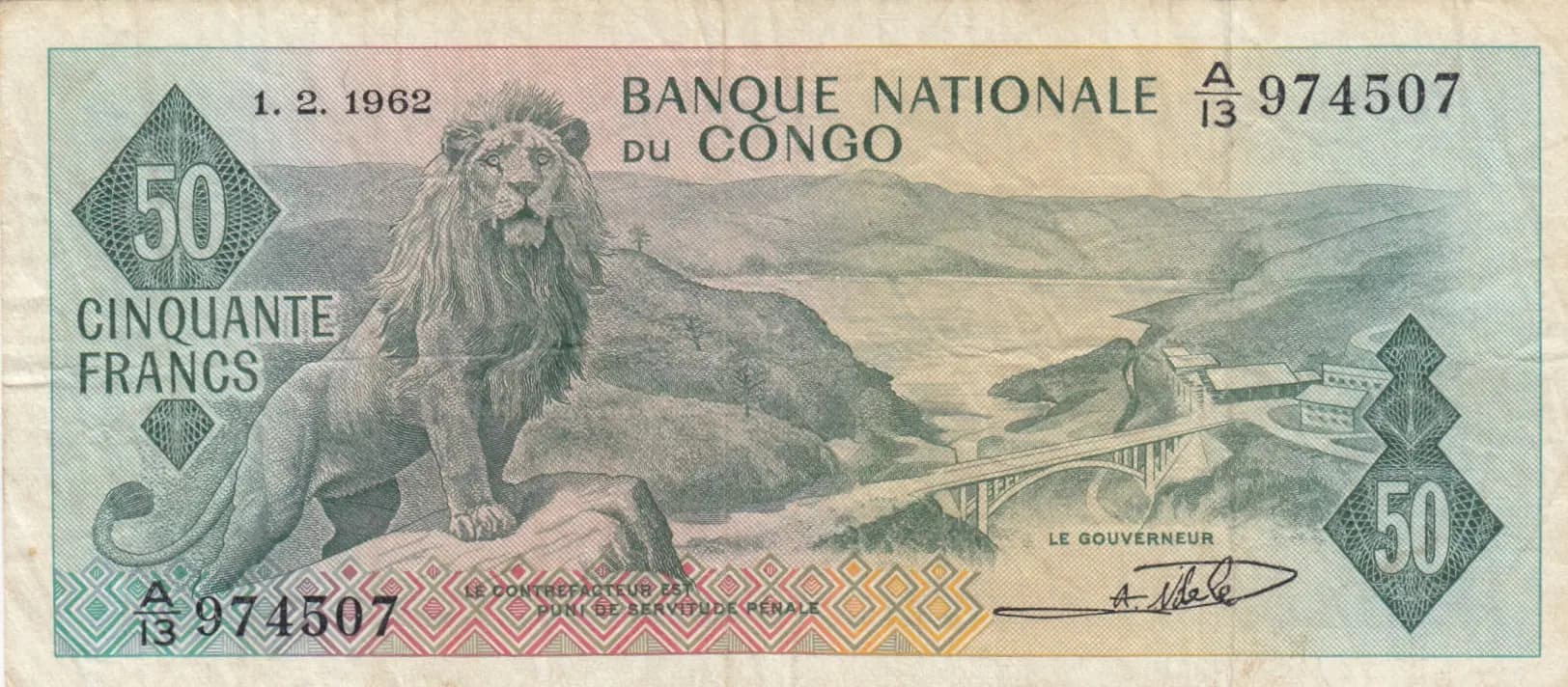
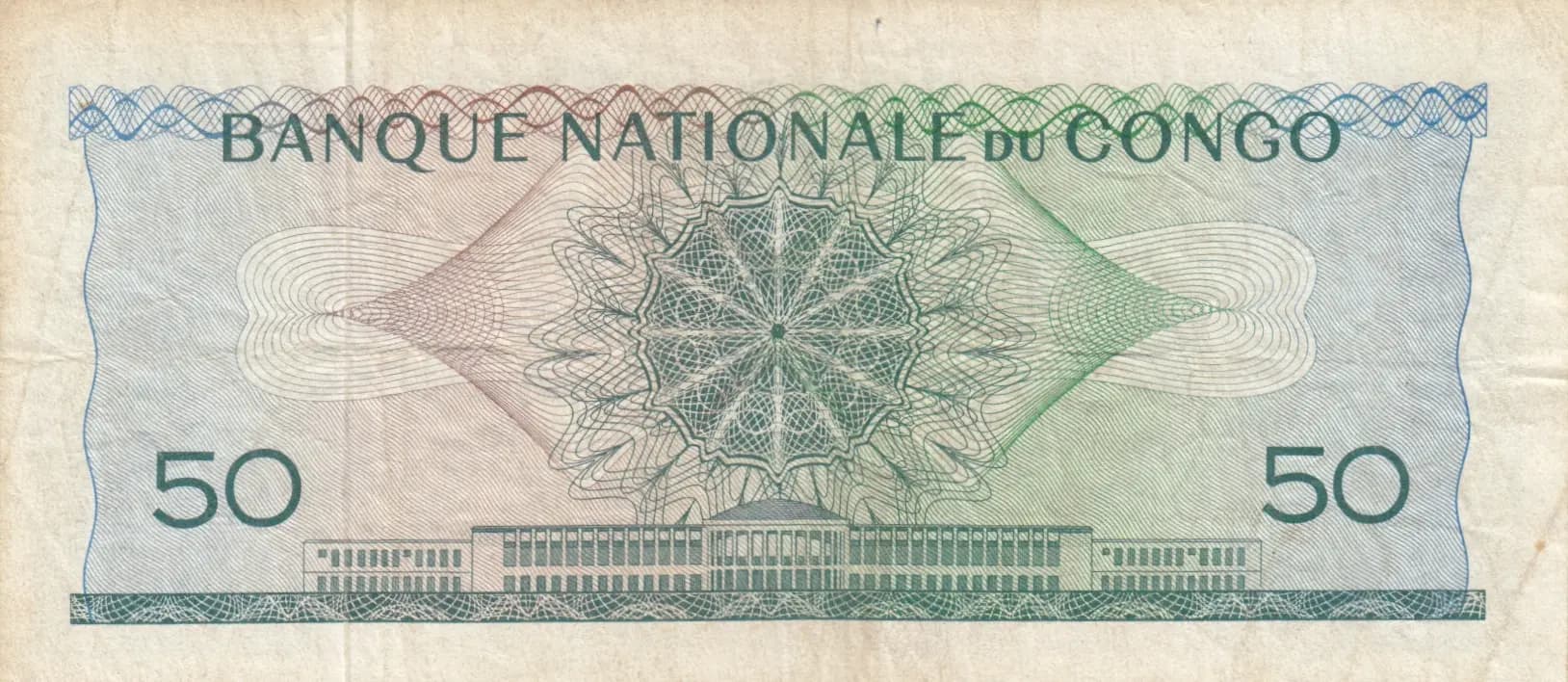
This is a 50 Francs banknote from the Banque Nationale du Congo, issued February 1, 1962 (Pick P-5), graded in Fine condition. The note displays the iconic lion's head on the obverse and an ornate institutional building on the reverse, featuring the characteristic teal and brown color palette of early Congolese currency. Despite visible creasing, foxing, and age-related discoloration consistent with circulation, the note retains good detail in its fine engraving work and remains a desirable example of post-independence Congolese numismatics.
Common. The eBay market data shows consistent sales of this note in comparable grades (F) ranging from $9.99 to $35.53 over the past decade, with an average around $15-20. The 2019 catalogue value for VF grade is only $25, and UNC specimens command $145, indicating this is a well-circulated, frequently encountered note. The Banque Nationale du Congo maintained regular production of this denomination during 1961-1962, and no print run limitations or recall circumstances are documented. Market activity is steady but prices remain modest, confirming this is a standard, widely available issue.
This banknote was issued during the critical early months following Congo's independence from Belgium (June 30, 1961), when the newly formed Banque Nationale du Congo began asserting sovereignty over the nation's currency. The depicted lion symbolizes Congolese national identity and strength, while the columned institutional building on the reverse represents the National Assembly in Kinshasa, the seat of the new government. The February 1, 1962 date places this note in the tumultuous period of the Congo Crisis, when central authority was contested and currency production was a key assertion of statehood.
The obverse features a detailed engraved portrait of a lion's head with full mane positioned prominently on the left, symbolizing Congolese national pride and sovereignty. The center-right background depicts a landscape with a notable bridge or viaduct spanning a valley with rolling hills—likely representing the modern infrastructure of the newly independent nation. Diamond-shaped frames containing the numeral '50' flank the composition, with decorative geometric and guilloche patterns along the bottom border. The reverse displays a large, symmetrically designed institutional building with repetitive columned sections, identified as the National Assembly building in Kinshasa, centered below an ornate rosette or star-burst pattern featuring radiating geometric line-work. This building represents the democratic institutions of the young Congo republic.
Front side: 'BANQUE NATIONALE du CONGO' (National Bank of Congo); '1.2.1962' (issue date: February 1, 1962); 'CINQUANTE FRANCS' (Fifty Francs); '50' (denomination); 'LE GOUVERNEUR' (The Governor); serial number 'A 13 974507'; governor's signature (illegible in image). Back side: 'BANQUE NATIONALE DU CONGO' (National Bank of Congo); '50' (denomination in large numerals on left and right margins).
Intaglio engraving (recess printing), the standard security printing method for banknotes of this era. The fine line-work, intricate guilloche patterns, and detailed portraiture visible throughout both sides are characteristic of high-quality intaglio production. The consistent, precise geometric patterns and anti-counterfeiting line designs indicate professional security printing, likely produced by Banque de Belgique or a similar European security printer contracted by the Banque Nationale du Congo during the early independence period.
This note is catalogued as Pick P-5, with the PMG population report indicating three variants exist: P-5a, P-5cts, and P-5s. The observed specimen has a date of 1.2.1962 (February 1, 1962) and serial number prefix 'A 13 974507'. The issue was produced with dates ranging from 1961 to July 1, 1962. Variety classification would depend on specific signature authority (governor identity) and serial number ranges, which require comparison with the Pick catalog's detailed variety specifications. The 'A' prefix and early 1962 date suggest this may be a P-5a variant, but definitive attribution would require reference to the complete Pick variety guide and comparison of signature specimens.