1000 francs 1962
Market Prices
14 salesAbout This Note
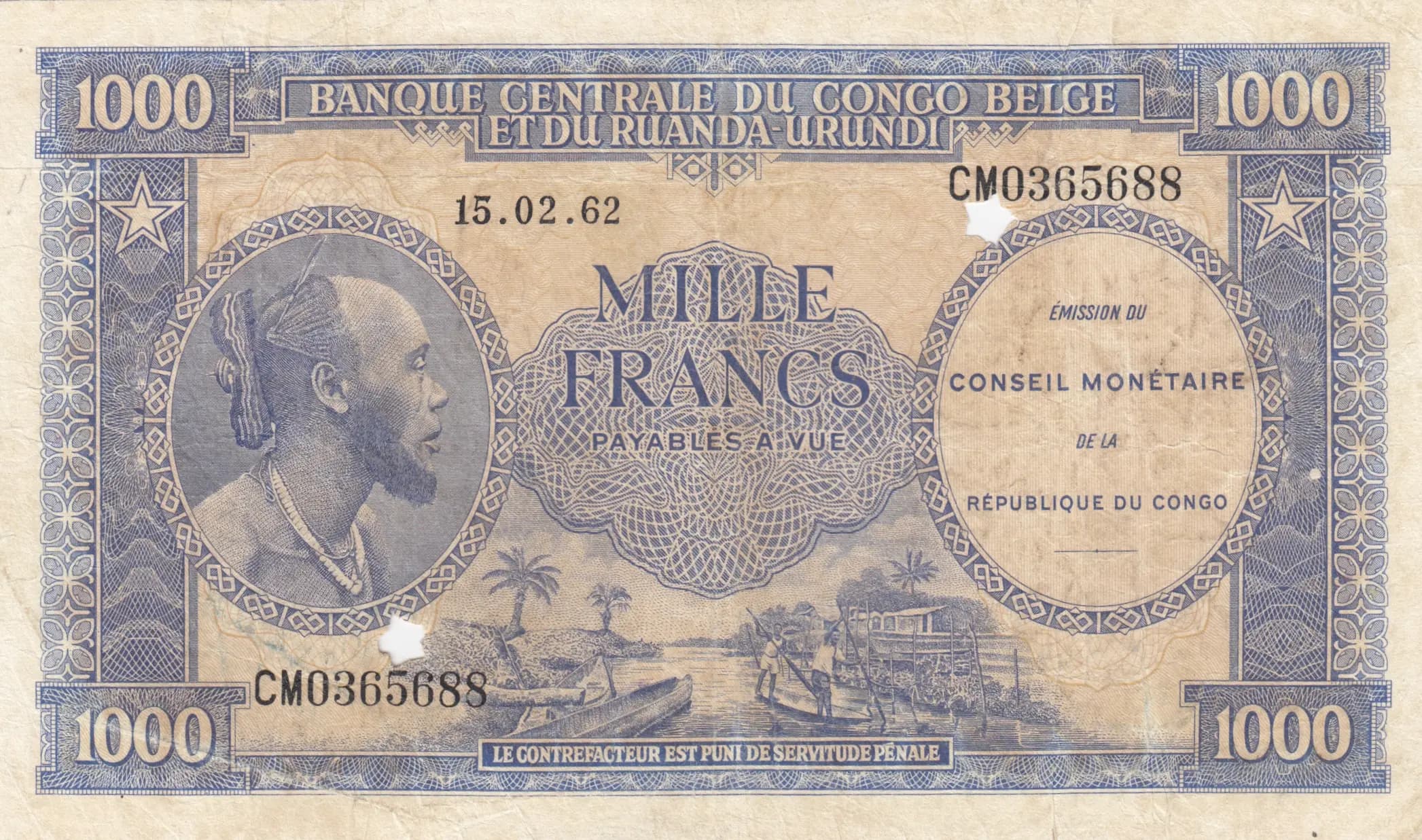
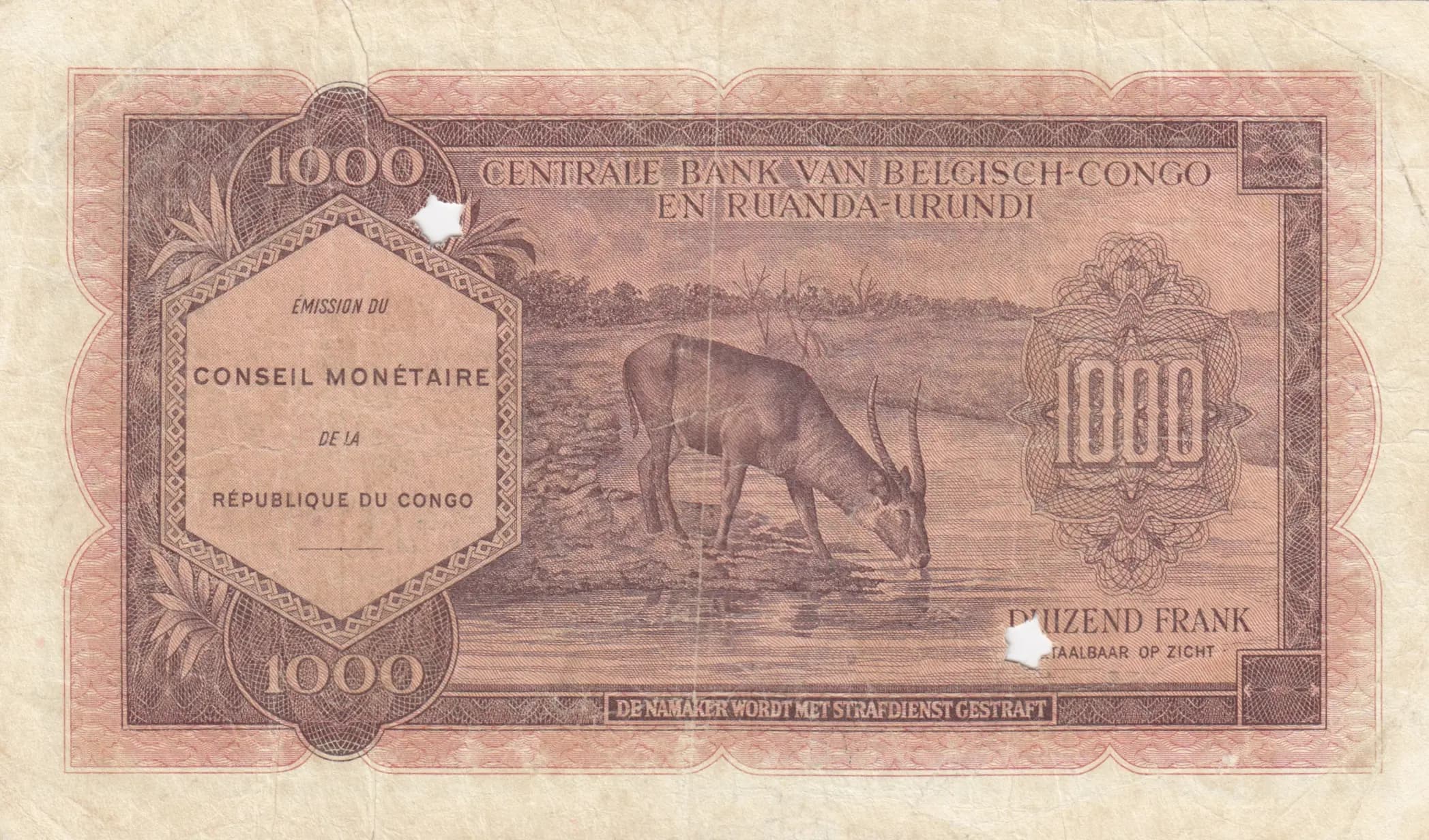
This 1000 Francs banknote from the Democratic Republic of Congo (1962) represents an early post-independence issue by the Conseil Monétaire, featuring a striking portrait of a bearded man from the Moliro region on the obverse and a waterbuck drinking scene on the reverse. The note displays moderate wear consistent with VF grading, including visible creasing, foxing, and age-related tan discoloration, yet retains clear legibility and the intricate engraved details that characterize this transitional currency issue from the brief Conseil Monétaire period.
Common. This issue demonstrates typical circulation patterns for a standard post-independence currency issue. eBay market data shows consistent VF sales in the $79–$115 range across multiple decades (2009–2025), with catalogue value at $100 VF (2019), indicating stable collector demand for a readily available note. The Conseil Monétaire's brief operational period (1962–1967) and relatively high print volumes for this denomination support the common classification.
Issued on February 15, 1962, this note marks the immediate post-independence monetary transition of the Democratic Republic of Congo, replacing Belgian colonial currency with notes from the newly established Conseil Monétaire de la République du Congo. The bilingual inscriptions (French and Dutch) reflect the linguistic heritage of Belgian colonization, while the indigenous portraiture and wildlife imagery symbolized the nation's sovereignty and natural heritage during the tumultuous first months of independence.
The obverse features a dignified profile portrait of a bearded man facing right, positioned on the left side, identified as representing the Moliro region population. The composition includes a river scene with boats and palm trees in the lower portion, symbolizing Congo's vital waterway resources. Ornate geometric borders with four-pointed stars, crossed design elements, and intricate decorative patterns frame the composition. The denomination appears in all four corners with 'MILLE FRANCS' prominently displayed centrally. The reverse presents a waterbuck antelope drinking from a stream in a naturalistic landscape setting with vegetation, enclosed within an ornate circular cartouche on the right. The note employs a blue and cream color scheme on the obverse with a contrasting warm rose-brown and cream palette on the reverse, typical of the engraved security printing of this era.
FRONT SIDE: 'BANQUE CENTRALE DU CONGO BELGE ET DU RUANDA-URUNDI' (Central Bank of Belgian Congo and Ruanda-Urundi); '1000' and 'MILLE FRANCS' (One thousand francs); '15.02.62' (Issue date: February 15, 1962); 'PABLES A VUE' (Payable on sight); 'EMISSION DU CONSEIL MONETAIRE DE LA REPUBLIQUE DU CONGO' (Issue of the Monetary Council of the Republic of Congo); 'LE CONTREFACTEUR EST PUNI DE SERVITUDE PENALE' (The counterfeiter is punished with penal servitude); Serial number 'CM0365688'. BACK SIDE: 'CENTRALE BANK VAN BELGISCH-CONGO EN RUANDA-URUNDI' (Central Bank of Belgian Congo and Ruanda-Urundi in Dutch); '1000' and 'DUIZEND FRANK' (One thousand francs in Dutch); 'TAALBAAR OP ZICHT' (Payable on sight in Dutch); 'EMISSION DU CONSEIL MONETAIRE DE LA REPUBLIQUE DU CONGO' (Issue of the Monetary Council of the Republic of Congo); 'DENAMAKER WORDT MET STRAFDIENST GESTRAFT' (The counterfeiter is punished with penal servitude in Dutch).
Intaglio engraving (recess printing) by Banque Belge pour l'Etranger (BWC), the security printer responsible for P-2 issues. The intricate geometric line patterns, fine engraved details in the landscape and portraiture, ornate borders, and security patterns throughout confirm high-quality intaglio production. Watermark areas are visible as lighter sections within the design structure.
This specimen represents Pick number P-2a (printer: BWC). The PMG population report identifies two catalogued variants: P-2a and P-2s, both printed by BWC. The serial number CM0365688 and issue date 15.02.1962 confirm this as a standard early-issue example from the initial release. No significant overprints, signature variants, or security feature modifications distinguishing this from the primary type are evident from the visual analysis.