1000 francs 1961
Market Prices
23 salesAbout This Note
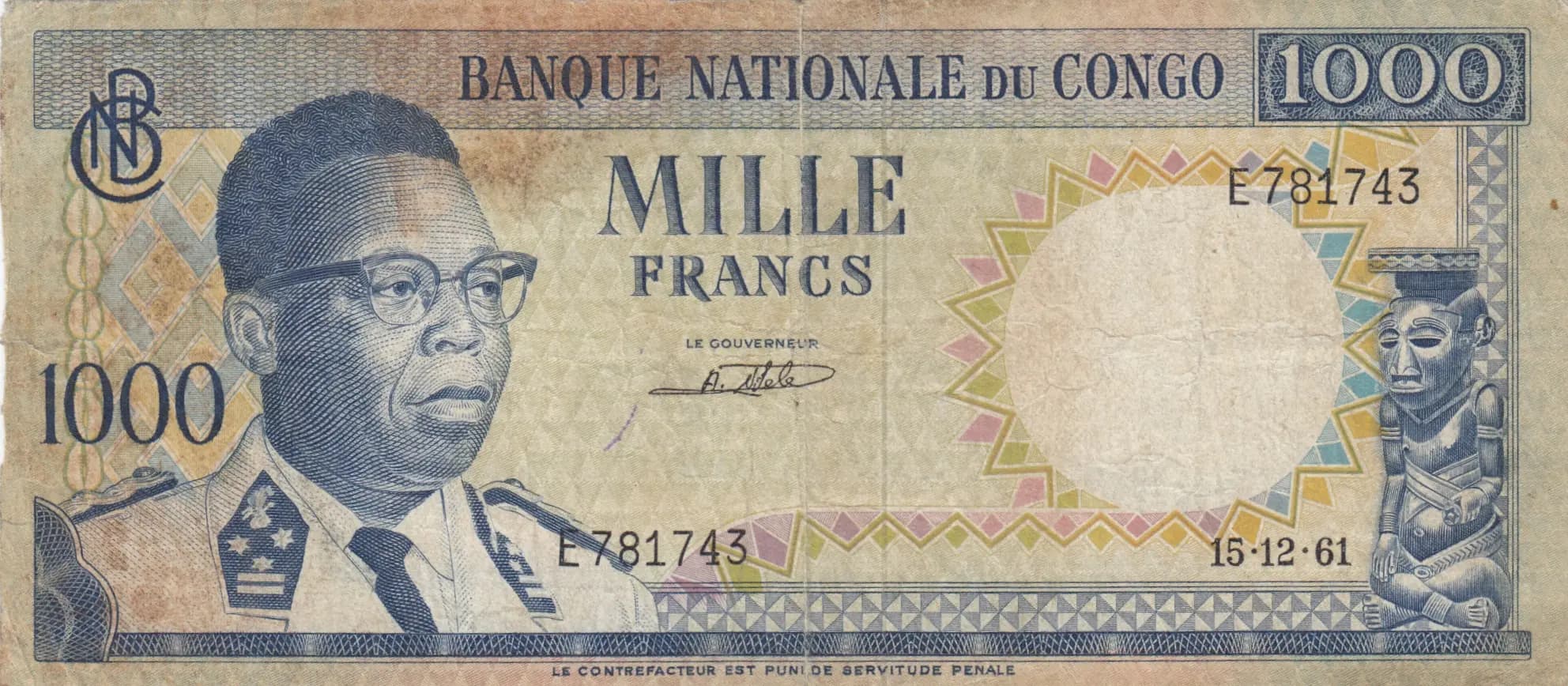
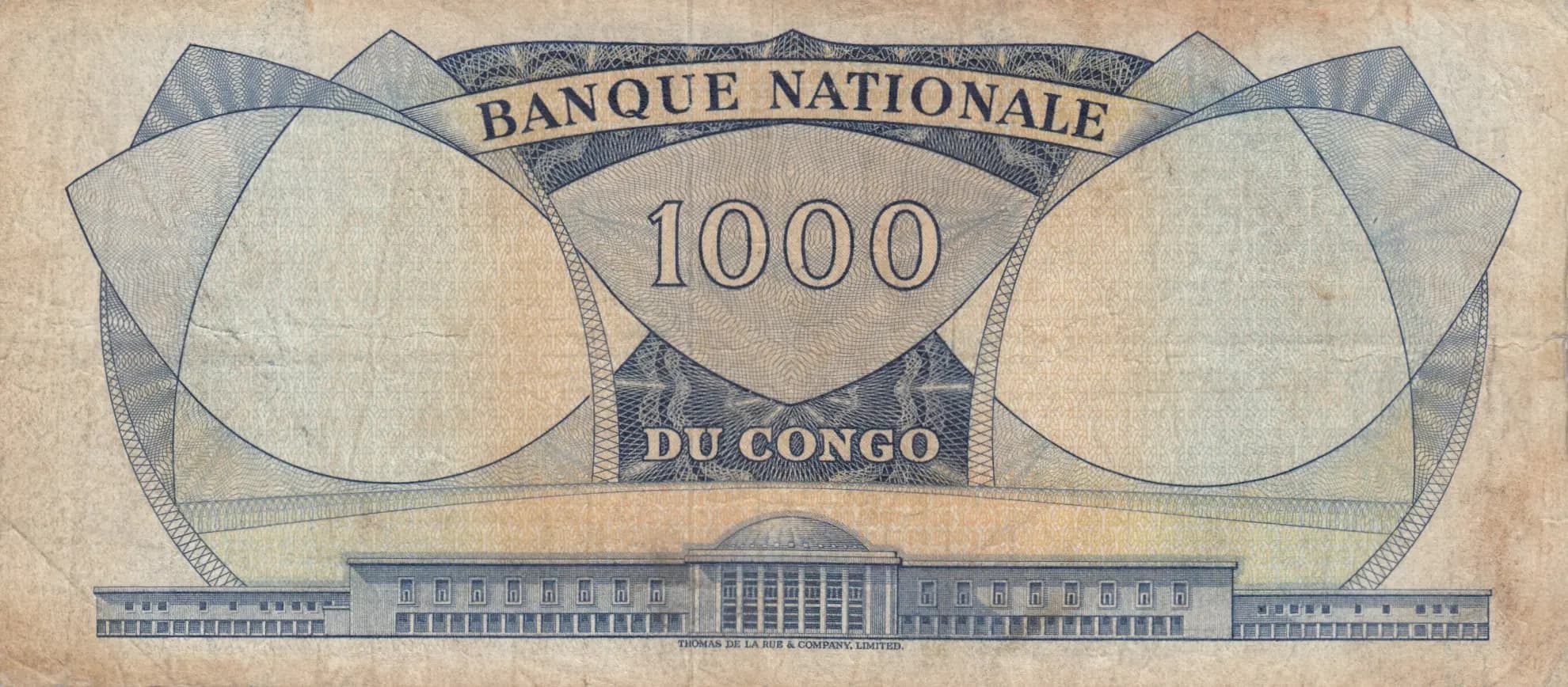
This 1000 Francs note from the Banque Nationale du Congo (1961) represents an important early post-independence currency issue, printed by Thomas De La Rue in London. The note features a portrait of President Joseph Kasavubu on the obverse and the National Assembly building in Kinshasa on the reverse, both rendered in fine engraved detail. In Fine (F) condition, this note shows expected aging with creasing, foxing, and tan discoloration from circulation, yet remains legible and displayable—a representative example of Congo's formative monetary period.
Common. The eBay market data provided shows consistent sales activity across multiple condition grades (F, VF, EF, UNC) spanning from 2012 to 2023, with typical prices ranging from $4.81 to $57 for graded examples (PMG 64), and catalogue values at $30 (VF) and $150 (UNC) as of 2019. The abundance of comparable sales, the lack of any recall or short-print designation, and the relatively modest secondary market prices all indicate this is a commonly encountered note in the collector market. Notes of this denomination and issuer from 1961 were produced in substantial quantities.
Issued on December 15, 1961, this note commemorates the newly independent Democratic Republic of Congo, just months after independence from Belgium (June 30, 1961). The portrait of President Joseph Kasavubu, the nation's first elected head of state, celebrates the transition to self-governance, while the neoclassical National Assembly building depicted on the reverse symbolizes the fledgling democratic institutions of the nascent nation. This currency marked Congo's assertion of monetary sovereignty during a tumultuous period of post-colonial consolidation.
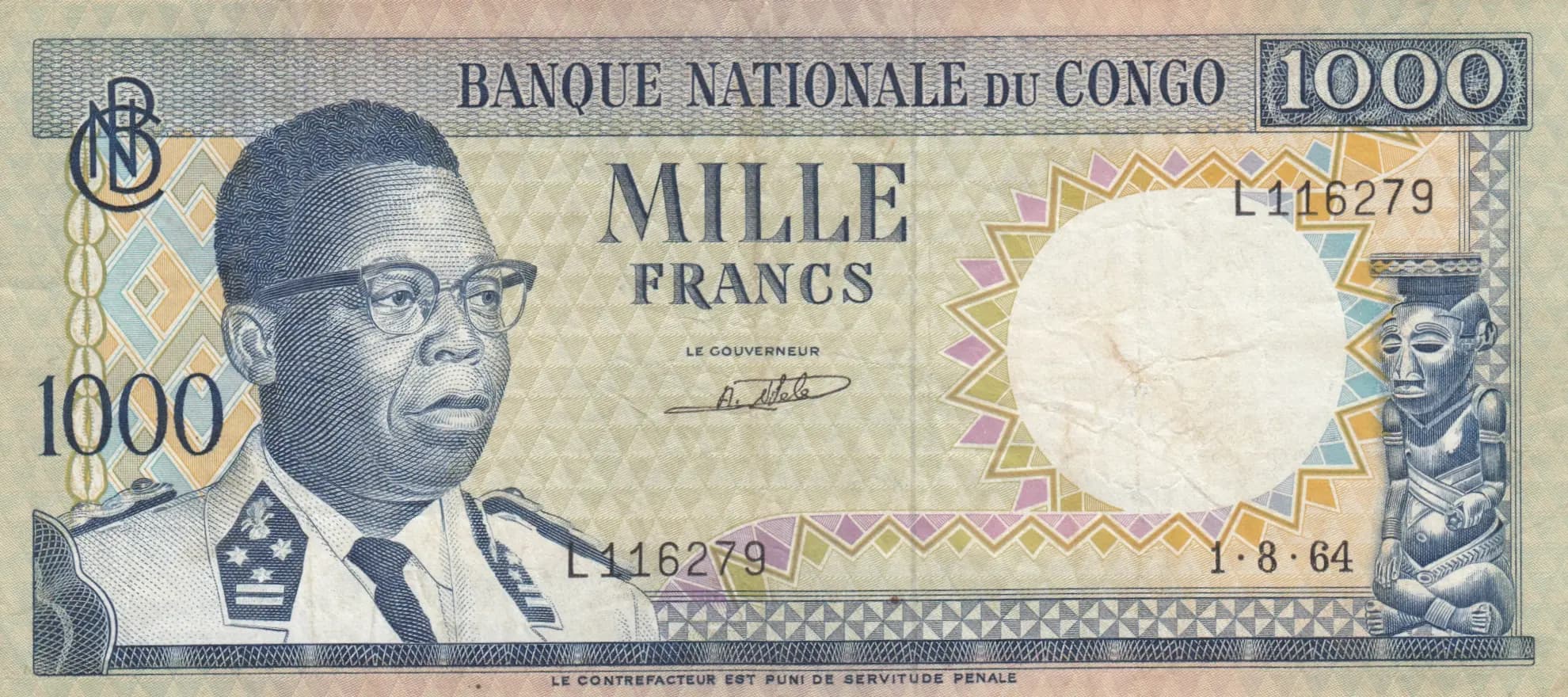
The obverse features a dignified portrait of President Joseph Kasavubu in formal attire, positioned at left, wearing eyeglasses and displaying military or official insignia on his shoulder patch—emphasizing his role as head of state. To the right stands a carved wooden African figure, incorporating traditional artistic elements that celebrate Congo's cultural heritage. The composition is framed by multicolored geometric patterns in pastel tones (pink, yellow, green, blue) arranged in diamond and zigzag designs that serve as both decorative and security elements. The reverse presents a classical government building—the National Assembly (Palais du Peuple) in Kinshasa—rendered with symmetrical architecture featuring a prominent central dome flanked by regular window patterns on either side. Large ornamental curved frames and oval borders frame the architectural composition, emphasizing the importance of the institution. The denomination '1000' is prominently displayed on both sides, with 'MILLE FRANCS' clearly stated on the obverse.
FRONT SIDE: 'BANQUE NATIONALE du CONGO' (National Bank of Congo); '1000' and 'MILLE FRANCS' (One Thousand Francs); 'LE GOUVERNEUR' (The Governor); 'E781743' (Serial number); '15·12·61' (December 15, 1961); 'LE CONTREFACTEUR EST PUNI DE SERVITUDE PENALE' (Counterfeiting is punished by penal servitude). BACK SIDE: 'BANQUE NATIONALE' (National Bank); '1000 DU CONGO' (One Thousand of Congo); 'THOMAS DE LA RUE & COMPANY, LIMITED' (Printer's mark).
This note was produced using intaglio engraving by Thomas De La Rue & Company, Limited, London—the renowned security printer whose name appears on the reverse. The technique is evident from the fine, precise line work visible throughout the portrait, architectural details, and decorative geometric patterns. The multicolor printing process involved layering multiple color plates to achieve the blue, tan, pink, yellow, and green tones observed. Serial numbers were applied using letterpress printing in two locations (upper right and lower left on the obverse), a standard security practice of the period.
This note is catalogued as Pick P-8a (variant designation indicating TDLR printing). The visual inspection confirms the 1961 issue date (15·12·61) and the characteristic TDLR printer identification on the reverse. The serial number E781743 and the presence of Kasavubu's portrait without overprints are consistent with the standard 1961 variety. PMG records indicate both P-8a and P-8s variants exist (the 's' variant may represent specimen notes), both printed by TDLR. No evidence of overprints, emergency variations, or commemorative modifications is visible on this example.