1 dollar 1971
Market Prices
38 salesAbout This Note
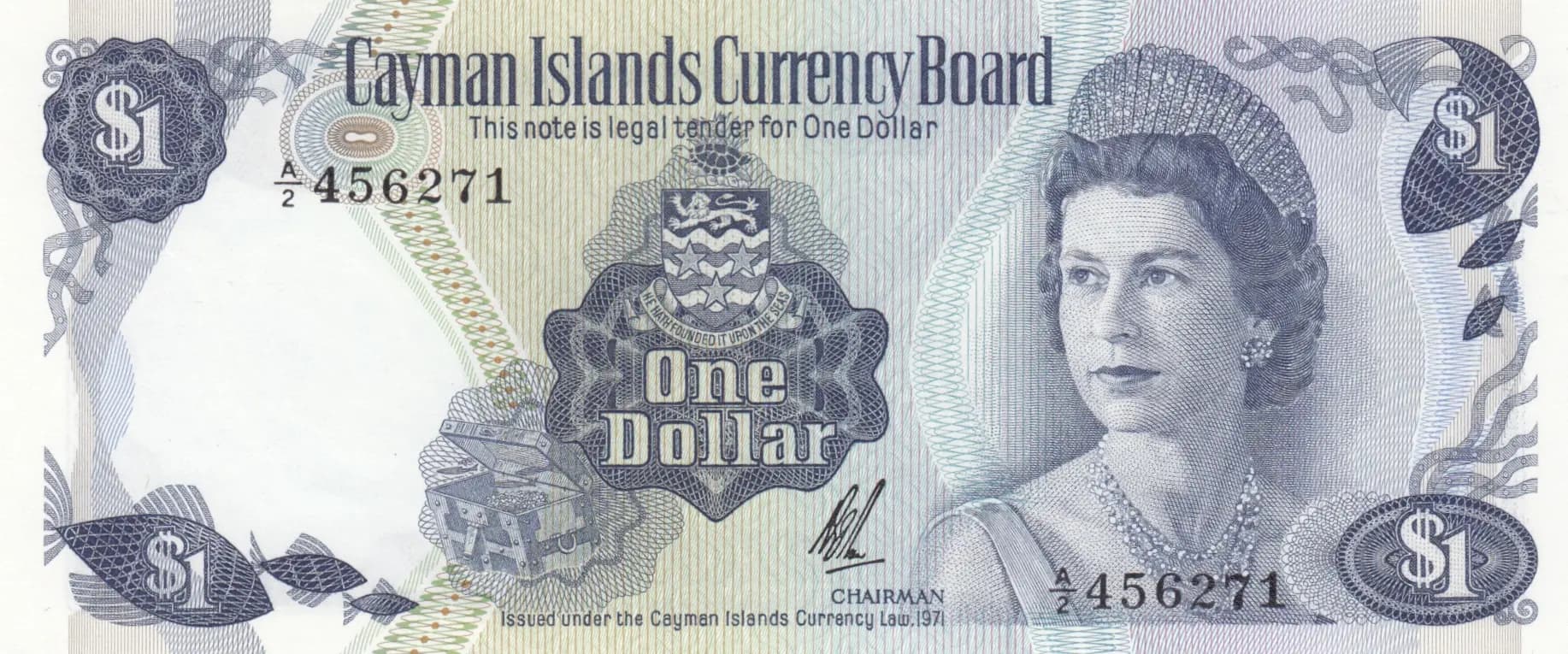
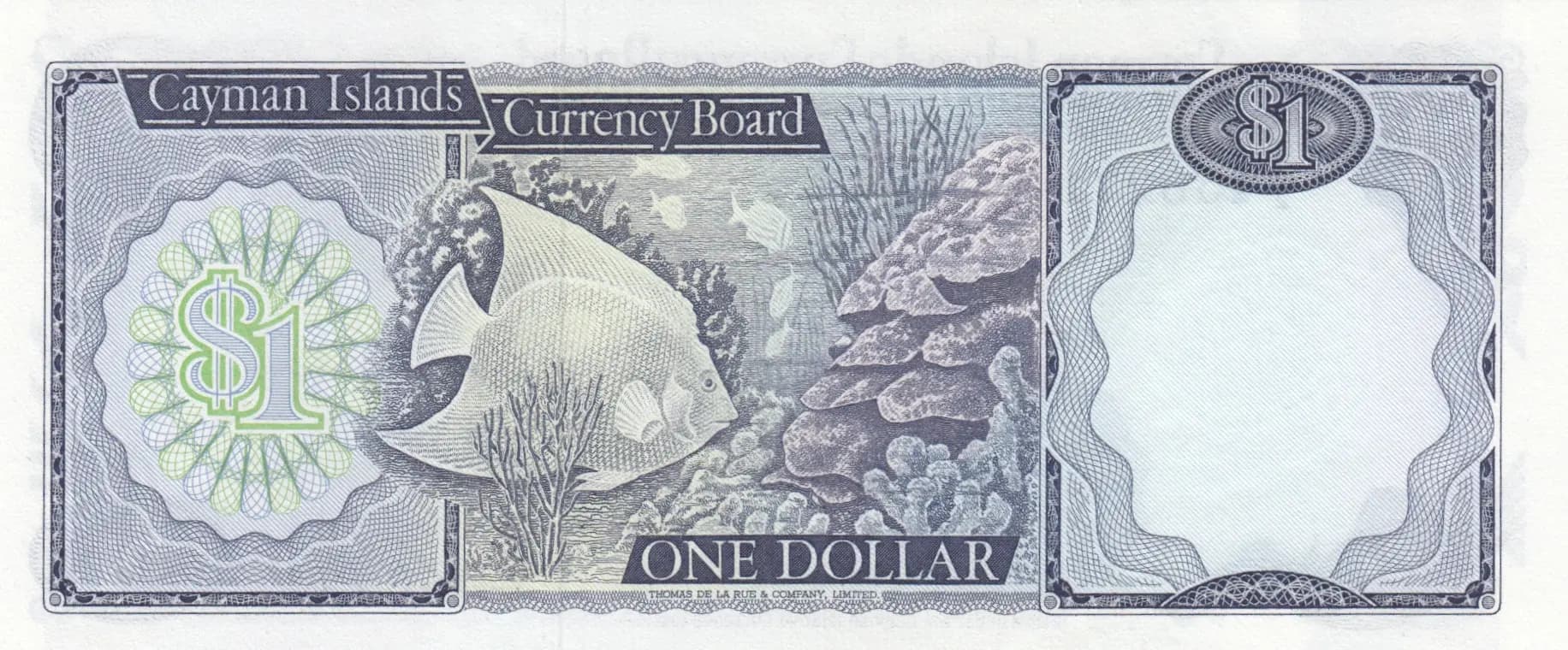
This is a pristine Uncirculated example of the Cayman Islands Currency Board's inaugural 1 Dollar note (Pick P-1b, 1971), printed by Thomas de la Rue. The note features Queen Elizabeth II in formal dress on the obverse and a striking underwater coral reef scene with tropical fish on the reverse, both executed in the fine engraved style characteristic of TDLR's premium banknote production. This first-year issue represents an important piece of Caymanian numismatic history and is highly sought after by collectors, particularly in higher grades.
Common. While this is the first issue of Caymanian currency (P-1b variant), eBay market data shows consistent availability with ungraded UNC examples selling in the $10-40 range and professionally-graded examples (PMG 65-67) in the $25-60 range in recent years. The historical price data demonstrates steady supply across multiple transactions from 2013-2025. Current catalog values cite UNC at $130, but actual market realizations are substantially lower, indicating healthy supply and collector interest but without artificial scarcity. The Pick P-1b designation suggests this is one variant among multiple documented varieties for the 1 Dollar denomination, further supporting a common classification.
Issued under the Cayman Islands Currency Law of 1971, this note marks the establishment of the Caymanian monetary system independent from previous British colonial currency arrangements. The iconography reflects the islands' maritime heritage and natural resources—the coat of arms featuring wavy lines and a lion represents both the sea and British sovereignty, while the reverse's detailed depiction of tropical fish and coral emphasizes the economic and cultural significance of the marine environment to the territory. The 1971 date coincides with Cayman Islands' assertion of greater financial and administrative autonomy during the post-colonial period.
The obverse features a formal portrait of Queen Elizabeth II positioned on the right side, depicted in formal attire with pearls and styled hair, consistent with commonwealth currency conventions of the early 1970s. Dominating the center is the Cayman Islands Coat of Arms with its distinctive shield containing wavy lines (representing the sea) and a lion (representing British heritage), positioned above the denomination text. Ornate dollar signs ($) appear in all four corners within decorative circular and square frames. The reverse depicts a naturalistic underwater scene centered on a tropical angelfish or similar reef species rendered in fine detail, swimming above elaborate coral formations and seaweed on the seabed, with the denomination 'ONE DOLLAR' at the base. The design employs navy blue and green tones with intricate cross-hatching and fine line work throughout, creating a sophisticated, anti-counterfeiting appearance.
FRONT: 'Cayman Islands Currency Board' (issuing authority); 'This note is legal tender for One Dollar' (legal tender declaration); 'One Dollar' (denomination); 'Issued under the Cayman Islands Currency Law, 1971' (legislative authorization); 'CHAIRMAN' (signature line title); Serial number 'A/2 456271' (appears twice, top left and bottom right corners); 'M' (signature initial or mint mark). BACK: 'Cayman Islands Currency Board' (issuing authority repeated); 'ONE DOLLAR' (denomination confirmation); 'THOMAS DE LA RUE & COMPANY, LIMITED' (printer and security printer identification).
Intaglio (engraved) printing by Thomas de la Rue & Company, Limited, London. The fine line patterns, cross-hatching, intricate detail work in both the portraits and marine scene, complex ornamental borders, and overall depth of image are characteristic of premium intaglio banknote production. The note exhibits the security features typical of TDLR's 1970s-era work, including fine engraved background patterns and detailed portraiture that would be extremely difficult to counterfeit with contemporary reproduction methods.
This note is cataloged as Pick P-1b, indicating it is the second major variety of the Cayman Islands 1 Dollar note. The visual analysis confirms the serial number prefix 'A/2', consistent with documented variant characteristics. PMG population data shows P-1a and P-1b as distinct cataloged varieties, with both types professionally graded. The TDLR printer mark and 1971 Law of 1971 date are consistent with the base issue type. Future graded examples may reveal signature variations or subtle design differences between P-1a and P-1b variants, typical of early currency board issues where minor design refinements were made between print runs.