10 dollars 1991 specimen
Market Prices
1 saleAbout This Note
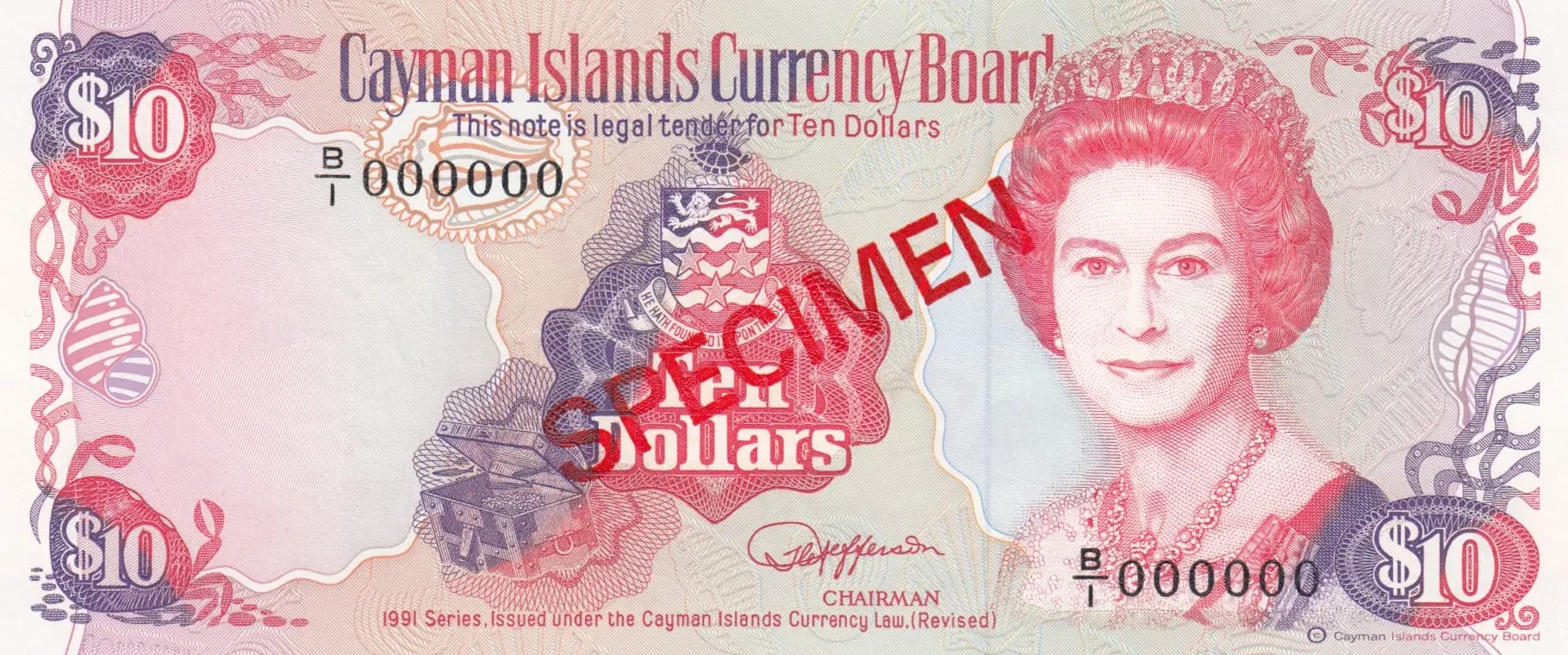
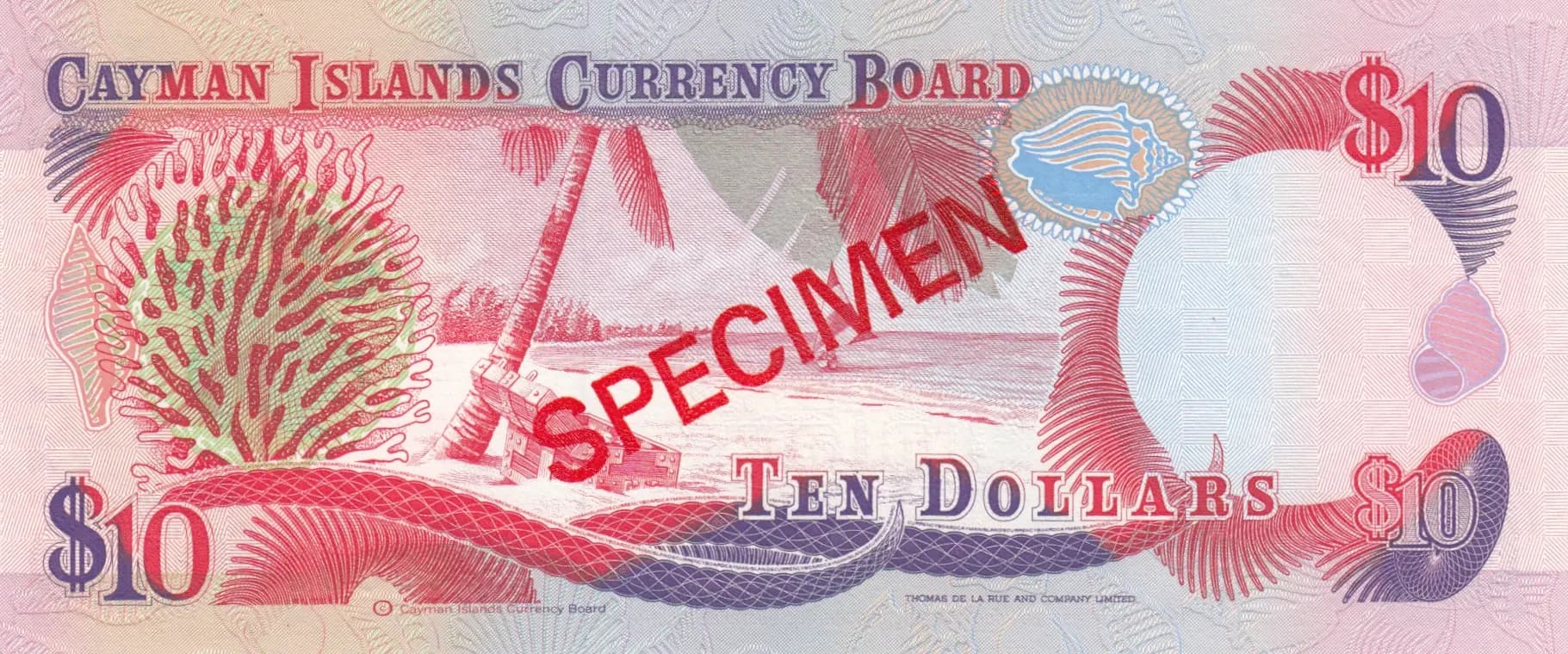
This is an uncirculated 1991 Cayman Islands 10 Dollar specimen note (Pick P-13s) issued by the Cayman Islands Currency Board and printed by Thomas de la Rue in London. The note features a portrait of Queen Elizabeth II on the obverse with ornate purple and pink decorative borders, and a reverse depicting nautical and tropical imagery including a sailing vessel and conch shell. The bold red 'SPECIMEN' overprint across both sides indicates this was produced for display and archival purposes rather than circulation, making it a desirable item for collectors of Commonwealth currency and specimen notes.
Common. While specimen notes are produced in smaller quantities than circulating currency, the 1991 Cayman Islands 10 Dollar specimen (P-13s) is not a scarce issue. The referenced eBay market data shows an AUNC example sold for $39 in 2020, consistent with common specimen note pricing. Specimen notes from major printers like Thomas de la Rue for established currency boards are routinely produced for distribution to banks, collectors, and archival purposes, and many have survived in numismatic circulation.
This 1991 series note represents the Cayman Islands' monetary autonomy under the Currency Board system established by local law. The nautical and maritime imagery on the reverse—including the sailing vessel, windmill structure, and conch shell—reflects the islands' historical dependence on seafaring trade, fishing, and maritime commerce in the Caribbean. The prominence of Queen Elizabeth II's portrait on the obverse reflects the Cayman Islands' status as a British Overseas Territory during this period.
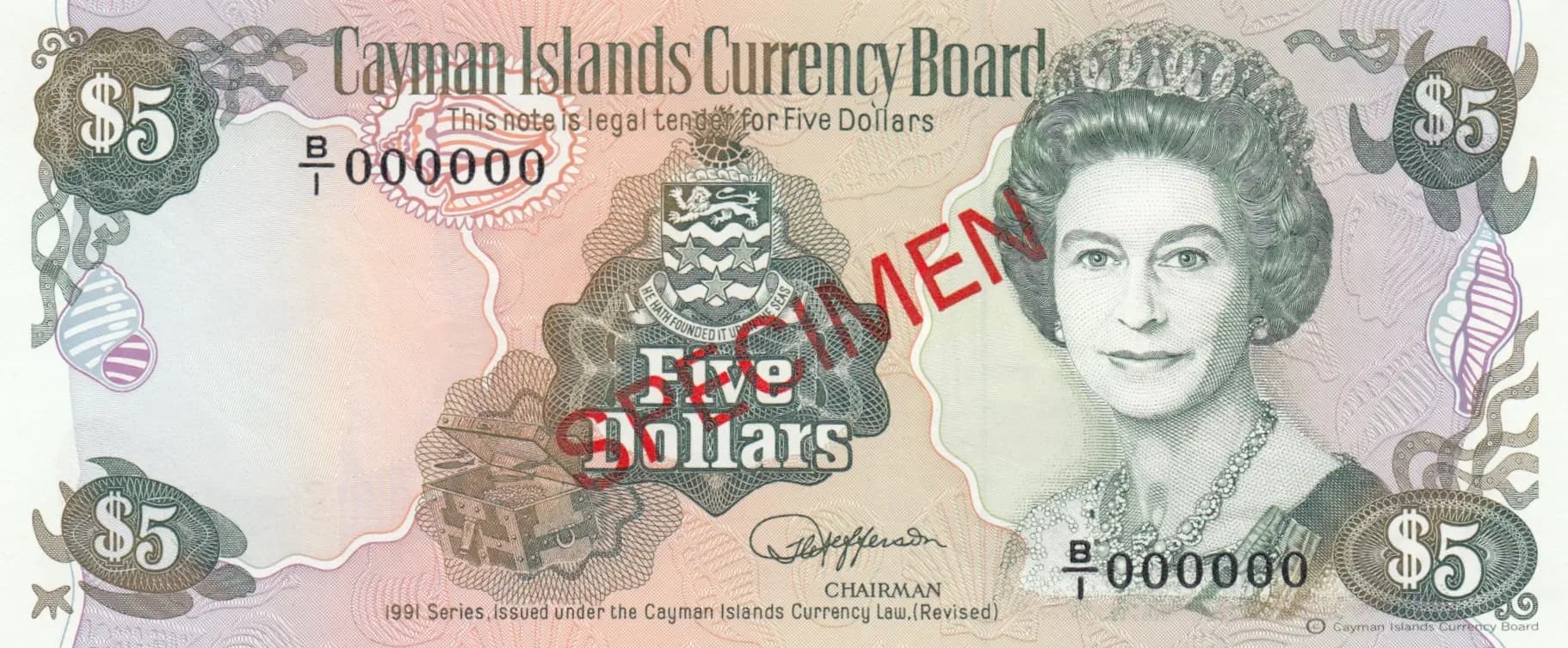
The obverse features a formal portrait of Queen Elizabeth II positioned on the right side wearing a pearl necklace and styled hair, rendered in classical intaglio style. The upper center displays the Cayman Islands coat of arms with heraldic lion design and shield. Decorative seahorse or sea creature motifs appear in the corners alongside dollar sign symbols. The note employs an ornate color scheme of pink, purple, red, and cream with intricate guilloche patterns forming the background security design. The reverse depicts a romantic tropical maritime scene with a historic windmill or fortified structure on the left, a sailing vessel with blue sails in the center-right, and a detailed conch shell illustration on the right. The landscape conveys the Cayman Islands' nautical heritage and natural beauty. Both sides are dominated by elaborate decorative borders and fine-line intaglio work.
Front side: 'Cayman Islands Currency Board' (issuing authority), 'This note is legal tender for Ten Dollars' (legal tender statement), '$10' (denomination), 'B 000000' (specimen serial number), 'SPECIMEN' (overprint indicating non-circulation status), 'CHAIRMAN' (signature designation), '1991 Series, Issued under the Cayman Islands Currency Law, (Revised)' (issue authority and year). Back side: 'Cayman Islands Currency Board' (issuing authority), 'Ten Dollars' (denomination), '$10' (denomination), 'SPECIMEN' (overprint), 'Thomas De La Rue and Company Limited' (printer attribution).
Intaglio printing (engraved plates), characteristic of Thomas de la Rue's security printing methods. The fine line work, ornate guilloche patterns, and detailed portraiture visible in the images are hallmarks of traditional intaglio engraving. The note exhibits the crisp, detailed rendering and color separation typical of multi-plate intaglio production employed by de la Rue for Commonwealth currency.
This note is cataloged as Pick P-13s, denoting the specimen variety of the 1991 10 Dollar series. The PMG population data indicates multiple cataloged variants exist (P-13, P-13CS2, P-13a, and P-13s), with P-13s representing the standard specimen overprint version printed by Thomas de la Rue (TDLR). The specimen serial number observed is B 000000, typical for specimen notes produced in sheets rather than sequential circulation ranges. No additional varieties (such as signature variations or date changes) are noted in the visual analysis.