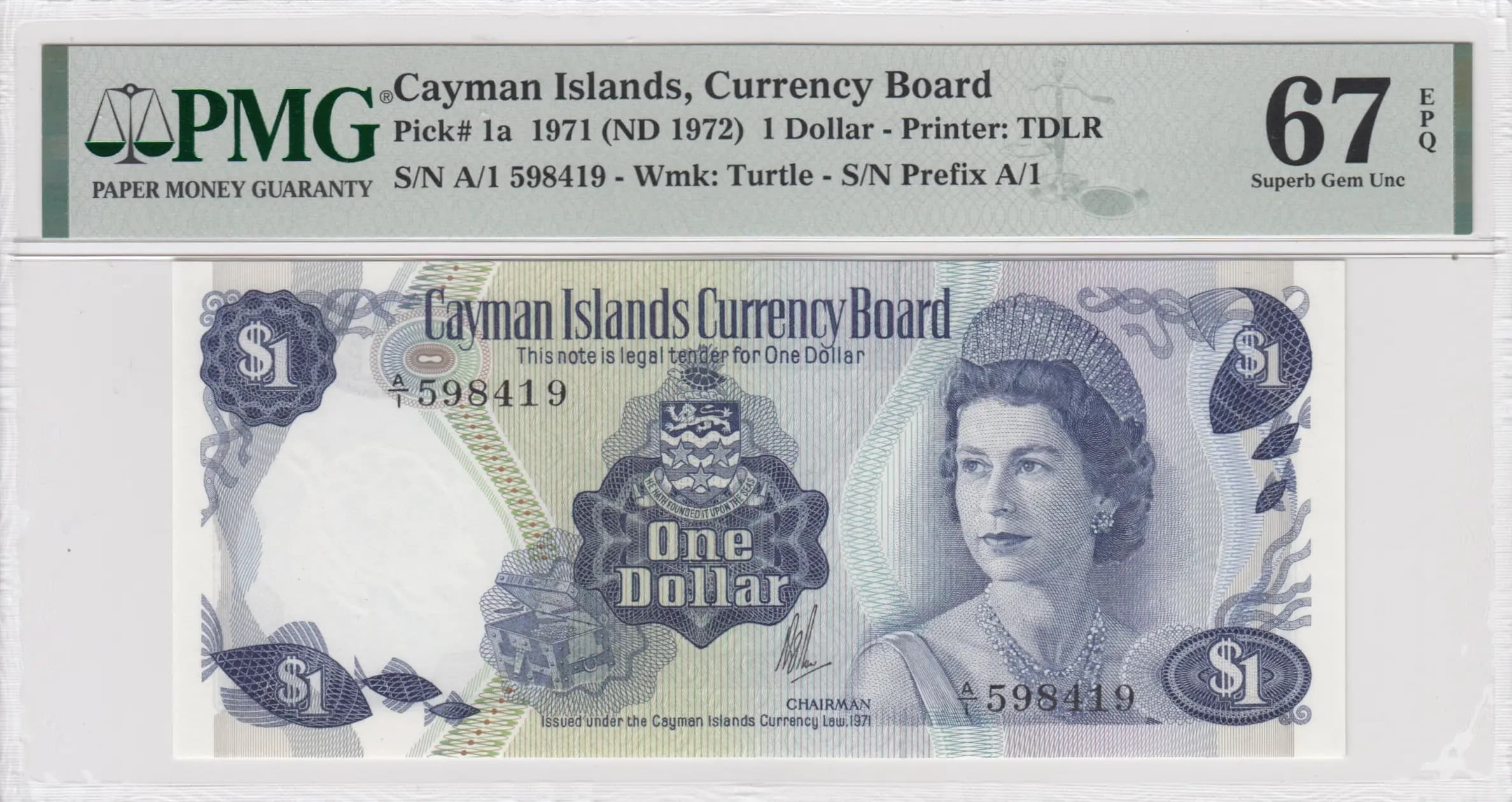
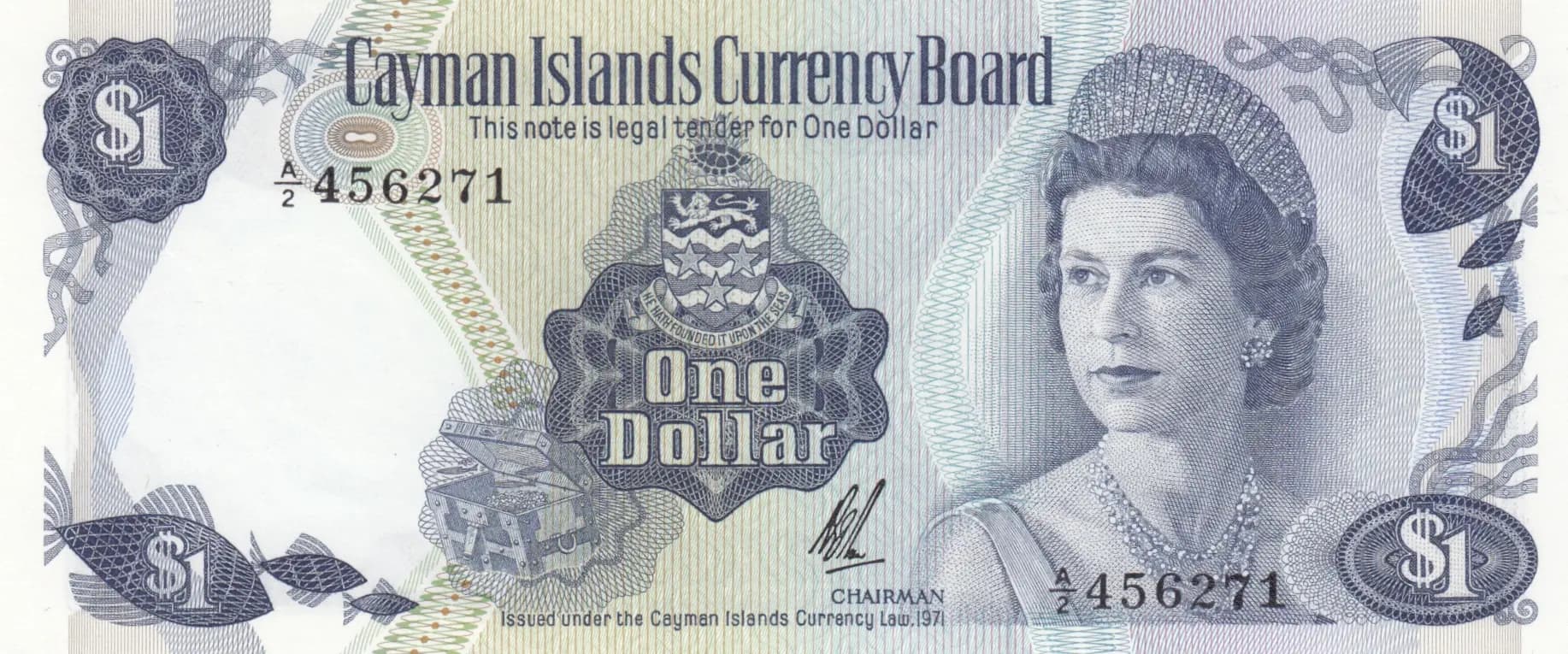
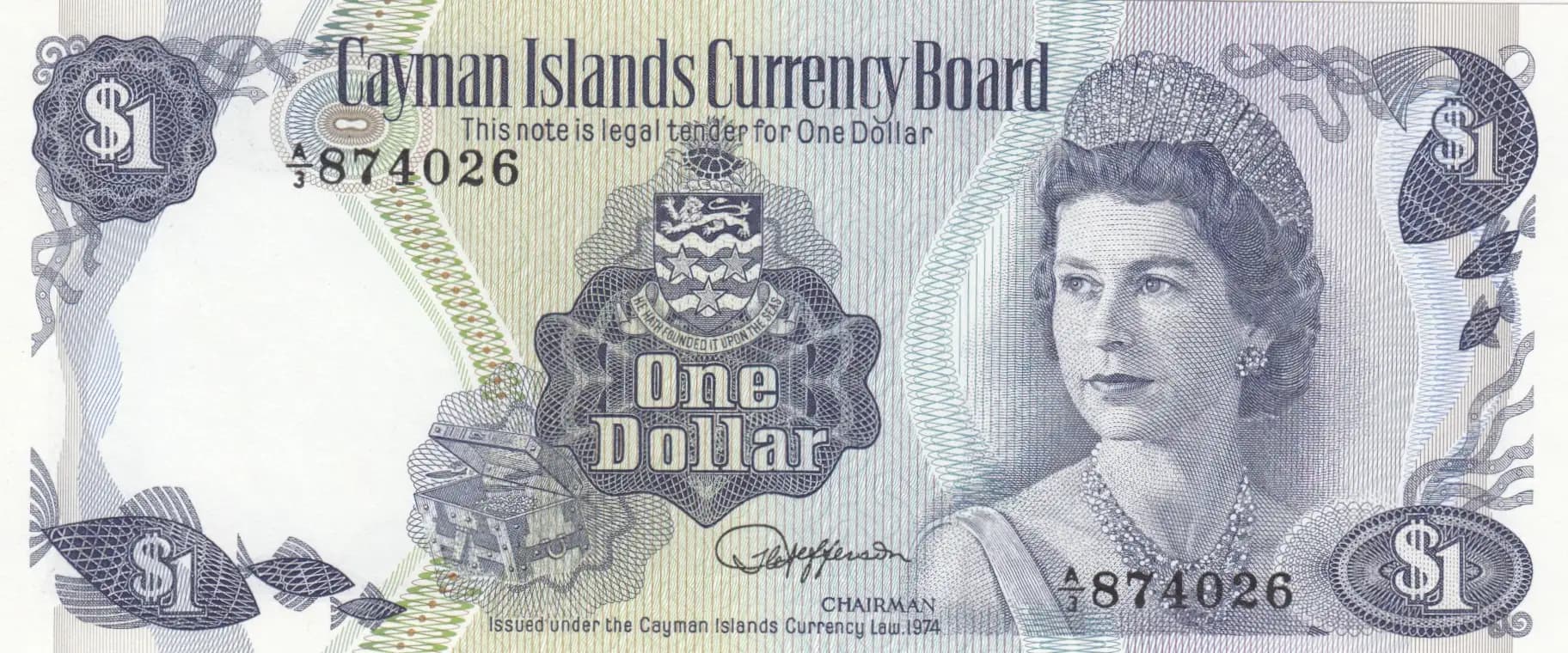
25 dollars 1991 specimen
Market Prices
1 saleAbout This Note
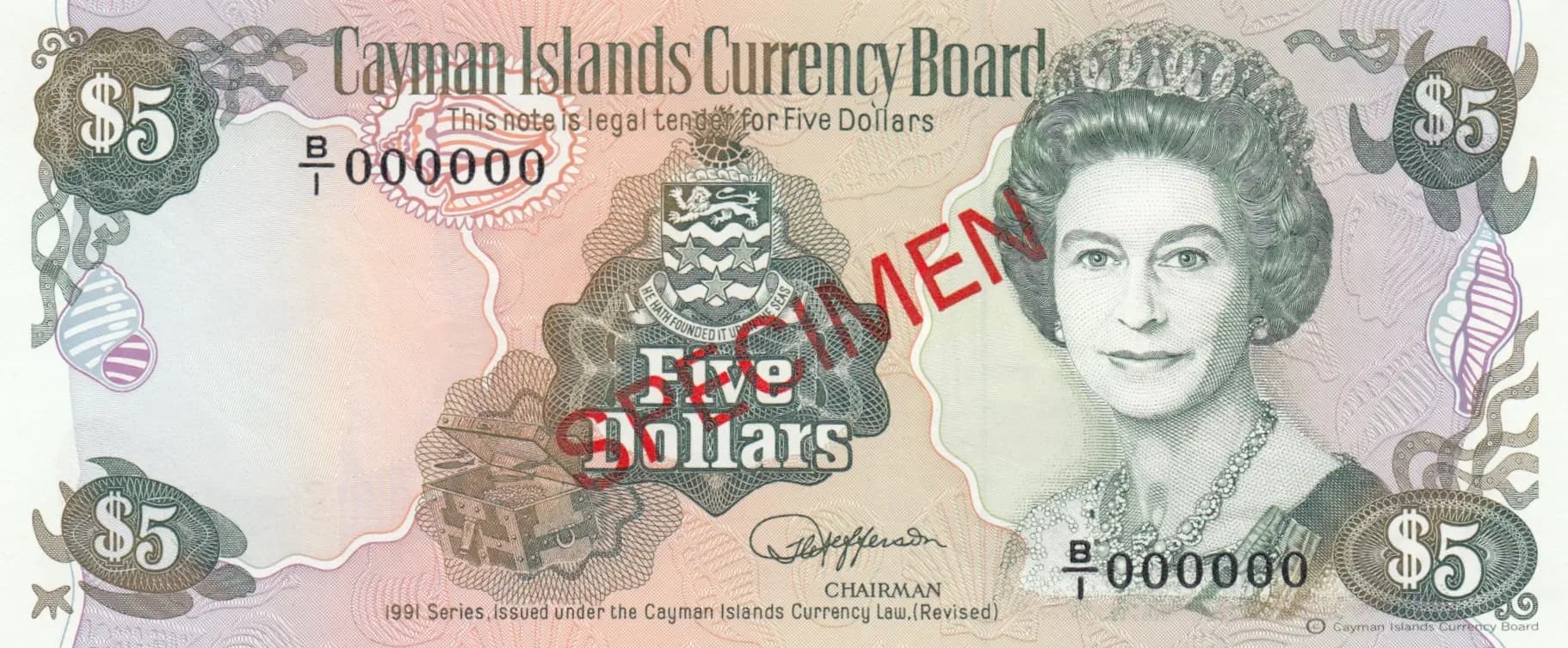
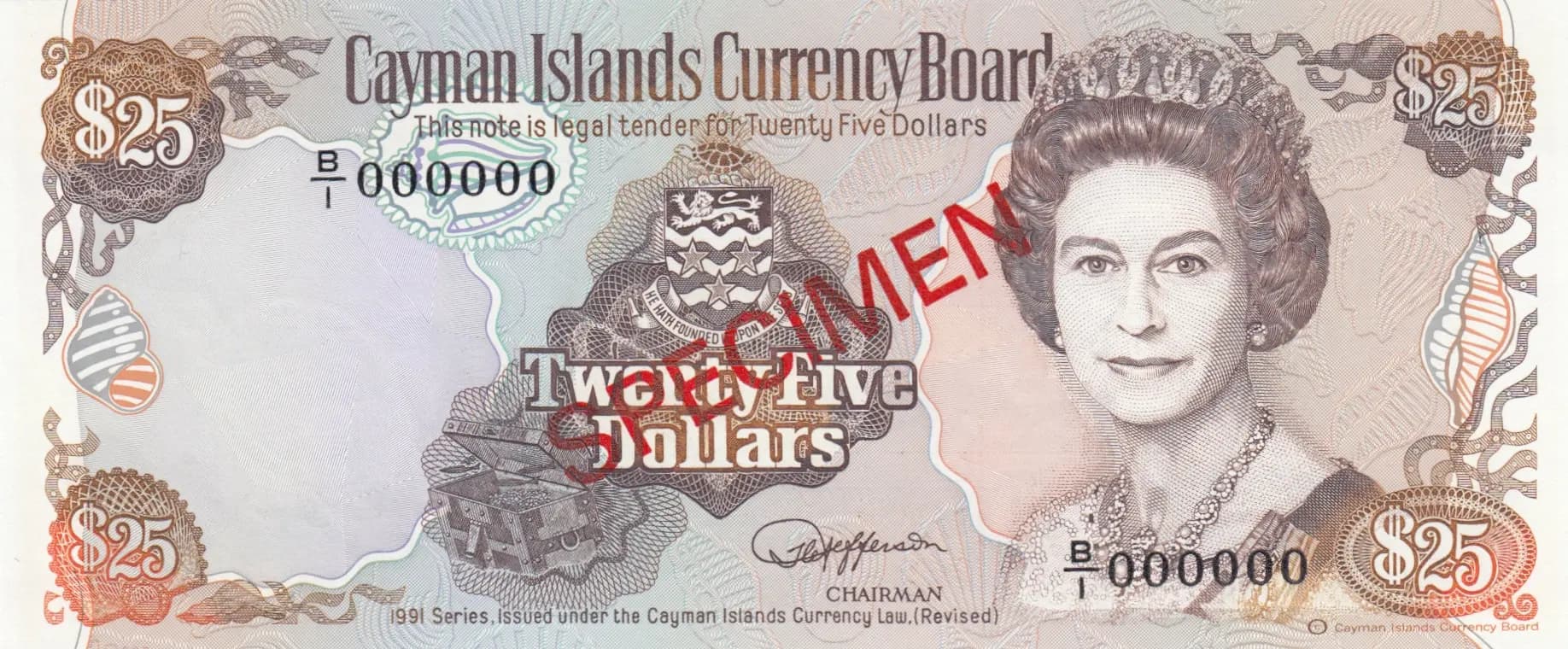
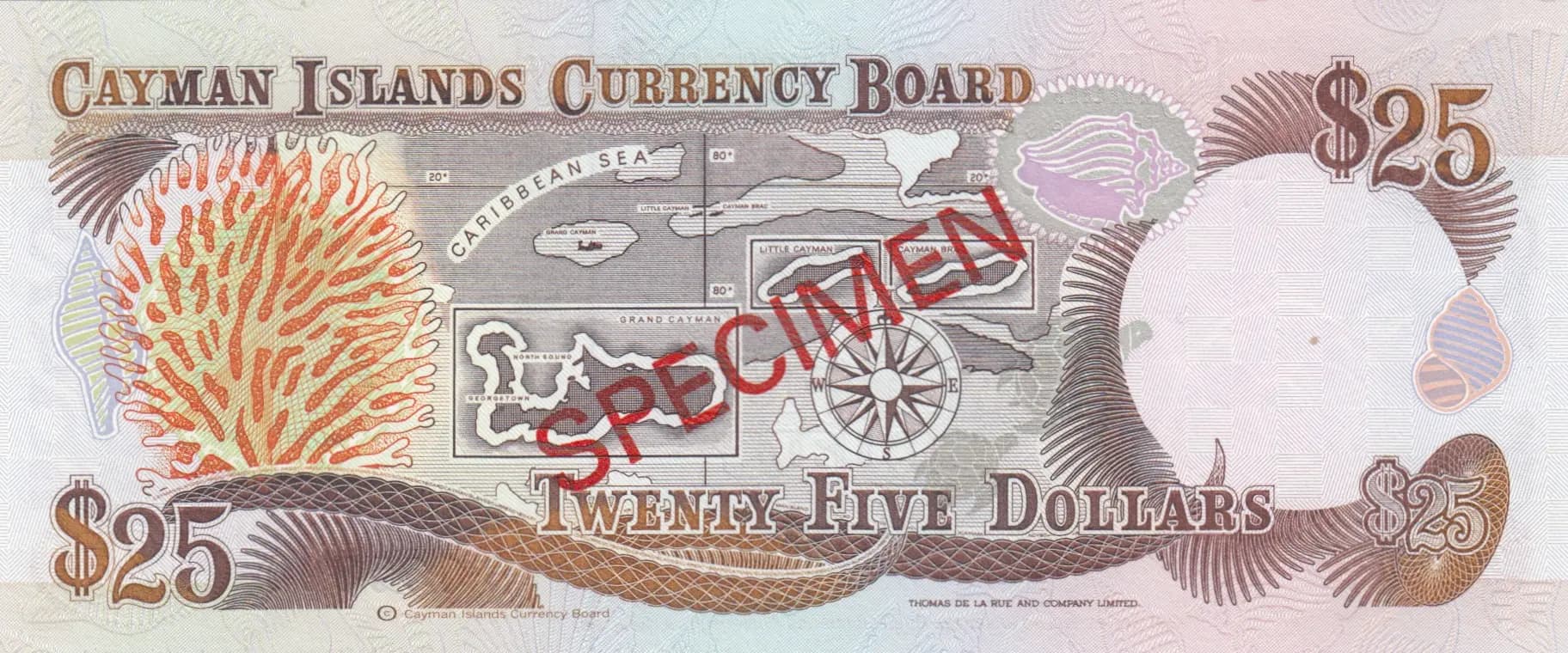
This is a 1991 Cayman Islands Currency Board $25 specimen banknote (Pick P-14s) produced by Thomas de la Rue, London, in uncirculated condition. The note features Queen Elizabeth II on the obverse and a detailed map of the Cayman Islands with red coral illustration on the reverse, both bearing prominent red 'SPECIMEN' overprints and zero serial numbers characteristic of specimen notes. The sharp printing quality, vibrant multicolored underprint, and pristine condition make this an attractive example of late 20th-century Commonwealth currency design.
Common. This is a specimen note from the standard 1991 Cayman Islands Currency Board $25 series (Pick P-14s), which was produced in typical quantities for a modern Commonwealth territory currency. Specimen notes, while not circulating, were produced in reasonable quantities for archival, display, and institutional purposes. The single eBay comparable sale recorded ($52 for an AUNC example in 2020) reflects typical market pricing for common modern specimen banknotes. The note exhibits no characteristics of limited production, recall, or scarcity that would elevate its rarity status.
Issued in 1991 under the Cayman Islands Currency Law (Revised), this note represents a period of modernization for the Cayman Islands' currency system under the stewardship of the Cayman Islands Currency Board. The reverse design emphasizes the territory's geographic identity and marine heritage, featuring the three constituent islands (Grand Cayman, Little Cayman, and Cayman Brac) with a Caribbean Sea context, reflecting the economic and cultural importance of the islands' maritime position. The continued portrayal of Queen Elizabeth II on the obverse, alongside the national coat of arms, reinforces the Cayman Islands' Commonwealth status during this era.
The obverse features a formal portrait of Queen Elizabeth II positioned at the right side of the note, rendered in the classical style typical of Commonwealth currency of this period. The Cayman Islands national coat of arms appears at the center-upper portion, incorporating heraldic elements representative of the territory's sovereignty. Decorative security elements include shell and nautilus designs in the left and right margins, with ornamental scalloped frames containing the $25 denomination in all four corners. The dominant color palette of beige, brown, gray, and cream with orange-brown accents creates an elegant, formal appearance. The reverse showcases a cartographic design highlighting the three Cayman Islands with the surrounding Caribbean Sea, a compass rose for navigation reference, and latitude/longitude coordinates (20° and 80°). A large red coral or sea fan illustration dominates the left side, symbolizing the archipelago's marine ecology and natural wealth. Nautilus shell designs frame the corners, creating visual continuity with the obverse design and reinforcing the maritime theme.
FRONT SIDE: 'Cayman Islands Currency Board' (issuing authority); 'This note is legal tender for Twenty Five Dollars' (legal tender declaration); '$25' and 'Twenty Five Dollars' (denominations in numeral and word form); 'SPECIMEN' (overprint indicating non-circulating use); 'B 000000' (specimen serial number); 'CHAIRMAN' (signature designation); '1991 Series, Issued under the Cayman Islands Currency Law, (Revised)' (series designation and legal basis). BACK SIDE: 'CAYMAN ISLANDS CURRENCY BOARD' (issuing authority); 'CARIBBEAN SEA', 'LITTLE CAYMAN', 'CAYMAN BRAC', 'GRAND CAYMAN' (geographic labels); 'TWENTY FIVE DOLLARS' and '$25' (denominations); 'SPECIMEN' (overprint); 'THOMAS DE LA RUE AND COMPANY LIMITED' (printer attribution); '20°' and '80°' (geographic coordinates).
Intaglio engraving (line engraving and steel-plate engraving), as evidenced by the fine-line detail work, intricate engraved patterns, complex security borders, and the sharp, crisp printing quality visible throughout both sides of the note. The printer, Thomas de la Rue and Company Limited, London, was renowned for its intaglio security printing techniques. Security features include watermark areas in the background, fine-line engraved patterns, and complex design elements that are characteristic of de la Rue's high-security banknote production standards of the 1991 period.
This is specifically identified as Pick P-14s, the specimen variant of the 1991 $25 note. PMG has catalogued three variants for this base Pick number: P-14 (circulation issue), P-14CS2 (circulation issue with alternative features), and P-14s (specimen). The 'SPECIMEN' overprint in red diagonal across both sides, combined with the zero serial number (B 000000), confirms this as the specimen variety. No signature variations or other distinguishing features are evident from the visual analysis that would suggest additional sub-varieties within the P-14s designation.