5000 francs 1974
Market Prices
12 salesAbout This Note
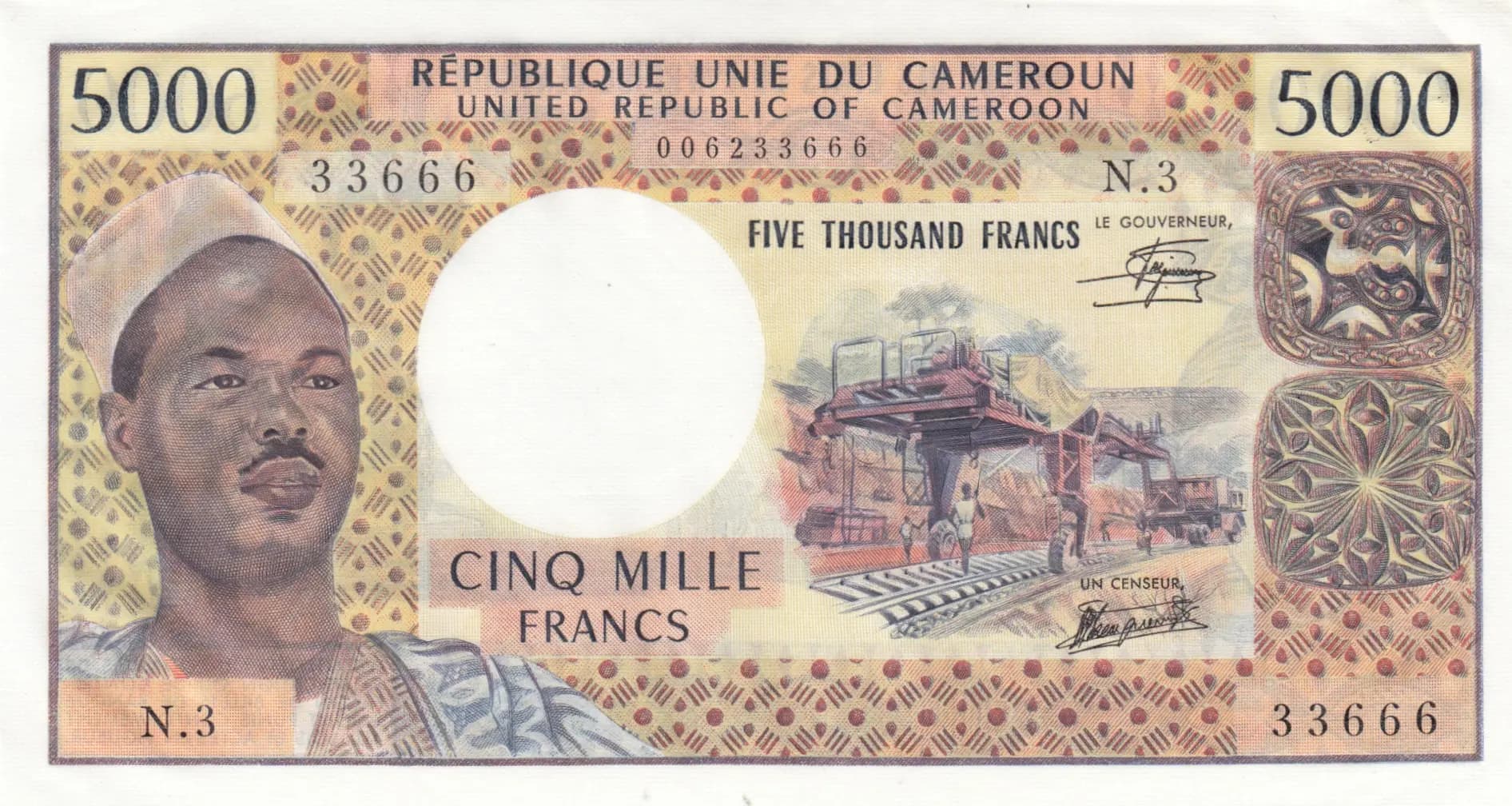
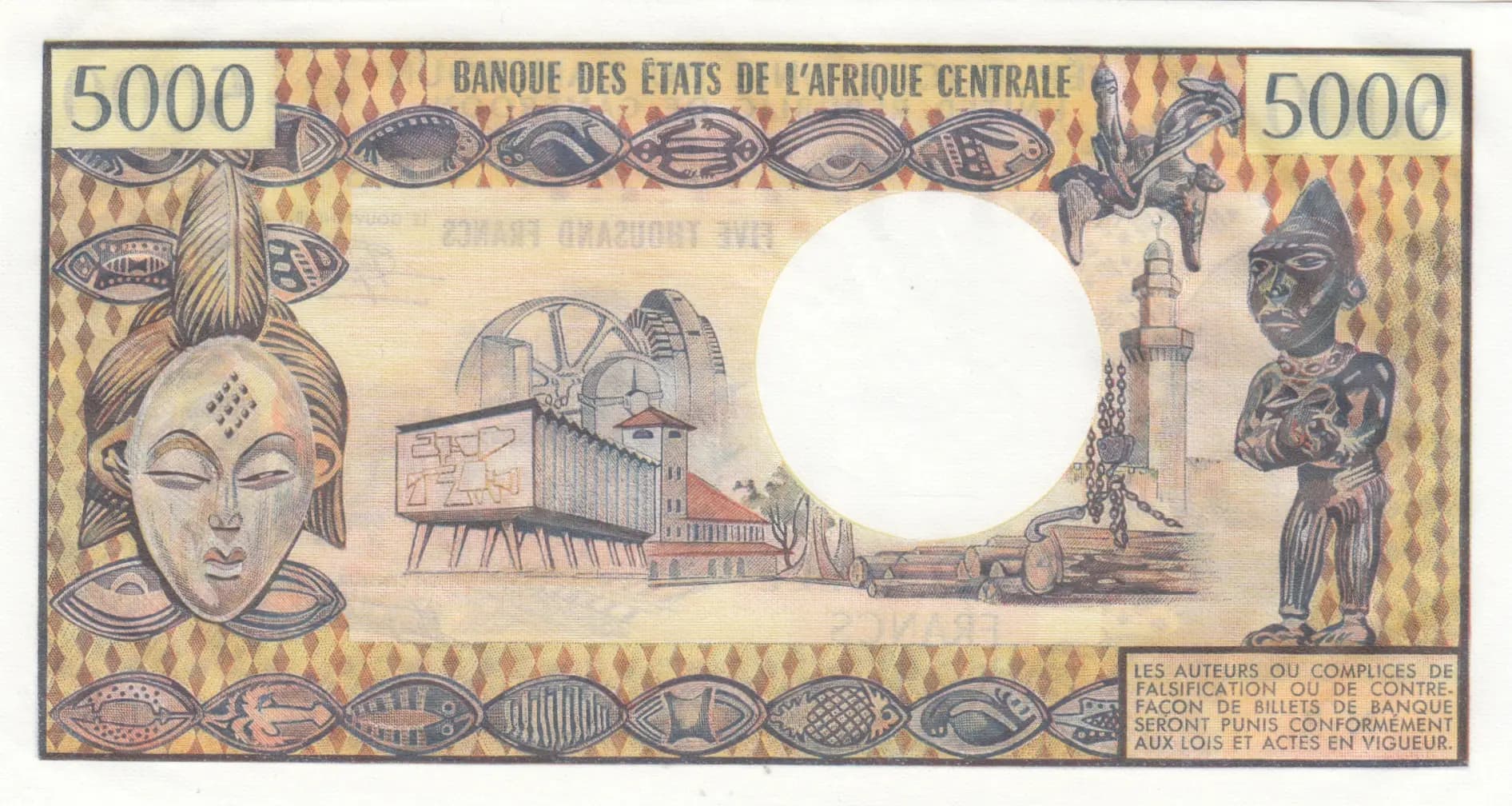
This is an uncirculated example of the Cameroon 5000 Francs from 1974 (Pick P-17c), issued by the Banque des Etats de l'Afrique Centrale. The note displays pristine condition with sharp, crisp printing throughout—no creases, folds, tears, or discoloration visible. The obverse features President Ahmadou Ahidjo in traditional dress on the left, with an industrial railway scene on the right, while the reverse showcases African artistic heritage through stylized masks and architectural landmarks representing member states of the Central African monetary union.
Common. This is a regular-issue banknote from a major central bank serving multiple African nations, with substantial print runs typical of denominations in circulation during the 1970s. eBay market data confirms this assessment: UNC examples consistently sell in the $15–$45 range, with even higher grades (EF/AU) averaging $20–$30, with occasional outliers around $200. The 2019 catalogue valuation of $250 for UNC reflects collector interest but not scarcity—most UNC examples remain accessible to collectors. Multiple signature varieties (P-17a, P-17b, P-17c) and printer variations further indicate substantial production runs across different printings.
This banknote reflects Cameroon's role within the Central African monetary union during the 1970s, a period emphasizing industrial development and pan-African cultural identity. The imagery deliberately showcases both economic progress (railroad and factory infrastructure) and African heritage (masks and regional architectural landmarks), symbolizing the post-colonial modernization efforts under President Ahidjo's administration. The reverse design featuring landmarks from member states (Gabon's Town Hall of Libreville, Congo's Pointe Noire train station, and Chad's Abéché mosque) underscores the shared currency and economic cooperation of French-speaking Central African nations.
The obverse features a left-facing profile portrait of President Ahmadou Ahidjo wearing a traditional white head covering (turban) and blue-patterned traditional garment, positioned on the left portion of the note. The right side depicts an industrial complex with factory buildings, smokestacks, and railway infrastructure—symbolizing Cameroon's economic development during the 1970s. The design employs a cream and beige background with decorative geometric patterns in red and gold, ornamental square designs with curved patterns, and dual-language text reflecting the bilingual nature of the Cameroon state. The reverse presents African artistic and architectural heritage through two prominent stylized African masks (one on each side) with elongated geometric features, a central composition including a hanging sculptural figure (possibly a bat or bird motif), and standing carved wooden figures. The central scene incorporates architectural representations: a modernist/brutalist building structure, a minaret-style tower reflecting Islamic architecture, and a cylindrical fortification. An 'eye motif' pattern forms decorative borders at top and bottom, serving as a security feature. The entire design celebrates both modernization and cultural pride, with the large white circular watermark area centrally placed on both sides.
FRONT: '5000' (denomination in numerals); 'RÉPUBLIQUE UNIE DU CAMEROUN' (United Republic of Cameroon); 'UNITED REPUBLIC OF CAMEROON' (English version); 'FIVE THOUSAND FRANCS' (English denomination); 'CINQ MILLE FRANCS' (French denomination); 'LE GOUVERNEUR,' (The Governor); 'UN CENSEUR,' (A Censor); serial numbers '33666' and '00623366'; signature designation 'N.3'. BACK: '5000' (denomination); 'BANQUE DES ÉTATS DE L'AFRIQUE CENTRALE' (Bank of the Central African States); 'LES AUTEURS OU COMPLICES DE L'FALSIFICATION OU DE CONTREFAÇON DE BILLETS DE BANQUE SERONT PUNIS CONFORMÉMENT AUX LOIS ET ACTES EN VIGUEUR' (The authors or accomplices of the falsification or counterfeiting of banknotes will be punished in accordance with current laws and acts).
Intaglio engraving (line engraving), the standard security printing method for BEAC banknotes of this era. The crisp, fine-line detail visible in the decorative borders, portrait rendering, geometric patterns, and the repeating eye motif security feature all confirm professional intaglio engraving. The note was produced by a central security printer contracted to the Banque des Etats de l'Afrique Centrale; such notes typically employed European security printers such as Bradbury Wilkinson or Giesecke+Devrient, though specific printer attribution for BEAC issues of this period requires consultation of printing documentation.
This note is catalogued as Pick P-17c, identified by the watermark feature (Antelope's Head watermark specification). The signature designation 'N.3' visible on the obverse indicates this is the third signature variety of this issue. The PMG population report documents at least eight distinct varieties for the base 5000 Francs Pick number (P-17a through P-17pp2), differentiated by signature variety, watermark details, and printer variants. The serial number prefix and numbering format ('33666' and '00623366') should be cross-referenced with known serial ranges for P-17c to establish position within the print run, though all such variants remain common in the current market.