50 francs 1973
Market Prices
7 salesAbout This Note
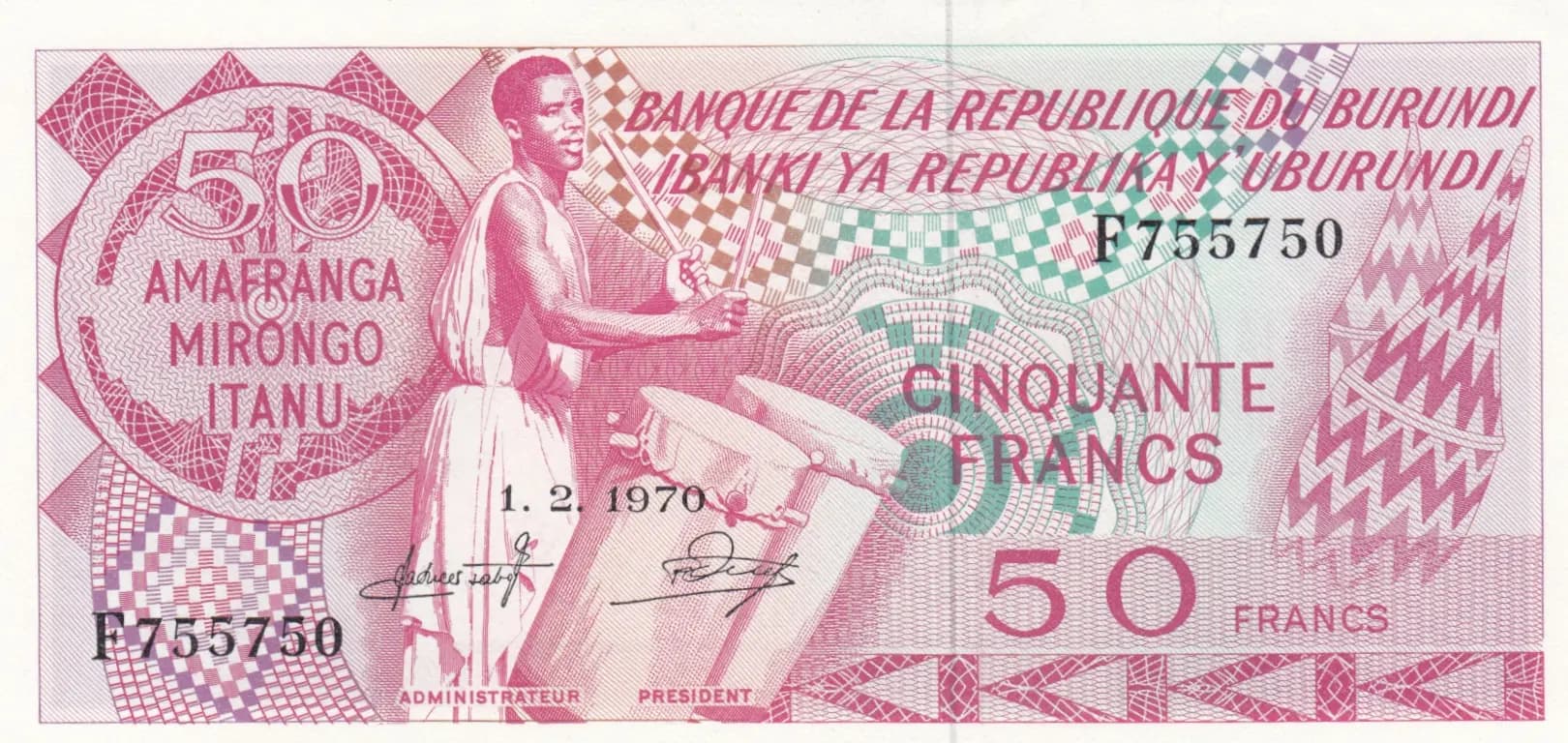
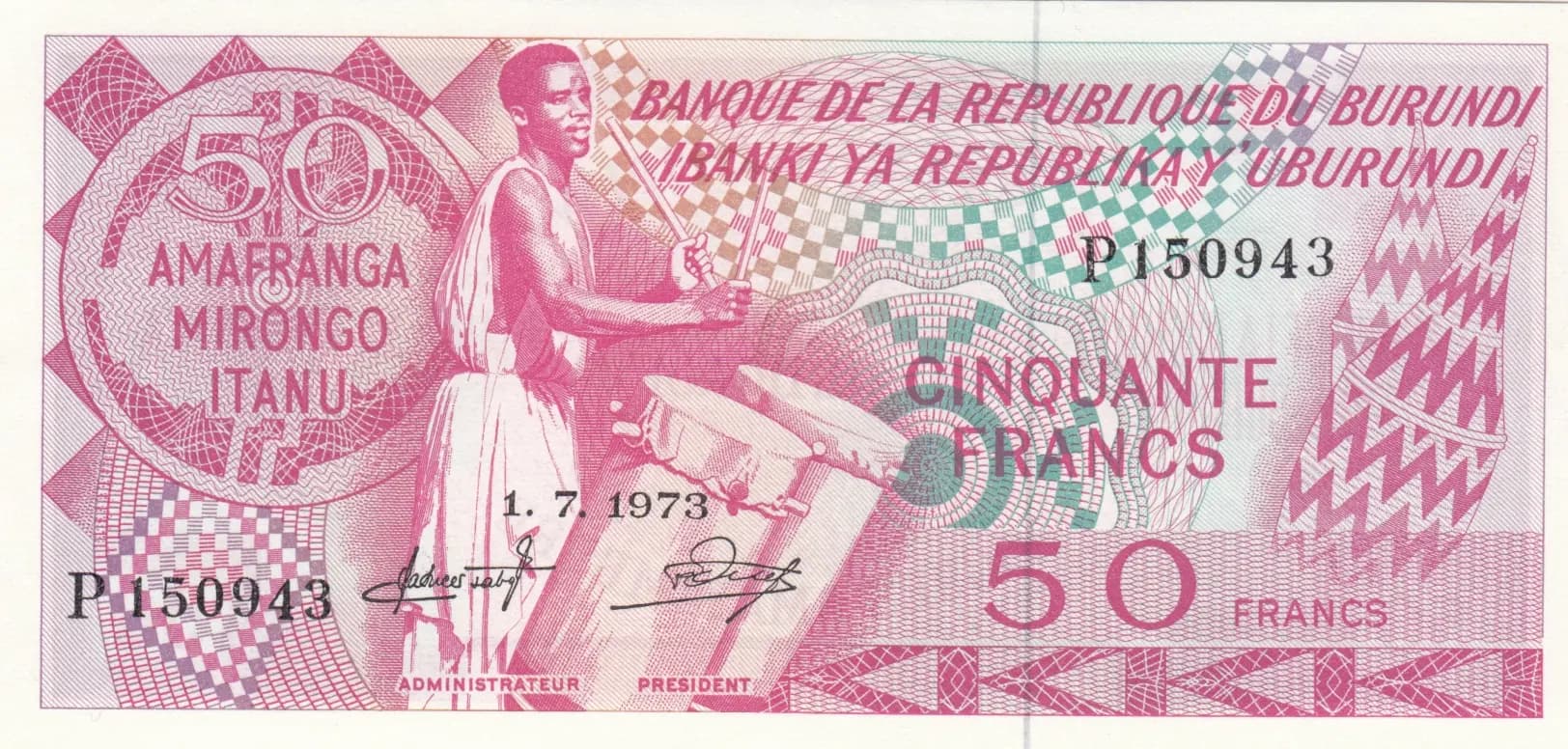
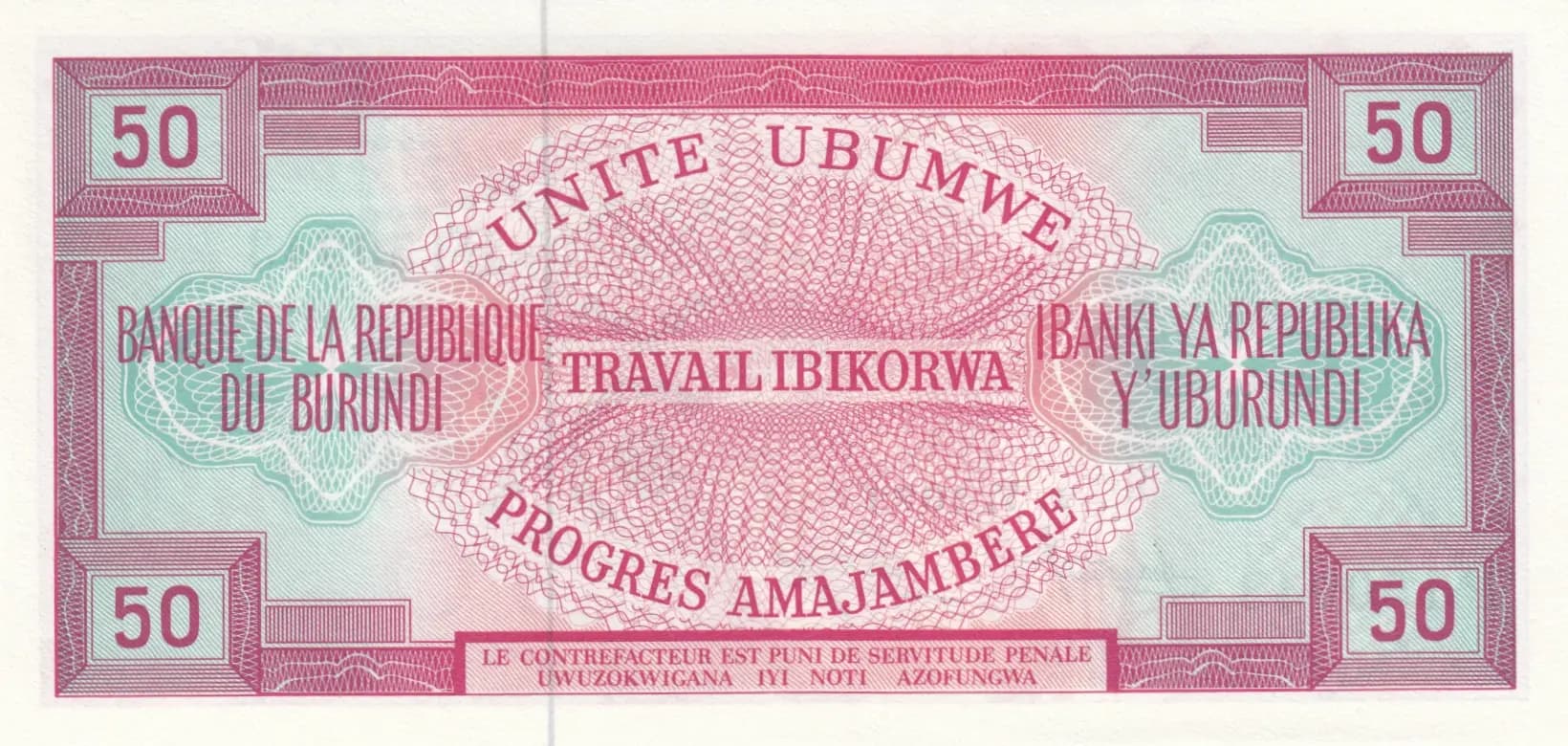
This is a 1973 Burundi 50 Francs banknote (Pick P-22b) in UNC condition, featuring a striking pink/magenta and green color scheme characteristic of early Central African currency design. The obverse displays a drummer portrait in the upper-center-right area alongside the national emblem, with the date 1.7.1973 clearly visible, while the reverse features an ornate oval medallion inscribed with the national motto 'Unité, Travail, Progrès' in both French and Kirundi. The note exhibits some light creasing and a central fold mark, though printing remains sharp and the color registration is precise throughout.
Common. The eBay market data provided shows multiple sales at modest prices ($11–$26 in Fine condition, $150 catalog value for UNC), with regular supply on the secondary market. The print run for this 1973 issue was substantial, and no documented scarcities or recalls affect this Pick number. While UNC examples command higher prices, the underlying rarity remains low; this is a standard-issue currency note from a well-documented series.
Issued during Burundi's early post-independence period under the Banque de la République du Burundi, this note reflects the nation's emphasis on unity and progress through its dual-language inscriptions in French and Kirundi and its central motto 'Unité, Travail, Progrès.' The drummer imagery on the obverse represents Burundian cultural heritage, connecting the currency to the country's rich musical and traditional identity. The 1973 date places this note within the presidency of Michel Micombero, a period of significant political consolidation in the young nation.
The obverse features a portrait of a drummer positioned in the upper-center-right area, shown in profile from the shoulders up, rendered in a naturalistic style typical of African banknote portraiture of the era. On the left side is a large circular national emblem of Burundi rendered in teal/green with intricate geometric patterns. The denomination '50' is prominently displayed within this emblem alongside 'Amabaranga Mirongo Itanu' (Kirundi for fifty francs). The reverse showcases an ornate oval medallion at the center with decorative scrollwork, containing the national motto arranged in three languages/versions: 'Unité/Ubumwe,' 'Travail/Ibikorwa,' and 'Progrès/Amajambere.' Rectangular denomination boxes containing '50' occupy all four corners. Throughout both sides, fine guilloche patterns and geometric designs provide sophisticated security features, with the overall color scheme of pink/magenta combined with pale green/teal creating a distinctive visual identity.
FRONT SIDE: 'Banque de la République du Burundi' / 'Ibanki ya Repubrika y'Uburundi' (Bank of the Republic of Burundi — French and Kirundi); 'Amabaranga Mirongo Itanu' (Fifty Francs — Kirundi); 'Cinquante Francs' / '50 Francs' (Fifty Francs — French); 'Administrateur' / 'Président' (Administrator / President — signature titles); Serial number: 'P150943'; Date: '1.7.1973' (July 1, 1973). REVERSE SIDE: 'Banque de la République du Burundi' / 'Ibanki ya Repubrika y'Uburundi' (Bank of the Republic of Burundi — French and Kirundi); 'Unité Ubumwe' (Unity — French/Kirundi); 'Travail Ibikorwa' (Work — French/Kirundi); 'Progrès Amajambere' (Progress — French/Kirundi); '50' (Denomination — corners); 'Le Contrefacteur est puni de Servitude Pénale' (The counterfeiter is punished by penal servitude — French); 'Uwuzokwigana n'i Noti azofungwa' (He who counterfeits notes will be imprisoned — Kirundi).
This banknote was produced using intaglio (engraved) printing combined with offset lithography for the multicolored background elements, a standard technique for Central African currency during the 1970s. The precise color registration, fine line work, and intricate guilloche patterns visible throughout are characteristic of high-security intaglio production. The specific security printer for Burundi notes of this period is believed to be Giesecke+Devrient or a similar European security printer, though definitive attribution for Pick P-22b would require archival documentation.
This specimen represents the 1.7.1973 date variety from the series that spans 1970–1973 (with documented dates of 1.8.1970, 1.8.1971, and 1.7.1973). The serial number 'P150943' indicates the 'P' prefix series. Known signature varieties exist with different 'Administrateur' and 'Président' signatures; this example should be cataloged with reference to the specific signatures present. The 'P' series prefix is consistent with earlier printings within this issue. No overprints are visible, and the note presents the standard design without special markings.