5 rupees 1942
Market Prices
22 salesAbout This Note
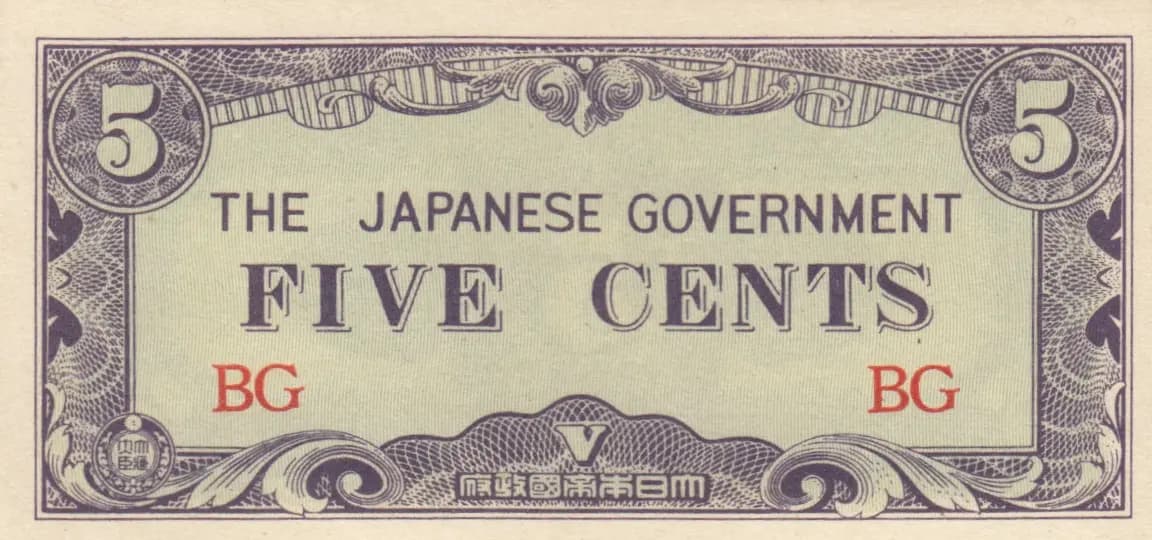
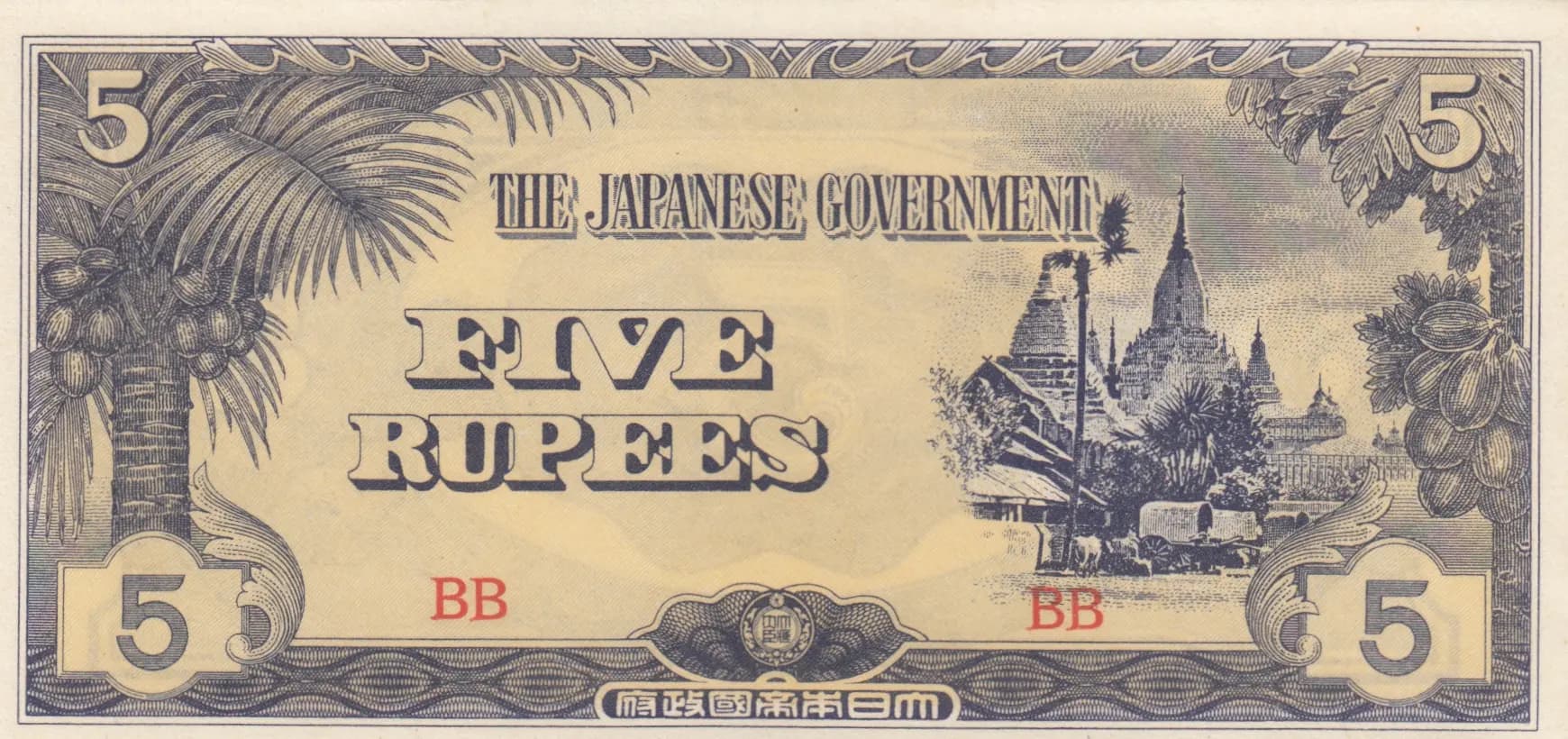
This is a well-preserved example of the Japanese Government's 5 Rupees note from 1942 (Pick P-15b), issued during Japan's occupation of Burma. The note displays the iconic Ananda Temple of Pagan on its obverse, rendered in fine detail against a cream background with dark blue-purple printing. In uncirculated condition with sharp printing and no visible wear, this note represents an important piece of World War II-era currency history and remains affordable for collectors despite its historical significance.
Common. This is an occupation note issued in substantial quantities during the Japanese administration of Burma (1942-1944). The robust eBay price history demonstrates consistent availability at modest prices, with the vast majority of sales occurring well under $5 (even graded examples in VF-UNC condition typically sell for $1-3). The 2016 catalog UNC value of $1 and consistent pricing across the 2010-2022 period indicate a steady, readily available supply in the collector market. No print run restrictions, recalls, or scarcity indicators apply to this standard issue.
Issued by the Japanese Government during their military occupation of Burma (1942-1944), this banknote reflects Japan's attempt to establish economic control over occupied territories through the creation of occupation currency. The choice to feature the Ananda Temple—one of Burma's most revered Buddhist architectural monuments—suggests an effort to appeal to local populations while asserting Japanese administrative authority. This currency issue was part of Japan's broader military administration system across Southeast Asia during World War II.
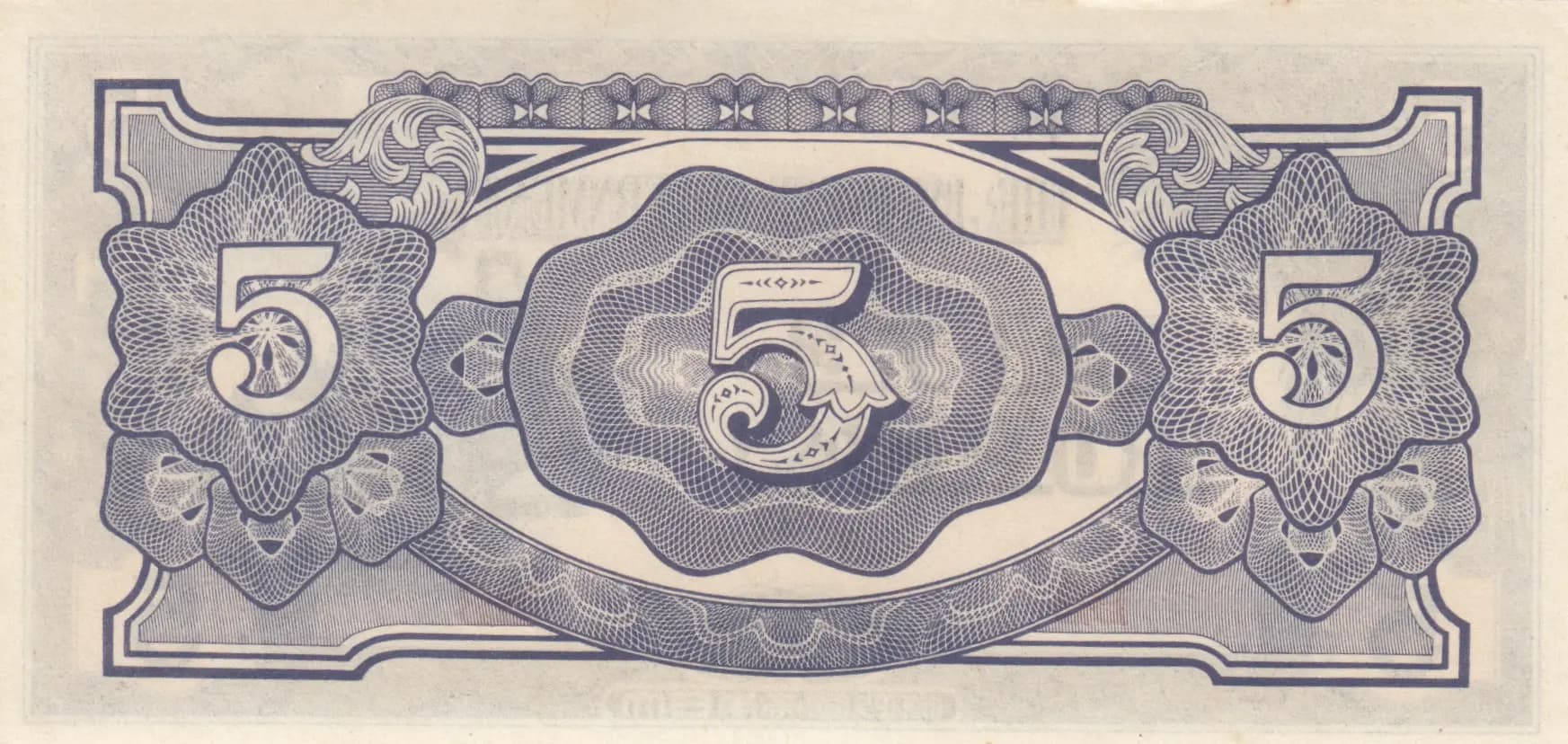
The obverse features the Ananda Temple (Ananada Phaya) of Pagan, one of Myanmar's most significant Buddhist architectural achievements, depicted as a multi-spired pagoda structure surrounded by tropical vegetation including palm trees. This temple vignette occupies the central position, framed by ornamental borders with elaborate wave patterns, floral motifs in the corners, and wreath-like decorative elements. The reverse employs a classical symmetrical design with a central circular medallion containing the numeral '5' surrounded by ornate floral rosette patterns, matching decorative cartouches on both edges, and intricate scrollwork and geometric patterns throughout. The color scheme—cream/beige background with dark blue-purple printing—is consistent across both sides.
Front side: 'THE JAPANESE GOVERNMENT' (English, top center); 'FIVE RUPEES' (English, center-left); '5' (Arabic numerals, top left and right corners); 'BB' (alphanumeric serial number prefix, appears twice). Japanese text: '昭和5国家債券明印' translates to 'Showa 5 National Bond Official Seal' or 'Showa Period National Government Seal.' Back side: '5' (Arabic numerals, appears in multiple decorative cartouches and central medallion).
Intaglio engraving (line engraving), evidenced by the fine line work, crisp detail reproduction, and intricate security features visible throughout both sides. The ornamental borders, decorative scrollwork, and complex geometric patterns are characteristic of high-security intaglio production. For this Pick number, the note was likely produced by Japanese government security printing facilities, though specific printer information is not definitively established in standard catalogs.
This example is cataloged as Pick P-15b, indicating it is the second recognized variety of the 5 Rupees 1942 issue. The serial number prefix 'BB' visible on this specimen may represent a specific printing batch or series designation. The note is undated (ND) in catalog terminology, though contextually issued between 1942-1944. No specific overprints, signature varieties, or other major sub-varieties have been formally documented for this Pick number in standard references, though serial number series variations (such as the BB prefix observed here) may exist among different printings.