100 rupees 1942
Market Prices
20 salesAbout This Note
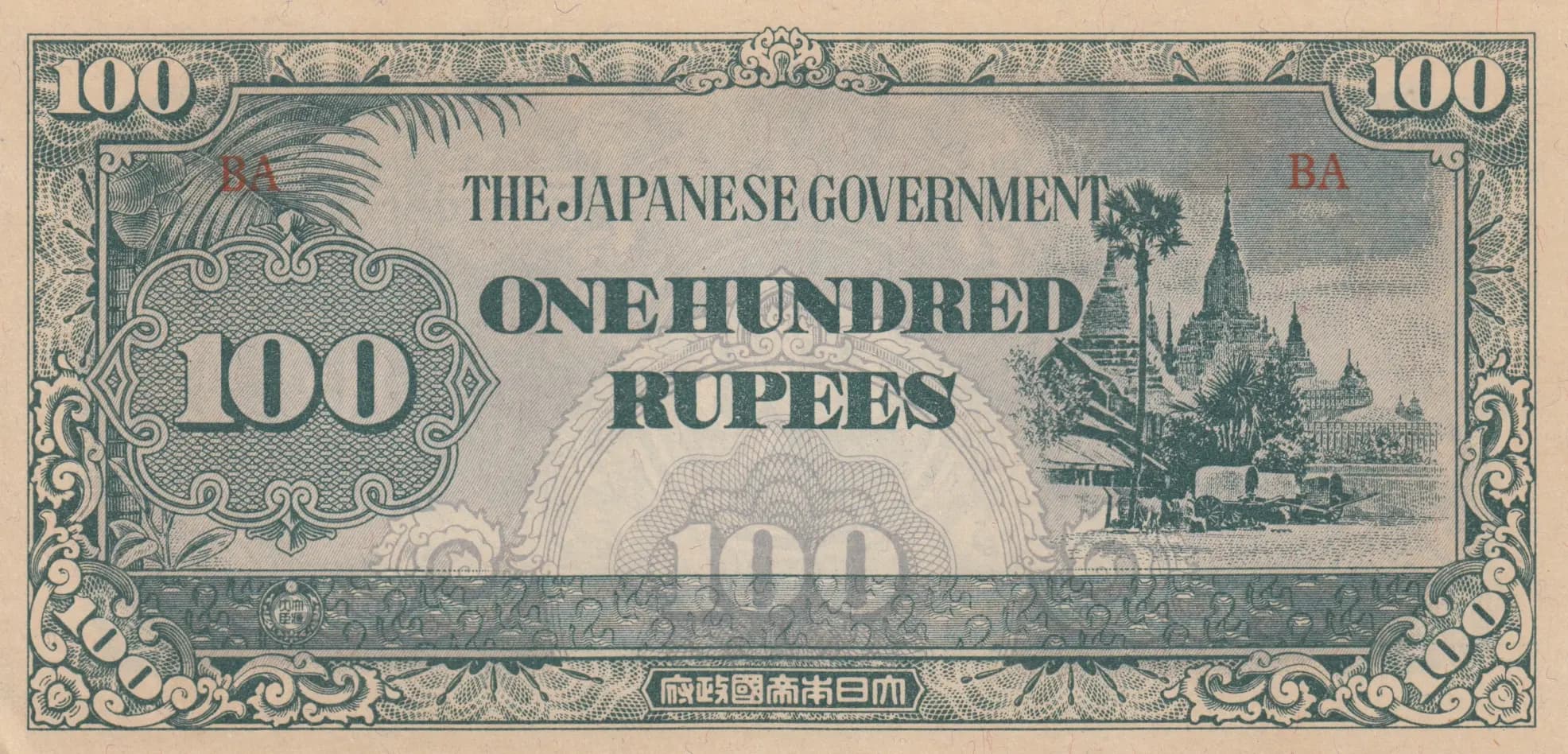
This is a 100 Rupees banknote issued by the Japanese Government for Burma in 1942, graded UNC (Uncirculated). The note features the iconic Ananda Temple of Pagan prominently displayed on the right side of the obverse, accompanied by tropical vegetation and palm trees rendered in fine detail. The note exhibits exceptional condition with sharp, clear printing throughout, vibrant teal-green and cream coloring, and pristine ornamental borders demonstrating the quality intaglio engraving work characteristic of Japanese occupation currency.
Common. eBay market data shows consistent sales ranging from $1.06 to $3.52 across multiple condition grades from 2015 to 2025, with UNC examples cataloged at $1 (2016 values). The regular, predictable pricing and frequent auction activity indicate this is a widely available note among collectors. The Japanese occupation currency series was issued in substantial quantities for circulation in Burma, and this denomination remains readily obtainable in all grades.
This note was issued during Japan's occupation and administration of Burma (Myanmar) in World War II, following the Japanese invasion in 1942. The selection of the Ananda Temple in Pagan as the central iconic imagery reflects Japan's attempt to present itself as a respectful administrator of Burmese cultural heritage, while the English-language inscriptions and denomination in rupees (the pre-existing currency) maintained continuity with colonial-era monetary systems. The Japanese Government's issuance of occupation currency in Burma represents a significant historical artifact from this period of Southeast Asian military administration.
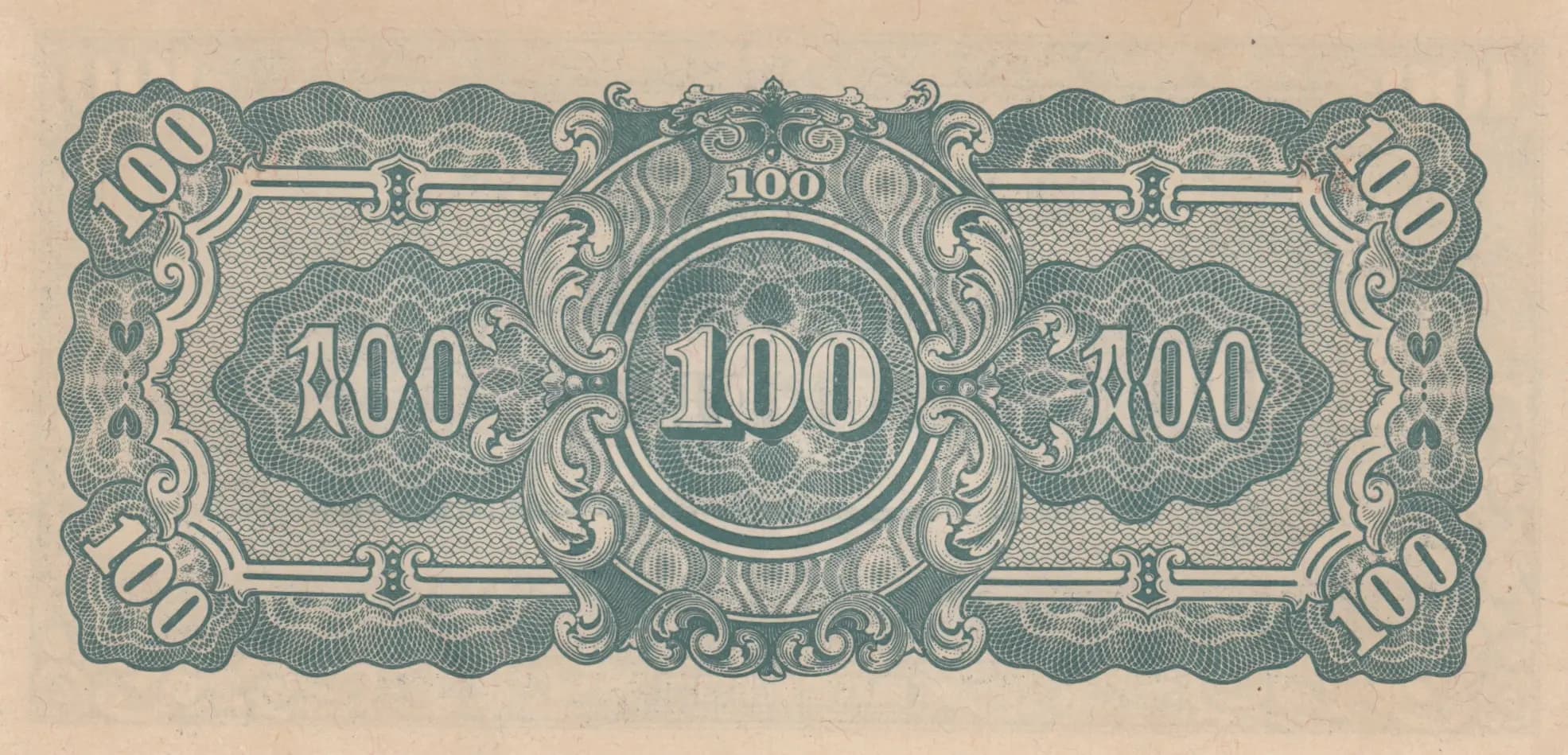
The obverse features a symmetrical design anchored by the Ananda Temple (Ānanda Pahto), one of Burma's most significant architectural monuments located in Pagan, depicted in three-quarter view on the right side with its characteristic multi-tiered structure and ornate spire rendered in fine detail. Surrounding the temple are stylized palm trees and tropical vegetation suggesting the Burmese landscape. The left side contains the denomination '100' in an ornamental square cartouche. An elaborate geometric and floral border frames the entire note in the corners with scroll patterns typical of Japanese banknote design. The reverse presents a purely ornamental design with a large central circular medallion containing '100', surrounded by six additional denomination markers in ornamental frames positioned symmetrically across the note. Both sides employ a two-color scheme of dark teal-green and cream, with red accents visible on the serial number.
Front Side: 'THE JAPANESE GOVERNMENT' (top center, English), 'ONE HUNDRED' and 'RUPEES' (center, English denomination text), '100' (appears in top left, top right ornamental frame, and left side ornamental square frame, Arabic numerals), 'BA' (top right serial number prefix, Latin characters). Back Side: '100' (repeated six times in various ornamental frames and medallions positioned at cardinal points and center, Arabic numerals). All text appears in English with no Burmese or Japanese language inscriptions visible on the obverse.
Intaglio engraving (recess printing/copperplate engraving), evidenced by the fine line work, intricate detail in the ornamental borders, the temple architecture rendering, and the sharp, raised impression visible throughout the note. The consistent depth of impression and crisp definition of even the finest decorative elements indicate traditional high-security intaglio methods. The printer for Japanese Government occupation notes of this series was typically the Imperial Mint or associated Japanese security printers, though specific attribution for the P-17b variety requires confirmation of the engraving marks or printer's imprint.
Pick catalog number P-17b with serial number block prefix 'BA'. The visual analysis confirms characteristics typical of this variety: dark green and gray-violet coloring, Ananda Temple at right on obverse, no watermark, block letter prefix 'BA' approximately 6.5mm wide, and silk threads incorporated in the paper. The serial number prefix 'BA' may indicate a specific printing batch or series. No date appears printed on the note (designated ND in some catalogs), though historical records confirm 1942 as the issue year. No signature varieties or notable overprints are evident in the observed images.