10 rupees 1947
Market Prices
10 salesAbout This Note
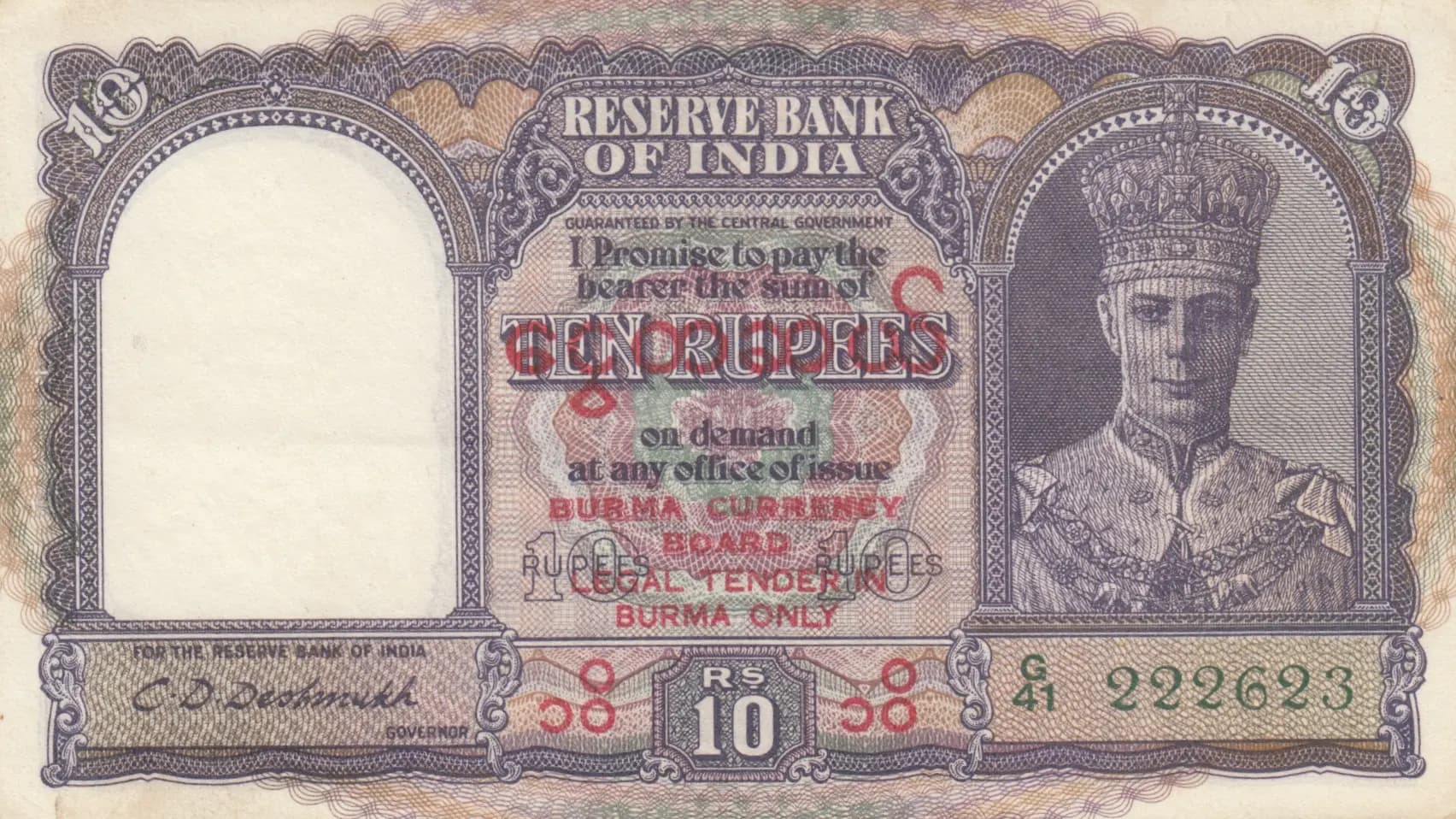
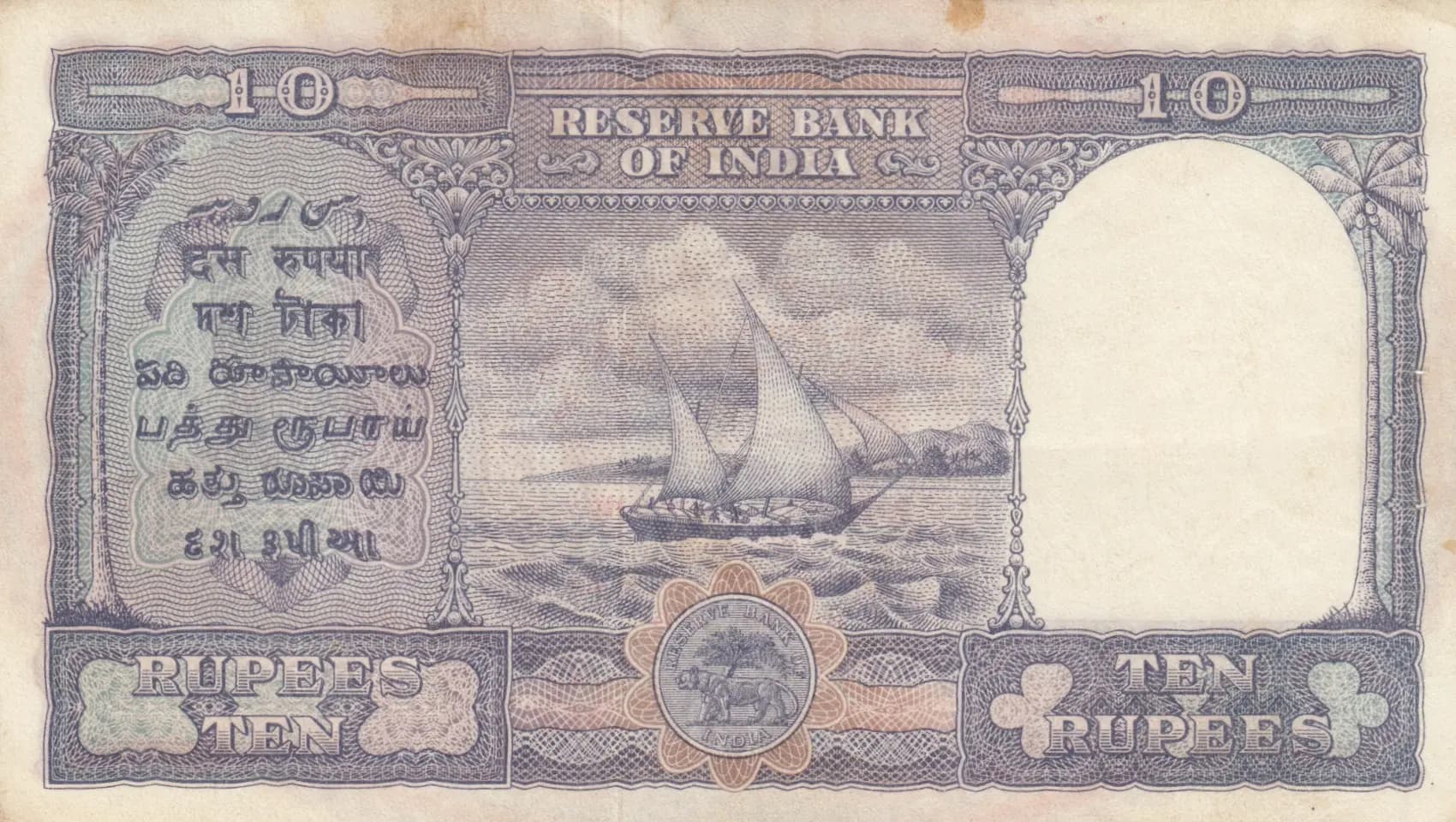
This is a 1947 Burma Currency Board 10 Rupees note (Pick-32) in VF condition, featuring King George VI in formal dress on the obverse and a detailed engraved dhow (sailing vessel) on the reverse. The note displays the characteristic purple-violet coloring with red overprint reading 'BURMA CURRENCY BOARD' and 'LEGAL TENDER IN BURMA ONLY,' indicating its status as an overprinted India note issued during the Military Administration of Burma period. The note shows expected signs of age and circulation with light staining and foxing, consistent with authentic historical currency from this transitional period.
Common. eBay market data shows consistent sales of VF examples in the $24-$48 range during 2013-2020, with catalog values listing VF at $200 (2016). The frequency of sales at modest prices, the straightforward overprinting method used (overprinting existing Indian currency plates rather than creating entirely new plates), and the 1947 issuance date during an active circulation period all indicate this is a commonly encountered note among collectors. While historically significant, it was produced in sufficient quantities to remain accessible to collectors.
This note represents a significant transitional moment in Burmese history, issued in 1947 when Burma was transitioning from British colonial rule and Indian currency dominion toward independence. The overprint 'BURMA CURRENCY BOARD' on an India Reserve Bank design reflects the political separation of Burma from India while maintaining temporary use of Indian currency infrastructure. The portrait of King George VI and the dhow sailing vessel symbolize the maritime heritage and Commonwealth connection during this brief but historically important period of Burmese monetary autonomy.
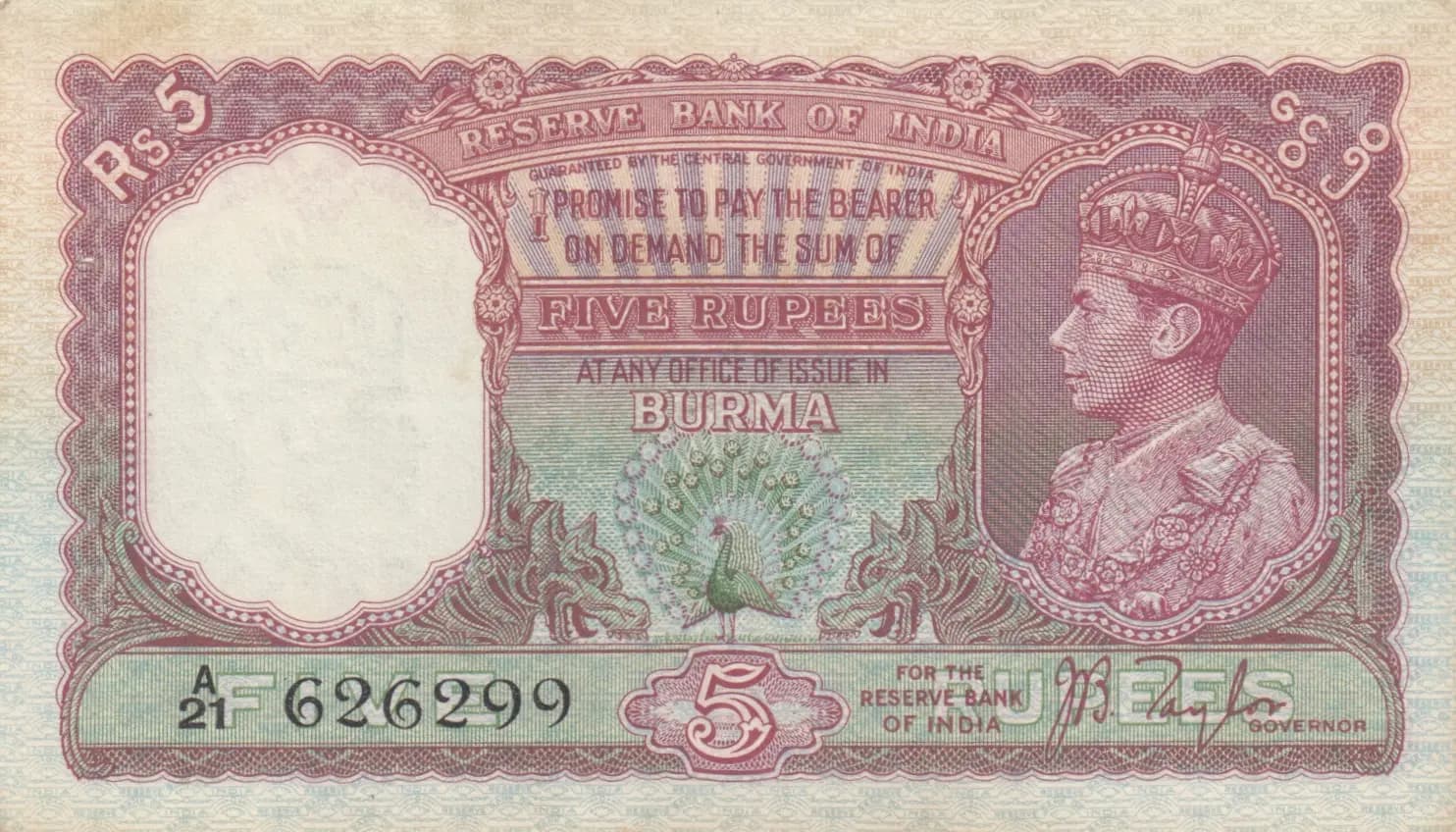
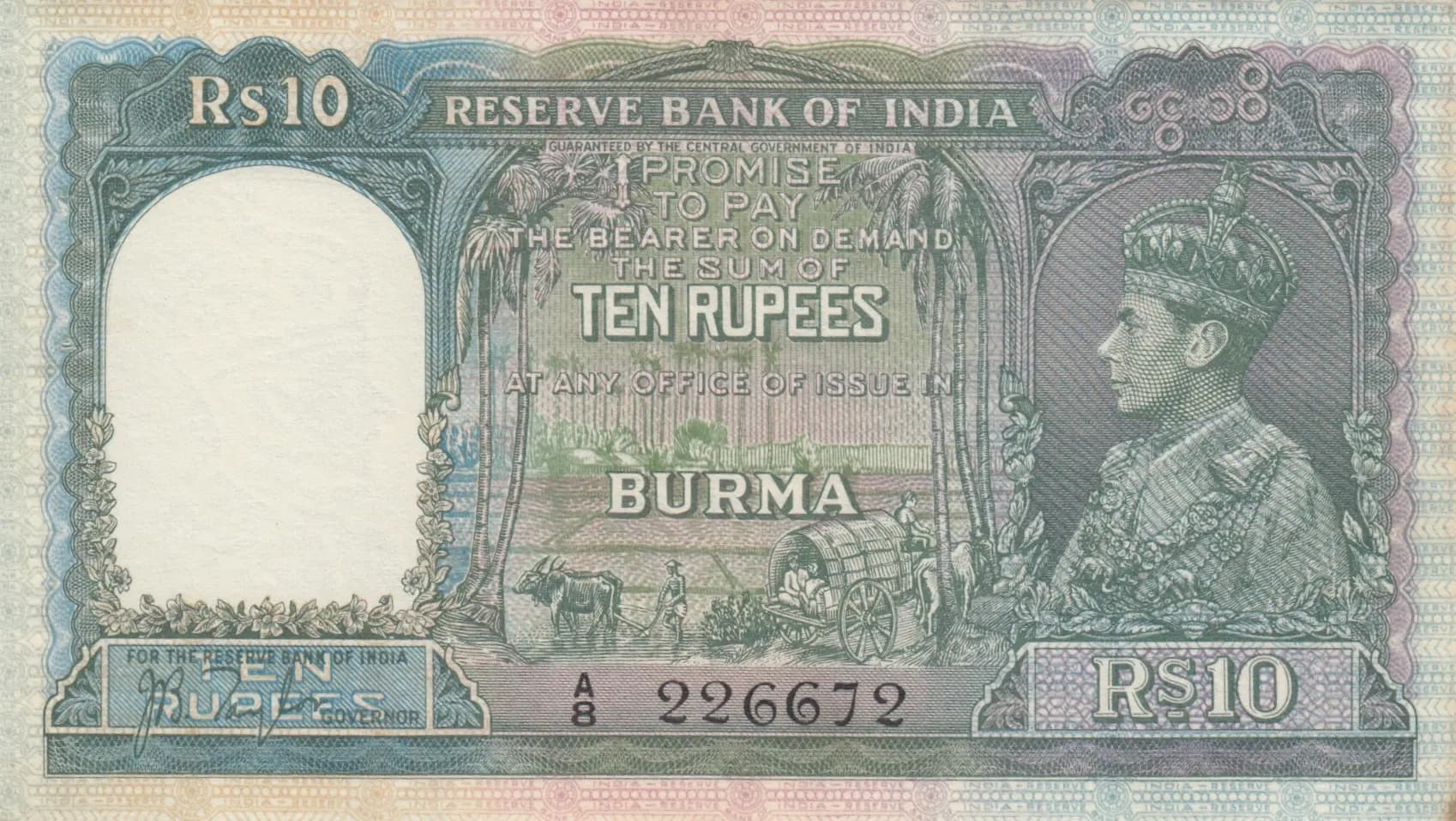
The obverse features a formal portrait of King George VI in profile wearing military formal dress with distinctive ceremonial headdress, positioned on the right side of an ornate engraved design. The left side contains a large oval frame, currently blank, which was typical of India Reserve Bank notes. The design is dominated by intricate geometric and floral border patterns in purple-violet ink with red overprint text. The reverse showcases a detailed engraved dhow (traditional sailing vessel with multiple sails) positioned centrally on open water, rendered in fine detail characteristic of high-quality banknote engraving. The bottom features a prominent circular emblem containing an elephant motif, symbolizing Indian/Commonwealth heritage. Both sides display the denomination '10' in ornamental circles in the top corners and include multilingual text reflecting the note's transitional use across Indian linguistic regions.
FRONT SIDE: 'RESERVE BANK OF INDIA' (top center); 'GUARANTEED BY THE CENTRAL GOVERNMENT'; 'I Promise to pay the bearer the sum of TEN RUPEES on demand at any office of issue'; 'BURMA CURRENCY BOARD' (red overprint); 'LEGAL TENDER IN BURMA ONLY' (red overprint); 'RUPEES'; Governor signature area marked 'GOVERNOR'; Serial number 'G 992623'; Denomination circles '10'. BACK SIDE: 'RESERVE BANK OF INDIA' (top center); 'RUPEES TEN' and 'TEN RUPEES' (English denominations); Devanagari script 'दश रूपये' (Ten rupees); Kannada script 'ಹತ್ತು ರೂಪಾಯಿ' (Ten rupees); Telugu script 'పద్ధతి రూపాయి' (Ten rupees); Malayalam script 'പത്ത് രൂപ' (Ten rupees); Circular seal with elephant motif and surrounding inscriptions; Denomination circles '10' in top corners.
Intaglio (engraved) printing on watermarked paper, a standard security printing method for Reserve Bank of India notes of this period. The fine line work, detailed shading in the sailing vessel illustration, intricate border patterns, and the crisp rendering of the portrait of King George VI are all characteristic of high-quality intaglio engraving. The red overprint 'BURMA CURRENCY BOARD' and 'LEGAL TENDER IN BURMA ONLY' was applied as a secondary printing process to an existing India Reserve Bank plate (India Pick-24), a cost-effective approach for the Military Administration of Burma's brief currency period.
This note is an overprinted variety of India Reserve Bank Note Pick-24 (10 Rupees). The specific variety is identified by the red overprint reading 'BURMA CURRENCY BOARD' and 'LEGAL TENDER IN BURMA ONLY.' Serial number prefix 'G' with number '992623' suggests this is from a specific printing batch. The note lacks Burma-specific security features beyond the overprint, as it was produced by overprinting existing India currency plates rather than commissioning new plates. Other varieties may exist with different serial number prefixes or slight variations in overprint positioning, though the catalog (Pick-32) treats these as a single issue type.