10 rupees 1942
Market Prices
14 salesAbout This Note
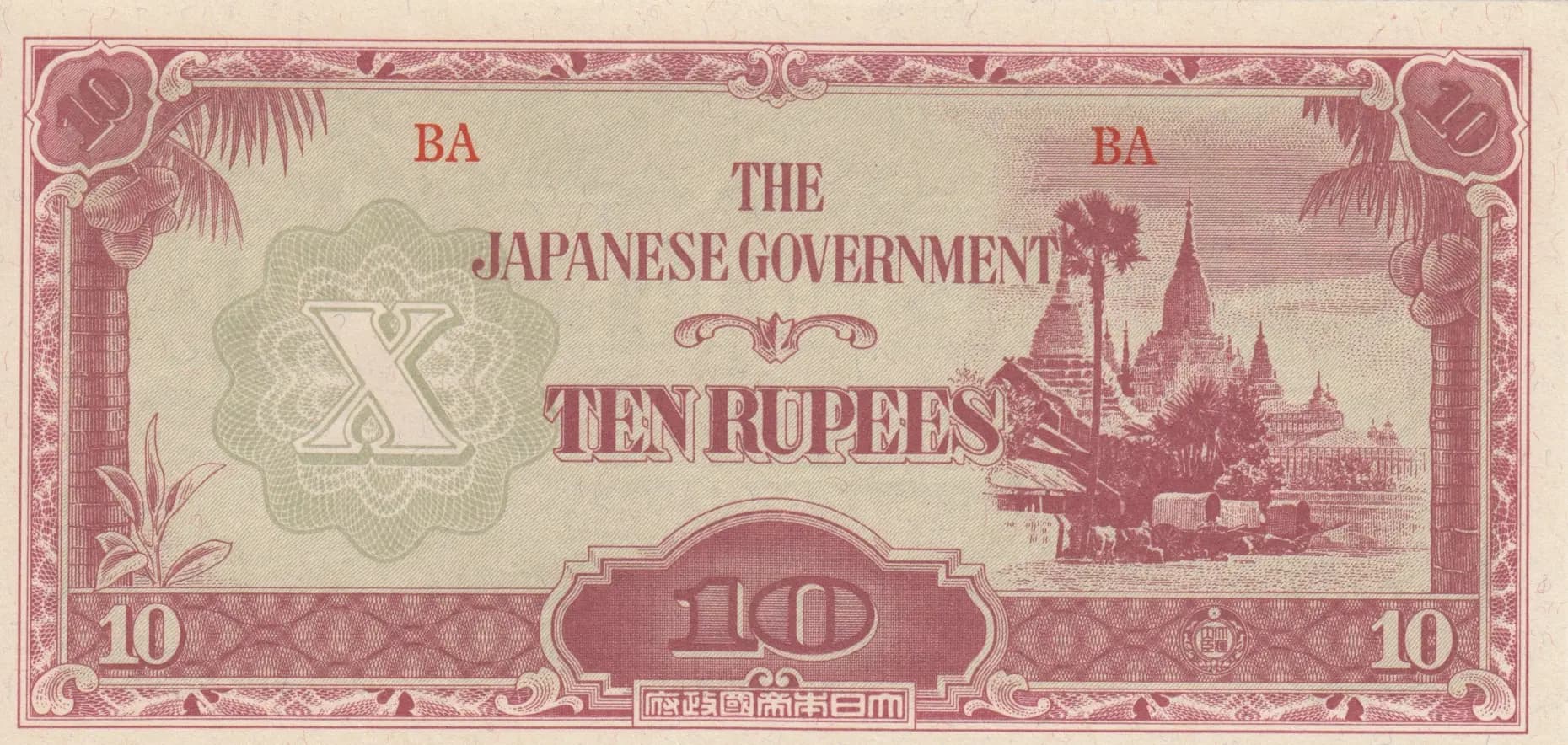
This is a 1942 Japanese Government issue 10 Rupees banknote from Burma (Pick-16a), presented in uncirculated condition. The note features an exceptional mauve and rose color scheme with the iconic Ananda Temple of Pagan rendered on the front right side, complemented by ornate baroque-style decorative elements and fine engraving throughout. The UNC grade combined with the pristine condition observed—no tears, stains, or creases—and the rich color preservation make this an excellent example of Japanese occupation currency from Burma.
Common. The eBay market price data provided shows consistent sales ranging from under $1 to approximately $33 for higher grades (PMG 66), with the 2016 catalog value for UNC listed at only $3. Despite the historical significance of Japanese occupation currency, the production run for Burma rupee notes was substantial, and these notes remain readily available in the market. The frequency of sales at modest prices indicates steady collector availability rather than scarcity.
This note was issued by the Japanese Government during its occupation of Burma (1942-1944), a period when Japan issued its own currency across occupied territories in Southeast Asia. The Ananda Temple depicted on the obverse is one of Burma's most significant Buddhist monuments located in Pagan (modern-day Bagan), reflecting Japan's attempt to legitimize their rule by incorporating locally recognizable cultural landmarks. The English-language inscriptions and rupee denomination represent Japan's effort to maintain economic continuity in the occupied territory while asserting control through their own governmental authority.
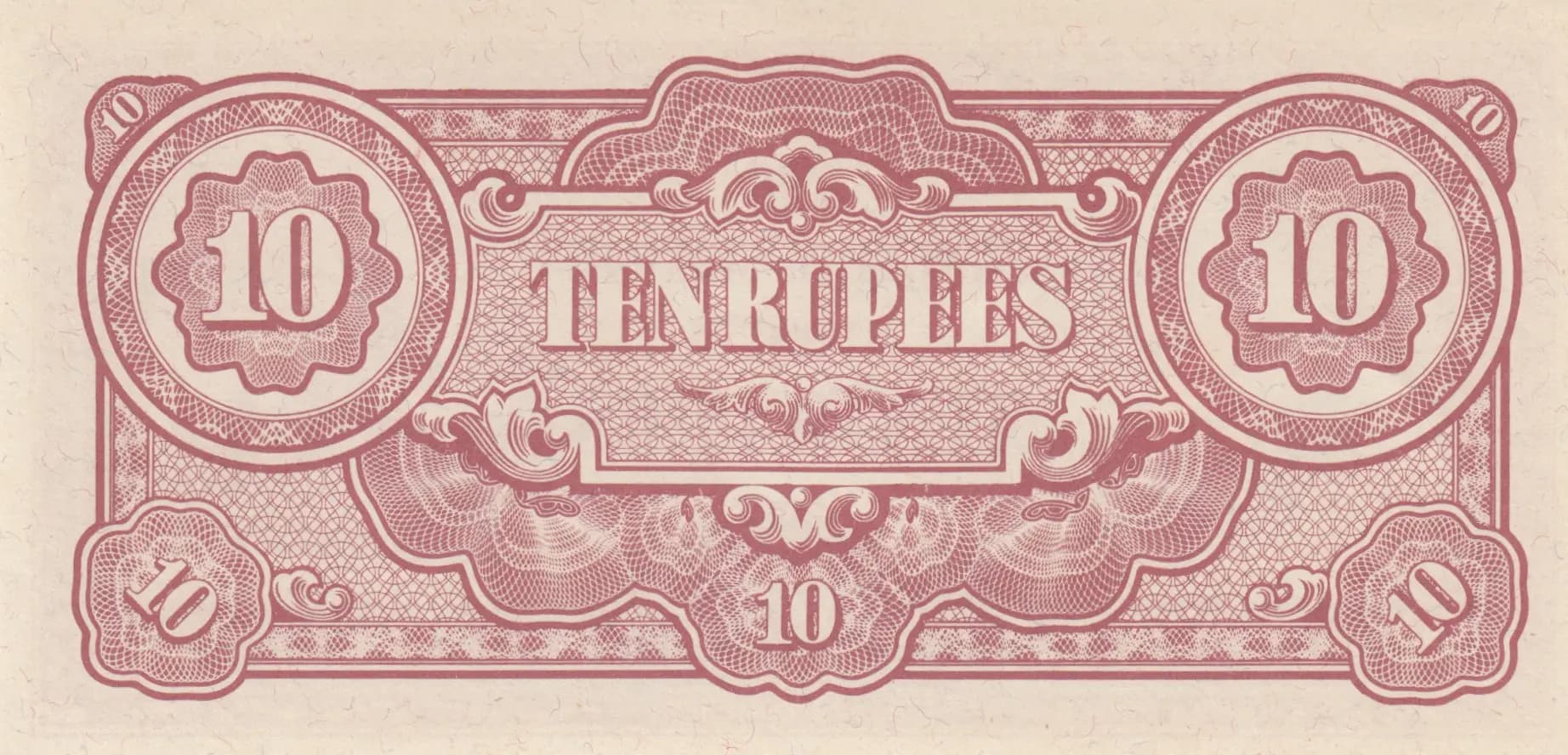
The obverse (front) features an elaborate ornamental design centered around a large decorative 'X' in a rosette cartouche on the left side, with the Ananda Temple—a multi-spired Buddhist temple structure with pointed pagoda-style peaks—depicted on the right alongside a palm tree and tropical vegetation. The reverse (back) adopts a strictly symmetrical, heraldic design with the denomination 'TEN RUPEES' prominently displayed in the center, flanked by two large rosette medallions containing the numeral '10', with additional corner cartouches containing denomination numerals. Both sides employ fine baroque-inspired scrollwork and geometric border patterns consistent with 1940s security printing standards.
Front side: 'THE JAPANESE GOVERNMENT' (top center), 'TEN RUPEES' (center and lower denominations), '10' (corner cartouches), 'BA' (upper left and right, indicating block letter variety), and Japanese characters '昭和國國日本' (reading right to left, indicating the issuing period of the Japanese Government). Back side: 'TEN RUPEES' (center), '10' (multiple rosette cartouches at top, middle, and lower corners). All inscriptions are printed in mauve/rose ink on the cream-colored paper.
Intaglio (engraved) printing on cream-colored paper, utilizing fine line engraving with detailed crosshatching for borders and decorative elements. The consistent quality of the fine line work, complex geometric patterns, and multi-color registration (mauve and rose inks) indicate professional security printing, likely produced by a major Japanese Government printing facility. The watermark area visible in the rosette design and the 'BA' block letter designation suggest quality control measures typical of official currency production.
This note is identified as Pick-16a, with the 'BA' block letters visible in the upper corners being a key variety identifier. The block letters appear in red text and measure 8mm wide according to catalog references. The date range for this series is listed as ND (1942-1944), with 1942 being the likely issue year. No significant serial number variations, overprints, or signature varieties are evident from the visual analysis, suggesting this represents the standard regular issue type for this denomination.