1/4 rupee 1942
Market Prices
6 salesAbout This Note
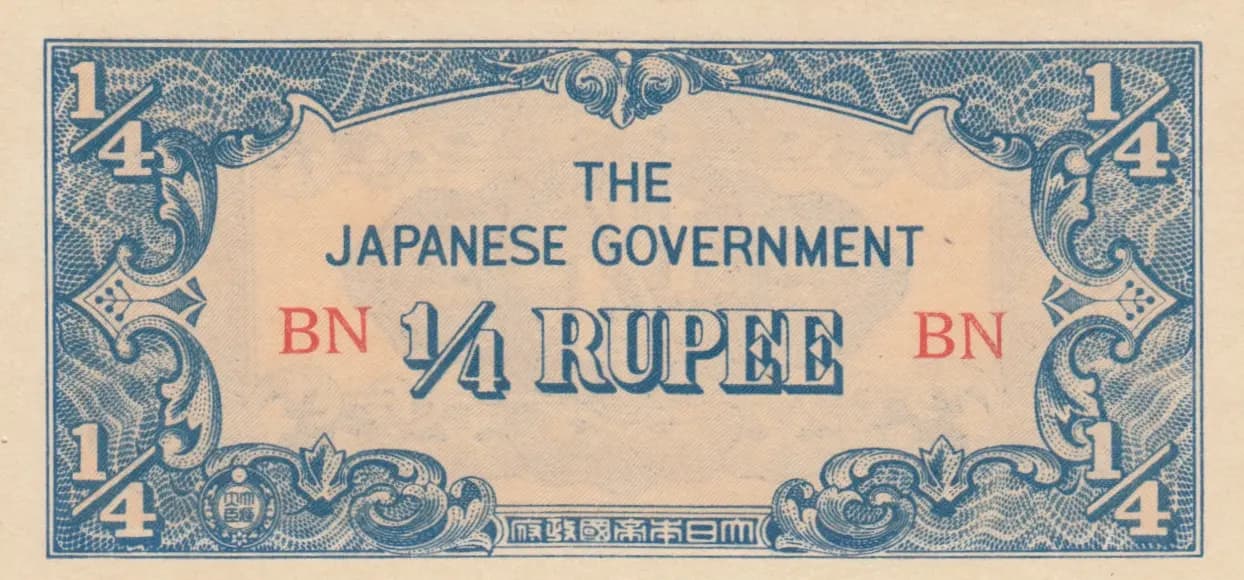
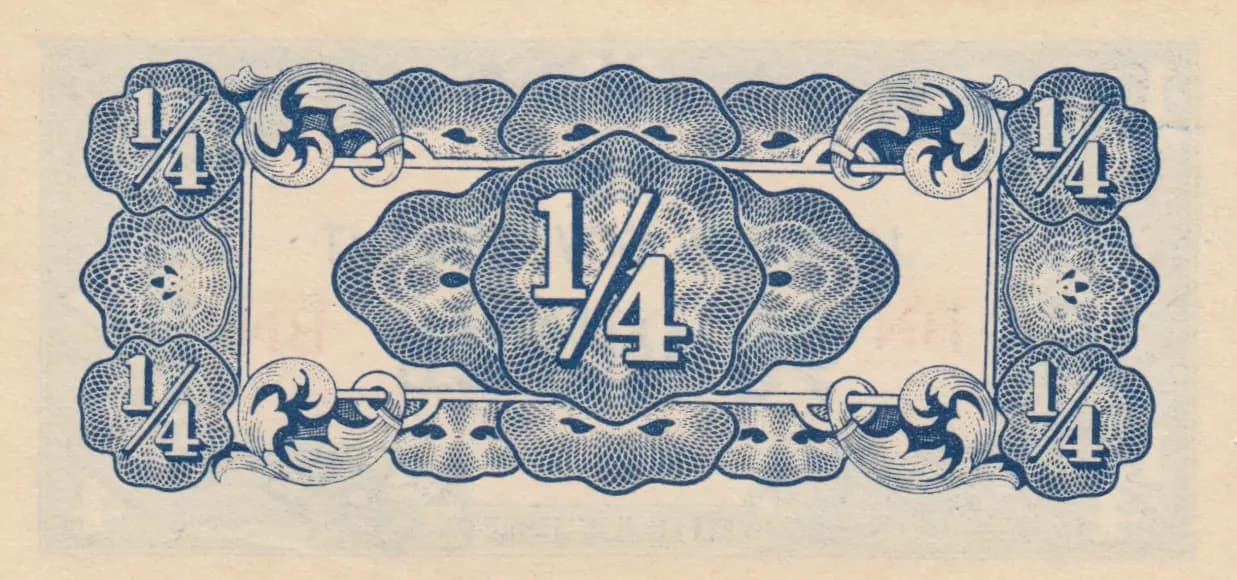
This is a Japanese Government 1/4 Rupee note from Burma (1942), Pick P-12, in uncirculated condition. The note features elegant blue ornamental borders with intricate scrollwork and floral patterns on both sides, maintaining a pristine cream/beige background with no visible wear, creases, or tears. The design exemplifies the high-quality engraving standards of Japanese occupation currency, with symmetrical corner denominations and a prominent scalloped medallion frame on the reverse.
Common. eBay market data shows consistent sales in the $1-$7.51 range across multiple condition grades (F through PMG 64) over a 3-year period (2020-2023), with catalog values listing UNC examples at $1. The regular, sustained market activity with multiple sales and modest pricing indicates robust supply. This denomination was part of a standard series of Japanese occupation currency issued in large quantities during the 1942-1945 occupation period.
This note was issued by the Japanese Government during its occupation of Burma in 1942, representing the military administration's attempt to establish economic control through localized currency. The formal English inscriptions ('THE JAPANESE GOVERNMENT' and '1/4 RUPEE') reflect Japan's effort to maintain administrative legitimacy while replacing the previous British Indian rupee currency system. The ornate, classical design aesthetic was deliberately chosen to project authority and stability during a period of significant geopolitical upheaval in Southeast Asia.
The note presents a classical, highly symmetrical design typical of Japanese occupation currency. The front features 'THE JAPANESE GOVERNMENT' as the primary inscription with the denomination '1/4 RUPEE' clearly marked in all four corners. Both sides employ identical color schemes of blue printed elements on cream/beige paper. The primary decorative elements include ornate corner scrollwork with acanthus-leaf motifs, geometric lattice patterns in the border background, and fine floral/botanical elements. The back features a dominant ornate scalloped (shell-shaped) medallion frame housing the denomination, surrounded by elaborate flourishes and symmetrical ornamental dividing lines. A circular seal or emblem appears at the bottom center of the front, along with Japanese character marks or seals, indicating official government authorization. The overall composition reflects high-quality line engraving with careful attention to anti-counterfeiting design principles.
Front side: 'THE JAPANESE GOVERNMENT' (English) — identifying the issuing authority; '1/4 RUPEE' (English) — denomination marking; 'BN' (English) — serial number prefix appearing twice. Back side: '1/4' (English) — denomination clearly displayed within the central medallion. No translations required as all inscriptions are in English.
Intaglio/line engraving, characteristic of Japanese occupation currency production. The fine detail work, consistent line weights, and intricate ornamental patterns indicate professional security printer work. Based on the Pick catalog attribution and the nature of Japanese Government Burma notes, this was likely produced by the Japanese Imperial Mint or an authorized security printer under military administration, employing traditional engraved steel plates for the blue-on-cream color scheme.
Serial number prefix 'BN' is observed on this example. Japanese occupation Burma notes exist with various serial number prefixes and blocks. The Pick P-12 designation corresponds to the standard 1/4 Rupee issue. No overprints or significant date variations are noted on this piece, consistent with the ND (No Date) 1942 designation in the reference catalogs. The condition grade UNC and the pristine state of preservation represent the finest available examples of this common variety.