1/2 rupee 1942
Market Prices
13 salesAbout This Note
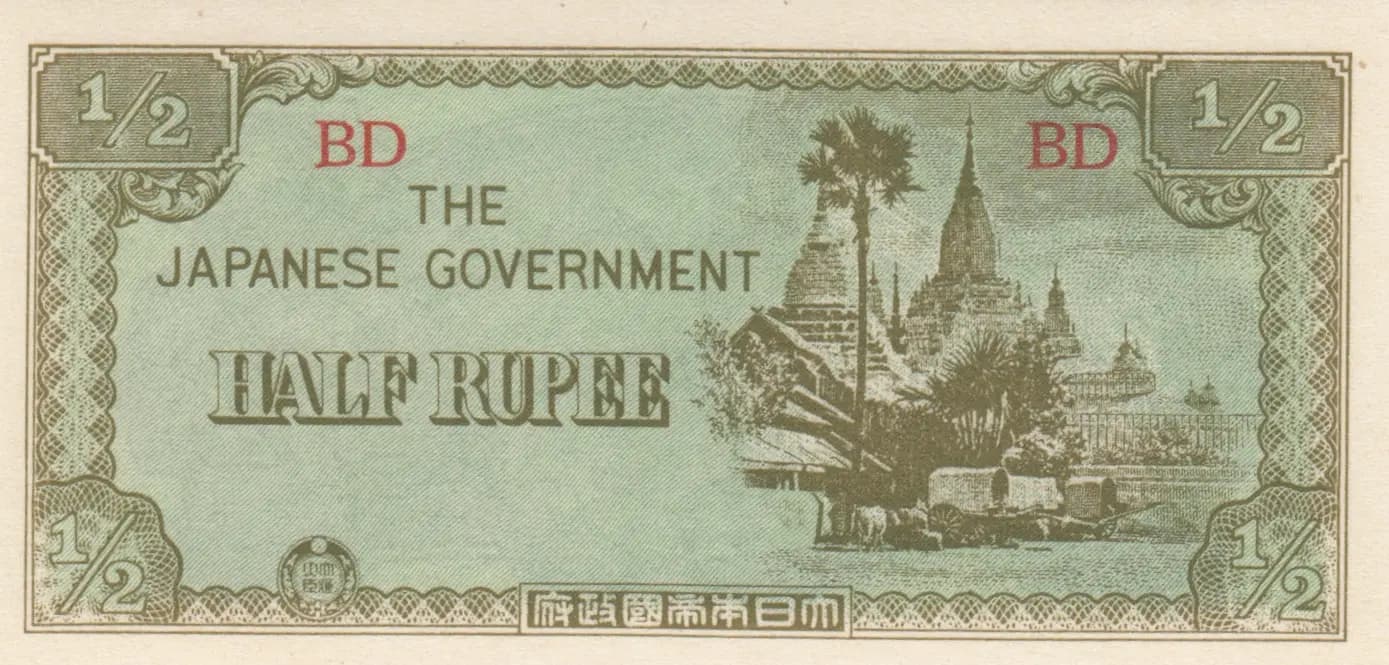
This 1/2 Rupee note from 1942 represents a fascinating artifact of Japanese occupation currency issued for Burma during World War II. The obverse features a beautifully engraved depiction of the Ananda Temple in Pagan, one of Burma's most iconic architectural landmarks, rendered in pale green tones with intricate ornamental borders. The note is presented in uncirculated condition with crisp printing, sharp detail preservation, and no visible signs of handling or wear, making it a desirable specimen for collectors of Japanese military currency and Southeast Asian numismatics.
Common. The eBay price history provided demonstrates consistent market values in the $1-3 range for circulated examples and under $7 for raw UNC specimens, with only certified high-grade examples (PMG 64-65) reaching $12-16. These price points, combined with the apparently steady supply of examples on the secondary market across multiple condition grades and years, indicate this is a regularly available note. Japanese occupation currency for Burma was issued in substantial quantities during 1942-1945, and the 1/2 Rupee denomination appears to have been produced in higher volumes than some other denominations in the series. The 2016 catalog value of $0.75 for UNC condition further confirms this as a common issue within its category.
This banknote was issued by the Japanese Government during their occupation and administration of Burma in 1942, following the invasion of Southeast Asia in World War II. The choice to feature the Ananda Temple—a 12th-century Buddhist temple complex in Pagan (Bagan)—on the obverse reflects Japanese efforts to create occupation currency that acknowledged local cultural heritage while establishing economic control. The denomination in both English and Japanese, combined with the deliberate selection of this sacred architectural landmark, illustrates the complex relationship between Japanese imperial administration and the occupied Burmese territory.
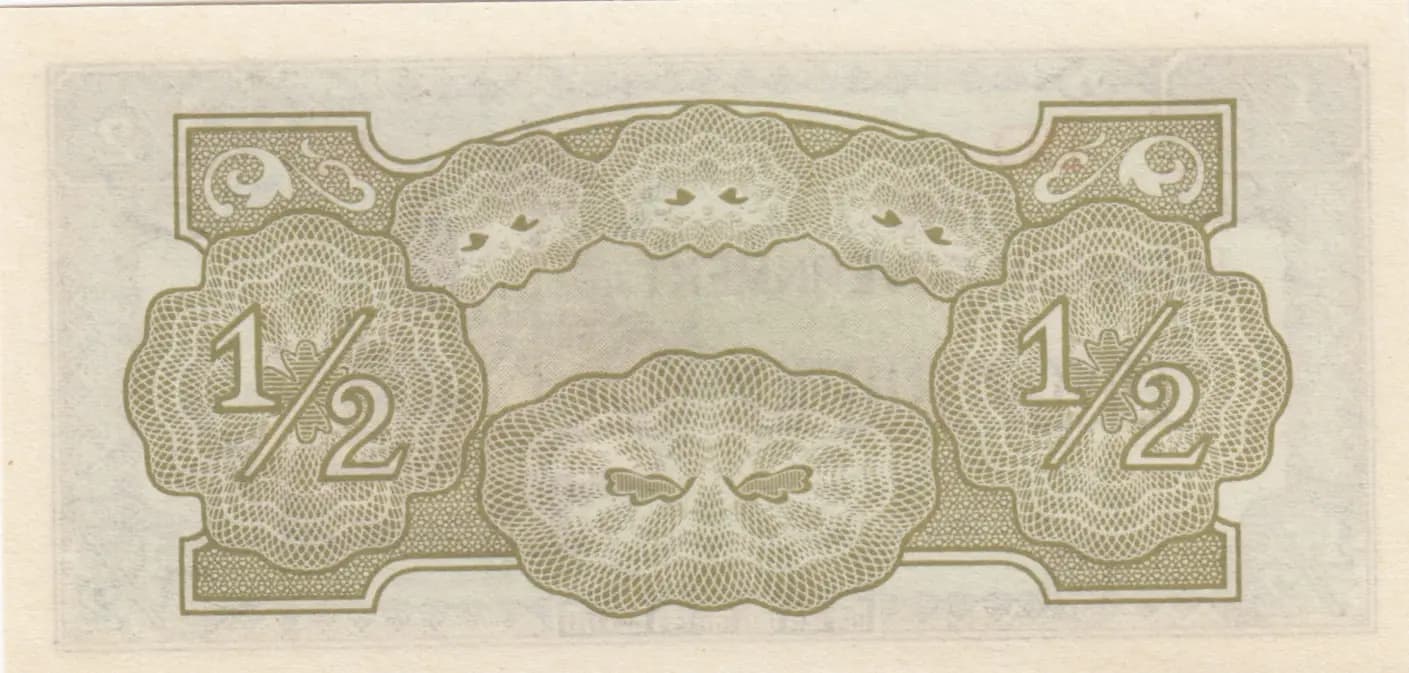
The obverse features the Ananda Temple complex of Pagan (Bagan), Burma's most significant Buddhist architectural monument, depicted with characteristic twin spires and ornate temple structures in the central engraved vignette. The temple is shown with surrounding palm trees and a water feature in the foreground, creating a picturesque representation of Burmese cultural iconography. Ornamental guilloche borders frame all edges with intricate corner cartouches in the Art Deco/early 20th-century style typical of Japanese occupation currency design. The reverse is minimalist in comparison, featuring symmetrical decorative corner ornaments and a central blank cartouche, focusing entirely on geometric and floral filigree patterns. The color palette of pale sage green with olive-brown accents and cream undertones is consistent across both sides, typical of the Japanese Government's Burma rupee series.
Front: '1/2' (English numerals, upper left and right corners indicating denomination); 'BD' (abbreviation for Burma/British Burma); 'THE JAPANESE GOVERNMENT' (English text identifying issuer); 'HALF RUPEE' (English denomination spelling). Japanese characters present (明治日本国南南円 or similar) relating to Japanese government designation. A circular seal with Japanese characters appears in the lower left area. Back: '1/2' (English numerals repeated in upper corners within ornamental frames). The reverse contains primarily decorative ornamental elements with no substantive text inscriptions.
Intaglio (engraved) printing, evidenced by the fine line work, crisp detail reproduction, and the characteristic raised texture of ornamental guilloche patterns and filigree designs visible throughout both sides. The precision of the central temple vignette, the intricate corner cartouches, and the security-oriented decorative borders indicate professional security printing. Japanese occupation currency of this period was typically produced by the Imperial Japanese Government Printing Bureau or contracted security printers; specific attribution would require examination of minute printing characteristics or archival records specific to the P-13b variety.
Pick catalog P-13b designation indicates this is specifically the 'b' variety of the 1/2 Rupee from 1942. Without serial number visibility or other distinguishing characteristics clearly documented in the visual analysis, specific variety differentiation cannot be precisely determined from the images alone. However, P-13b typically represents a known sub-variety within the Japanese Government's Burma rupee series, potentially distinguished by signature varieties, serial number prefixes, or minor design details. Collectors of this series should note that Japanese Burma currency exists in multiple cataloged varieties; verification of the specific 'b' variety designation would benefit from cross-reference with the exact serial number range and any signature variants present on the note.