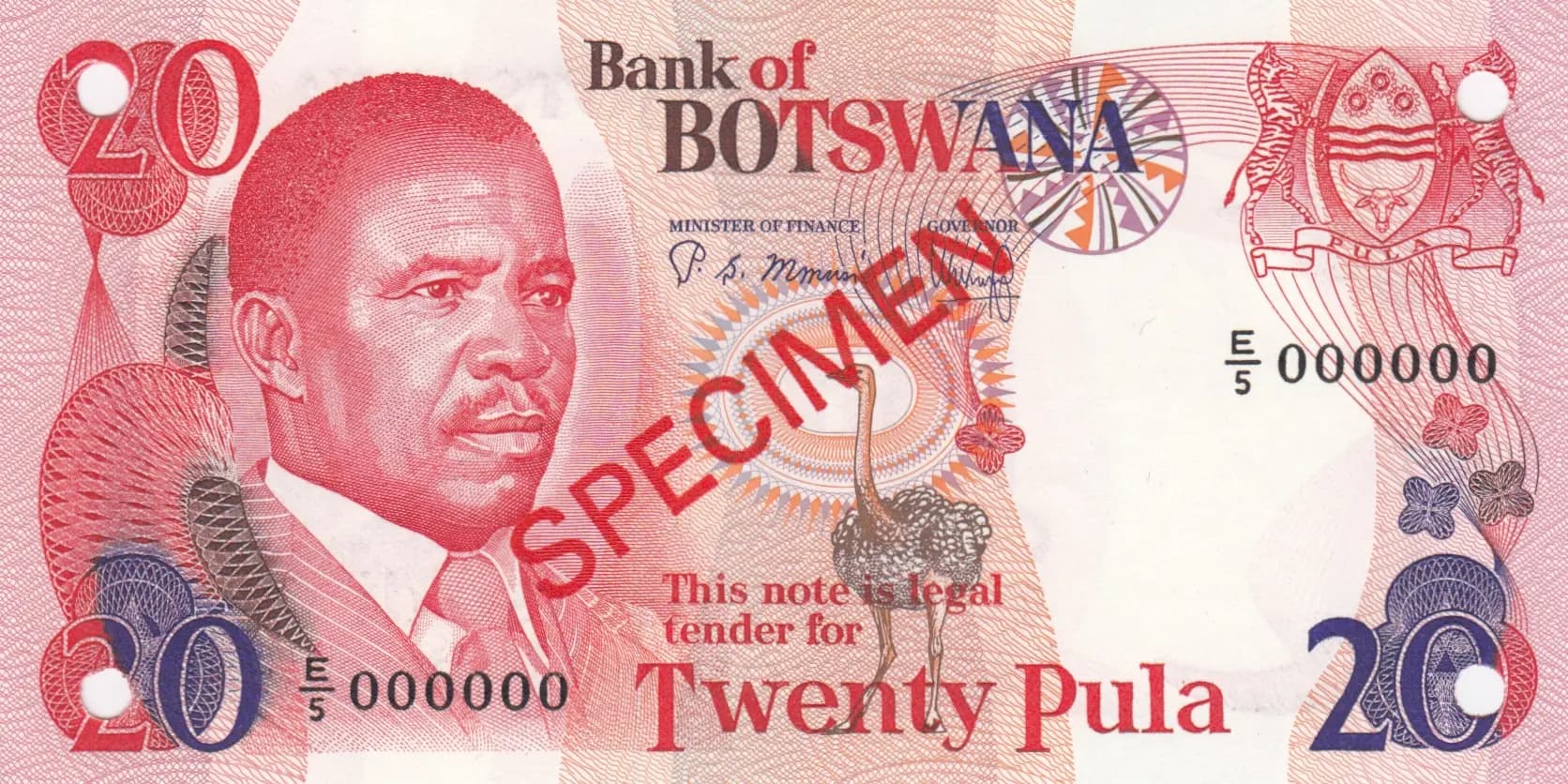
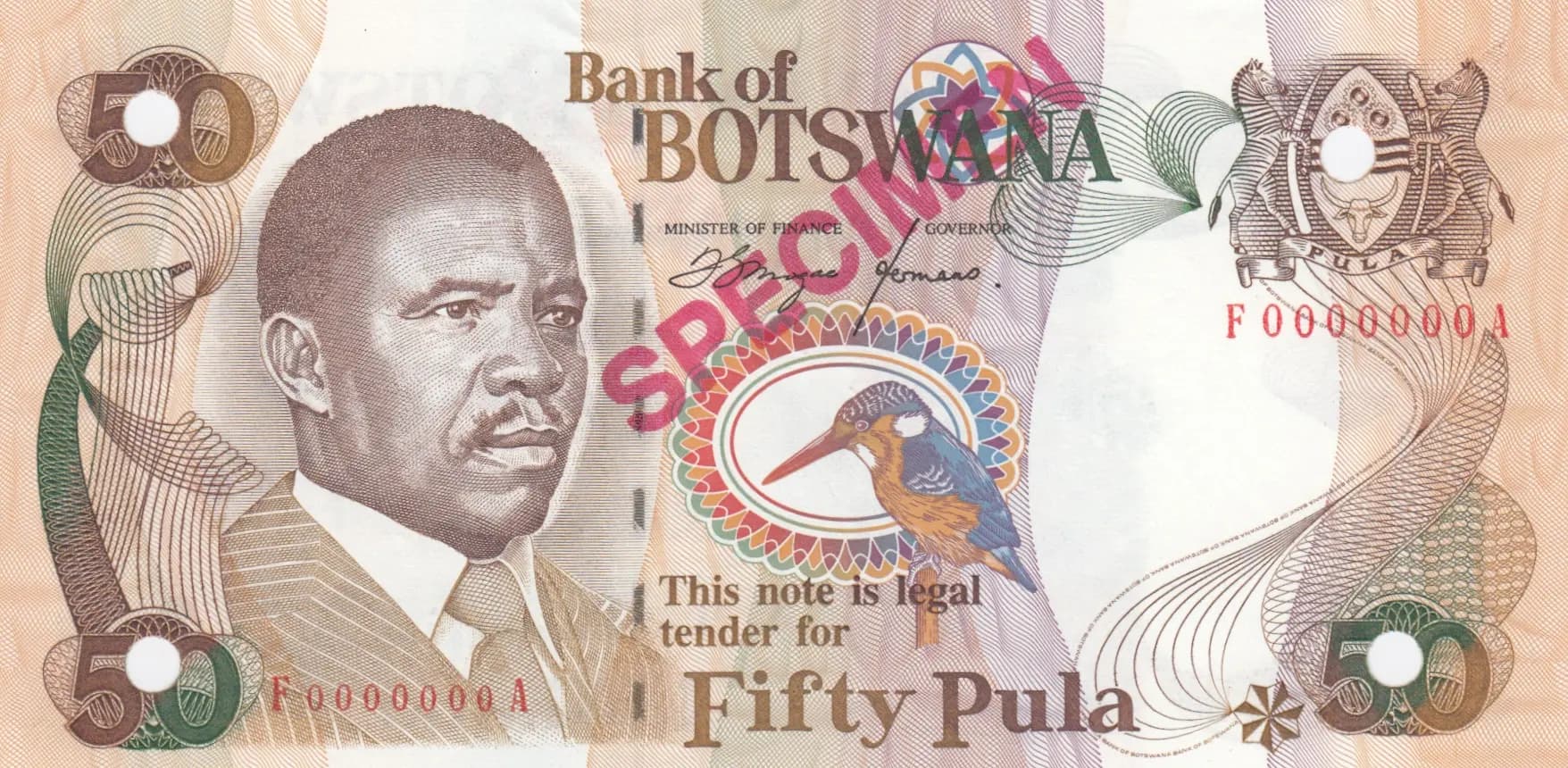
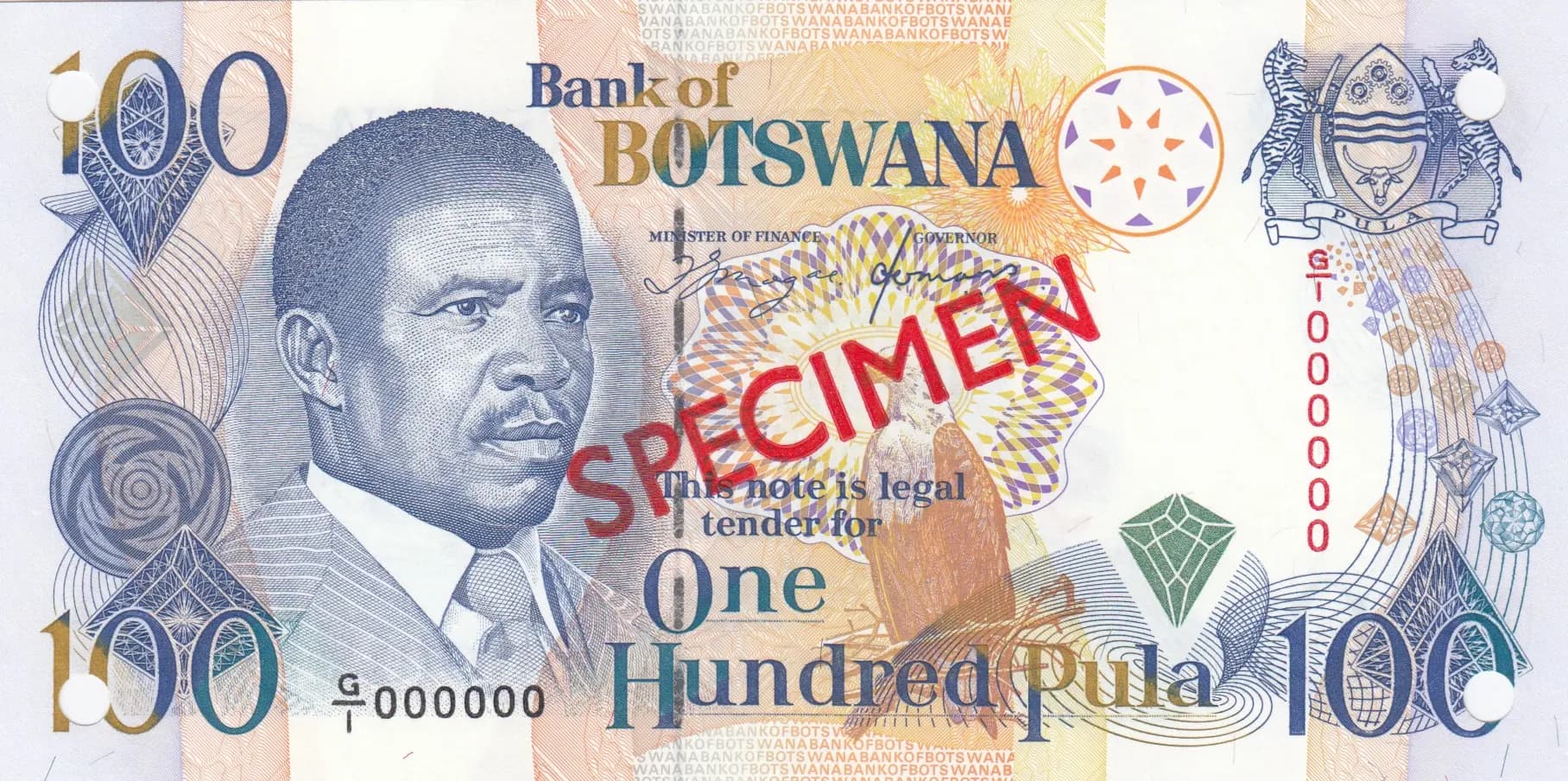
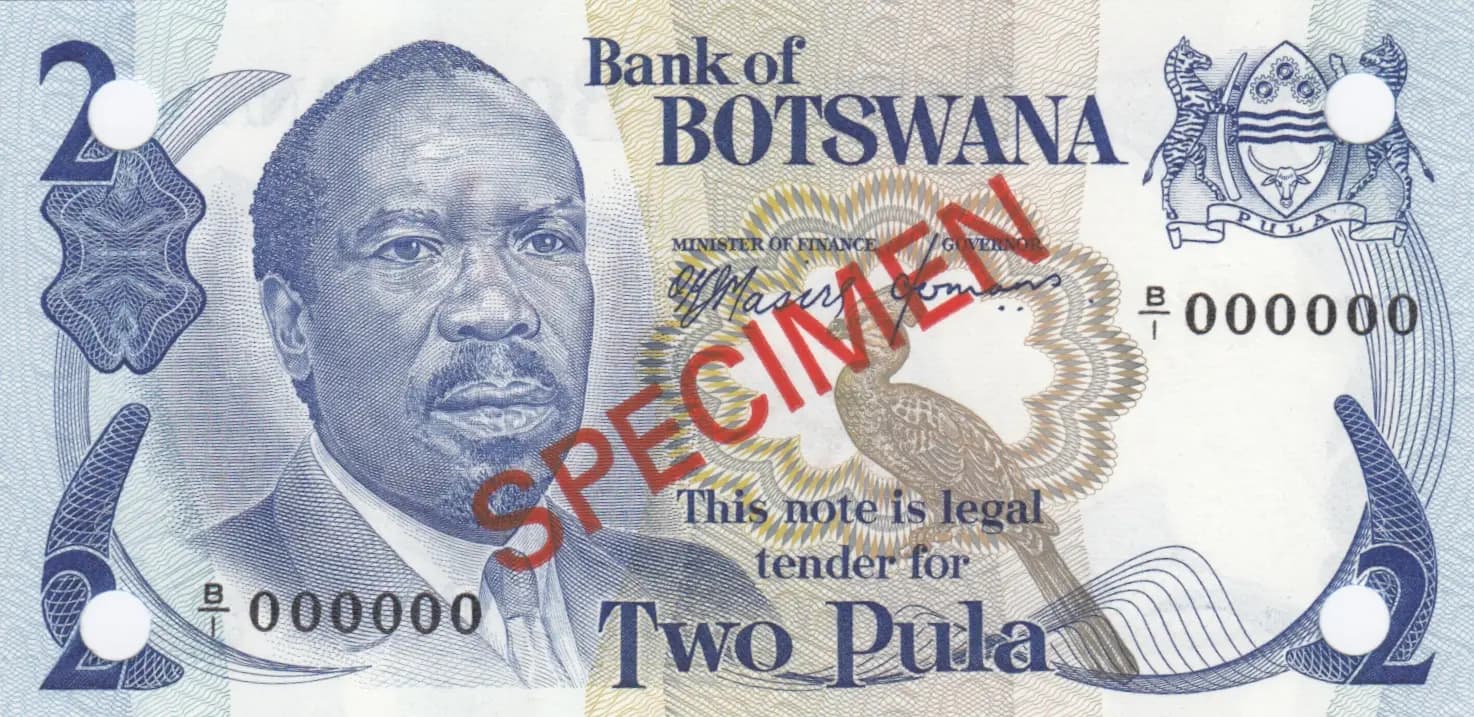
1 pula 1976 specimen
Market Prices
1 saleAbout This Note
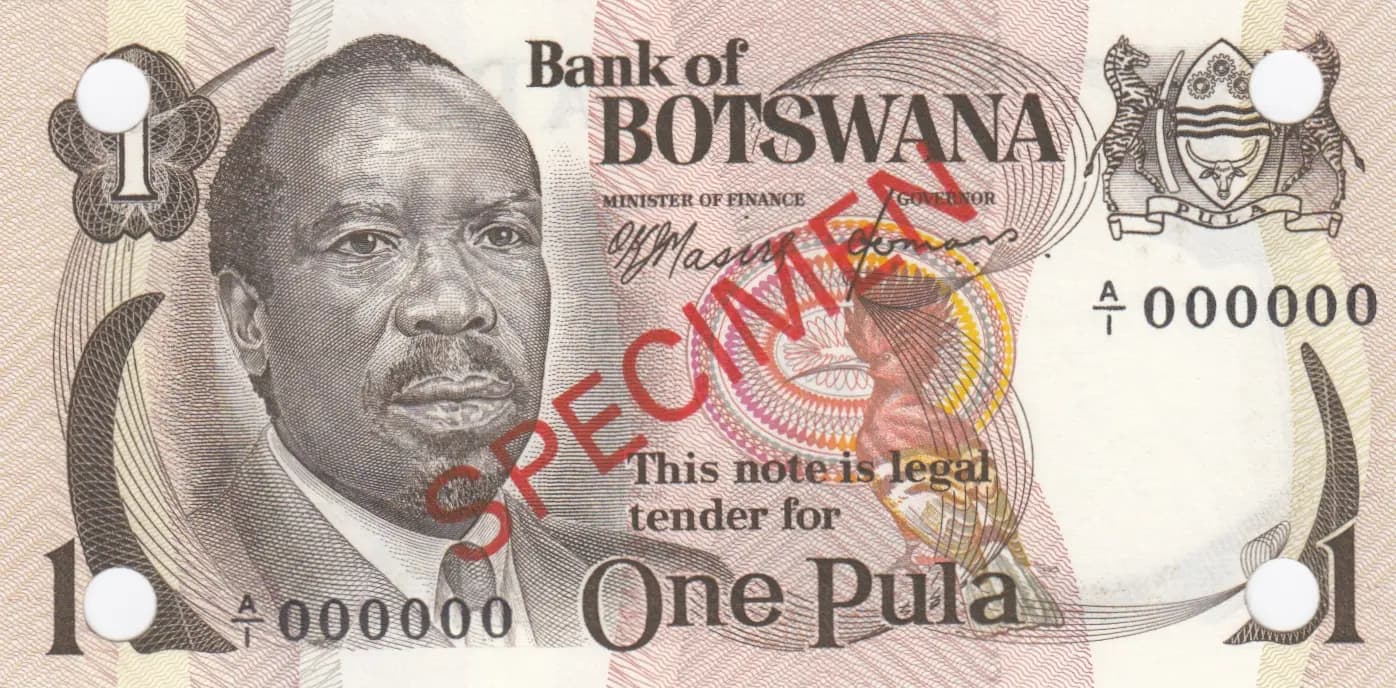
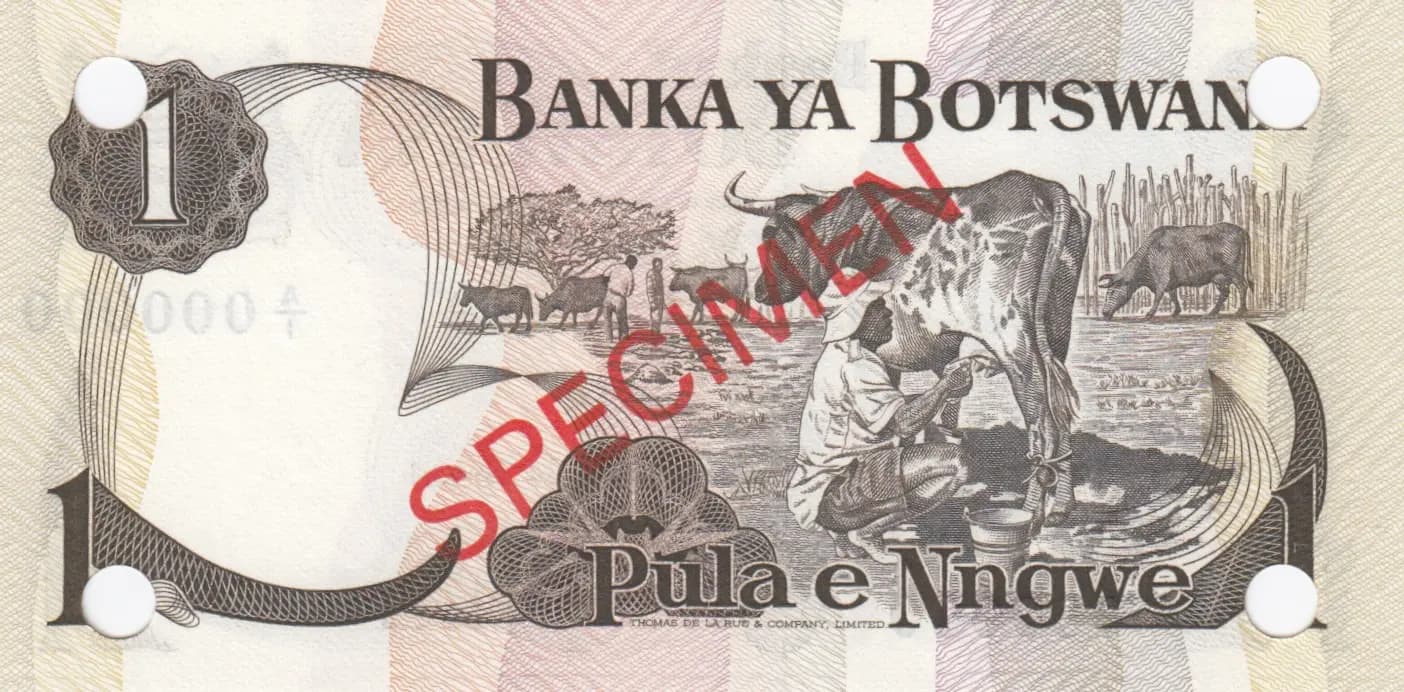
This is an exceptional 1976 specimen note from the inaugural series of Botswana's Bank of Botswana, graded UNC and printed by Thomas de la Rue. The front features a formal portrait of President Sir Seretse Khama in black engraving, while the reverse depicts a rural agricultural scene with cattle herding and farming activities, reflecting the nation's pastoral heritage. As a specimen note with serial prefix A/1 and diagonal 'SPECIMEN' overprint, this piece represents an important artifact from Botswana's early independence period and remains highly sought by collectors of African currency and political portraiture.
Common. This is a specimen note from the inaugural 1 Pula series (P-1s), which was produced in typical specimen quantities by Thomas de la Rue for distribution to banks, governments, and the numismatic trade. The eBay sold price of $19.99 in 2022 confirms common market status, despite the 2019 catalog valuation of $95 (specimen notes often command premiums in specialized catalogs but trade below these values in practice). Specimen notes from Botswana's first series remain readily available to collectors, and UNC examples are not scarce.
Issued in 1976, this 1 Pula note commemorates President Sir Seretse Khama, the founding leader of independent Botswana, whose formal portrait dominates the obverse. The reverse's emphasis on cattle herding and agricultural labor reflects the economic foundation of post-colonial Botswana, where pastoralism remained central to national identity and subsistence. The bilingual design—featuring both English ('Bank of Botswana') and Setswana ('Banka ya Botswana', 'Pula e Nngwe')—underscores the young nation's commitment to cultural preservation alongside modernization.
The obverse features a formal engraved portrait of Sir Seretse Khama positioned on the left, depicted as a middle-aged man with distinctive mustache wearing formal collar and suit jacket. The Bank of Botswana emblem appears on the left side with the national coat of arms on the right, featuring Botswana's heraldic shield with geometric patterns and distinctive crest. Ornamental circular designs frame the corners (top left and bottom left), with decorative floral and geometric motifs in the top right. The reverse presents a comprehensive pastoral scene depicting rural Botswanan life: workers engaged in cattle herding and agricultural labor, with grazing cattle, crops/grain vegetation, and a water body or wetland landscape. Decorative numerals '1' appear in ornamental frames on both sides, with a curved serpent or design element along the bottom left and corner floral borders. The color palette of brown on multicolored underprint (black, beige/cream, pink/mauve) creates visual depth throughout.
Front side: 'Bank of BOTSWANA' (English), 'MINISTER OF FINANCE' (English), 'GOVERNOR' (English), 'This note is legal tender for' (English), 'One Pula' (English), 'SPECIMEN' (English overprint), Serial number 'A 000000' (appears twice). Back side: 'BANKA YA BOTSWANA' (Setswana: 'Bank of Botswana'), 'Pula e Nngwe' (Setswana: 'One Pula'), 'SPECIMEN' (English overprint), 'THOMAS DE LA RUE & COMPANY, LIMITED' (English printer attribution).
Intaglio engraving (line engraving) executed by Thomas de la Rue & Company, Limited, London—the premier British security printer of the era. The detailed portrait work, fine line engraving, intricate cross-hatching, and complex geometric patterns are characteristic of TDLR's high-security banknote production. Watermark security features are present, with a rearing zebra watermark specified for this series. The specimen overprint in red is applied as a separate security measure to distinguish non-circulating examples.
This note is identified as Pick P-1s (the 's' designation indicating specimen status). The serial number prefix 'A/1' with all zeros (A 000000) is standard for specimen notes. PMG population data indicates multiple varieties exist for the base P-1 denomination (P-1a regular issue, P-1a* with asterisk, P-1aCS1 color shifted variety, and P-1s specimen), but the specimen variant (P-1s) is a discrete cataloged variety printed by TDLR specifically for non-circulating distribution.