100 peso bolivanos 1962
Market Prices
About This Note
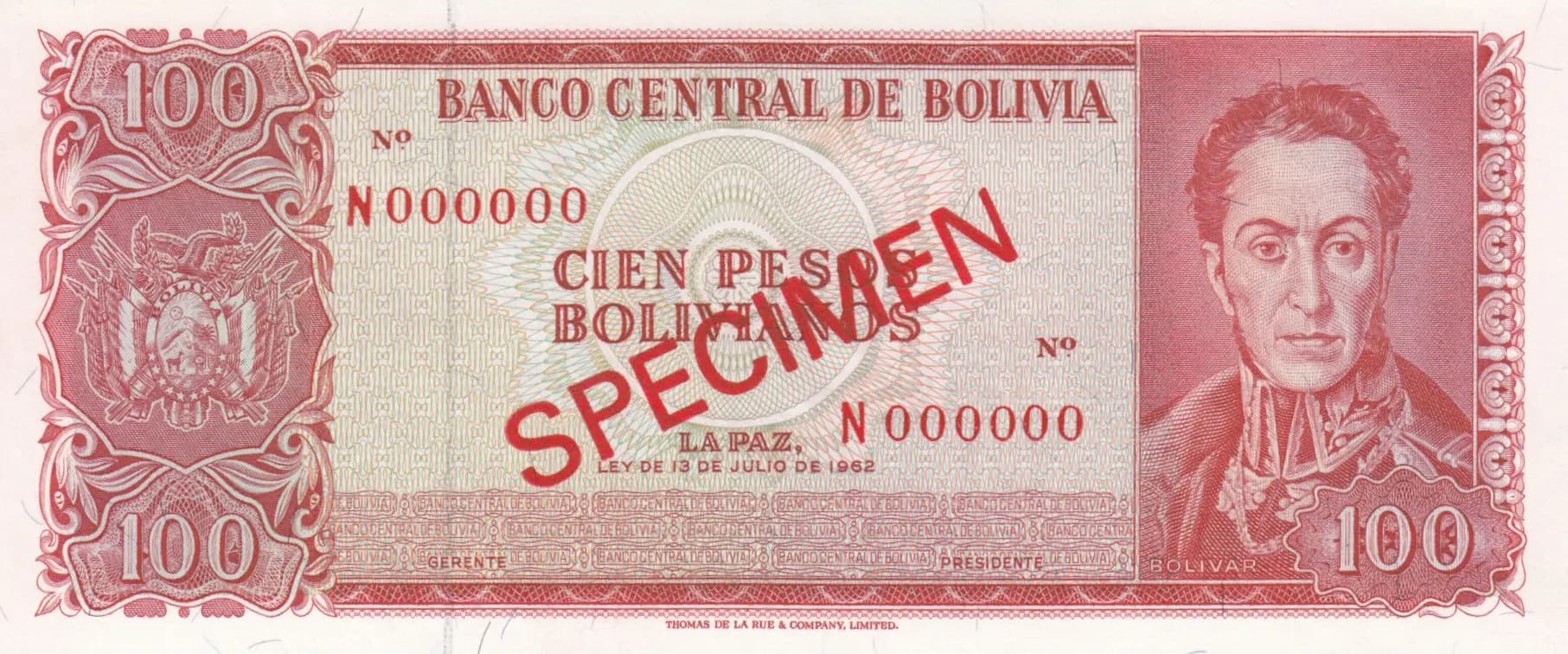
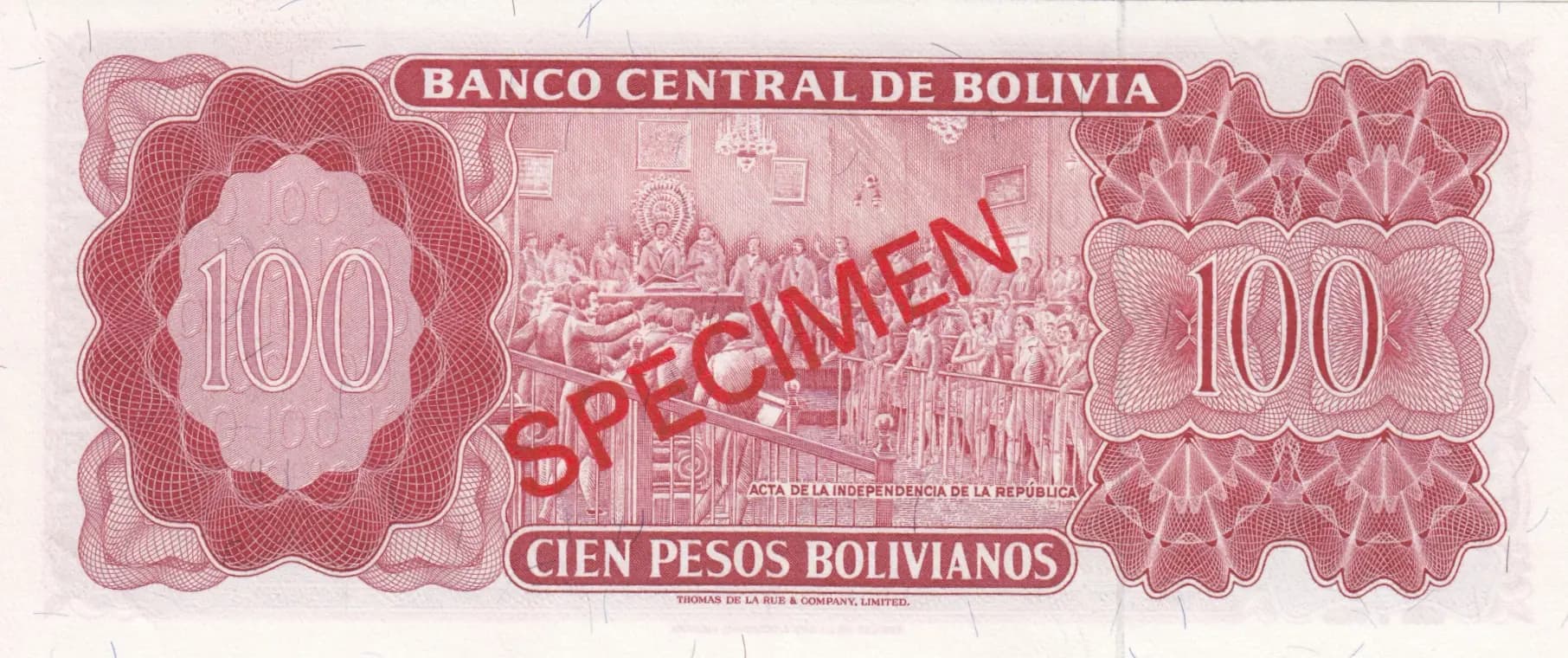
This is a specimen note of the 1962 Bolivian 100 peso bolivianos, printed by Thomas de la Rue in London and issued under the Law of July 13, 1962. The note features an exceptional portrait of Simón Bolívar in formal military dress on the obverse and a detailed engraved historical scene depicting the Declaration of Independence on the reverse, both rendered in the characteristic pink/rose color scheme with red accents. In uncirculated condition with crisp engraving and clear security details throughout, this specimen example represents a well-preserved example of Bolivian monetary design from the early post-reform period.
Common. While this is a specimen note (a non-circulating example created for archival, approval, or promotional purposes), specimen notes of this denomination from the 1962 issue are regularly encountered in the collector market. The catalog reference data and eBay pricing history show moderate market activity with UNC examples trading between $9.99 and $199.99, with most examples clustering in the $20–50 range, indicating adequate supply. The 1962 Bolivian 100 peso bolivianos was part of a standard production run following the currency reform, and specimen examples were produced in reasonable quantities for distribution to banks and official archives. Specimen designation does not inherently make a note rare unless accompanied by other limiting factors (such as low print run, signature varieties, or series scarcity), none of which appear applicable here.
The 100 peso bolivianos note was issued following Bolivia's monetary reform under the Law of July 13, 1962, which marked a significant reorganization of the Bolivian currency system. The obverse portrait of Simón Bolívar, the Venezuelan-born liberator of Bolivia (formerly Upper Peru), served as a nationalist symbol of the nation's independence and sovereignty. The reverse design's depiction of the Act of Independence of the Republic reinforced this foundational moment, celebrating the declaration of the Bolivian Republic as a sovereign nation separate from Spanish colonial rule.
The obverse features a formal portrait of Simón Bolívar positioned at the right side, depicted in profile facing left, wearing an ornate military uniform with decorative medals and insignia befitting his status as a military leader and founding father. The left side displays the denomination '100' within elaborate ornamental frames featuring baroque-style scrollwork and leaf motifs. A prominent circular sunburst design occupies the center, serving as both a decorative and security element. The Bolivian coat of arms, featuring the national shield with the condor and landscape elements, is incorporated into the design. The reverse presents an engraved historical scene showing multiple figures in 19th-century period dress gathered for the formal declaration of independence, with architectural elements and flags visible in the composition, demonstrating the high-quality engraving work characteristic of Thomas de la Rue's production. Both sides employ fine parallel line patterns as background security features and maintain the pink/rose color palette with red text and accents throughout.
FRONT SIDE: 'BANCO CENTRAL DE BOLIVIA' (Central Bank of Bolivia); '100' and 'CIEN PESOS BOLIVIANOS' (One Hundred Boliviano Pesos); 'LEY DE 13 DE JULIO DE 1962' (Law of July 13, 1962); 'LA PAZ' (La Paz, the capital city); 'PRESIDENTE' (President) and 'GERENTE' (Manager) - signature lines; 'BOLIVAR' (identifying the portrait subject); 'THOMAS DE LA RUE & COMPANY, LIMITED' (London printer); 'SPECIMEN' (overprinted designation). BACK SIDE: '100' and 'CIEN PESOS BOLIVIANOS' (One Hundred Boliviano Pesos); 'BANCO CENTRAL DE BOLIVIA' (Central Bank of Bolivia); 'ACTA DE LA INDEPENDENCIA DE LA REPÚBLICA' (Act of Independence of the Republic); 'SPECIMEN' (overprinted designation); 'THOMAS DE LA RUE & COMPANY, LIMITED' (printer attribution).
This note was produced using intaglio (engraving) printing by Thomas de la Rue & Company, Limited, the renowned London-based security printer. The visual analysis confirms the use of intricate line engraving throughout, evidenced by the fine detailed work visible in the portrait, the central sunburst design, the complex historical scene on the reverse, and the elaborate ornamental frames. The security features—including fine parallel line patterns, circular watermark design areas, and the depth created through multiple layers of engraved detail—are characteristic of high-security intaglio production. The red serial number and specimen overprint were applied as secondary printing elements after the primary engraved design was produced.
This specimen note exhibits the characteristics of P-163s with clear engraved back details and red serial number, as referenced in the catalog data. The specimen overprint in red text across both obverse and reverse confirms this as an official specimen issue rather than a circulated note. The visual analysis indicates this note carries the Series G designation. The catalog reference notes distinguish this variety from P-164 (which features poor details on back and black serial number) and P-164A (which features series 13E–19T with clear details and red serial numbers). As a specimen with red serial number and clear engraved back details, this note represents the standard P-163s variety. No evidence of additional overprints, signature variations, or series letters beyond what has been noted is apparent from the images provided.