5 bolivanos 1928
Market Prices
37 salesAbout This Note
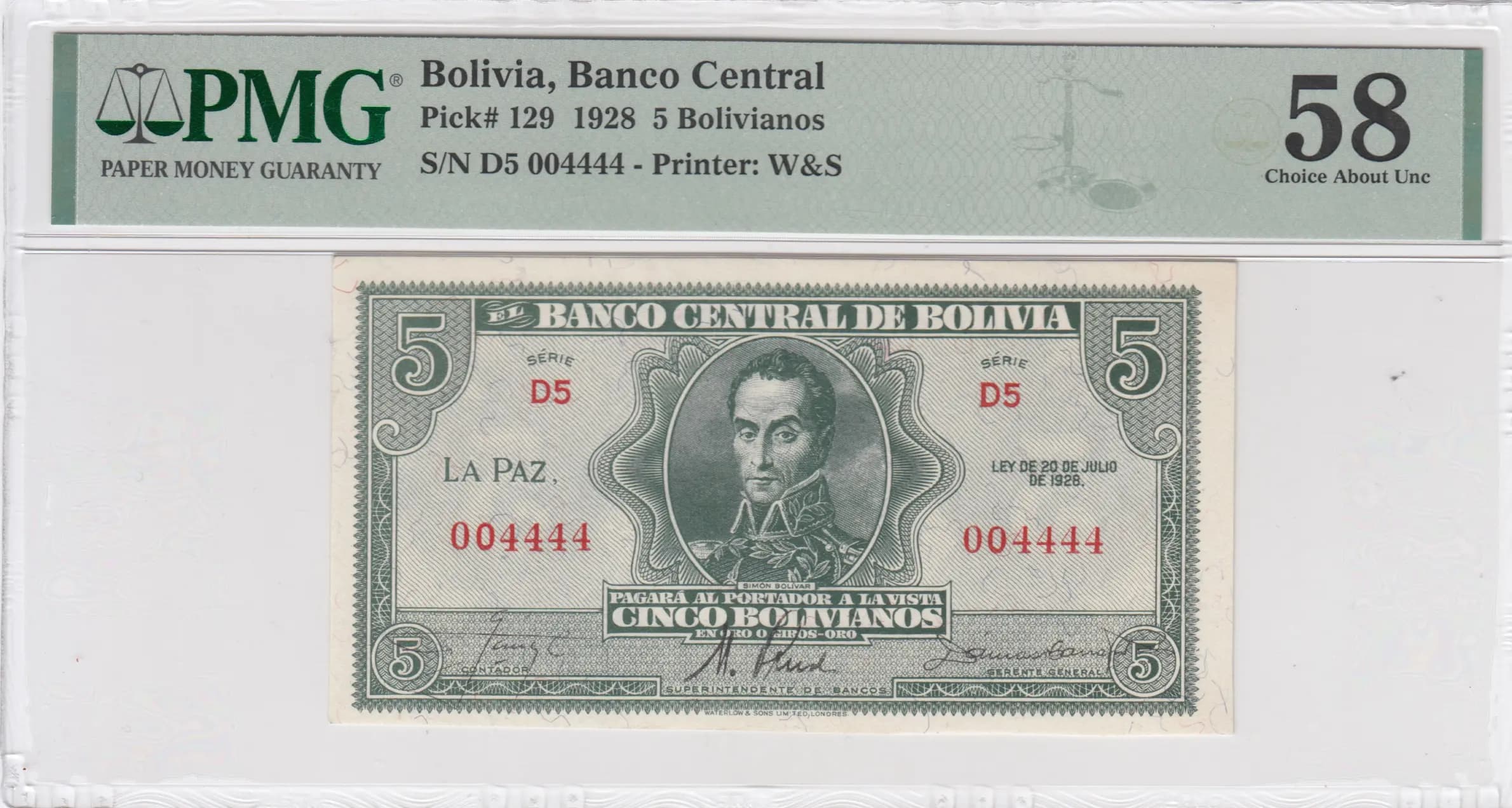
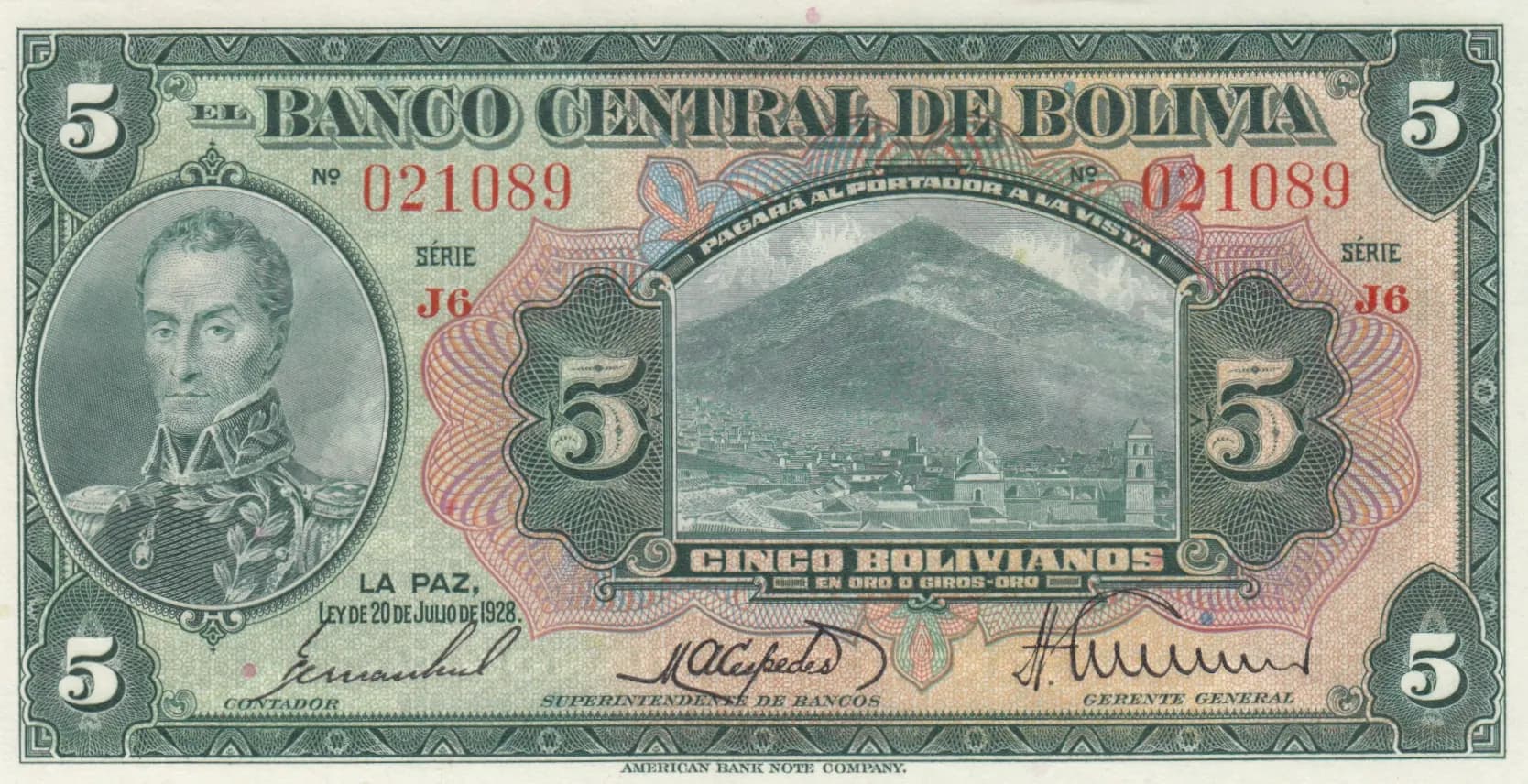
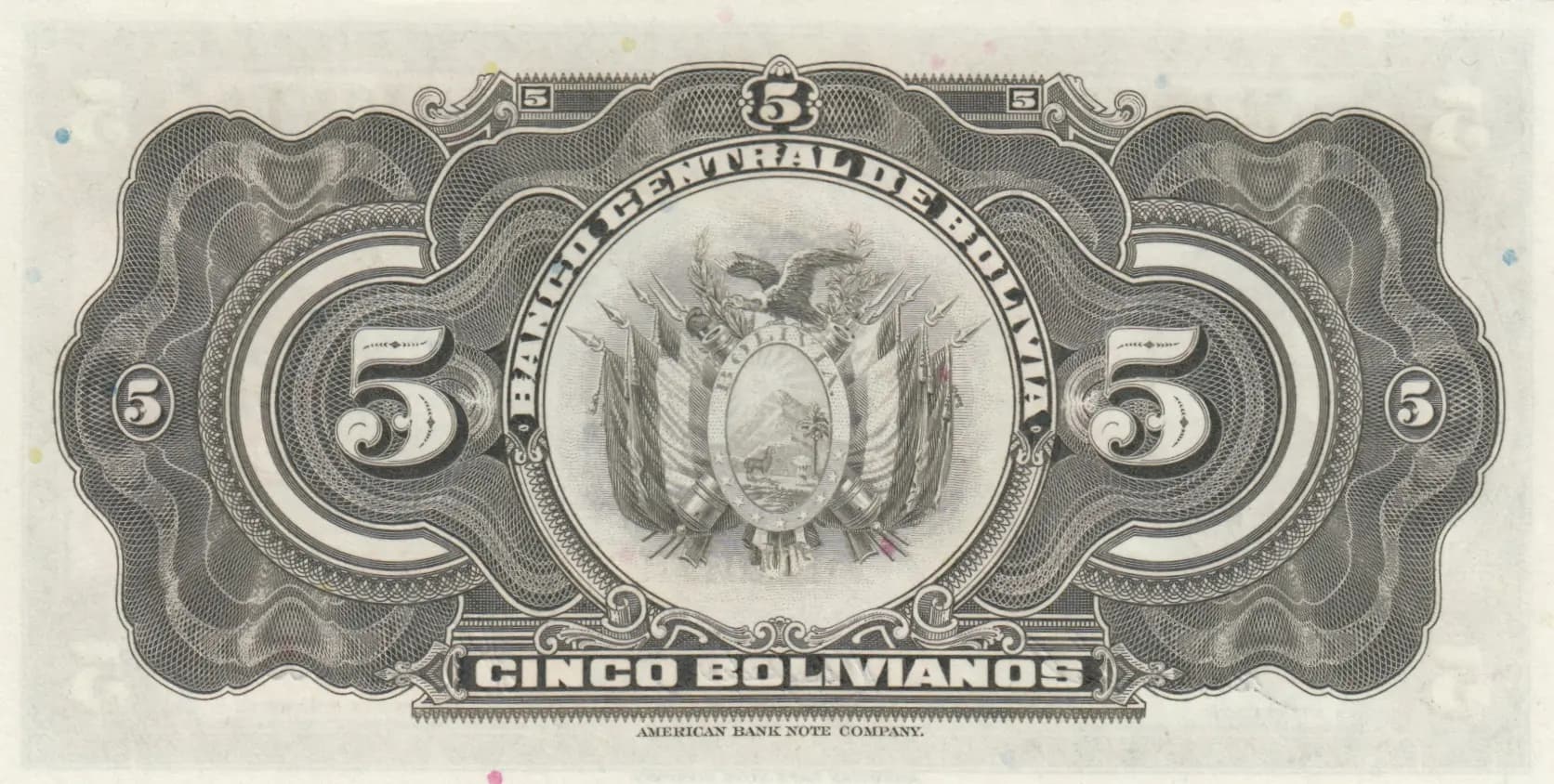
This is a pristine example of the 1928 Banco Central de Bolivia 5 Bolivianos note (Pick P-120), graded UNC. The note features a striking portrait of Simón Bolívar in military dress on the left side, with an elaborate vignette of Potosí and its iconic mountain landscape dominating the right. The front displays sophisticated multi-color printing in deep green, blue, brown, and rose tones, while the reverse presents the national arms in black and gray on a clean field. The exceptional clarity and condition of this note, combined with its historical significance as an early emission from the newly-established Central Bank, makes it a noteworthy specimen.
Common. This is a regular issue banknote with substantial print run numbers evident from the wide range of series and serial number variants (Series A-Z with numerals A1-Z10 documented). Recent eBay market data shows consistent sales in the $4-20 range for UNC examples, with most ungraded UNC notes selling at $5-7. Even professionally graded high-quality specimens (PMG 63-66) achieve only $16-48. The accessibility of these notes, coupled with their relatively recent issuance (1928) and lack of documented recall or scarcity, confirms common status despite their historical interest.
This note was issued pursuant to the Law of July 20, 1928, marking an important moment in Bolivia's monetary modernization following the establishment of the Banco Central de Bolivia. The prominent depiction of Potosí and its mountain—referencing the historic silver mining wealth that built Bolivia's early economy—reflects the nation's reliance on its mineral resources during this period. The choice to feature Simón Bolívar, the liberator of South America, on Bolivian currency underscored the nation's identity and connection to pan-American independence ideals in the post-WWI era.
The obverse features a left-facing profile portrait of Simón Bolívar wearing a high-collared military uniform with medals and chest insignia, rendered in fine engraved detail. The right side contains an ornate vignette depicting the city of Potosí nestled in a valley beneath a snow-capped mountain peak, with prominent colonial architecture including a notable bell tower and church spire visible in the cityscape. This landscape is framed by elaborate scrollwork and geometric borders. The note employs multiple color layers: dominant deep green with blue, brown, and rose underprinting creating a complex, visually rich composition. The reverse displays Bolivia's heraldic arms—an eagle and shield design—surrounded by laurel wreaths and decorative scrollwork, executed in black fine-line engraving on a clean field. Denomination numerals (5) appear in multiple locations on both sides within ornate frames.
FRONT: 'EL BANCO CENTRAL DE BOLIVIA' (The Central Bank of Bolivia); 'CINCO BOLIVIANOS' (Five Bolivianos); 'LEY DE 20 DE JULIO DE 1928' (Law of July 20, 1928); 'LA PAZ' (La Paz); 'PAGARA AL PORTADOR A LA VISTA' (Payable to Bearer on Sight); 'CONTADOR' (Accountant); 'SUPERINTENDENTE DE BANCOS' (Superintendent of Banks); 'GERENTE GENERAL' (General Manager); 'AMERICAN BANK NOTE COMPANY' (American Bank Note Company, New York); Serial number and series designation (SERIE J6, 021089 observed). BACK: 'BANCO CENTRAL DE BOLIVIA' (Central Bank of Bolivia); 'CINCO BOLIVIANOS' (Five Bolivianos); 'AMERICAN BANK NOTE COMPANY' (American Bank Note Company); Multiple denomination numerals (5).
Intaglio engraving (steel plate engraving and line engraving), with multiple color printing. The note was produced by the American Bank Note Company (ABNC) of New York, one of the world's premier security printers. The fine crosshatching, stippling patterns, intricate geometric security designs, and complex line-work throughout are characteristic of premium intaglio banknote production. Multiple color layers were applied, demonstrating sophisticated multi-pass printing technique typical of high-security banknote manufacture of the 1920s.
This specimen displays Series J6 with serial number 021089, indicating the mid-range of the J series within the documented series run. The Pick catalog identifies two known varieties: P-120a and P-120s (specimen note). Multiple signature varieties are documented across the series. The J series designation falls within the established range (A-Z series documented), confirming this as a standard circulation variety of the base P-120 type. No specimen overprints or special varieties are evident in this example.