10 peso bolivanos 1962
Market Prices
36 salesAbout This Note
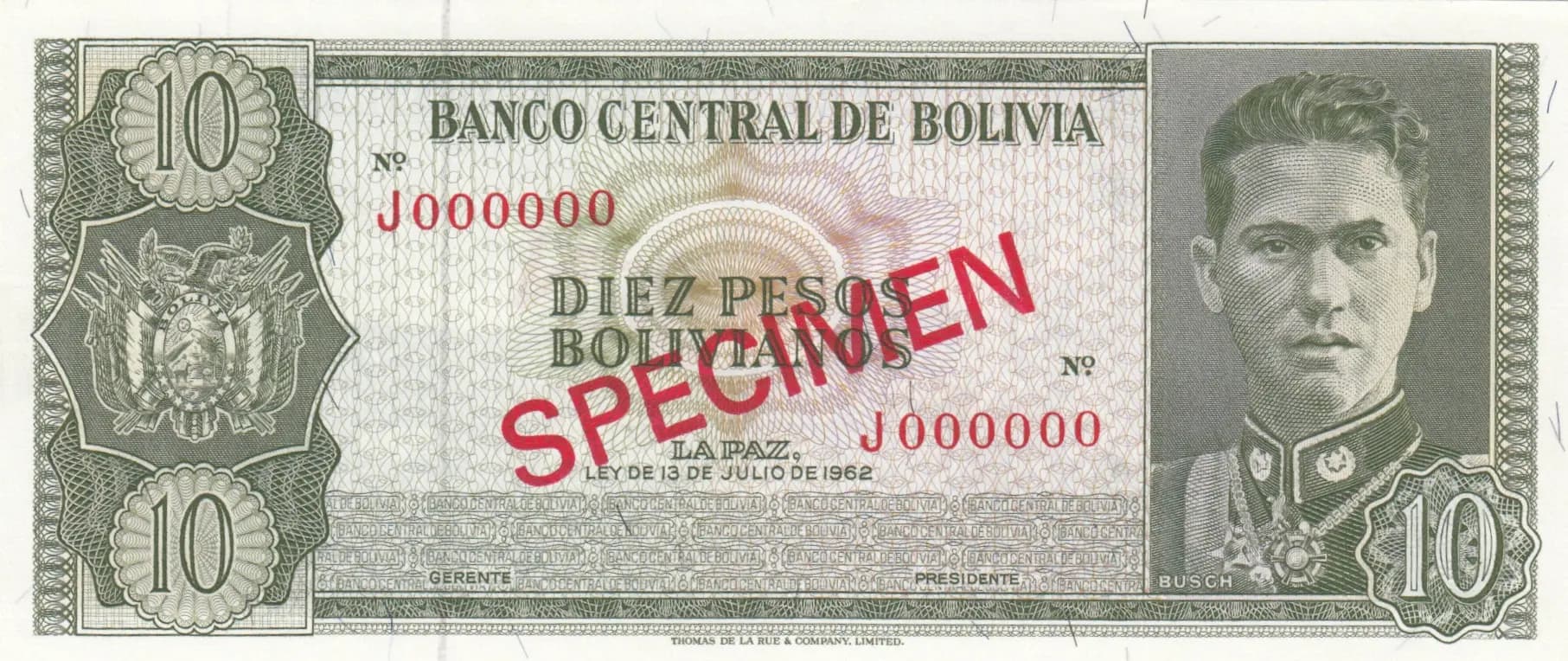
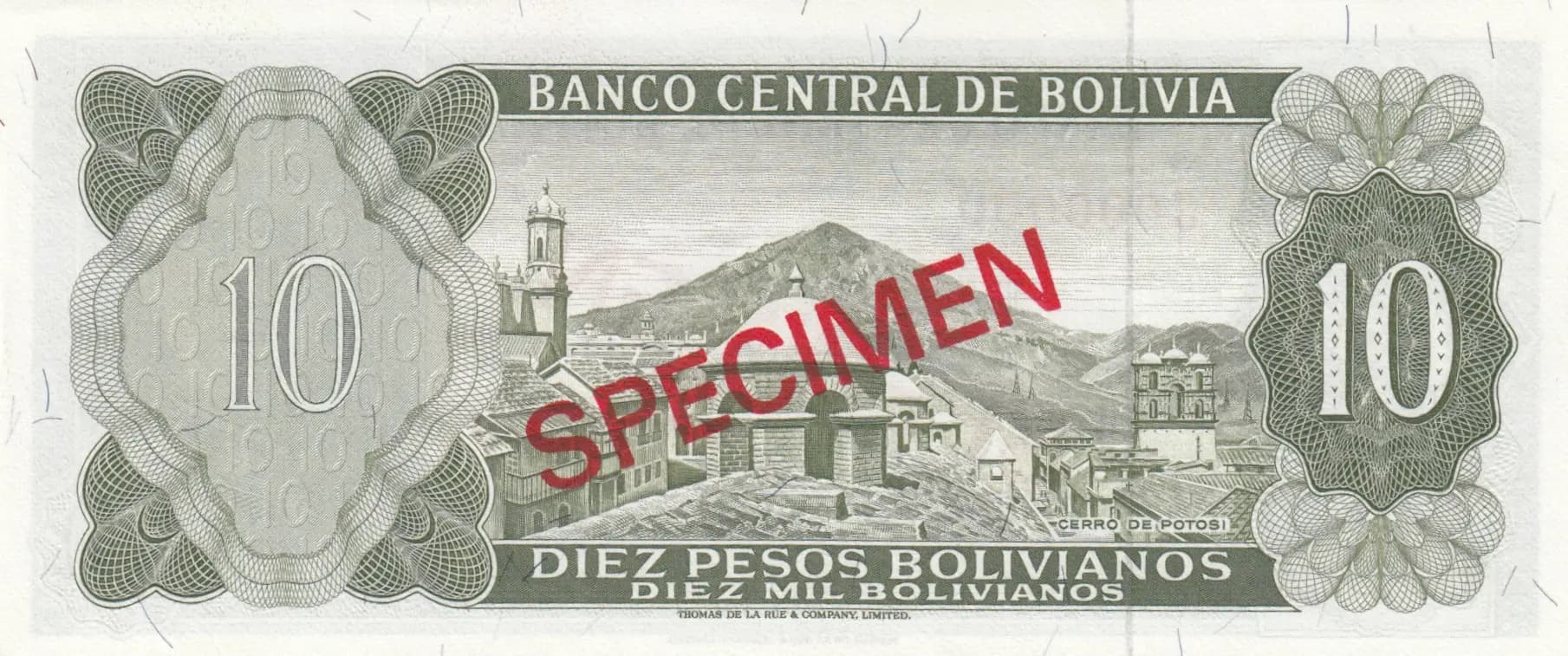
This is a 1962 Bolivian 10 Pesos Bolivianos specimen note issued by the Banco Central de Bolivia and printed by Thomas De La Rue in London. The note features a distinguished portrait of Colonel Germán Busch Becerra in military uniform on the obverse and an engraved landscape of Cerro de Potosí on the reverse, exemplifying the high-quality intaglio craftsmanship characteristic of TDLR's production. As a specimen note with the characteristic red diagonal SPECIMEN overprint and null serial number (J000000), this piece represents a non-circulating example of an otherwise common denomination from Bolivia's mid-20th century currency reform period.
Common. This note represents a regular issue of the 1962 Bolivian currency reform with no indication of limited print run or withdrawal. The extensive eBay transaction history provided (over 30 sales records) demonstrates consistent and available supply in the market, with most UNC examples selling in the $1–$4 range, indicating widespread collector availability. Specimen notes, while technically non-circulating, are regularly produced during currency design and distribution phases and are not inherently rare. The 2019 catalog valuation of $0.75 in UNC condition further confirms common status.
This note was issued under the Law of July 18, 1962, representing a significant monetary reform in Bolivia during the post-revolutionary period following the 1952 National Revolution. Colonel Germán Busch Becerra, depicted in military dress on the obverse, was a prominent Bolivian military and political figure, reflecting the nation's military-influenced governance of the era. The reverse features Cerro de Potosí (the Mountain of Potosí), one of Bolivia's most historically significant landmarks, symbolizing the nation's mineral wealth that had defined its economy since the Spanish colonial period.
The obverse features Colonel Germán Busch Becerra rendered in right-facing profile, depicted in full military dress uniform with decorative medals and insignia on the chest, positioned on the right side of the note. The Bolivian national coat of arms—featuring two flags flanking a shield—is prominently displayed on the left side. Ornamental circular medallions containing the numeral '10' in elaborate frames accent both lateral edges of the note. The color palette is predominantly olive green with multicolored security underprinting in gray and cream tones. The reverse presents a detailed engraved landscape scene of Cerro de Potosí, Bolivia's iconic mountain, rendered in fine intaglio style with a colonial-era church featuring a distinctive bell tower positioned in the foreground, with settlement buildings in the valley below and the imposing mountain range dominating the composition. Matching decorative '10' medallions frame the reverse sides, maintaining design cohesion with the obverse.
FRONT SIDE: 'BANCO CENTRAL DE BOLIVIA' (Central Bank of Bolivia) — central header; 'DIEZ PESOS BOLIVIANOS' (Ten Bolivian Pesos) — primary denomination; 'DIEZ MIL BOLIVIANOS' (Ten Thousand Bolivianos) — reformed denomination value; 'LA PAZ' (La Paz) — city of issue; 'LEY DE 18 DE JULIO DE 1962' (Law of July 18, 1962) — legislative authorization; 'GERENTE' (Manager) — signature line designation; 'PRESIDENTE' (President) — signature line designation; 'BUSCH' — surname reference to the portrayed figure; 'SPECIMEN' (non-circulating example). BACK SIDE: 'BANCO CENTRAL DE BOLIVIA' (Central Bank of Bolivia); 'CERRO DE POTOSI' (Potosí Mountain/Hill) — landmark identification; 'DIEZ PESOS BOLIVIANOS' and 'DIEZ MIL BOLIVIANOS' (denomination text repeated); 'THOMAS DE LA RUE & COMPANY, LIMITED' (printer attribution); 'SPECIMEN' (non-circulating designation).
Intaglio (steel engraving) process, executed by Thomas De La Rue & Company, Limited of London, one of the world's leading banknote security printers. The fine line work, intricate geometric patterns, decorative ornamental elements, and the detailed architectural and landscape engraving observable throughout both sides are characteristic of TDLR's high-security intaglio production standards. These anti-counterfeiting features include complex line engraving patterns, fine detail work in portraiture and landscape rendering, and elaborate ornamental borderwork typical of mid-20th century premium banknote production.
This note is cataloged as P-154s under the Pick numbering system, with the 's' suffix designating this as a specimen variety. The visual analysis identifies this as bearing serial number J000000 and the red SPECIMEN overprint diagonal stamp, confirming specimen status. Per the realbanknotes.com reference data, this issue type encompasses 18 known signature varieties across series A-U3, though the specific signature variety cannot be definitively determined from the visual information provided. The denomination appears in both old value format ('DIEZ PESOS BOLIVIANOS') and new reformed format ('DIEZ MIL BOLIVIANOS') on both sides, consistent with the 1962 redenomination. No additional sub-varieties (such as different colored overprints or serial number series variants) are apparent in the specimen presented.