1 peso bolivano 1962
Market Prices
About This Note
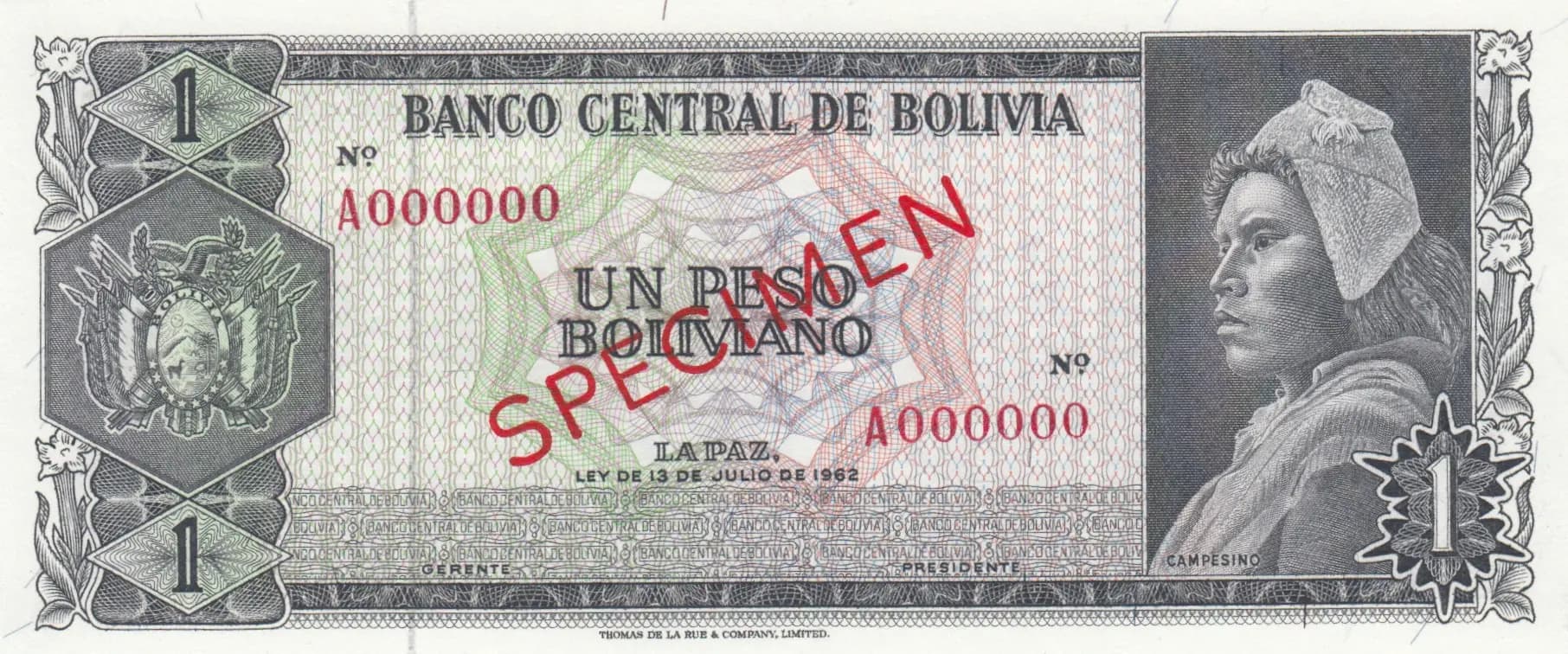
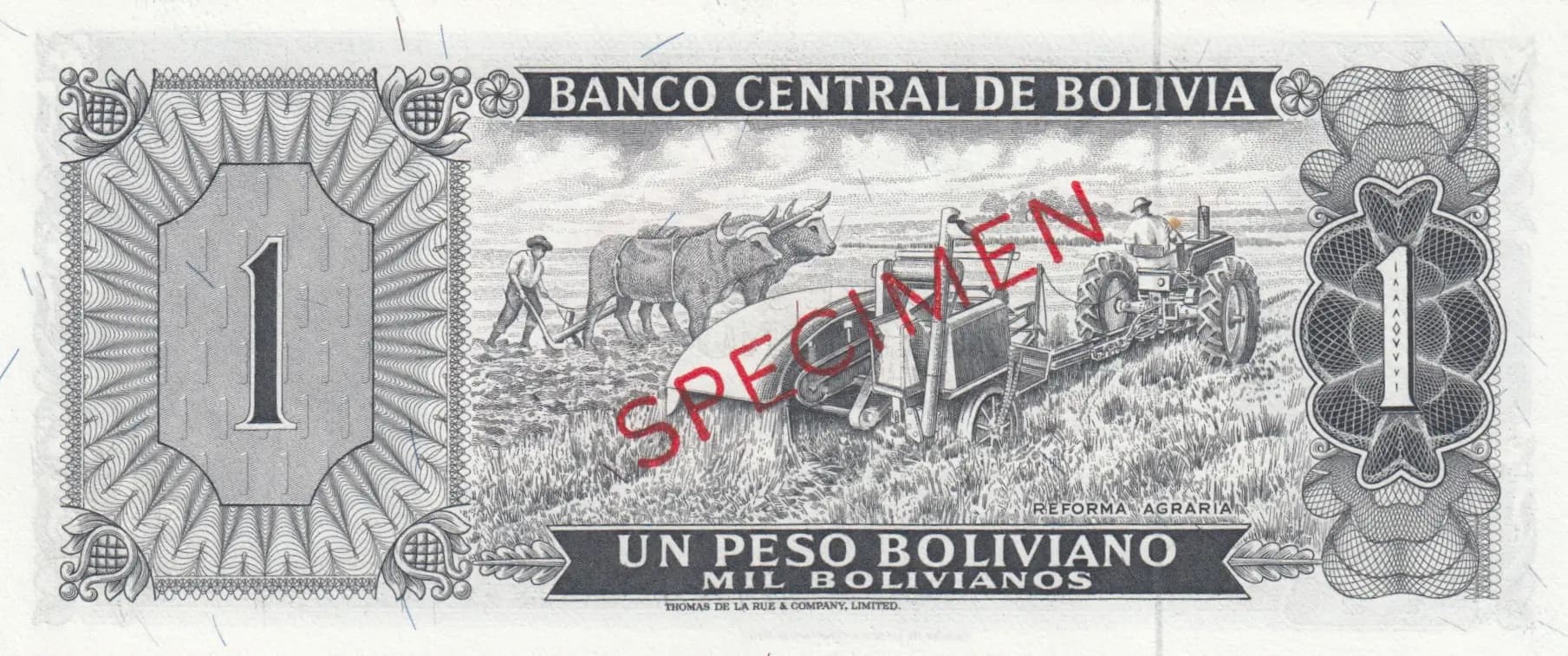
This is a 1962 Bolivian 1 Peso Boliviano specimen note issued by the Banco Central de Bolivia and printed by Thomas De La Rue. The note features a striking portrait of a Campesino woman in traditional Andean dress on the obverse and an agrarian reform scene depicting traditional oxen-drawn plowing alongside modern mechanized agriculture on the reverse. As a specimen note with red 'SPECIMEN' overprint and serial number A000000, this represents an important documentary example of Bolivia's mid-20th century monetary reform, in Uncirculated condition.
Common. This specimen note represents standard Thomas De La Rue production for the 1962 Bolivian peso redenomination. eBay market data shows UNC specimens trading consistently in the $2.77–$29.00 USD range with a 2019 catalog value of approximately $20, indicating strong collector supply and regular availability. Specimen notes from major denominations and recognized printers typically achieve wide distribution among institutional holders and collectors, supporting common status. The note was not a short-run issue and does not exhibit characteristics of a recalled or limited-edition variety.
Issued under the Law of July 13, 1962, this note commemorates Bolivia's significant post-revolutionary period following the 1952 National Revolution. The agrarian reform imagery on the reverse, explicitly labeled 'REFORMA AGRARIA' (Agrarian Reform), reflects the Movimiento Nacionalista Revolucionario government's land redistribution policies and modernization efforts. The juxtaposition of traditional peasant labor with tractors symbolizes Bolivia's transition toward mechanized agriculture while honoring the indigenous Campesino population central to the nation's identity and economy.
The obverse features a left-facing profile portrait of a Campesino woman wearing traditional Andean dress including a distinctive white layered head covering (Andean bowler hat style), representing the indigenous peasant class central to Bolivian society. The Bolivian coat of arms (shield with condor and heraldic elements) appears on the left side. The reverse depicts an agrarian reform scene showing traditional oxen-drawn plowing in the foreground with farmers alongside, and a tractor visible in the background—symbolizing the nation's transition from subsistence to mechanized agriculture. Both sides feature ornate decorative borders with geometric and floral patterns, and large numeral '1's in ornamental frames appear in the corners of the reverse. The dual denomination display ('UN PESO BOLIVIANO' and 'TREINTA BOLIVIANOS') on the back indicates this note's place within a redenomination scheme.
FRONT SIDE: 'BANCO CENTRAL DE BOLIVIA' (Central Bank of Bolivia), 'UN PESO BOLIVIANO' (One Bolivian Peso), 'LEY DE 13 DE JULIO DE 1962' (Law of July 13, 1962), 'LA PAZ' (La Paz), 'CAMPESINO' (Peasant/Farmer), 'PRESIDENTE' (President), 'GERENTE' (Manager), 'No A000000' (Serial Number A000000), 'SPECIMEN' (Specimen). BACK SIDE: 'BANCO CENTRAL DE BOLIVIA' (Central Bank of Bolivia), 'UN PESO BOLIVIANO' (One Bolivian Peso), 'TREINTA BOLIVIANOS' (Thirty Bolivianos), 'REFORMA AGRARIA' (Agrarian Reform), 'THOMAS DE LA RUE & COMPANY, LIMITED' (Printer identification), '1' (Denomination numeral), 'SPECIMEN' (Specimen).
Intaglio engraving (recess printing) by Thomas De La Rue & Company, Limited, London, as confirmed by the printer's imprint and the fine-line security features visible throughout. The note exhibits characteristic intaglio elements including complex guilloche patterns in decorative borders, fine line engraving in the agricultural scene, intricate geometric patterns providing security, and multi-color printing with black primary color on a multicolored underprint base. The crisp detail and dimensional quality of the portrait and landscape imagery are hallmarks of Thomas De La Rue's premium currency production standards.
This is specifically identified as Pick P-152s (the 's' suffix denoting 'specimen'). The note displays Series A and exhibits the characteristic dual-denomination marking on the lower back ('UN PESO BOLIVIANO' and 'TREINTA BOLIVIANOS'), which distinguishes it from similar notes without this dual-denomination feature (referenced in catalog data as comparable to but distinct from P-158). The red 'SPECIMEN' overprint and serial number A000000 are standard specimen markings. No signature varieties are visible in the images provided, though catalog references indicate signature varieties exist for circulating issues of this type. The specimen status and Series A designation are the primary variety identifiers for this example.