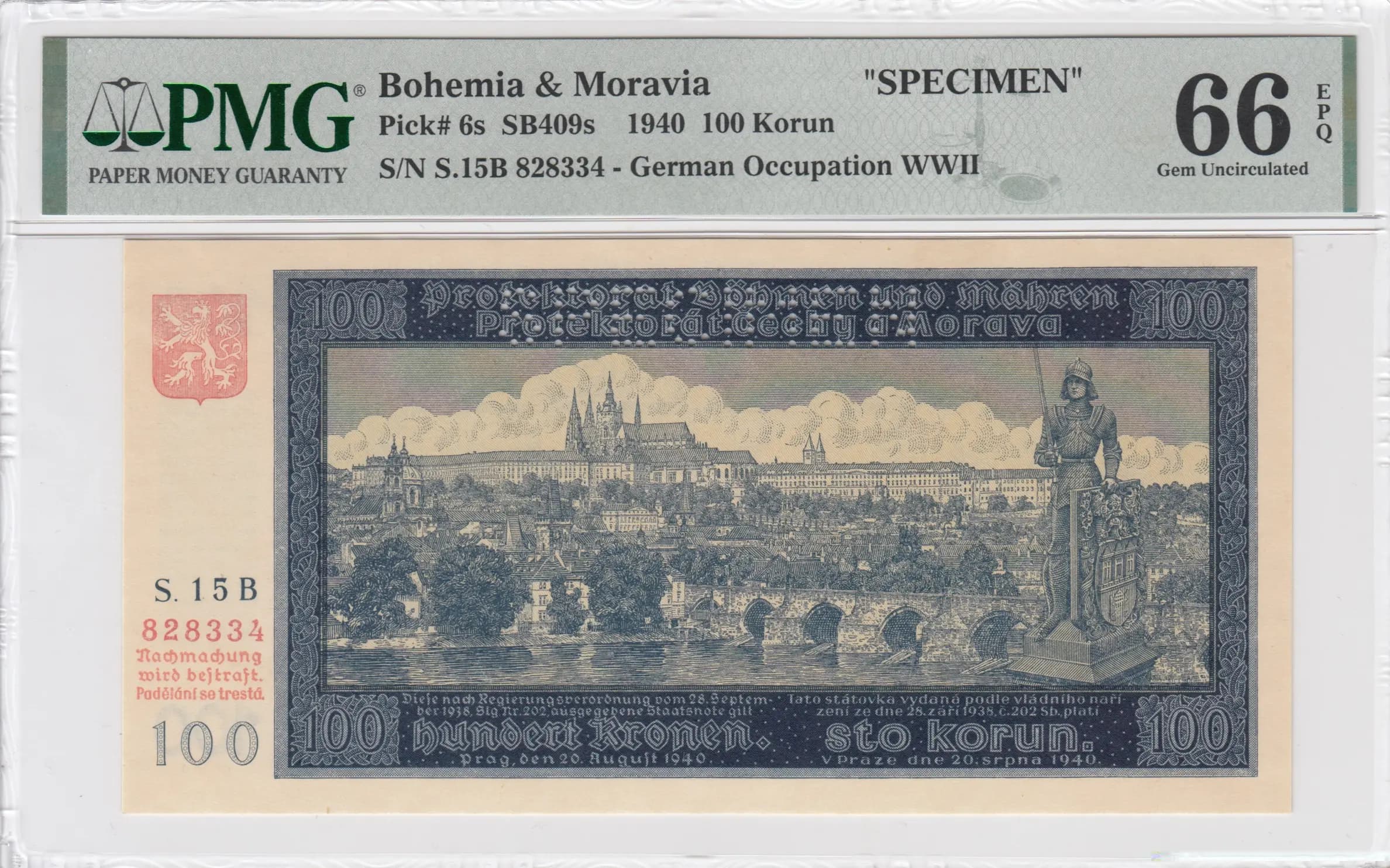
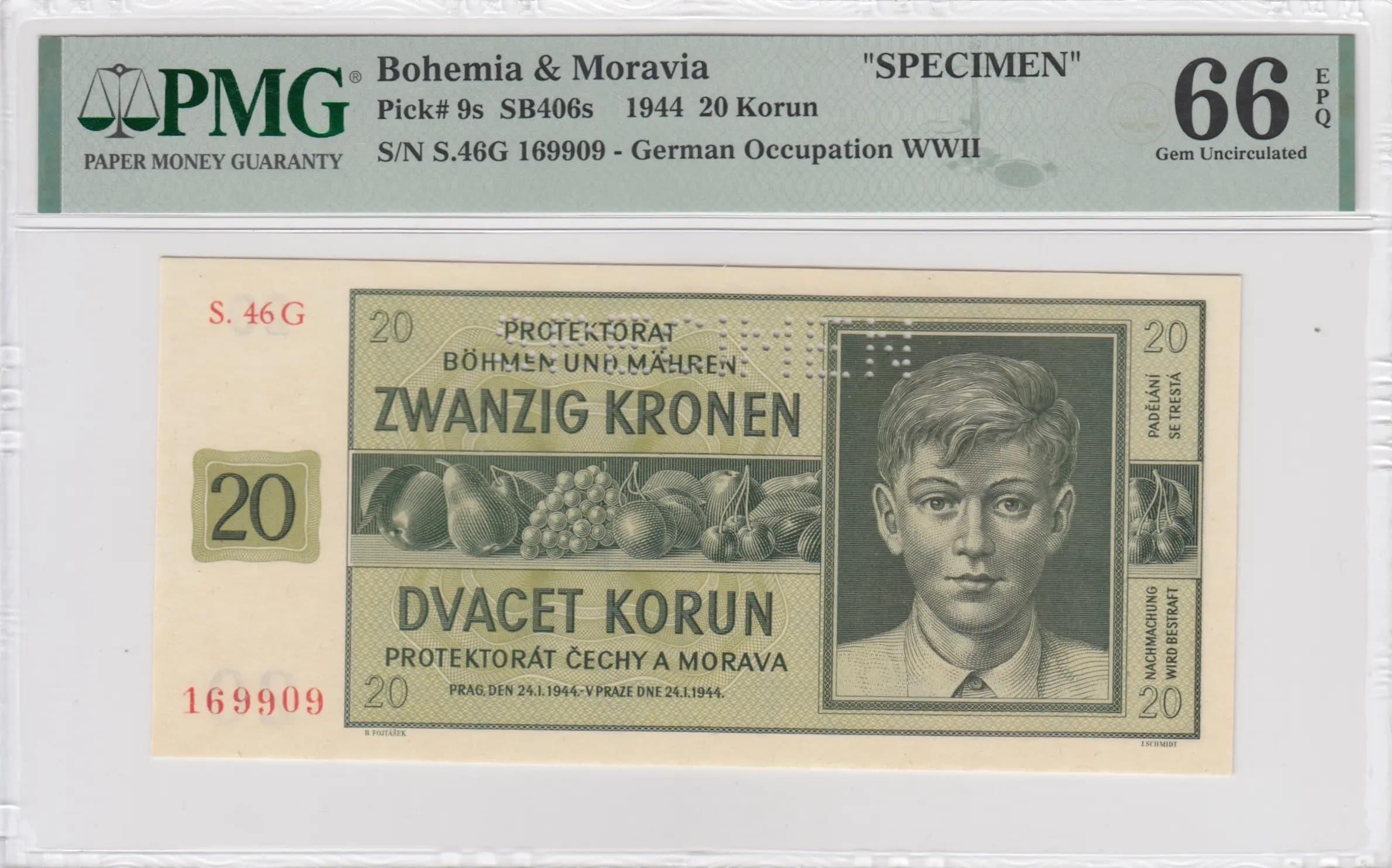
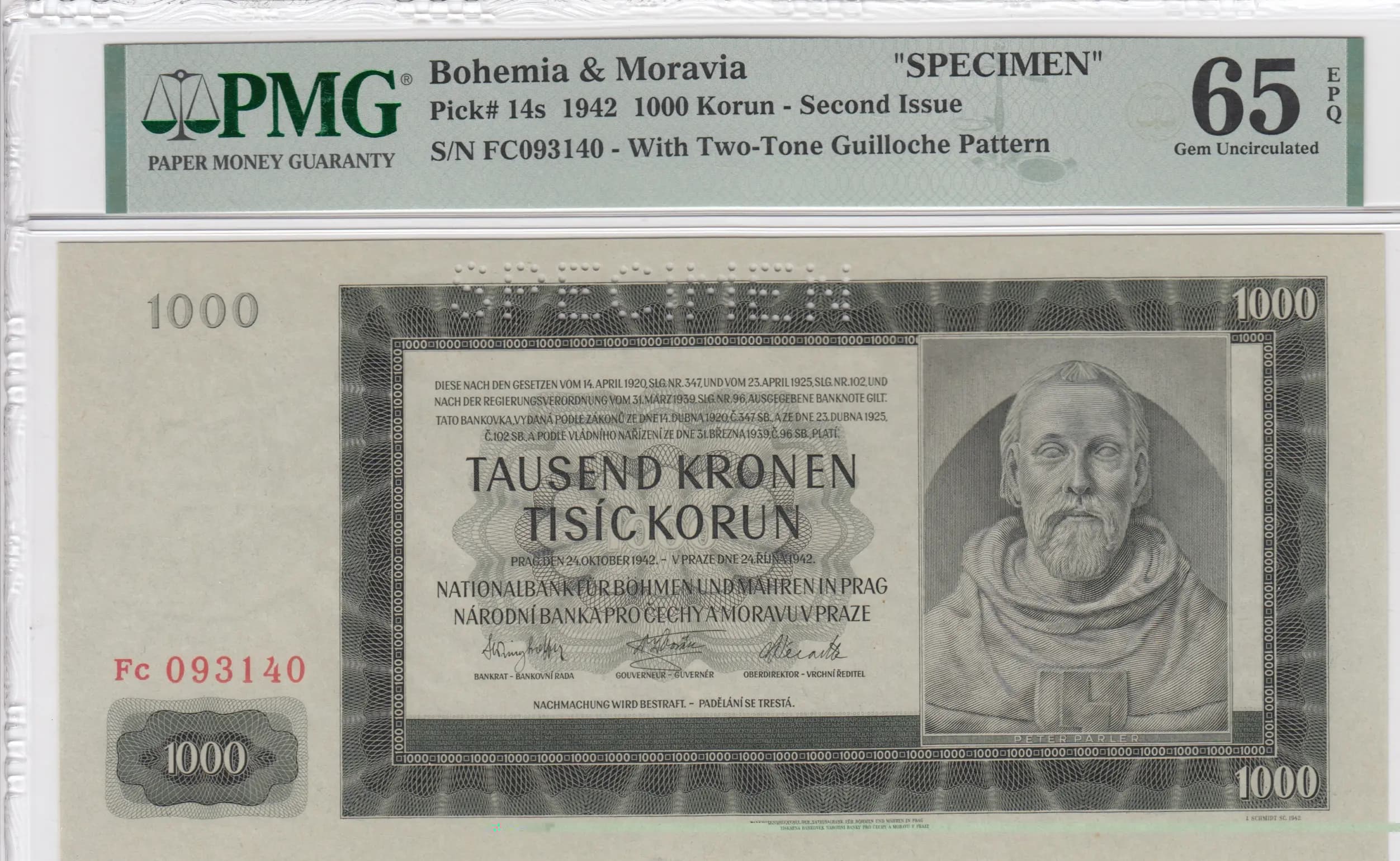
500 korun 1942 specimen
About This Note
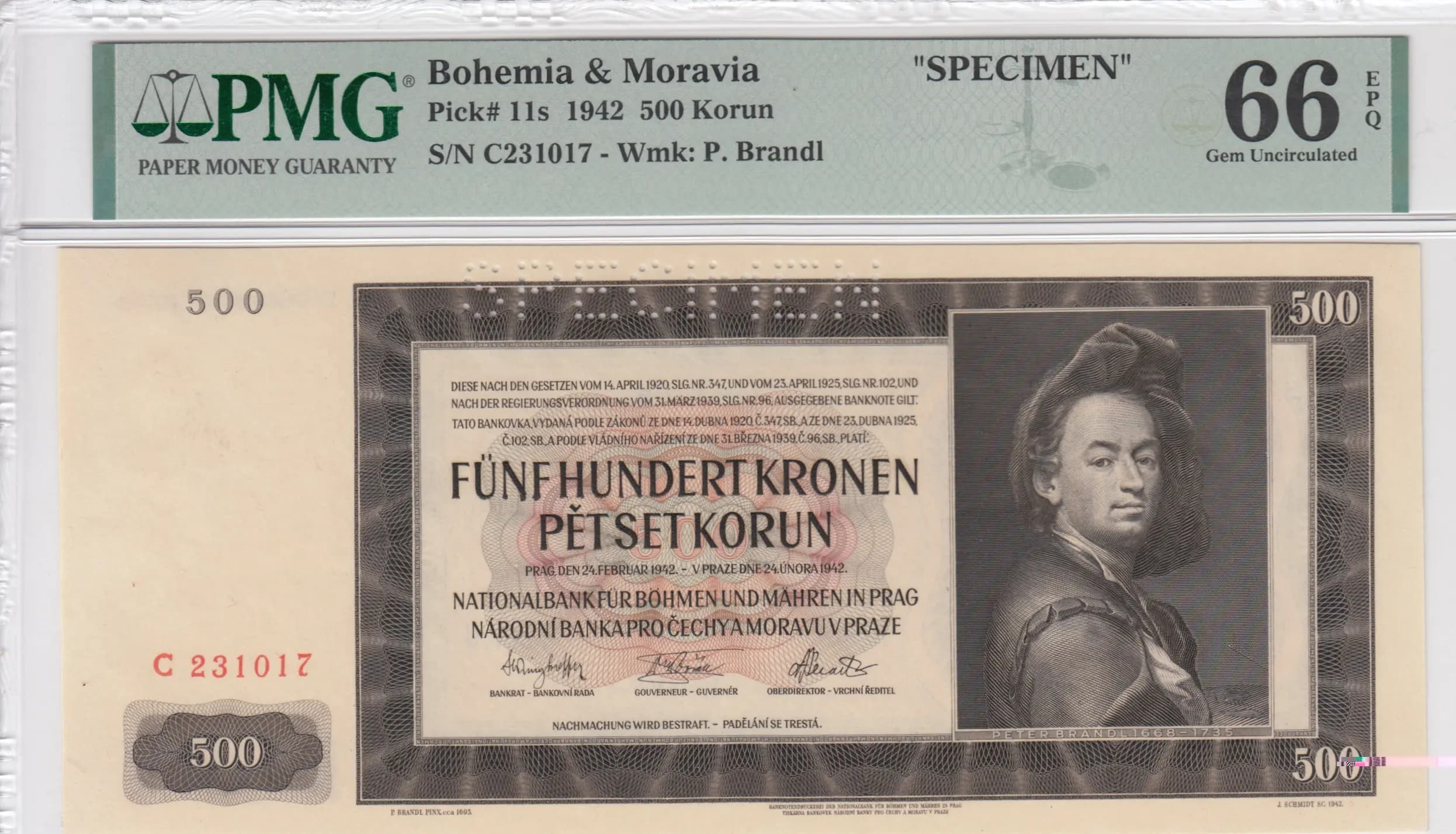
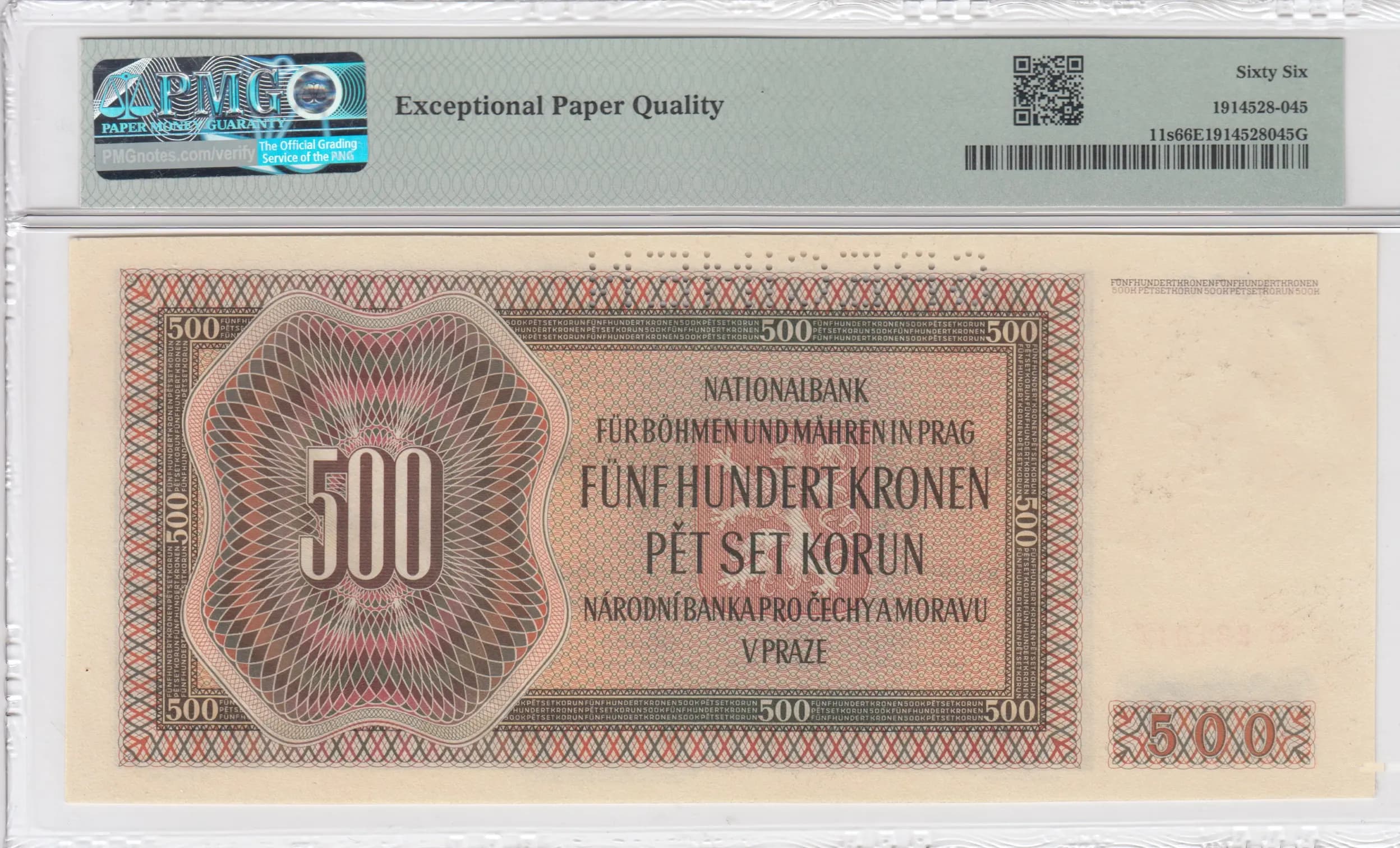
This 500 Korun specimen note from Bohemia & Moravia (1942) represents an exceptional example of wartime Central European currency design, graded PMG 66 EPQ. The note exhibits pristine condition with no signs of wear or circulation, featuring intricate guilloche engraving throughout and bilingual German-Czech inscriptions reflecting the protectorate's dual administrative character. As a specimen note rather than a circulation issue, this represents a historically significant artifact from the Nazi-occupied Protektorate Böhmen und Mähren period.
common
Issued on February 24, 1942, by the Národní Banka pro Čechy a Moravu (National Bank for Bohemia and Moravia), this note was produced during the Nazi occupation of the former Czechoslovakia. The bilingual German-Czech inscriptions and dual institutional naming reflect the complex political reality of the Protectorate, where Czech administration nominally continued under German oversight. The legal references to pre-1939 Czechoslovak laws (dating to 1920 and 1925) embedded in the note's text demonstrate the protectorate's attempt to maintain continuity with previous Czech statehood while operating under German control.
The front of this 500 Korun note features a classical profile portrait of a historical figure on the right side, depicted in period dress consistent with 18th or 19th century styling, rendered in fine black and white engraving. The left side displays the large denomination '500' in multiple locations, with the serial number 'C 231017' prominently placed. The design is framed by elaborate guilloche patterns and ornamental borders characteristic of high-security banknote design. The center contains the dual-language legal text authorizing the note's issuance. The reverse features an ornamental rosette or floral medallion design at the center, surrounded by concentric decorative frames and geometric guilloche patterns, with the denomination prominently displayed. The entire design employs intricate fine-line engraving to create security patterns resistant to reproduction. The color scheme combines black, gray, cream/beige tones on the obverse with red/pink, brown, and cream tones on the reverse, typical of period printing techniques.
FRONT SIDE: Denomination - 'FÜNFHUNDERT KRONEN / PĚTSET KORUN' (Five Hundred Crowns). Serial Number: 'C 231017'. Date and Place: 'PRAG DEN 24. FEBRUAR 1942 / V PRAZE DNE 24. ÚNORA 1942' (Prague, February 24, 1942). Issuing Authority: 'NATIONALBANK FÜR BÖHMEN UND MÄHREN IN PRAG / NÁRODNÍ BANKA PRO ČECHY A MORAVU V PRAZE' (National Bank for Bohemia and Moravia in Prague). Legal Authority Text: 'DIESE NACH DEN GESETZEN VOM 14. APRIL 1920 SIG NR. 347 UND VOM 23. APRIL 1925 SIG NR. 102 UND NACH DER REGIERUNGSVERORDNUNG VOM 31.MÄRZ 1939 SIG.NR.96, AUSGEGEBENE BANKNOTE GILT...' (This banknote issued according to laws from April 14, 1920 Sig No. 347 and April 23, 1925 Sig No. 102 and according to government regulation from March 31, 1939 Sig No. 96 is valid). Signature Lines: 'BANKRAT / BANKONSKA RADA' (Bank Council), 'GOUVERNEUR / GUVENÉR' (Governor), 'OBERDIREKTOR / VICENÍ REDITEL' (Director). Warning: 'NACHMACHUNG WIRD BESTRAFT / PADĚLÁNÍ SE TRESTÁ' (Counterfeiting will be punished). BACK SIDE: Denomination - 'FÜNF HUNDERT KRONEN / PET SET KORUN' (Five Hundred Crowns). Issuing Authority: 'NATIONALBANK / FÜR BÖHMEN UND MÄHREN IN PRAG / NÁRODNÍ BANKA PRO ČECHY A MORAVU V PRAZE' (National Bank for Bohemia and Moravia in Prague).
This note was produced using intaglio engraving (line engraving), the standard security printing method for banknotes of this era. The fine-line guilloche patterns, complex ornamental designs, and sharp detail visible throughout the note—particularly in the background security work and decorative borders—are characteristic of intaglio printing from steel engraved plates. The quality of the engraving and the clarity of detail suggest production by a major security printer, likely one of the established European banknote printers operating under German supervision during the protectorate period. The specimen status and exceptional paper quality indicate this was produced as a proof or presentation example rather than for general circulation.
This is identified as a specimen note (designated by the 's' suffix in Pick-11s), which distinguishes it from circulation issues of the same note. Specimen notes typically bear official markings or perforations (such as 'SPECIMEN' text or punch holes) to distinguish them from regular currency. The serial number 'C 231017' with the 'C' prefix may indicate a specific printing series or batch designation. The date of February 24, 1942, represents the official issuance date. No visible overprints or secondary markings indicating different varieties are apparent from the images, though the specimen status itself constitutes the primary variety distinction for this Pick number.