1000 korun 1942 specimen
About This Note
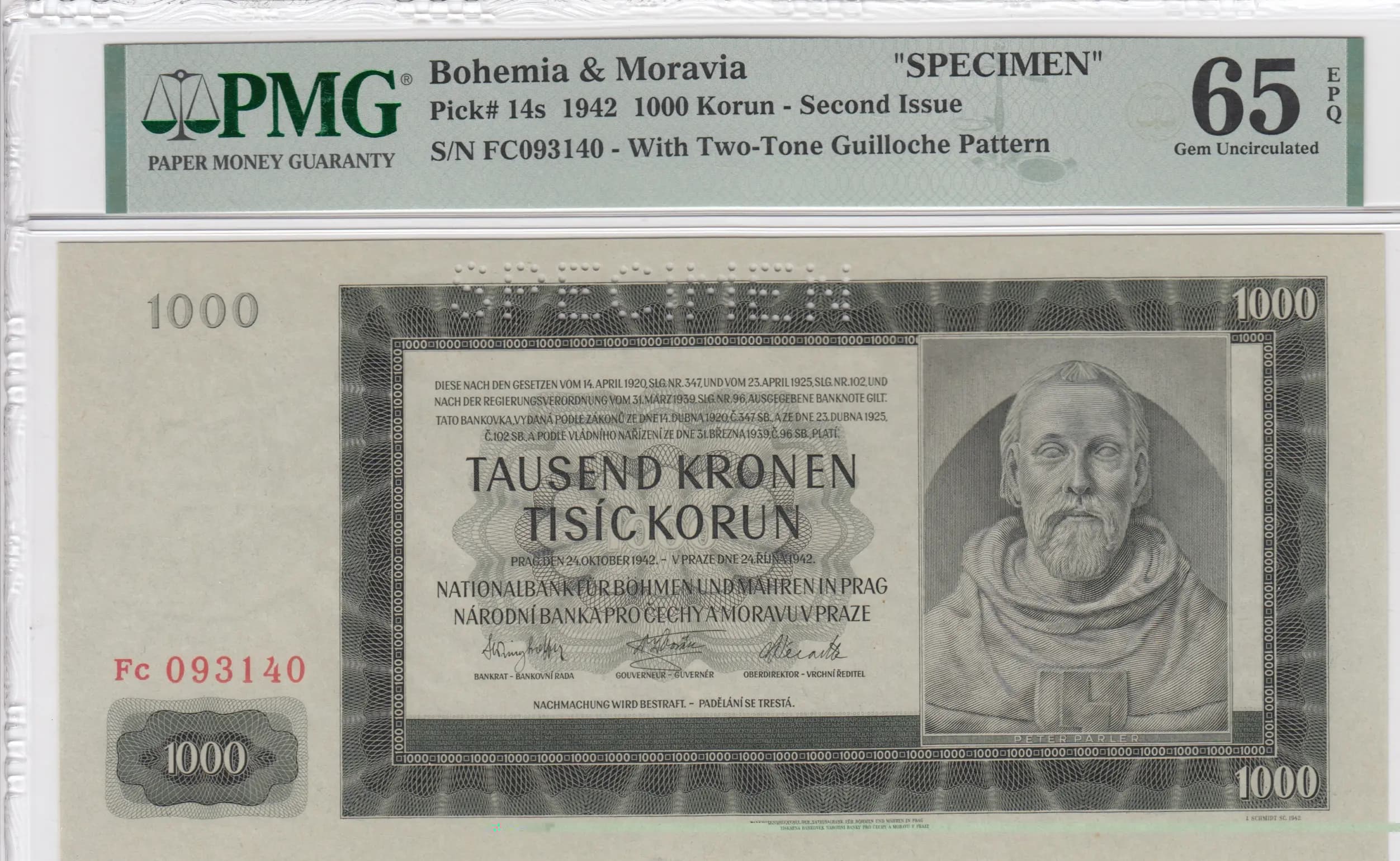
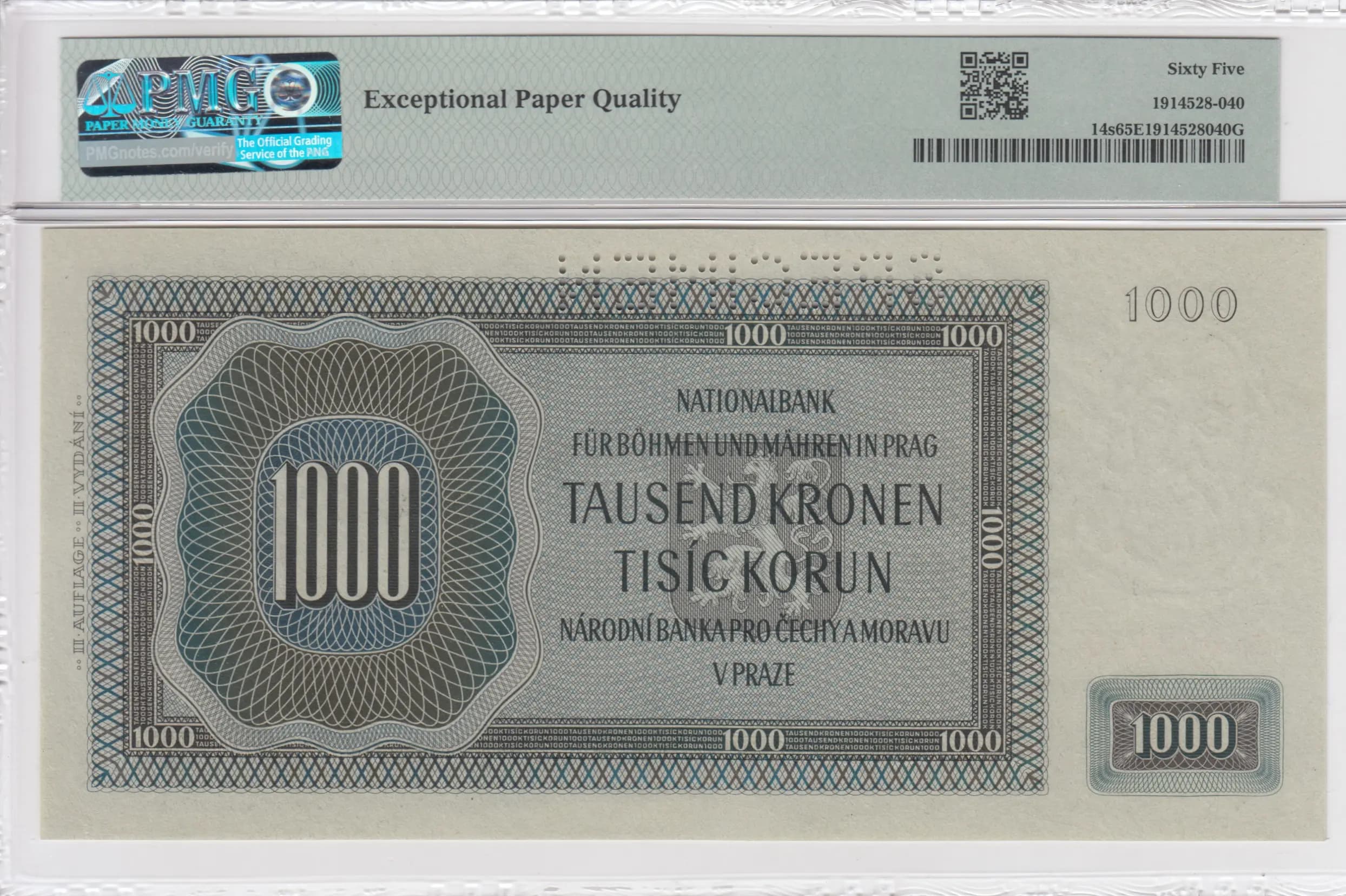
This is a PMG 65 Gem Uncirculated specimen of the 1000 Korun banknote issued by the Nationalbank für Böhmen und Mähren in 1942, representing an important piece of Protectorate currency history. The note exhibits exceptional paper quality with pristine condition, featuring a striking portrait of a bearded historical figure and elaborate security printing including complex guilloche patterns and geometric designs in gray, black, and teal tones. As a specimen note with red serial number Fc 093140, this represents an institutional or archival example rather than circulation currency, making it a significant collectible for specialists of this historically significant period.
Common. The 1000 Korun denomination from the 1942 Protectorate issue is a standard, widely produced banknote with no documented print run restrictions or rarity factors. Specimen notes (marked with special serial number prefixes and intended for archival or institutional purposes) were produced in limited quantities, but the 1942 series itself saw substantial circulation. While the PMG 65 grade indicates exceptional condition (typical specimen notes are usually well-preserved), this does not substantially increase rarity, as most surviving specimens have been maintained in archives. Specimen notes of this issue appear regularly in the numismatic market and typically command modest premiums over circulated examples, but do not qualify as rare or scarce.
The Protectorate of Bohemia and Moravia (1939-1945) issued currency under German occupation following the dismemberment of Czechoslovakia. The bilingual German-Czech inscriptions and the mention of laws from the First Czechoslovak Republic (1920 and 1925) reflect the complex political situation where pre-war legal frameworks were maintained under the Nazi-controlled Protectorate administration. The 1942 dating places this note in the middle period of World War II, when the Protectorate's economy was fully integrated into the German war effort.
The 1000 Korun note features a classical banknote design typical of Central European currency of the interwar and wartime period. The front displays a portrait of a bearded historical figure in period robes, positioned on the right side of the note in three-quarter profile view, though the specific identity of this figure is not definitively established from the visual analysis alone. The design's primary security and aesthetic element is an elaborate system of guilloche patterns—fine-line engraved geometric frameworks featuring nested curved lines, wave patterns, and crosshatching—which dominate both the front and back. The back showcases an especially intricate ornate geometric pattern forming a shield-like frame around the central denomination, utilizing nested circular and wavy lines in what appears to be a teal or blue-green tone contrasting with the primary gray and black elements. Corner denomination boxes containing '1000' appear on all four corners of the note. The ornate border pattern with repeating geometric elements frames the entire note on both sides. The bilingual presentation in German and Czech reflects the official dual-language policy of the Protectorate administration.
FRONT SIDE: The primary denomination text reads 'TAUSEND KRONEN / TISÍC KORUN' (One Thousand Crowns in German and Czech). The issuing authority is identified as 'NATIONALBANK FÜR BÖHMEN UND MÄHREN IN PRAG / NÁRODNÍ BANKA PRO ČECHY A MORAVU V PRAZE' (National Bank for Bohemia and Moravia in Prague). Legal text states: 'This banknote issued according to laws from April 14, 1920 (SG No. 347) and April 23, 1925 (SG No. 102) and according to government regulation from March 31, 1930 (SG No. 96) is valid.' Additional text includes 'BANKNOT - BANKOVNÍ ŘADA' (Banknote - Banking Series), 'GOUVERNEUR - GUVERNÉR' (Governor), 'OBERDIREKITOR - VRCHNÍ ŘIDITEL' (General Director), and the warning 'NACHMACHUNG WIRD BESTRAFT - PADĚLÁNÍ SE TRESTÁ' (Counterfeiting will be punished). The serial number 'Fc 093140' appears in red. BACK SIDE: The back repeats 'TAUSEND KRONEN / TISÍC KORUN' and 'NATIONALBANK FÜR BÖHMEN UND MÄHREN IN PRAG / NÁRODNÍ BANKA PRO ČECHY A MORAVU V PRAZE' with the large central denomination '1000' framed within an ornate geometric pattern.
This note was produced using intaglio (recess) engraving, the standard security printing method for banknotes of this era. The fine-line guilloche patterns, precise geometric borders, and complex wave-line structures visible throughout are characteristic of master engraving work, indicating production by a skilled security printer. The tonal variations and the exceptional clarity of the micro-patterning suggest professional-grade intaglio printing, likely executed by a major European security printer such as Giesecke+Devrient or a similar establishment contracted to the Protectorate banking authority. The multiple color tones (gray, black, and teal) indicate either multi-pass printing or the use of colored inks within the intaglio process.
This specimen is identified as Pick catalog number P-14s, where the 's' suffix designates it as a specimen note rather than a regular issue. The specimen designation is confirmed by the red serial number prefix 'Fc' and the number 093140, which follows the pattern used for institutional specimens. The note carries the standard 1942 date for this series. No signature varieties are distinctly noted in the visual analysis, though the spaces for 'GOUVERNEUR' (Governor) and 'OBERDIREKITOR' (General Director) signatures are present, as was typical for Protectorate currency. The specific variety would be further refined by examining signature combinations and any additional overprints, which are not clearly detailed in the available visual documentation.